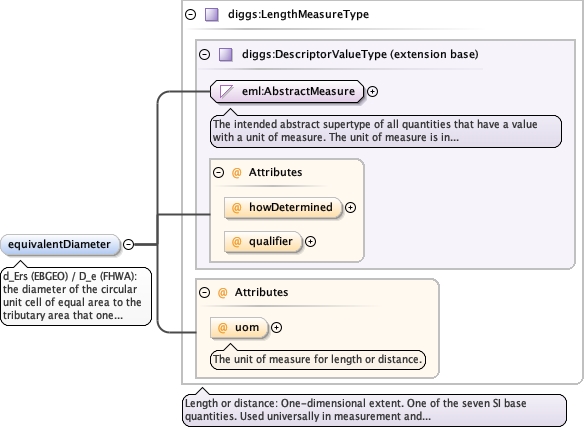
d_Ers (EBGEO) / D_e (FHWA): the diameter of the circular unit cellof equal area to the tributary area that one inclusion supports,derived from spacingX, spacingY and gridPattern. It is reportedexplicitly because the unit-cell radius, not the rawcenter-to-center spacing, enters most arching and settlementformulations. It is a typed convenience element rather than adictionary parameter, because it is method-agnostic and computedentirely from fields on this type. Where it disagrees with arecomputation from spacingX, spacingY and gridPattern, therecomputation governs.
<element minOccurs="0" name="equivalentDiameter" type="diggs:LengthMeasureType"><annotation><documentation>d_Ers (EBGEO) / D_e (FHWA): the diameter of the circular unit cell of equal area to the tributary area that one inclusion supports, derived from spacingX, spacingY and gridPattern. It is reported explicitly because the unit-cell radius, not the raw center-to-center spacing, enters most arching and settlement formulations. It is a typed convenience element rather than a dictionary parameter, because it is method-agnostic and computed entirely from fields on this type. Where it disagrees with a recomputation from spacingX, spacingY and gridPattern, the recomputation governs.</documentation></annotation></element>
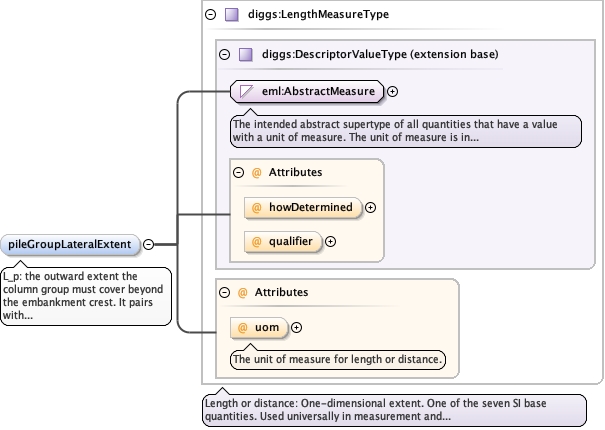
<element minOccurs="0" name="pileGroupLateralExtent" type="diggs:LengthMeasureType"><annotation><documentation>L_p: the outward extent the column group must cover beyond the embankment crest. It pairs with diggs:DesignRILTPType/embankmentHeight.</documentation></annotation></element>
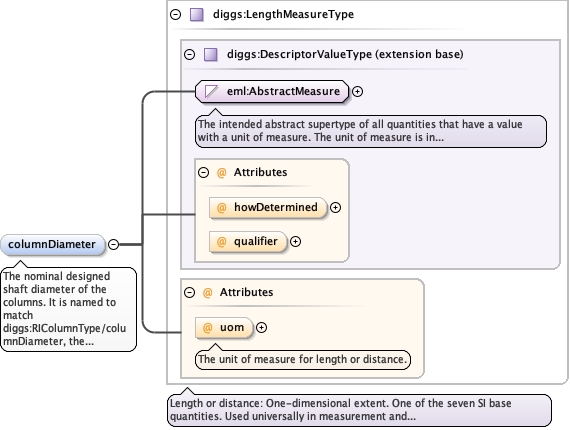
The nominal designed shaft diameter of the columns. It is named tomatch diggs:RIColumnType/columnDiameter, the as-built counterpart,so that the design value and the constructed value carry one nameand a conformance check has an unambiguous pair to compare.
<element minOccurs="0" name="columnDiameter" type="diggs:LengthMeasureType"><annotation><documentation>The nominal designed shaft diameter of the columns. It is named to match diggs:RIColumnType/columnDiameter, the as-built counterpart, so that the design value and the constructed value carry one name and a conformance check has an unambiguous pair to compare.</documentation></annotation></element>
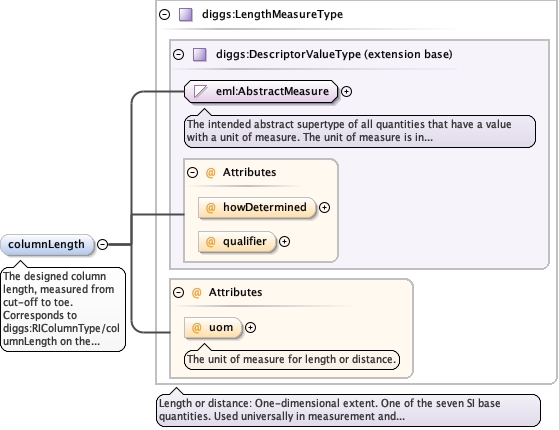
The designed column length, measured from cut-off to toe.Corresponds to diggs:RIColumnType/columnLength on the as-builtcolumn. Length and toeElevation are independent values; givewhichever governs the design, or both.
<element minOccurs="0" name="columnLength" type="diggs:LengthMeasureType"><annotation><documentation>The designed column length, measured from cut-off to toe. Corresponds to diggs:RIColumnType/columnLength on the as-built column. Length and toeElevation are independent values; give whichever governs the design, or both.</documentation></annotation></element>
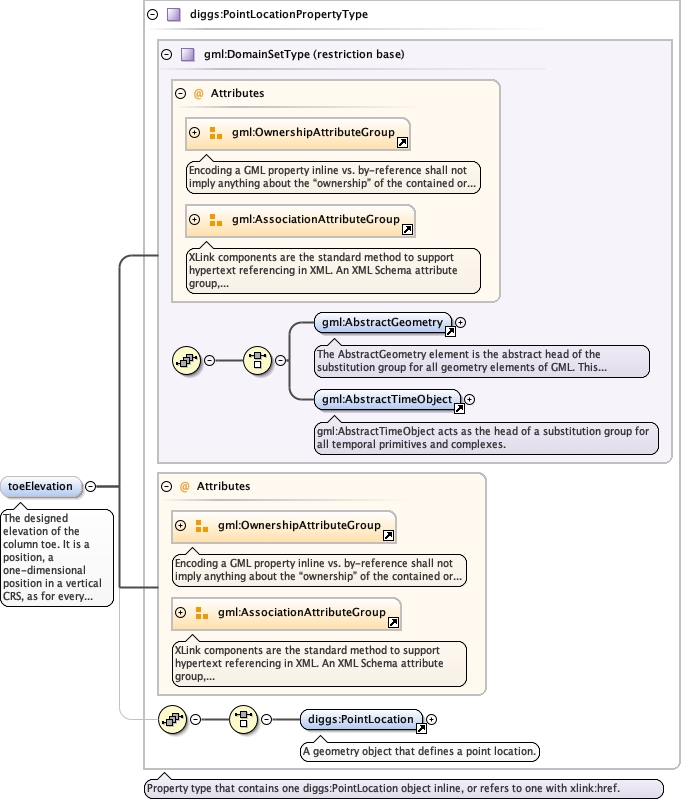
The designed elevation of the column toe. It is a position, aone-dimensional position in a vertical CRS, as for every otherelevation in DIGGS, not a scalar. It is the natural companion to thedesign bearing-stratum level: the toe elevation is normally set bythe required penetration into that stratum, and the requiredpenetration itself is an acceptance criterion, not a value here.
<element minOccurs="0" name="toeElevation" type="diggs:PointLocationPropertyType"><annotation><documentation>The designed elevation of the column toe. It is a position, a one-dimensional position in a vertical CRS, as for every other elevation in DIGGS, not a scalar. It is the natural companion to the design bearing-stratum level: the toe elevation is normally set by the required penetration into that stratum, and the required penetration itself is an acceptance criterion, not a value here.</documentation></annotation></element>
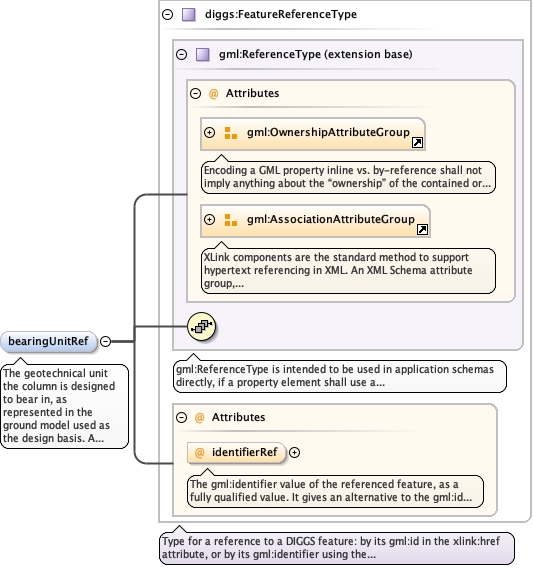
The geotechnical unit the column is designed to bear in, asrepresented in the ground model used as the design basis. A designwhose scope spans several models cites the bearing unit as itappears in each, and the one whose volume contains a given columnapplies to it; repeat for each model. Where a geoUnitDesignQuantitystates a bearingStratumLevel, its geoUnitRef should be one of theseunits. It is distinct fromdiggs:RIColumnConstructionType/embedmentLayerRef, which records theunit the column actually terminated in. Given by reference only.
The gml:identifier value of the referenced feature, as a fully qualifiedvalue. It gives an alternative to the gml:id in xlink:href for findingthe referenced feature, mainly to reference a feature by a globallyunique identifier and where naming conflicts occur with gml:id whenaccessing data in external files.
<element minOccurs="0" maxOccurs="unbounded" name="bearingUnitRef" type="diggs:FeatureReferenceType"><annotation><appinfo source="urn:x-gml:targetElement">diggs:GeoUnitObservation</appinfo><documentation>The geotechnical unit the column is designed to bear in, as represented in the ground model used as the design basis. A design whose scope spans several models cites the bearing unit as it appears in each, and the one whose volume contains a given column applies to it; repeat for each model. Where a geoUnitDesignQuantity states a bearingStratumLevel, its geoUnitRef should be one of these units. It is distinct from diggs:RIColumnConstructionType/embedmentLayerRef, which records the unit the column actually terminated in. Given by reference only.</documentation></annotation></element>
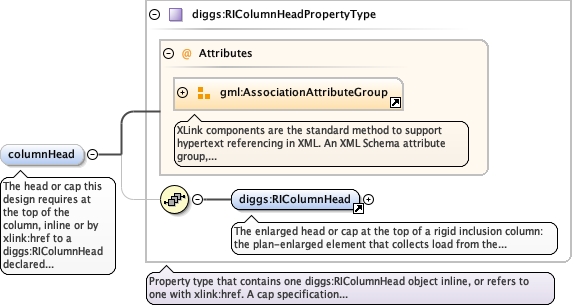
The head or cap this design requires at the top of the column,inline or by xlink:href to a diggs:RIColumnHead declared once andshared by every column designed to the same cap detail. It is theinput to areaReplacementRatio: where a cap is present it is the capplan area, not the shaft area, that is replaced, so a ratio statedwithout the cap dimension it was computed from is not reproducible.The punching-shear provisions consume headThickness the same way.
<element minOccurs="0" name="columnHead" type="diggs:RIColumnHeadPropertyType"><annotation><documentation>The head or cap this design requires at the top of the column, inline or by xlink:href to a diggs:RIColumnHead declared once and shared by every column designed to the same cap detail. It is the input to areaReplacementRatio: where a cap is present it is the cap plan area, not the shaft area, that is replaced, so a ratio stated without the cap dimension it was computed from is not reproducible. The punching-shear provisions consume headThickness the same way.</documentation></annotation></element>
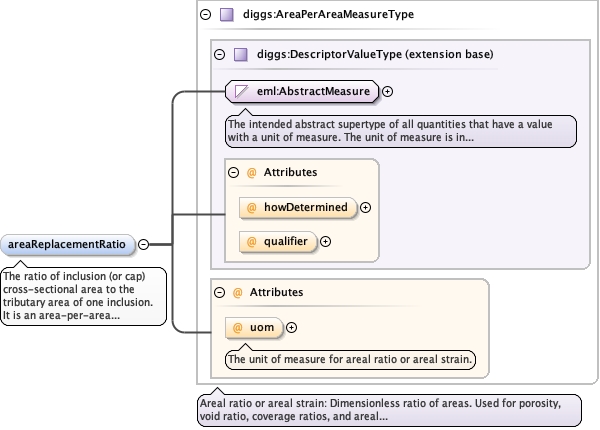
The ratio of inclusion (or cap) cross-sectional area to thetributary area of one inclusion. It is an area-per-area measure, nota dimensionless one: the quantity is quoted as a fraction about asoften as a percentage, and it is among the most-used numbers inrigid inclusion design (coverage is typically under 10 percentbeneath embankments), so a file that reports 0.05 where a readerexpects 5 is a silent error. The explicit uom prevents it.
The unit of measure for areal ratio or areal strain.
Source
<element minOccurs="0" name="areaReplacementRatio" type="diggs:AreaPerAreaMeasureType"><annotation><documentation>The ratio of inclusion (or cap) cross-sectional area to the tributary area of one inclusion. It is an area-per-area measure, not a dimensionless one: the quantity is quoted as a fraction about as often as a percentage, and it is among the most-used numbers in rigid inclusion design (coverage is typically under 10 percent beneath embankments), so a file that reports 0.05 where a reader expects 5 is a silent error. The explicit uom prevents it.</documentation></annotation></element>
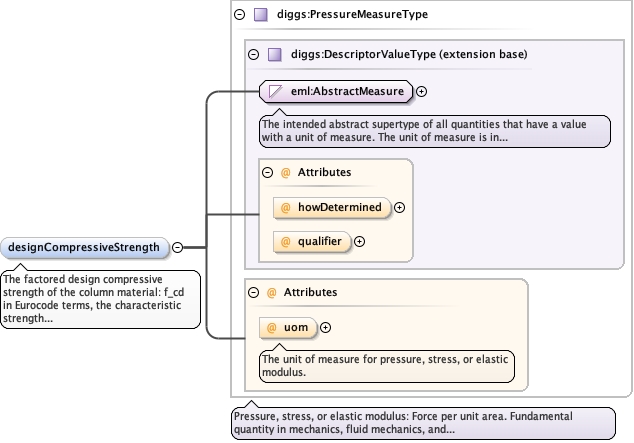
The factored design compressive strength of the column material:f_cd in Eurocode terms, the characteristic strength reduced by amaterial factor, or the equivalent construction-method andinspection-level reduction other practices apply. It is distinctfrom allowableMeanCompressiveStress, and both may bind. Thecharacteristic strength it is derived from is a property of thematerial, not of the column design, and belongs on the referenceddiggs:DesignGroutMix.
The unit of measure for pressure, stress, or elastic modulus.
Source
<element minOccurs="0" name="designCompressiveStrength" type="diggs:PressureMeasureType"><annotation><documentation>The factored design compressive strength of the column material: f_cd in Eurocode terms, the characteristic strength reduced by a material factor, or the equivalent construction-method and inspection-level reduction other practices apply. It is distinct from allowableMeanCompressiveStress, and both may bind. The characteristic strength it is derived from is a property of the material, not of the column design, and belongs on the referenced diggs:DesignGroutMix.</documentation></annotation></element>
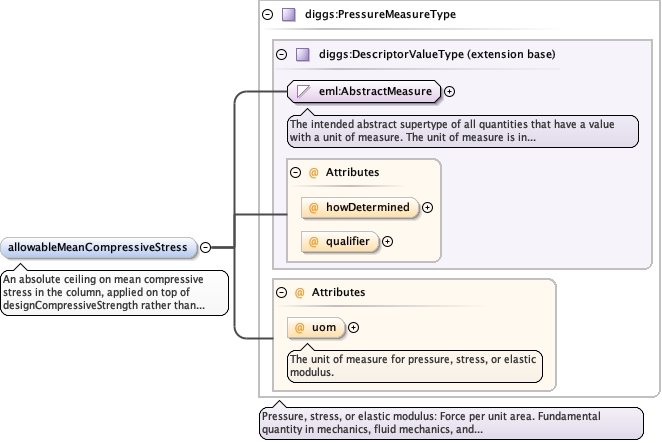
An absolute ceiling on mean compressive stress in the column,applied on top of designCompressiveStrength rather than instead ofit. The two limits bind independently, and a design governed by theabsolute cap differs from one governed by the factored strength;conflating them would lose which controlled. It is named genericallyrather than after one practice's symbol, because several practicesreach the same constraint by different routes: a fixed cap inEuropean ground-improvement recommendations, and allowable-stresstables for deep foundation materials in US building codes.
The unit of measure for pressure, stress, or elastic modulus.
Source
<element minOccurs="0" name="allowableMeanCompressiveStress" type="diggs:PressureMeasureType"><annotation><documentation>An absolute ceiling on mean compressive stress in the column, applied on top of designCompressiveStrength rather than instead of it. The two limits bind independently, and a design governed by the absolute cap differs from one governed by the factored strength; conflating them would lose which controlled. It is named generically rather than after one practice's symbol, because several practices reach the same constraint by different routes: a fixed cap in European ground-improvement recommendations, and allowable-stress tables for deep foundation materials in US building codes.</documentation></annotation></element>
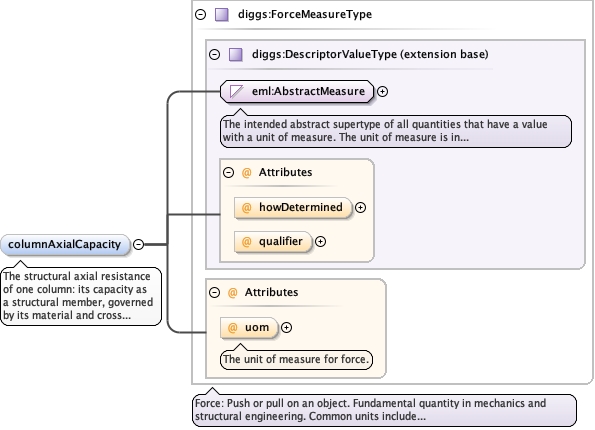
The structural axial resistance of one column: its capacity as astructural member, governed by its material and cross section. It isnot the geotechnical capacity, the sum of toe and shaft resistances,which is a per-soil-layer computation.
<element minOccurs="0" name="columnAxialCapacity" type="diggs:ForceMeasureType"><annotation><documentation>The structural axial resistance of one column: its capacity as a structural member, governed by its material and cross section. It is not the geotechnical capacity, the sum of toe and shaft resistances, which is a per-soil-layer computation.</documentation></annotation></element>
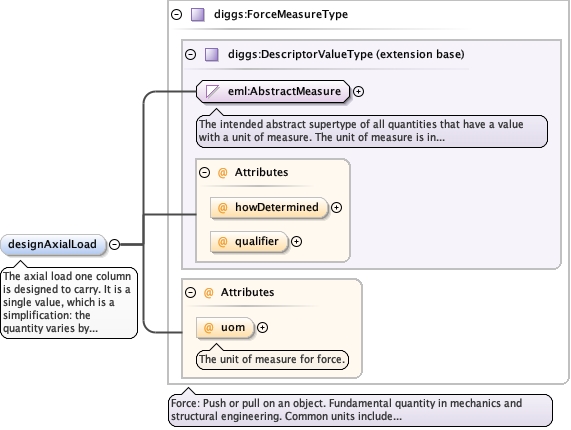
The axial load one column is designed to carry. It is a singlevalue, which is a simplification: the quantity varies by columnposition (edge columns see different demand from interior ones) andby load combination, and practice does not agree on which load touse, from allowable bearing pressure times area, through sustainedservice loads, to a conservative assumption that the columns takethe entire applied load. State the governing value here, and carrythe load case and basis as otherProperty on the planned column.
<element minOccurs="0" name="designAxialLoad" type="diggs:ForceMeasureType"><annotation><documentation>The axial load one column is designed to carry. It is a single value, which is a simplification: the quantity varies by column position (edge columns see different demand from interior ones) and by load combination, and practice does not agree on which load to use, from allowable bearing pressure times area, through sustained service loads, to a conservative assumption that the columns take the entire applied load. State the governing value here, and carry the load case and basis as otherProperty on the planned column.</documentation></annotation></element>
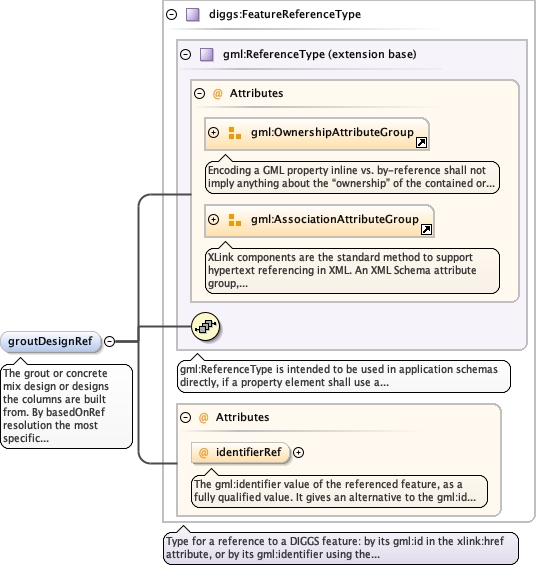
The grout or concrete mix design or designs the columns are builtfrom. By basedOnRef resolution the most specific value wins, so adesign stating none uses the mix of the design it is based on, and azone-level design may state its own where a different mix applies.It is a plain reference rather than basedOnRef, because a mix designis a component of the work, not a generalization of it, and one mixis normally shared across zones. The referenced diggs:DesignGroutMixis declared as a sibling under the design slot of the program andprecedes this object. Given by reference only. Repeat for each mix.
The gml:identifier value of the referenced feature, as a fully qualifiedvalue. It gives an alternative to the gml:id in xlink:href for findingthe referenced feature, mainly to reference a feature by a globallyunique identifier and where naming conflicts occur with gml:id whenaccessing data in external files.
<element minOccurs="0" maxOccurs="unbounded" name="groutDesignRef" type="diggs:FeatureReferenceType"><annotation><appinfo source="urn:x-gml:targetElement">diggs:DesignGroutMix</appinfo><documentation>The grout or concrete mix design or designs the columns are built from. By basedOnRef resolution the most specific value wins, so a design stating none uses the mix of the design it is based on, and a zone-level design may state its own where a different mix applies. It is a plain reference rather than basedOnRef, because a mix design is a component of the work, not a generalization of it, and one mix is normally shared across zones. The referenced diggs:DesignGroutMix is declared as a sibling under the design slot of the program and precedes this object. Given by reference only. Repeat for each mix.</documentation></annotation></element>
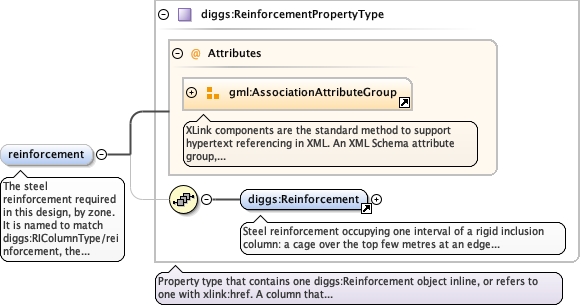
The steel reinforcement required in this design, by zone. It isnamed to match diggs:RIColumnType/reinforcement, the as-builtcounterpart. Absent where the design is unreinforced, the commoncase; see diggs:Reinforcement. Repeat for each reinforced zone.
<element maxOccurs="unbounded" minOccurs="0" name="reinforcement" type="diggs:ReinforcementPropertyType"><annotation><documentation>The steel reinforcement required in this design, by zone. It is named to match diggs:RIColumnType/reinforcement, the as-built counterpart. Absent where the design is unreinforced, the common case; see diggs:Reinforcement. Repeat for each reinforced zone.</documentation></annotation></element>
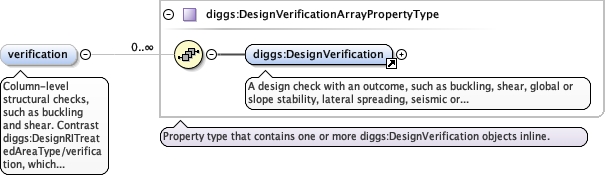
Column-level structural checks, such as buckling and shear. Contrastdiggs:DesignRITreatedAreaType/verification, which carries thesite-wide stability checks.
<element maxOccurs="1" minOccurs="0" name="verification" type="diggs:DesignVerificationArrayPropertyType"><annotation><documentation>Column-level structural checks, such as buckling and shear. Contrast diggs:DesignRITreatedAreaType/verification, which carries the site-wide stability checks.</documentation></annotation></element>
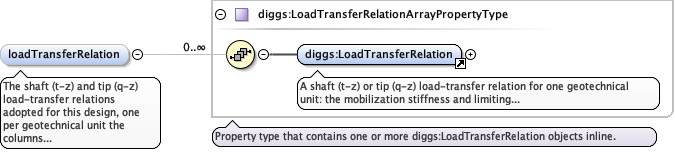
The shaft (t-z) and tip (q-z) load-transfer relations adopted forthis design, one per geotechnical unit the columns pass through orbear on. A column typically passes through several units, each withits own relation per mechanism, so a multi-layer site states severaldiggs:LoadTransferRelation entries here.
<element maxOccurs="1" minOccurs="0" name="loadTransferRelation" type="diggs:LoadTransferRelationArrayPropertyType"><annotation><documentation>The shaft (t-z) and tip (q-z) load-transfer relations adopted for this design, one per geotechnical unit the columns pass through or bear on. A column typically passes through several units, each with its own relation per mechanism, so a multi-layer site states several diggs:LoadTransferRelation entries here.</documentation></annotation></element>
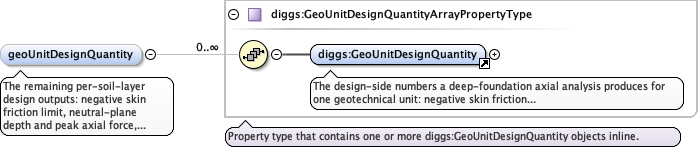
The remaining per-soil-layer design outputs: negative skin frictionlimit, neutral-plane depth and peak axial force, toe and shaftresistance, limit unit tip resistance, the adopted bearing-stratumlevel, and the subgrade reaction modulus. It repeats per unitexactly as loadTransferRelation does; the populated fields of oneentry vary with the role of the unit in the analysis (shaft-frictionlayer, bearing stratum, or the layer containing the neutral plane),as diggs:GeoUnitDesignQuantityType describes.
<element maxOccurs="1" minOccurs="0" name="geoUnitDesignQuantity" type="diggs:GeoUnitDesignQuantityArrayPropertyType"><annotation><documentation>The remaining per-soil-layer design outputs: negative skin friction limit, neutral-plane depth and peak axial force, toe and shaft resistance, limit unit tip resistance, the adopted bearing-stratum level, and the subgrade reaction modulus. It repeats per unit exactly as loadTransferRelation does; the populated fields of one entry vary with the role of the unit in the analysis (shaft-friction layer, bearing stratum, or the layer containing the neutral plane), as diggs:GeoUnitDesignQuantityType describes.</documentation></annotation></element>
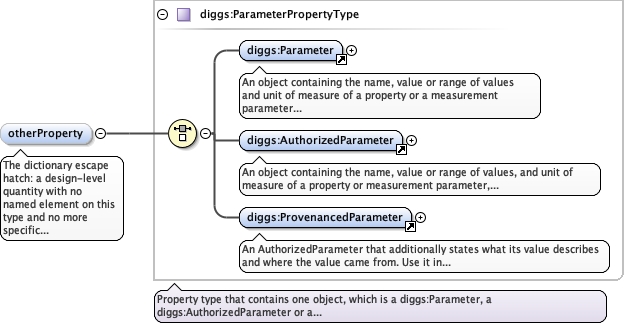
The dictionary escape hatch: a design-level quantity with no namedelement on this type and no more specific dictionary-boundcontainer, carried as a diggs:AuthorizedParameter bound to adefinition in ri_design_properties.xml. The equivalent diameter isthe typed equivalentDiameter; the column axial utilization ratio isstated by diggs:DesignVerificationType/utilisationRatio on theverification array (verificationType structural_axial); and thedimensionless geometry and stiffness ratios that gate arching-methodapplicability are indiggs:DesignRITreatedAreaType/methodApplicabilityRatio. Repeat foreach quantity.
<element minOccurs="0" maxOccurs="unbounded" name="otherProperty" type="diggs:ParameterPropertyType"><annotation><documentation>The dictionary escape hatch: a design-level quantity with no named element on this type and no more specific dictionary-bound container, carried as a diggs:AuthorizedParameter bound to a definition in ri_design_properties.xml. The equivalent diameter is the typed equivalentDiameter; the column axial utilization ratio is stated by diggs:DesignVerificationType/utilisationRatio on the verification array (verificationType structural_axial); and the dimensionless geometry and stiffness ratios that gate arching-method applicability are in diggs:DesignRITreatedAreaType/methodApplicabilityRatio. Repeat for each quantity.</documentation></annotation></element>
Database handle for the object. It is of XML type ID, so is constrained to beunique in the XML document within which it occurs. An external identifier for the object inthe form of a URI may be constructed using standard XML and XPointer methods. This is doneby concatenating the URI for the document, a fragment separator, and the value of the idattribute.
Source
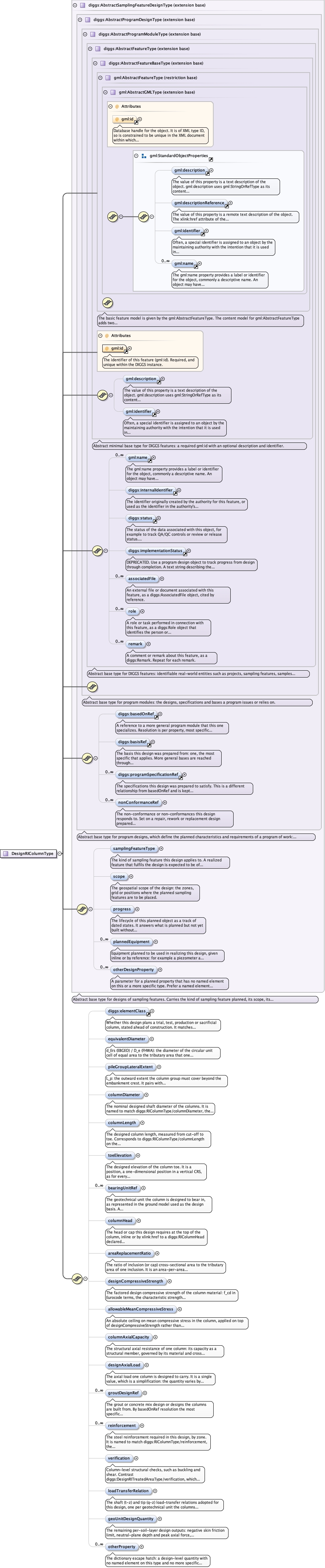
<complexType name="DesignRIColumnType"><complexContent><extension base="diggs:AbstractSamplingFeatureDesignType"><sequence><element ref="diggs:elementClass" minOccurs="0"><annotation><documentation>Whether this design plans a trial, test, production or sacrificial column, stated ahead of construction. It matches diggs:RIColumnType/elementClass on the eventual as-built object. Values come from the enumerated list, or "Other: xx", where xx is a user-defined term whose meaning differs from every listed value (not a synonym of one).</documentation></annotation></element><element minOccurs="0" name="equivalentDiameter" type="diggs:LengthMeasureType"><annotation><documentation>d_Ers (EBGEO) / D_e (FHWA): the diameter of the circular unit cell of equal area to the tributary area that one inclusion supports, derived from spacingX, spacingY and gridPattern. It is reported explicitly because the unit-cell radius, not the raw center-to-center spacing, enters most arching and settlement formulations. It is a typed convenience element rather than a dictionary parameter, because it is method-agnostic and computed entirely from fields on this type. Where it disagrees with a recomputation from spacingX, spacingY and gridPattern, the recomputation governs.</documentation></annotation></element><element minOccurs="0" name="pileGroupLateralExtent" type="diggs:LengthMeasureType"><annotation><documentation>L_p: the outward extent the column group must cover beyond the embankment crest. It pairs with diggs:DesignRILTPType/embankmentHeight.</documentation></annotation></element><element minOccurs="0" name="columnDiameter" type="diggs:LengthMeasureType"><annotation><documentation>The nominal designed shaft diameter of the columns. It is named to match diggs:RIColumnType/columnDiameter, the as-built counterpart, so that the design value and the constructed value carry one name and a conformance check has an unambiguous pair to compare.</documentation></annotation></element><element minOccurs="0" name="columnLength" type="diggs:LengthMeasureType"><annotation><documentation>The designed column length, measured from cut-off to toe. Corresponds to diggs:RIColumnType/columnLength on the as-built column. Length and toeElevation are independent values; give whichever governs the design, or both.</documentation></annotation></element><element minOccurs="0" name="toeElevation" type="diggs:PointLocationPropertyType"><annotation><documentation>The designed elevation of the column toe. It is a position, a one-dimensional position in a vertical CRS, as for every other elevation in DIGGS, not a scalar. It is the natural companion to the design bearing-stratum level: the toe elevation is normally set by the required penetration into that stratum, and the required penetration itself is an acceptance criterion, not a value here.</documentation></annotation></element><element minOccurs="0" maxOccurs="unbounded" name="bearingUnitRef" type="diggs:FeatureReferenceType"><annotation><appinfo source="urn:x-gml:targetElement">diggs:GeoUnitObservation</appinfo><documentation>The geotechnical unit the column is designed to bear in, as represented in the ground model used as the design basis. A design whose scope spans several models cites the bearing unit as it appears in each, and the one whose volume contains a given column applies to it; repeat for each model. Where a geoUnitDesignQuantity states a bearingStratumLevel, its geoUnitRef should be one of these units. It is distinct from diggs:RIColumnConstructionType/embedmentLayerRef, which records the unit the column actually terminated in. Given by reference only.</documentation></annotation></element><element minOccurs="0" name="columnHead" type="diggs:RIColumnHeadPropertyType"><annotation><documentation>The head or cap this design requires at the top of the column, inline or by xlink:href to a diggs:RIColumnHead declared once and shared by every column designed to the same cap detail. It is the input to areaReplacementRatio: where a cap is present it is the cap plan area, not the shaft area, that is replaced, so a ratio stated without the cap dimension it was computed from is not reproducible. The punching-shear provisions consume headThickness the same way.</documentation></annotation></element><element minOccurs="0" name="areaReplacementRatio" type="diggs:AreaPerAreaMeasureType"><annotation><documentation>The ratio of inclusion (or cap) cross-sectional area to the tributary area of one inclusion. It is an area-per-area measure, not a dimensionless one: the quantity is quoted as a fraction about as often as a percentage, and it is among the most-used numbers in rigid inclusion design (coverage is typically under 10 percent beneath embankments), so a file that reports 0.05 where a reader expects 5 is a silent error. The explicit uom prevents it.</documentation></annotation></element><element minOccurs="0" name="designCompressiveStrength" type="diggs:PressureMeasureType"><annotation><documentation>The factored design compressive strength of the column material: f_cd in Eurocode terms, the characteristic strength reduced by a material factor, or the equivalent construction-method and inspection-level reduction other practices apply. It is distinct from allowableMeanCompressiveStress, and both may bind. The characteristic strength it is derived from is a property of the material, not of the column design, and belongs on the referenced diggs:DesignGroutMix.</documentation></annotation></element><element minOccurs="0" name="allowableMeanCompressiveStress" type="diggs:PressureMeasureType"><annotation><documentation>An absolute ceiling on mean compressive stress in the column, applied on top of designCompressiveStrength rather than instead of it. The two limits bind independently, and a design governed by the absolute cap differs from one governed by the factored strength; conflating them would lose which controlled. It is named generically rather than after one practice's symbol, because several practices reach the same constraint by different routes: a fixed cap in European ground-improvement recommendations, and allowable-stress tables for deep foundation materials in US building codes.</documentation></annotation></element><element minOccurs="0" name="columnAxialCapacity" type="diggs:ForceMeasureType"><annotation><documentation>The structural axial resistance of one column: its capacity as a structural member, governed by its material and cross section. It is not the geotechnical capacity, the sum of toe and shaft resistances, which is a per-soil-layer computation.</documentation></annotation></element><element minOccurs="0" name="designAxialLoad" type="diggs:ForceMeasureType"><annotation><documentation>The axial load one column is designed to carry. It is a single value, which is a simplification: the quantity varies by column position (edge columns see different demand from interior ones) and by load combination, and practice does not agree on which load to use, from allowable bearing pressure times area, through sustained service loads, to a conservative assumption that the columns take the entire applied load. State the governing value here, and carry the load case and basis as otherProperty on the planned column.</documentation></annotation></element><element minOccurs="0" maxOccurs="unbounded" name="groutDesignRef" type="diggs:FeatureReferenceType"><annotation><appinfo source="urn:x-gml:targetElement">diggs:DesignGroutMix</appinfo><documentation>The grout or concrete mix design or designs the columns are built from. By basedOnRef resolution the most specific value wins, so a design stating none uses the mix of the design it is based on, and a zone-level design may state its own where a different mix applies. It is a plain reference rather than basedOnRef, because a mix design is a component of the work, not a generalization of it, and one mix is normally shared across zones. The referenced diggs:DesignGroutMix is declared as a sibling under the design slot of the program and precedes this object. Given by reference only. Repeat for each mix.</documentation></annotation></element><element maxOccurs="unbounded" minOccurs="0" name="reinforcement" type="diggs:ReinforcementPropertyType"><annotation><documentation>The steel reinforcement required in this design, by zone. It is named to match diggs:RIColumnType/reinforcement, the as-built counterpart. Absent where the design is unreinforced, the common case; see diggs:Reinforcement. Repeat for each reinforced zone.</documentation></annotation></element><element maxOccurs="1" minOccurs="0" name="verification" type="diggs:DesignVerificationArrayPropertyType"><annotation><documentation>Column-level structural checks, such as buckling and shear. Contrast diggs:DesignRITreatedAreaType/verification, which carries the site-wide stability checks.</documentation></annotation></element><element maxOccurs="1" minOccurs="0" name="loadTransferRelation" type="diggs:LoadTransferRelationArrayPropertyType"><annotation><documentation>The shaft (t-z) and tip (q-z) load-transfer relations adopted for this design, one per geotechnical unit the columns pass through or bear on. A column typically passes through several units, each with its own relation per mechanism, so a multi-layer site states several diggs:LoadTransferRelation entries here.</documentation></annotation></element><element maxOccurs="1" minOccurs="0" name="geoUnitDesignQuantity" type="diggs:GeoUnitDesignQuantityArrayPropertyType"><annotation><documentation>The remaining per-soil-layer design outputs: negative skin friction limit, neutral-plane depth and peak axial force, toe and shaft resistance, limit unit tip resistance, the adopted bearing-stratum level, and the subgrade reaction modulus. It repeats per unit exactly as loadTransferRelation does; the populated fields of one entry vary with the role of the unit in the analysis (shaft-friction layer, bearing stratum, or the layer containing the neutral plane), as diggs:GeoUnitDesignQuantityType describes.</documentation></annotation></element><element minOccurs="0" maxOccurs="unbounded" name="otherProperty" type="diggs:ParameterPropertyType"><annotation><documentation>The dictionary escape hatch: a design-level quantity with no named element on this type and no more specific dictionary-bound container, carried as a diggs:AuthorizedParameter bound to a definition in ri_design_properties.xml. The equivalent diameter is the typed equivalentDiameter; the column axial utilization ratio is stated by diggs:DesignVerificationType/utilisationRatio on the verification array (verificationType structural_axial); and the dimensionless geometry and stiffness ratios that gate arching-method applicability are in diggs:DesignRITreatedAreaType/methodApplicabilityRatio. Repeat for each quantity.</documentation></annotation></element></sequence></extension></complexContent></complexType>