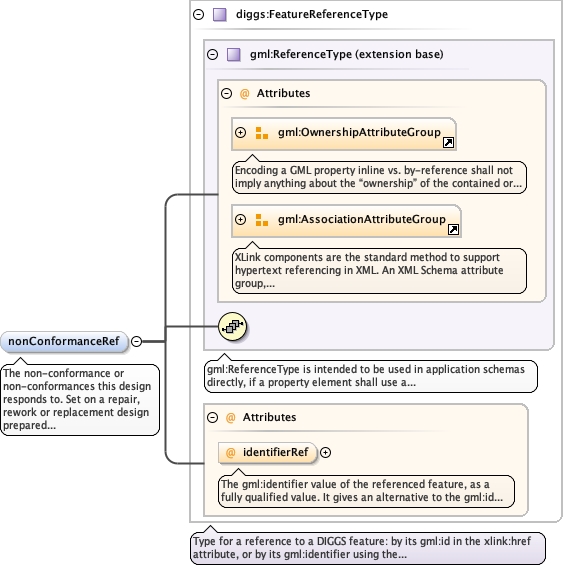
The non-conformance or non-conformances this design responds to. Seton a repair, rework or replacement design prepared to carry out adisposition; absent on an original design. A feature built to thisdesign cites the design through its own programDesignRef. Given byreference only.
The gml:identifier value of the referenced feature, as a fully qualifiedvalue. It gives an alternative to the gml:id in xlink:href for findingthe referenced feature, mainly to reference a feature by a globallyunique identifier and where naming conflicts occur with gml:id whenaccessing data in external files.
<element minOccurs="0" maxOccurs="unbounded" name="nonConformanceRef" type="diggs:FeatureReferenceType"><annotation><appinfo source="urn:x-gml:targetElement">diggs:NonConformance</appinfo><documentation>The non-conformance or non-conformances this design responds to. Set on a repair, rework or replacement design prepared to carry out a disposition; absent on an original design. A feature built to this design cites the design through its own programDesignRef. Given by reference only.</documentation></annotation></element>
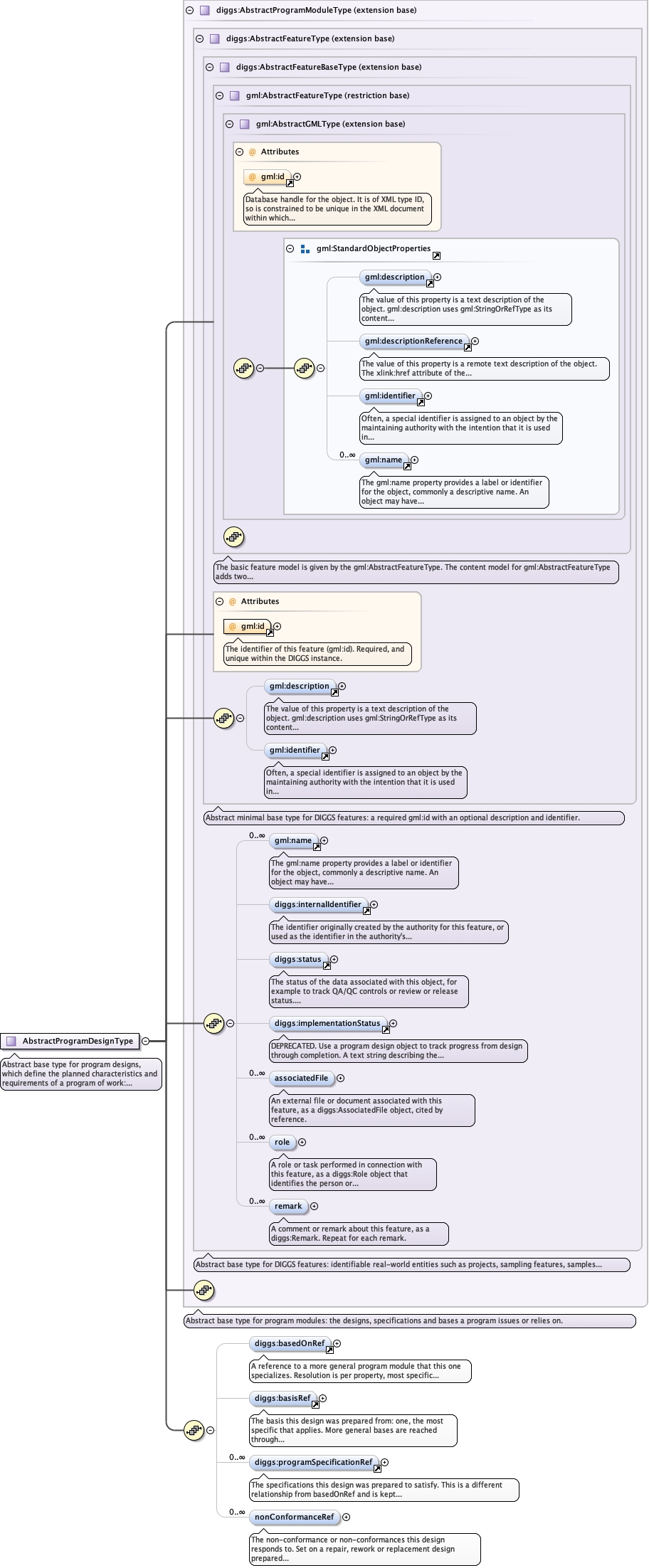
Complex Type diggs:AbstractProgramDesignType
Namespace
http://diggsml.org/schemas/3
Annotations
Abstract base type for program designs, which define the planned characteristics andrequirements of a program of work: target parameters, acceptance criteria, testingfrequencies and quality control measures. A design can be compared with the actualimplementation to track compliance and identify deviations.
Database handle for the object. It is of XML type ID, so is constrained to beunique in the XML document within which it occurs. An external identifier for the object inthe form of a URI may be constructed using standard XML and XPointer methods. This is doneby concatenating the URI for the document, a fragment separator, and the value of the idattribute.
Source
<complexType abstract="true" name="AbstractProgramDesignType"><annotation><documentation>Abstract base type for program designs, which define the planned characteristics and requirements of a program of work: target parameters, acceptance criteria, testing frequencies and quality control measures. A design can be compared with the actual implementation to track compliance and identify deviations.</documentation></annotation><complexContent><extension base="diggs:AbstractProgramModuleType"><sequence><element minOccurs="0" ref="diggs:basedOnRef"/><element minOccurs="0" maxOccurs="1" ref="diggs:basisRef"><annotation><documentation>The basis this design was prepared from: one, the most specific that applies. More general bases are reached through that basis's own basedOnRef chain, resolved per property with the most specific first.</documentation></annotation></element><element minOccurs="0" maxOccurs="unbounded" ref="diggs:programSpecificationRef"><annotation><documentation>The specifications this design was prepared to satisfy. This is a different relationship from basedOnRef and is kept separate so that inheritance up the basedOnRef chain does not pull constraints into the chain of intent.</documentation></annotation></element><element minOccurs="0" maxOccurs="unbounded" name="nonConformanceRef" type="diggs:FeatureReferenceType"><annotation><appinfo source="urn:x-gml:targetElement">diggs:NonConformance</appinfo><documentation>The non-conformance or non-conformances this design responds to. Set on a repair, rework or replacement design prepared to carry out a disposition; absent on an original design. A feature built to this design cites the design through its own programDesignRef. Given by reference only.</documentation></annotation></element></sequence></extension></complexContent></complexType>