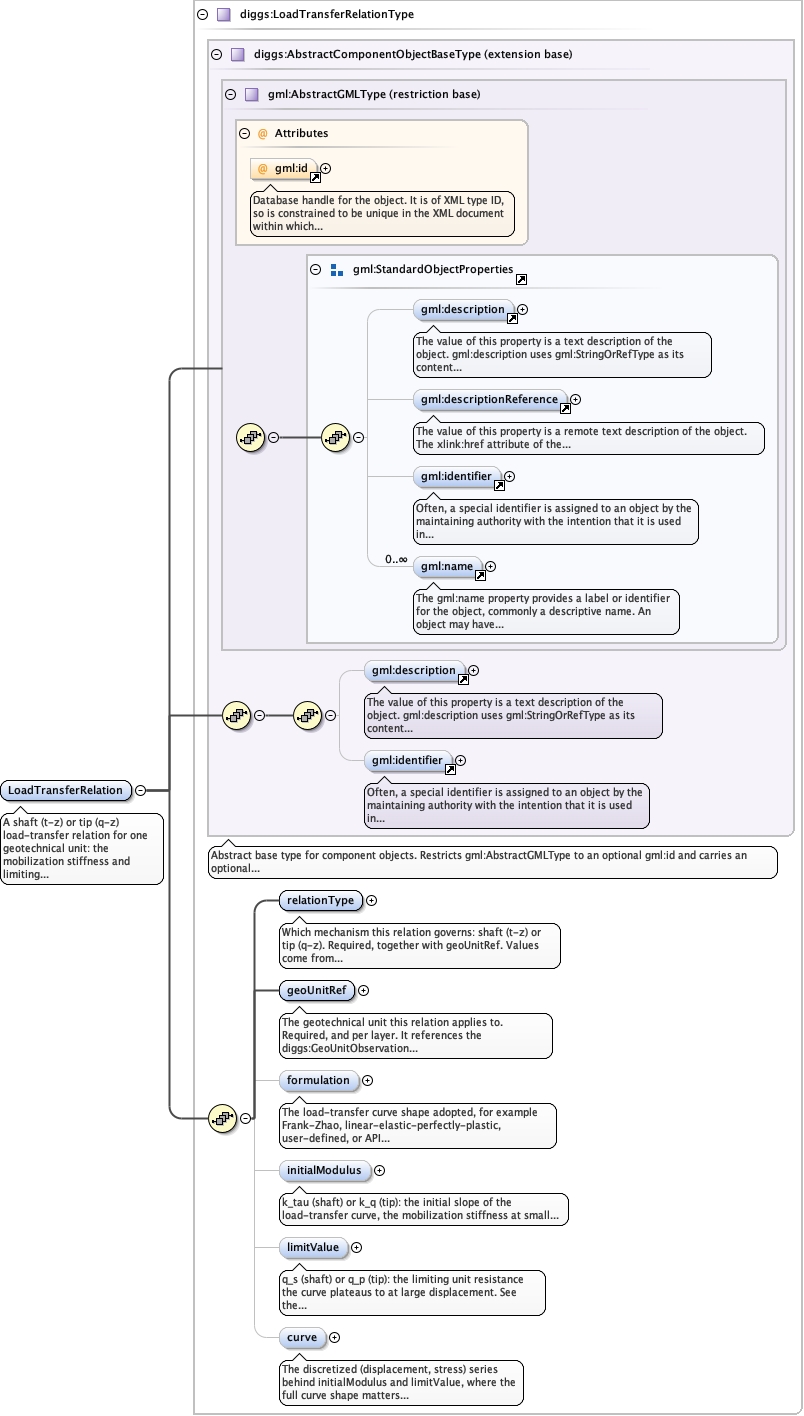
A shaft (t-z) or tip (q-z) load-transfer relation for one geotechnical unit: themobilization stiffness and limiting resistance that the shaft friction or tipbearing of a column develops against that unit, together with which unit it appliesto and, optionally, the discretized curve behind the stated modulus. Generic designmachinery, not specific to rigid inclusions: t-z and q-z load-transfer analysis isstandard deep-foundation practice for driven piles, drilled shafts and micropiles.An initial modulus alone discards the shape of the curve: k_tau and k_q are theinitial slopes of load-transfer curves, and in ASIRI practice they come from theFrank and Zhao formulation, which is trilinear (an initial slope, a break, a reducedslope and a plateau at the limiting value); the shape governs computed settlement,so give the curve where it matters. A relation is per layer, since a singlesite-wide k_tau is meaningless, and relationType and geoUnitRef are both required: aclassification with no layer, or a layer with no statement of which mechanism itgoverns, is uninterpretable. Mind the sign convention when the object is used forthe negative skin friction limit q_s: above the neutral plane it is the downdraglimit, the opposite sense from the positive shaft resistance below it, for the samephysical interface. State which regime a given relation describes in remark or inthe documentation of the referenced diggs:GeoUnitObservation, since limitValue alonedoes not disambiguate it.
Database handle for the object. It is of XML type ID, so is constrained to beunique in the XML document within which it occurs. An external identifier for the object inthe form of a URI may be constructed using standard XML and XPointer methods. This is doneby concatenating the URI for the document, a fragment separator, and the value of the idattribute.
Source
<element name="LoadTransferRelation" type="diggs:LoadTransferRelationType"><annotation><documentation>A shaft (t-z) or tip (q-z) load-transfer relation for one geotechnical unit: the mobilization stiffness and limiting resistance that the shaft friction or tip bearing of a column develops against that unit, together with which unit it applies to and, optionally, the discretized curve behind the stated modulus. Generic design machinery, not specific to rigid inclusions: t-z and q-z load-transfer analysis is standard deep-foundation practice for driven piles, drilled shafts and micropiles. An initial modulus alone discards the shape of the curve: k_tau and k_q are the initial slopes of load-transfer curves, and in ASIRI practice they come from the Frank and Zhao formulation, which is trilinear (an initial slope, a break, a reduced slope and a plateau at the limiting value); the shape governs computed settlement, so give the curve where it matters. A relation is per layer, since a single site-wide k_tau is meaningless, and relationType and geoUnitRef are both required: a classification with no layer, or a layer with no statement of which mechanism it governs, is uninterpretable. Mind the sign convention when the object is used for the negative skin friction limit q_s: above the neutral plane it is the downdrag limit, the opposite sense from the positive shaft resistance below it, for the same physical interface. State which regime a given relation describes in remark or in the documentation of the referenced diggs:GeoUnitObservation, since limitValue alone does not disambiguate it.</documentation></annotation></element>