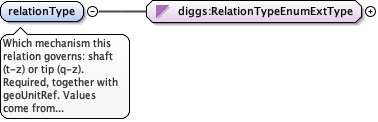
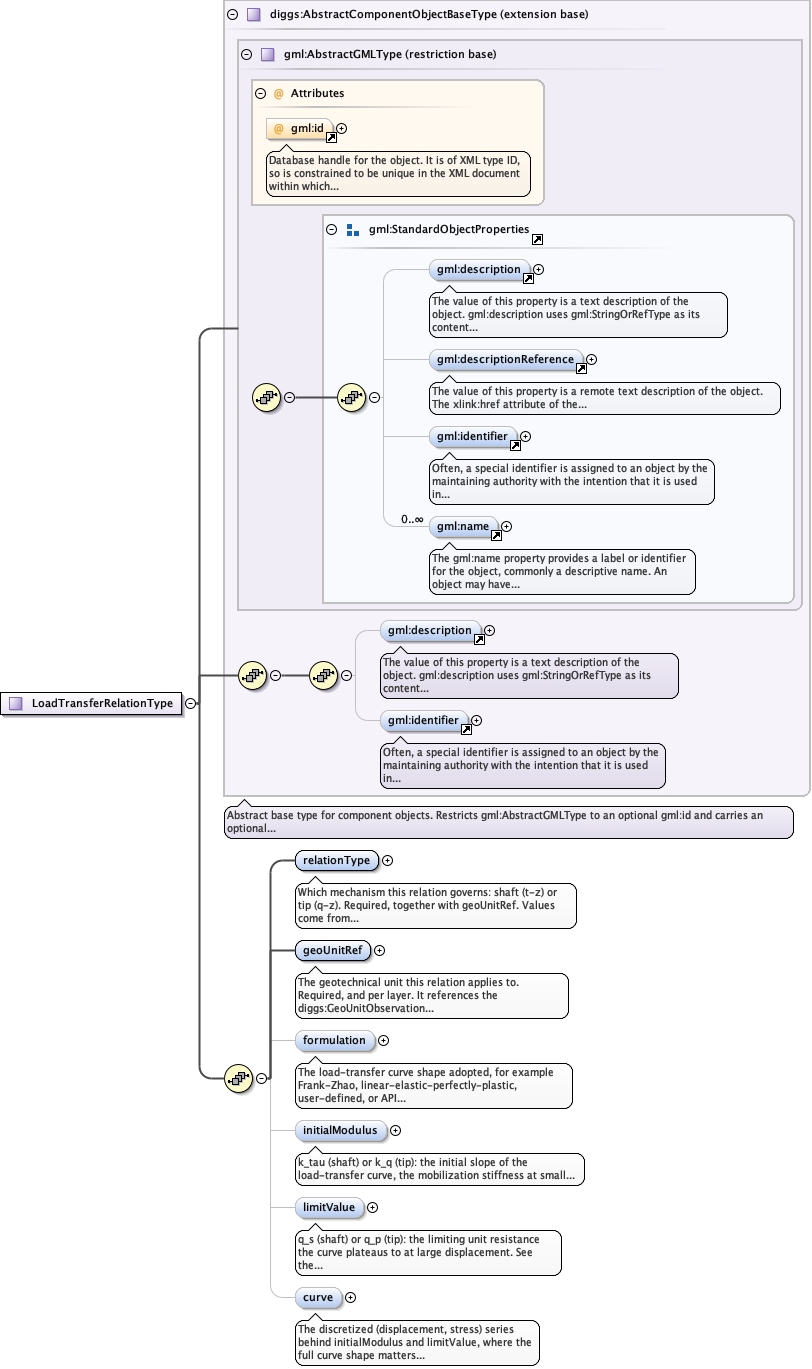
Which mechanism this relation governs: shaft (t-z) or tip (q-z).Required, together with geoUnitRef. Values come from the enumeratedlist, or "Other: xx", where xx is a user-defined term whose meaningdiffers from every listed value (not a synonym of one).
<element name="relationType" type="diggs:RelationTypeEnumExtType"><annotation><documentation>Which mechanism this relation governs: shaft (t-z) or tip (q-z). Required, together with geoUnitRef. Values come from the enumerated list, or "Other: xx", where xx is a user-defined term whose meaning differs from every listed value (not a synonym of one).</documentation></annotation></element>
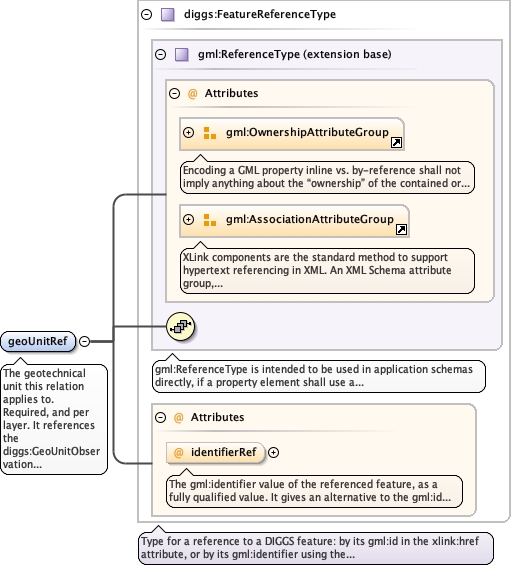
The geotechnical unit this relation applies to. Required, and perlayer. It references the diggs:GeoUnitObservation directly, theper-unit object in the ground model, not the enclosingdiggs:GeoUnitSystem, whose anchoring choice states what the modeldescribes rather than which unit this relation applies to.
The gml:identifier value of the referenced feature, as a fully qualifiedvalue. It gives an alternative to the gml:id in xlink:href for findingthe referenced feature, mainly to reference a feature by a globallyunique identifier and where naming conflicts occur with gml:id whenaccessing data in external files.
<element name="geoUnitRef" type="diggs:FeatureReferenceType"><annotation><appinfo source="urn:x-gml:targetElement">diggs:GeoUnitObservation</appinfo><documentation>The geotechnical unit this relation applies to. Required, and per layer. It references the diggs:GeoUnitObservation directly, the per-unit object in the ground model, not the enclosing diggs:GeoUnitSystem, whose anchoring choice states what the model describes rather than which unit this relation applies to.</documentation></annotation></element>
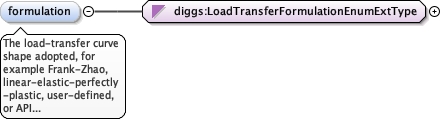
The load-transfer curve shape adopted, for example Frank-Zhao,linear-elastic-perfectly-plastic, user-defined, or API (for the t-zand q-z formulations of offshore piles). The documentation of eachenumerated value gives the exact curve shape. Values come from theenumerated list, or "Other: xx", where xx is a user-defined termwhose meaning differs from every listed value (not a synonym ofone).
<element minOccurs="0" name="formulation" type="diggs:LoadTransferFormulationEnumExtType"><annotation><documentation>The load-transfer curve shape adopted, for example Frank-Zhao, linear-elastic-perfectly-plastic, user-defined, or API (for the t-z and q-z formulations of offshore piles). The documentation of each enumerated value gives the exact curve shape. Values come from the enumerated list, or "Other: xx", where xx is a user-defined term whose meaning differs from every listed value (not a synonym of one).</documentation></annotation></element>
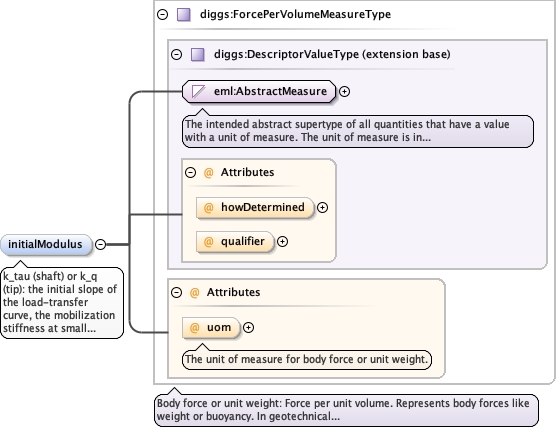
k_tau (shaft) or k_q (tip): the initial slope of the load-transfercurve, the mobilization stiffness at small displacement, before thefirst break of the curve.
The unit of measure for body force or unit weight.
Source
<element minOccurs="0" name="initialModulus" type="diggs:ForcePerVolumeMeasureType"><annotation><documentation>k_tau (shaft) or k_q (tip): the initial slope of the load-transfer curve, the mobilization stiffness at small displacement, before the first break of the curve.</documentation></annotation></element>
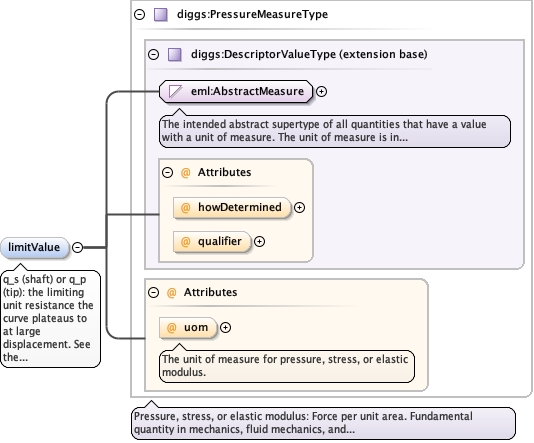
q_s (shaft) or q_p (tip): the limiting unit resistance the curveplateaus to at large displacement. See the sign-convention cautionon diggs:LoadTransferRelation for the negative skin friction limit.
The unit of measure for pressure, stress, or elastic modulus.
Source
<element minOccurs="0" name="limitValue" type="diggs:PressureMeasureType"><annotation><documentation>q_s (shaft) or q_p (tip): the limiting unit resistance the curve plateaus to at large displacement. See the sign-convention caution on diggs:LoadTransferRelation for the negative skin friction limit.</documentation></annotation></element>
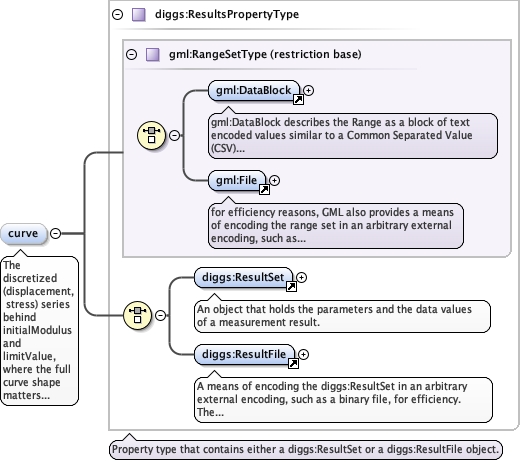
The discretized (displacement, stress) series behind initialModulusand limitValue, where the full curve shape matters and not only itsinitial slope and plateau. It reuses diggs:ResultsPropertyType,whose diggs:ResultSet holds parameters and a columnar dataValuesarray: declare a displacement diggs:Property and a stressdiggs:Property under parameters, and the paired series underdataValues. It carries no spatial domain, because the domain of at-z or q-z curve is displacement, not geometry.
<element minOccurs="0" name="curve" type="diggs:ResultsPropertyType"><annotation><documentation>The discretized (displacement, stress) series behind initialModulus and limitValue, where the full curve shape matters and not only its initial slope and plateau. It reuses diggs:ResultsPropertyType, whose diggs:ResultSet holds parameters and a columnar dataValues array: declare a displacement diggs:Property and a stress diggs:Property under parameters, and the paired series under dataValues. It carries no spatial domain, because the domain of a t-z or q-z curve is displacement, not geometry.</documentation></annotation></element>
Database handle for the object. It is of XML type ID, so is constrained to beunique in the XML document within which it occurs. An external identifier for the object inthe form of a URI may be constructed using standard XML and XPointer methods. This is doneby concatenating the URI for the document, a fragment separator, and the value of the idattribute.
Source
<complexType name="LoadTransferRelationType"><complexContent><extension base="diggs:AbstractComponentObjectBaseType"><sequence><element name="relationType" type="diggs:RelationTypeEnumExtType"><annotation><documentation>Which mechanism this relation governs: shaft (t-z) or tip (q-z). Required, together with geoUnitRef. Values come from the enumerated list, or "Other: xx", where xx is a user-defined term whose meaning differs from every listed value (not a synonym of one).</documentation></annotation></element><element name="geoUnitRef" type="diggs:FeatureReferenceType"><annotation><appinfo source="urn:x-gml:targetElement">diggs:GeoUnitObservation</appinfo><documentation>The geotechnical unit this relation applies to. Required, and per layer. It references the diggs:GeoUnitObservation directly, the per-unit object in the ground model, not the enclosing diggs:GeoUnitSystem, whose anchoring choice states what the model describes rather than which unit this relation applies to.</documentation></annotation></element><element minOccurs="0" name="formulation" type="diggs:LoadTransferFormulationEnumExtType"><annotation><documentation>The load-transfer curve shape adopted, for example Frank-Zhao, linear-elastic-perfectly-plastic, user-defined, or API (for the t-z and q-z formulations of offshore piles). The documentation of each enumerated value gives the exact curve shape. Values come from the enumerated list, or "Other: xx", where xx is a user-defined term whose meaning differs from every listed value (not a synonym of one).</documentation></annotation></element><element minOccurs="0" name="initialModulus" type="diggs:ForcePerVolumeMeasureType"><annotation><documentation>k_tau (shaft) or k_q (tip): the initial slope of the load-transfer curve, the mobilization stiffness at small displacement, before the first break of the curve.</documentation></annotation></element><element minOccurs="0" name="limitValue" type="diggs:PressureMeasureType"><annotation><documentation>q_s (shaft) or q_p (tip): the limiting unit resistance the curve plateaus to at large displacement. See the sign-convention caution on diggs:LoadTransferRelation for the negative skin friction limit.</documentation></annotation></element><element minOccurs="0" name="curve" type="diggs:ResultsPropertyType"><annotation><documentation>The discretized (displacement, stress) series behind initialModulus and limitValue, where the full curve shape matters and not only its initial slope and plateau. It reuses diggs:ResultsPropertyType, whose diggs:ResultSet holds parameters and a columnar dataValues array: declare a displacement diggs:Property and a stress diggs:Property under parameters, and the paired series under dataValues. It carries no spatial domain, because the domain of a t-z or q-z curve is displacement, not geometry.</documentation></annotation></element></sequence></extension></complexContent></complexType>