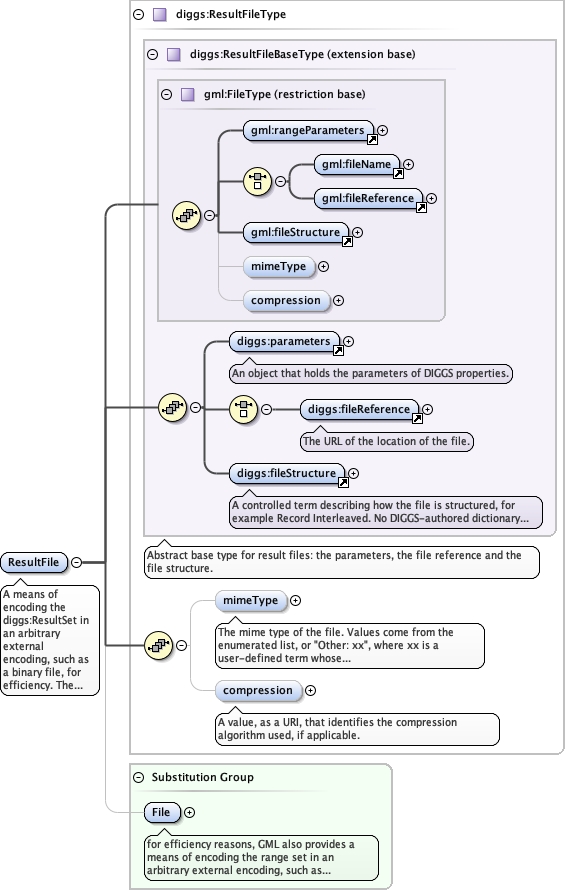
A means of encoding the diggs:ResultSet in an arbitrary external encoding, such as abinary file, for efficiency. The encoding can be well known but this is notrequired. The values of the dataValues element of the measurement are transmitted inan external file referenced from the structure described by diggs:ResultFileType;the file can be located remotely from the referencing DIGGS instance, sincefileReference is an anyURI. The compression property points, through an anyURI, to adefinition of the compression algorithm: a retrievable, computable definition, orsimply a reference to an unambiguous name. The mimeType property points to adefinition of the file mime type. The fileStructure property is defined by acodelist but should be "Record Interleaved" to preserve the required structure ofdataValues: each record contains a set of fields in parameter order, and each recordin document order is associated with a value, in order, in the location ortimeDomain property of the measurement. If a compression algorithm is applied, thatstructure applies only to the pre-compression or post-decompression file.
<element name="ResultFile" type="diggs:ResultFileType" substitutionGroup="gml:File"><annotation><documentation>A means of encoding the diggs:ResultSet in an arbitrary external encoding, such as a binary file, for efficiency. The encoding can be well known but this is not required. The values of the dataValues element of the measurement are transmitted in an external file referenced from the structure described by diggs:ResultFileType; the file can be located remotely from the referencing DIGGS instance, since fileReference is an anyURI. The compression property points, through an anyURI, to a definition of the compression algorithm: a retrievable, computable definition, or simply a reference to an unambiguous name. The mimeType property points to a definition of the file mime type. The fileStructure property is defined by a codelist but should be "Record Interleaved" to preserve the required structure of dataValues: each record contains a set of fields in parameter order, and each record in document order is associated with a value, in order, in the location or timeDomain property of the measurement. If a compression algorithm is applied, that structure applies only to the pre-compression or post-decompression file.</documentation></annotation></element>