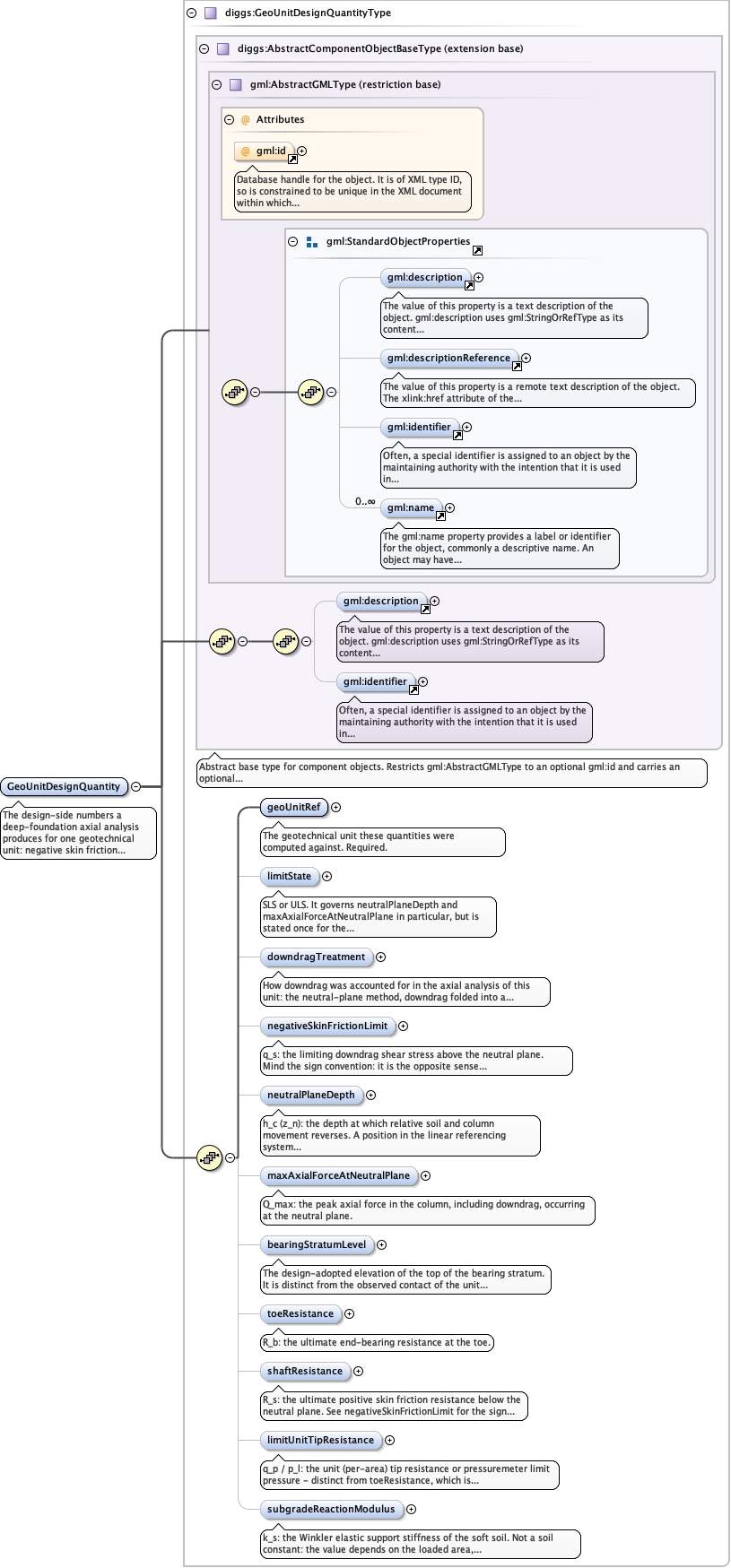
The design-side numbers a deep-foundation axial analysis produces for onegeotechnical unit: negative skin friction limit, neutral-plane depth and peak axialforce, toe and shaft resistance, limit unit tip resistance, the adoptedbearing-stratum level and the subgrade reaction modulus, each keyed to the unitthrough geoUnitRef, as for diggs:LoadTransferRelation. Generic design machinery, notspecific to rigid inclusions: neutral-plane analysis, end bearing and shaftresistance are standard deep-foundation practice. One object serves every role, withevery field optional except geoUnitRef: shaft friction and shaft resistance arestated once per layer the shaft passes through; toe resistance, limit tip resistanceand the bearing-stratum level apply only to the one unit that is the bearingstratum; the neutral-plane depth and peak force describe a single neutral plane thatfalls within exactly one unit; and the subgrade reaction modulus applies persoft-soil layer under a load transfer platform. State the subset that applies to therole of a unit: a shaft-friction layer states negativeSkinFrictionLimit andshaftResistance and leaves the bearing-stratum fields absent, and the bearingstratum states toeResistance, limitUnitTipResistance and bearingStratumLevel.geoUnitRef is required because every number is meaningless without the unit it wascomputed against; when the instance is the bearing-stratum instance it also suppliesthe reference to the observed stratum top, so no second reference restates it.limitState is carried once per object because the neutral-plane depth and peak forceare serviceability-limit-state quantities, and a file reporting them without thelimit state is ambiguous: negative skin friction should not be subtracted fromgeotechnical resistance when computing the geotechnical factor of safety, and as thefactor of safety approaches 1 the neutral plane migrates to the top of the element.
Database handle for the object. It is of XML type ID, so is constrained to beunique in the XML document within which it occurs. An external identifier for the object inthe form of a URI may be constructed using standard XML and XPointer methods. This is doneby concatenating the URI for the document, a fragment separator, and the value of the idattribute.
Source
<element name="GeoUnitDesignQuantity" type="diggs:GeoUnitDesignQuantityType"><annotation><documentation>The design-side numbers a deep-foundation axial analysis produces for one geotechnical unit: negative skin friction limit, neutral-plane depth and peak axial force, toe and shaft resistance, limit unit tip resistance, the adopted bearing-stratum level and the subgrade reaction modulus, each keyed to the unit through geoUnitRef, as for diggs:LoadTransferRelation. Generic design machinery, not specific to rigid inclusions: neutral-plane analysis, end bearing and shaft resistance are standard deep-foundation practice. One object serves every role, with every field optional except geoUnitRef: shaft friction and shaft resistance are stated once per layer the shaft passes through; toe resistance, limit tip resistance and the bearing-stratum level apply only to the one unit that is the bearing stratum; the neutral-plane depth and peak force describe a single neutral plane that falls within exactly one unit; and the subgrade reaction modulus applies per soft-soil layer under a load transfer platform. State the subset that applies to the role of a unit: a shaft-friction layer states negativeSkinFrictionLimit and shaftResistance and leaves the bearing-stratum fields absent, and the bearing stratum states toeResistance, limitUnitTipResistance and bearingStratumLevel. geoUnitRef is required because every number is meaningless without the unit it was computed against; when the instance is the bearing-stratum instance it also supplies the reference to the observed stratum top, so no second reference restates it. limitState is carried once per object because the neutral-plane depth and peak force are serviceability-limit-state quantities, and a file reporting them without the limit state is ambiguous: negative skin friction should not be subtracted from geotechnical resistance when computing the geotechnical factor of safety, and as the factor of safety approaches 1 the neutral plane migrates to the top of the element.</documentation></annotation></element>