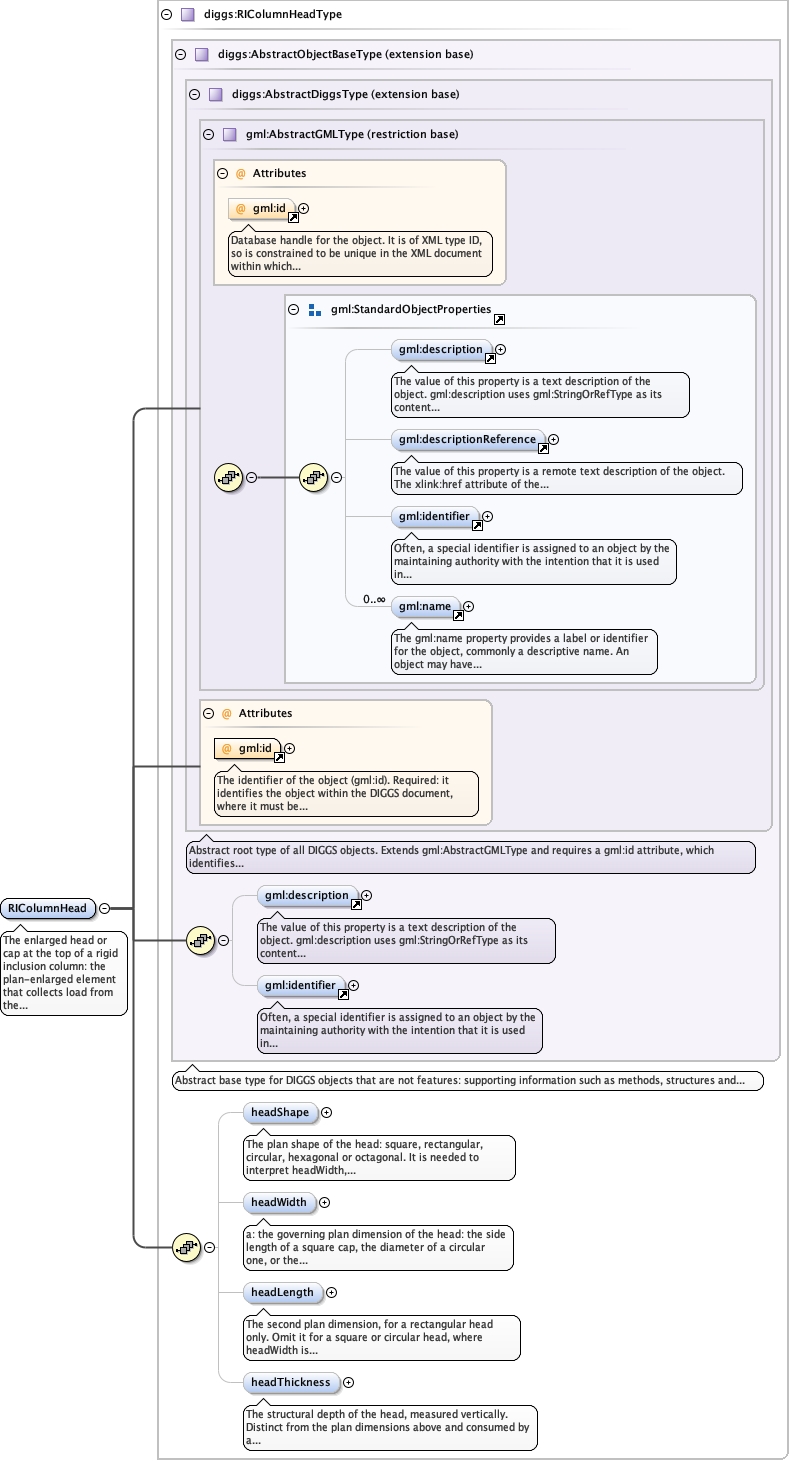
The enlarged head or cap at the top of a rigid inclusion column: the plan-enlargedelement that collects load from the load transfer platform and delivers it to thecolumn shaft. One object serves both the design and the as-built side:diggs:DesignRIColumnType carries it as the required cap and diggs:RIColumnType asthe installed one. It is reached through diggs:RIColumnHeadPropertyType, so it maybe given inline or cited by reference; a cap specification is normally identicalacross hundreds of columns, so declare it inline on first use and cite itthereafter. The presence of this object is the assertion that a head exists, and acolumn with no head omits the property.
Database handle for the object. It is of XML type ID, so is constrained to beunique in the XML document within which it occurs. An external identifier for the object inthe form of a URI may be constructed using standard XML and XPointer methods. This is doneby concatenating the URI for the document, a fragment separator, and the value of the idattribute.
Source
<element name="RIColumnHead" type="diggs:RIColumnHeadType"><annotation><documentation>The enlarged head or cap at the top of a rigid inclusion column: the plan-enlarged element that collects load from the load transfer platform and delivers it to the column shaft. One object serves both the design and the as-built side: diggs:DesignRIColumnType carries it as the required cap and diggs:RIColumnType as the installed one. It is reached through diggs:RIColumnHeadPropertyType, so it may be given inline or cited by reference; a cap specification is normally identical across hundreds of columns, so declare it inline on first use and cite it thereafter. The presence of this object is the assertion that a head exists, and a column with no head omits the property.</documentation></annotation></element>