Showing:

Annotations
Attributes
Diagrams
Properties
Source
Used by
Complex Type diggs:AbstractDiggsType
Namespace http://diggsml.org/schemas/3
Annotations
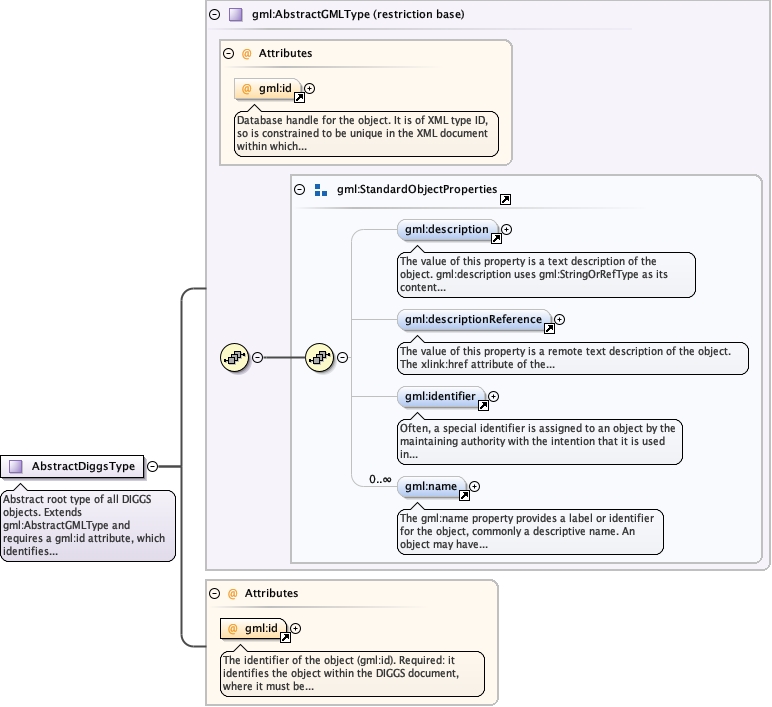
Abstract root type of all DIGGS objects. Extends gml:AbstractGMLType and requires a
gml:id attribute, which identifies the object within the DIGGS document and allows
it to be referenced with xlink. All DIGGS types that can be referenced derive from
it.
Diagram
Diagramgml3_2Profile_diggs_xsd_Attribute_gml_id.tmp#idgml3_2Profile_diggs_xsd_Element_gml_description.tmp#descriptiongml3_2Profile_diggs_xsd_Element_gml_descriptionReference.tmp#descriptionReferencegml3_2Profile_diggs_xsd_Element_gml_identifier.tmp#identifiergml3_2Profile_diggs_xsd_Element_gml_name.tmp#namegml3_2Profile_diggs_xsd_Element_Group_gml_StandardObjectProperties.tmp#StandardObjectPropertiesgml3_2Profile_diggs_xsd_Complex_Type_gml_AbstractGMLType.tmp#AbstractGMLTypegml3_2Profile_diggs_xsd_Attribute_gml_id.tmp#id
Type restriction of gml:AbstractGMLType
Type hierarchy
Properties
abstract true
Used by
Attributes
QName Type Use Annotation
gml:id ID required
Database handle for the object. It is of XML type ID, so is constrained to be
unique in the XML document within which it occurs. An external identifier for the object in
the form of a URI may be constructed using standard XML and XPointer methods. This is done
by concatenating the URI for the document, a fragment separator, and the value of the id
attribute.
Source
<complexType abstract="true" name="AbstractDiggsType">
  <annotation>
    <documentation>Abstract root type of all DIGGS objects. Extends gml:AbstractGMLType and requires a gml:id attribute, which identifies the object within the DIGGS document and allows it to be referenced with xlink. All DIGGS types that can be referenced derive from it.</documentation>
  </annotation>
  <complexContent>
    <restriction base="gml:AbstractGMLType">
      <attribute ref="gml:id" use="required">
        <annotation>
          <documentation>The identifier of the object (gml:id). Required: it identifies the object within the DIGGS document, where it must be unique, and lets other objects refer to it.</documentation>
        </annotation>
      </attribute>
    </restriction>
  </complexContent>
</complexType>