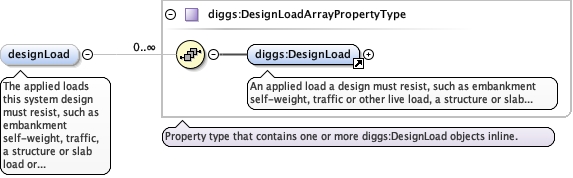
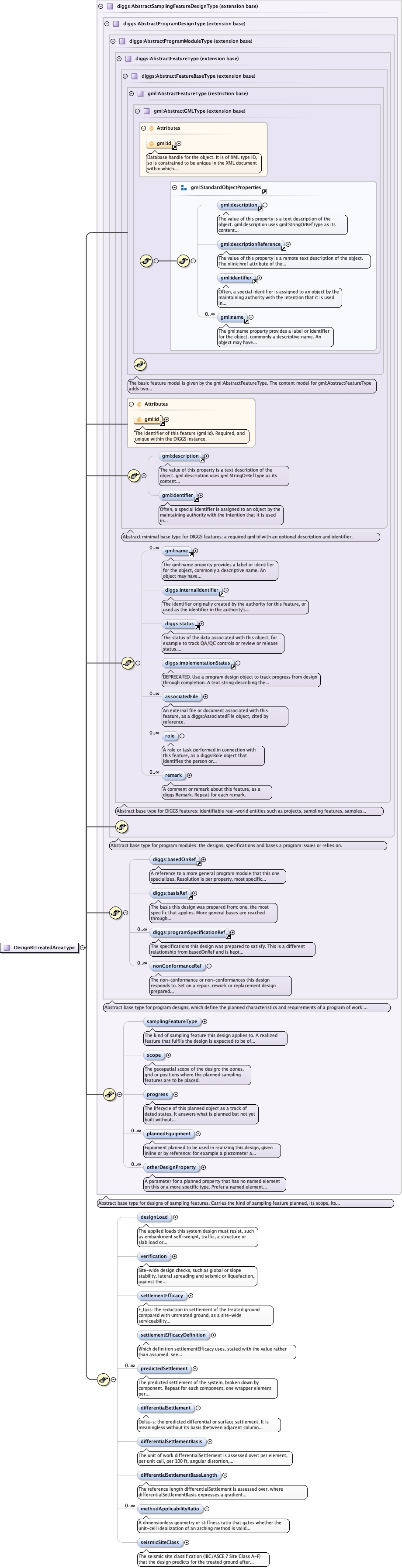
The applied loads this system design must resist, such as embankmentself-weight, traffic, a structure or slab load or a surcharge. Theyare held here rather than on diggs:DesignRILTPType because not everyload a site must resist is transmitted through a load transferplatform; a footing or tank load may bear on improved grounddirectly. Each diggs:DesignLoad's own appliesToZoneRef states whichpart of the site it governs where loading differs by zone.
<element maxOccurs="1" minOccurs="0" name="designLoad" type="diggs:DesignLoadArrayPropertyType"><annotation><documentation>The applied loads this system design must resist, such as embankment self-weight, traffic, a structure or slab load or a surcharge. They are held here rather than on diggs:DesignRILTPType because not every load a site must resist is transmitted through a load transfer platform; a footing or tank load may bear on improved ground directly. Each diggs:DesignLoad's own appliesToZoneRef states which part of the site it governs where loading differs by zone.</documentation></annotation></element>
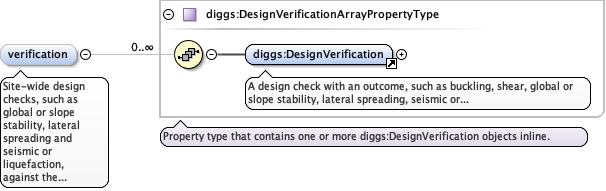
Site-wide design checks, such as global or slope stability, lateralspreading and seismic or liquefaction, against the stability andbehavior of the whole foundation system. Contrastdiggs:DesignRIColumnType/verification, which carries column-levelstructural checks (buckling, shear).
<element maxOccurs="1" minOccurs="0" name="verification" type="diggs:DesignVerificationArrayPropertyType"><annotation><documentation>Site-wide design checks, such as global or slope stability, lateral spreading and seismic or liquefaction, against the stability and behavior of the whole foundation system. Contrast diggs:DesignRIColumnType/verification, which carries column-level structural checks (buckling, shear).</documentation></annotation></element>
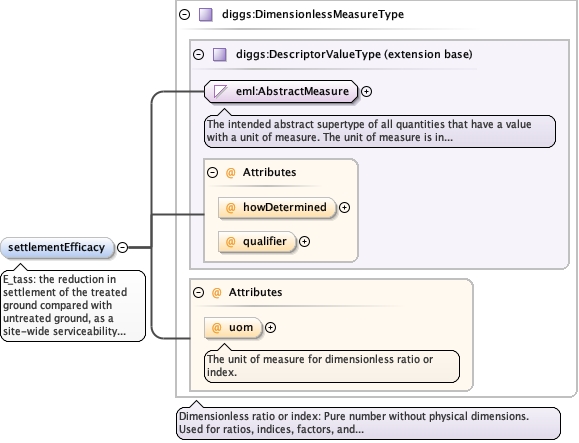
E_tass: the reduction in settlement of the treated ground comparedwith untreated ground, as a site-wide serviceability measure. Statethe definition used in settlementEfficacyDefinition. Contrastdiggs:DesignRILTPType/loadEfficacy, which is derived from the loadtransfer platform stresses.
The unit of measure for dimensionless ratio or index.
Source
<element minOccurs="0" name="settlementEfficacy" type="diggs:DimensionlessMeasureType"><annotation><documentation>E_tass: the reduction in settlement of the treated ground compared with untreated ground, as a site-wide serviceability measure. State the definition used in settlementEfficacyDefinition. Contrast diggs:DesignRILTPType/loadEfficacy, which is derived from the load transfer platform stresses.</documentation></annotation></element>
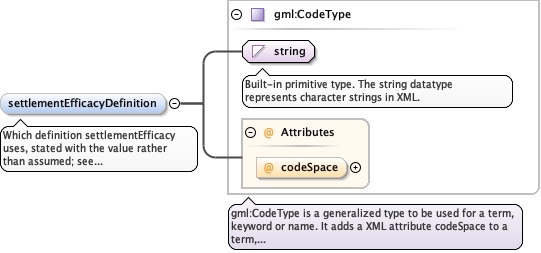
Which definition settlementEfficacy uses, stated with the valuerather than assumed; seediggs:DesignRILTPType/loadEfficacyDefinition. Use the DIGGSdictionary settlementEfficacyDefinition.xml for the list of values.
<element minOccurs="0" name="settlementEfficacyDefinition" type="gml:CodeType"><annotation><documentation>Which definition settlementEfficacy uses, stated with the value rather than assumed; see diggs:DesignRILTPType/loadEfficacyDefinition. Use the DIGGS dictionary settlementEfficacyDefinition.xml for the list of values.</documentation></annotation></element>
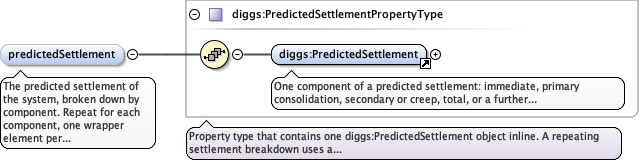
The predicted settlement of the system, broken down by component.Repeat for each component, one wrapper element per component as fordiggs:RIProgramBasisType/factor rather than an array wrapper; seediggs:PredictedSettlement.
<element minOccurs="0" maxOccurs="unbounded" name="predictedSettlement" type="diggs:PredictedSettlementPropertyType"><annotation><documentation>The predicted settlement of the system, broken down by component. Repeat for each component, one wrapper element per component as for diggs:RIProgramBasisType/factor rather than an array wrapper; see diggs:PredictedSettlement.</documentation></annotation></element>
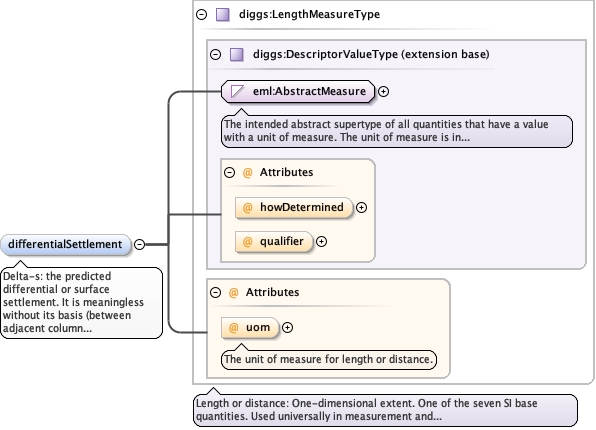
Delta-s: the predicted differential or surface settlement. It ismeaningless without its basis (between adjacent column heads, acrossa unit cell, over a 100 ft span, or as an angular distortion), whichdifferentialSettlementBasis and differentialSettlementBaseLengthstate. It has the same field set as the basis and baseLength ofdiggs:AbstractAcceptanceCriterionType, so that a predicted value andthe serviceability criterion it is checked against are comparablefield by field.
<element minOccurs="0" name="differentialSettlement" type="diggs:LengthMeasureType"><annotation><documentation>Delta-s: the predicted differential or surface settlement. It is meaningless without its basis (between adjacent column heads, across a unit cell, over a 100 ft span, or as an angular distortion), which differentialSettlementBasis and differentialSettlementBaseLength state. It has the same field set as the basis and baseLength of diggs:AbstractAcceptanceCriterionType, so that a predicted value and the serviceability criterion it is checked against are comparable field by field.</documentation></annotation></element>
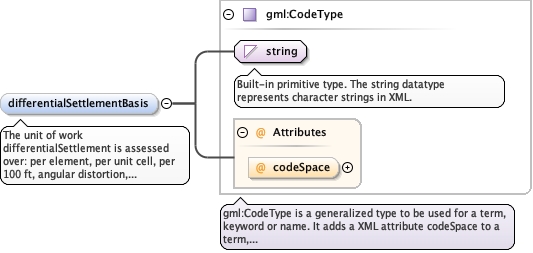
The unit of work differentialSettlement is assessed over: perelement, per unit cell, per 100 ft, angular distortion, and so on.Use the DIGGS dictionary basis.xml for the list of values.
<element minOccurs="0" name="differentialSettlementBasis" type="gml:CodeType"><annotation><documentation>The unit of work differentialSettlement is assessed over: per element, per unit cell, per 100 ft, angular distortion, and so on. Use the DIGGS dictionary basis.xml for the list of values.</documentation></annotation></element>
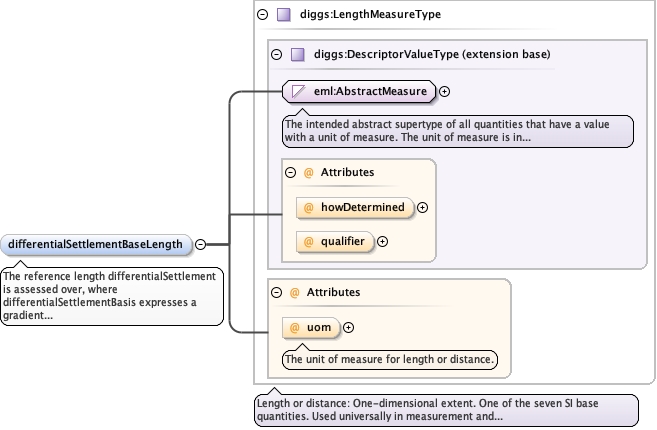
The reference length differentialSettlement is assessed over, wheredifferentialSettlementBasis expresses a gradient (for example 0.5 inper 100 ft). The magnitude form and the gradient form are differentquantity classes.
<element minOccurs="0" name="differentialSettlementBaseLength" type="diggs:LengthMeasureType"><annotation><documentation>The reference length differentialSettlement is assessed over, where differentialSettlementBasis expresses a gradient (for example 0.5 in per 100 ft). The magnitude form and the gradient form are different quantity classes.</documentation></annotation></element>
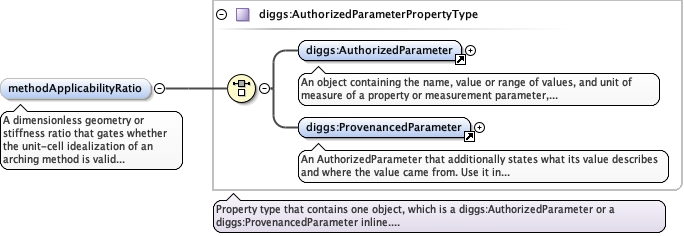
A dimensionless geometry or stiffness ratio that gates whether theunit-cell idealization of an arching method is valid for this zone'slayout: h/(s-d), d/s, sx/sy and the EBGEO stiffness ratio ks,T/ks,and whatever a later method's applicability check needs. Eachrepetition is a diggs:AuthorizedParameter ordiggs:ProvenancedParameter bound to a definition inri_design_properties.xml; the property type isdiggs:AuthorizedParameterPropertyType, notdiggs:ParameterPropertyType, so the schema itself enforces adictionary-bound name with a mandatory codeSpace. It is awhole-system judgment, likediggs:DesignRITreatedAreaType/verification: whether the assumptionof a method holds for the layout of the zone is evaluated at zone orsystem level, even though its ingredients come from componentdesigns (spacing and diameter on diggs:DesignRIColumnType,embankmentHeight on diggs:DesignRILTPType), and h/(s-d) needs both.It is a named container rather than diggs:otherProperty so that adictionary Occurrence can scope an entry to exactly this element(ancestor::diggs:methodApplicabilityRatio). Give the ratio itselfhere, such as ks,T/ks; the pass/fail requirement it must clear is averdict, not a value. Repeat for each ratio.
<element minOccurs="0" maxOccurs="unbounded" name="methodApplicabilityRatio" type="diggs:AuthorizedParameterPropertyType"><annotation><documentation>A dimensionless geometry or stiffness ratio that gates whether the unit-cell idealization of an arching method is valid for this zone's layout: h/(s-d), d/s, sx/sy and the EBGEO stiffness ratio ks,T/ks, and whatever a later method's applicability check needs. Each repetition is a diggs:AuthorizedParameter or diggs:ProvenancedParameter bound to a definition in ri_design_properties.xml; the property type is diggs:AuthorizedParameterPropertyType, not diggs:ParameterPropertyType, so the schema itself enforces a dictionary-bound name with a mandatory codeSpace. It is a whole-system judgment, like diggs:DesignRITreatedAreaType/verification: whether the assumption of a method holds for the layout of the zone is evaluated at zone or system level, even though its ingredients come from component designs (spacing and diameter on diggs:DesignRIColumnType, embankmentHeight on diggs:DesignRILTPType), and h/(s-d) needs both. It is a named container rather than diggs:otherProperty so that a dictionary Occurrence can scope an entry to exactly this element (ancestor::diggs:methodApplicabilityRatio). Give the ratio itself here, such as ks,T/ks; the pass/fail requirement it must clear is a verdict, not a value. Repeat for each ratio.</documentation></annotation></element>
The seismic site classification (IBC/ASCE 7 Site Class A-F) that thedesign predicts for the treated ground after improvement. It is apredicted output, of the same kind as predictedSettlement, andbelongs on the design. A required minimum site class is a constraintthe work is judged against and belongs on adiggs:PerformanceCriterion, as for a minimum shear-wave velocity: donot use this element to state a requirement, since a missedprediction is a finding whereas a missed requirement is anon-conformance. Its as-built counterpart isdiggs:RITreatedAreaType/seismicSiteClass, which carries the classachieved; the pair has the same vocabulary and subject, onepredicted and one verified. Values come from the enumerated list, or"Other: xx", where xx is a user-defined term whose meaning differsfrom every listed value (not a synonym of one).
<element minOccurs="0" name="seismicSiteClass" type="diggs:SeismicSiteClassEnumExtType"><annotation><documentation>The seismic site classification (IBC/ASCE 7 Site Class A-F) that the design predicts for the treated ground after improvement. It is a predicted output, of the same kind as predictedSettlement, and belongs on the design. A required minimum site class is a constraint the work is judged against and belongs on a diggs:PerformanceCriterion, as for a minimum shear-wave velocity: do not use this element to state a requirement, since a missed prediction is a finding whereas a missed requirement is a non-conformance. Its as-built counterpart is diggs:RITreatedAreaType/seismicSiteClass, which carries the class achieved; the pair has the same vocabulary and subject, one predicted and one verified. Values come from the enumerated list, or "Other: xx", where xx is a user-defined term whose meaning differs from every listed value (not a synonym of one).</documentation></annotation></element>
Database handle for the object. It is of XML type ID, so is constrained to beunique in the XML document within which it occurs. An external identifier for the object inthe form of a URI may be constructed using standard XML and XPointer methods. This is doneby concatenating the URI for the document, a fragment separator, and the value of the idattribute.
Source
<complexType name="DesignRITreatedAreaType"><complexContent><extension base="diggs:AbstractSamplingFeatureDesignType"><sequence><element maxOccurs="1" minOccurs="0" name="designLoad" type="diggs:DesignLoadArrayPropertyType"><annotation><documentation>The applied loads this system design must resist, such as embankment self-weight, traffic, a structure or slab load or a surcharge. They are held here rather than on diggs:DesignRILTPType because not every load a site must resist is transmitted through a load transfer platform; a footing or tank load may bear on improved ground directly. Each diggs:DesignLoad's own appliesToZoneRef states which part of the site it governs where loading differs by zone.</documentation></annotation></element><element maxOccurs="1" minOccurs="0" name="verification" type="diggs:DesignVerificationArrayPropertyType"><annotation><documentation>Site-wide design checks, such as global or slope stability, lateral spreading and seismic or liquefaction, against the stability and behavior of the whole foundation system. Contrast diggs:DesignRIColumnType/verification, which carries column-level structural checks (buckling, shear).</documentation></annotation></element><element minOccurs="0" name="settlementEfficacy" type="diggs:DimensionlessMeasureType"><annotation><documentation>E_tass: the reduction in settlement of the treated ground compared with untreated ground, as a site-wide serviceability measure. State the definition used in settlementEfficacyDefinition. Contrast diggs:DesignRILTPType/loadEfficacy, which is derived from the load transfer platform stresses.</documentation></annotation></element><element minOccurs="0" name="settlementEfficacyDefinition" type="gml:CodeType"><annotation><documentation>Which definition settlementEfficacy uses, stated with the value rather than assumed; see diggs:DesignRILTPType/loadEfficacyDefinition. Use the DIGGS dictionary settlementEfficacyDefinition.xml for the list of values.</documentation></annotation></element><element minOccurs="0" maxOccurs="unbounded" name="predictedSettlement" type="diggs:PredictedSettlementPropertyType"><annotation><documentation>The predicted settlement of the system, broken down by component. Repeat for each component, one wrapper element per component as for diggs:RIProgramBasisType/factor rather than an array wrapper; see diggs:PredictedSettlement.</documentation></annotation></element><element minOccurs="0" name="differentialSettlement" type="diggs:LengthMeasureType"><annotation><documentation>Delta-s: the predicted differential or surface settlement. It is meaningless without its basis (between adjacent column heads, across a unit cell, over a 100 ft span, or as an angular distortion), which differentialSettlementBasis and differentialSettlementBaseLength state. It has the same field set as the basis and baseLength of diggs:AbstractAcceptanceCriterionType, so that a predicted value and the serviceability criterion it is checked against are comparable field by field.</documentation></annotation></element><element minOccurs="0" name="differentialSettlementBasis" type="gml:CodeType"><annotation><documentation>The unit of work differentialSettlement is assessed over: per element, per unit cell, per 100 ft, angular distortion, and so on. Use the DIGGS dictionary basis.xml for the list of values.</documentation></annotation></element><element minOccurs="0" name="differentialSettlementBaseLength" type="diggs:LengthMeasureType"><annotation><documentation>The reference length differentialSettlement is assessed over, where differentialSettlementBasis expresses a gradient (for example 0.5 in per 100 ft). The magnitude form and the gradient form are different quantity classes.</documentation></annotation></element><element minOccurs="0" maxOccurs="unbounded" name="methodApplicabilityRatio" type="diggs:AuthorizedParameterPropertyType"><annotation><documentation>A dimensionless geometry or stiffness ratio that gates whether the unit-cell idealization of an arching method is valid for this zone's layout: h/(s-d), d/s, sx/sy and the EBGEO stiffness ratio ks,T/ks, and whatever a later method's applicability check needs. Each repetition is a diggs:AuthorizedParameter or diggs:ProvenancedParameter bound to a definition in ri_design_properties.xml; the property type is diggs:AuthorizedParameterPropertyType, not diggs:ParameterPropertyType, so the schema itself enforces a dictionary-bound name with a mandatory codeSpace. It is a whole-system judgment, like diggs:DesignRITreatedAreaType/verification: whether the assumption of a method holds for the layout of the zone is evaluated at zone or system level, even though its ingredients come from component designs (spacing and diameter on diggs:DesignRIColumnType, embankmentHeight on diggs:DesignRILTPType), and h/(s-d) needs both. It is a named container rather than diggs:otherProperty so that a dictionary Occurrence can scope an entry to exactly this element (ancestor::diggs:methodApplicabilityRatio). Give the ratio itself here, such as ks,T/ks; the pass/fail requirement it must clear is a verdict, not a value. Repeat for each ratio.</documentation></annotation></element><element minOccurs="0" name="seismicSiteClass" type="diggs:SeismicSiteClassEnumExtType"><annotation><documentation>The seismic site classification (IBC/ASCE 7 Site Class A-F) that the design predicts for the treated ground after improvement. It is a predicted output, of the same kind as predictedSettlement, and belongs on the design. A required minimum site class is a constraint the work is judged against and belongs on a diggs:PerformanceCriterion, as for a minimum shear-wave velocity: do not use this element to state a requirement, since a missed prediction is a finding whereas a missed requirement is a non-conformance. Its as-built counterpart is diggs:RITreatedAreaType/seismicSiteClass, which carries the class achieved; the pair has the same vocabulary and subject, one predicted and one verified. Values come from the enumerated list, or "Other: xx", where xx is a user-defined term whose meaning differs from every listed value (not a synonym of one).</documentation></annotation></element></sequence></extension></complexContent></complexType>