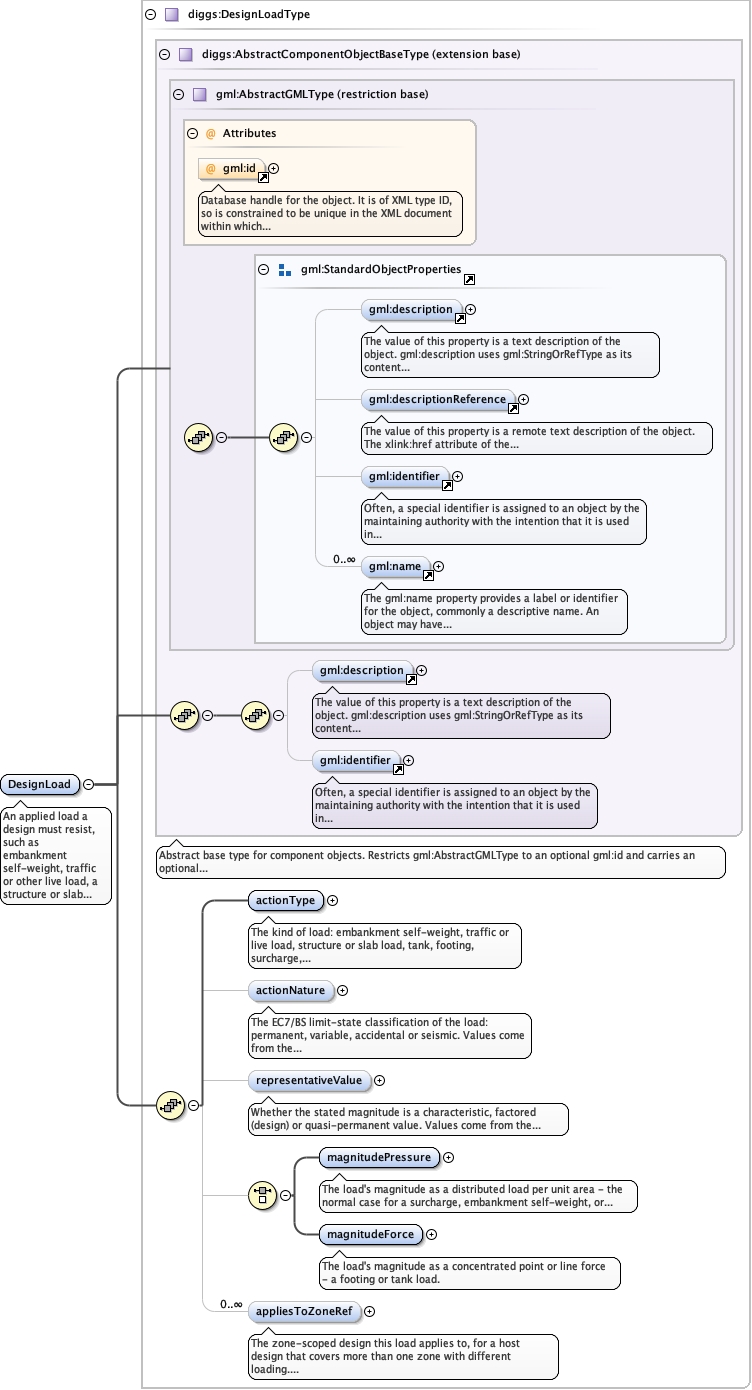
An applied load a design must resist, such as embankment self-weight, traffic orother live load, a structure or slab load, a tank, a footing, a surcharge, or aseismic or wind load, together with the limit-state classification needed to use itcorrectly: what kind of load it is, whether it is permanent, variable, accidental orseismic, and whether the stated magnitude is a characteristic, factored (design) orquasi-permanent value. Generic to any foundation or ground-improvement design.
Database handle for the object. It is of XML type ID, so is constrained to beunique in the XML document within which it occurs. An external identifier for the object inthe form of a URI may be constructed using standard XML and XPointer methods. This is doneby concatenating the URI for the document, a fragment separator, and the value of the idattribute.
Source
<element name="DesignLoad" type="diggs:DesignLoadType"><annotation><documentation>An applied load a design must resist, such as embankment self-weight, traffic or other live load, a structure or slab load, a tank, a footing, a surcharge, or a seismic or wind load, together with the limit-state classification needed to use it correctly: what kind of load it is, whether it is permanent, variable, accidental or seismic, and whether the stated magnitude is a characteristic, factored (design) or quasi-permanent value. Generic to any foundation or ground-improvement design.</documentation></annotation></element>