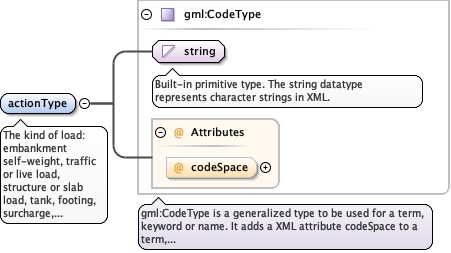
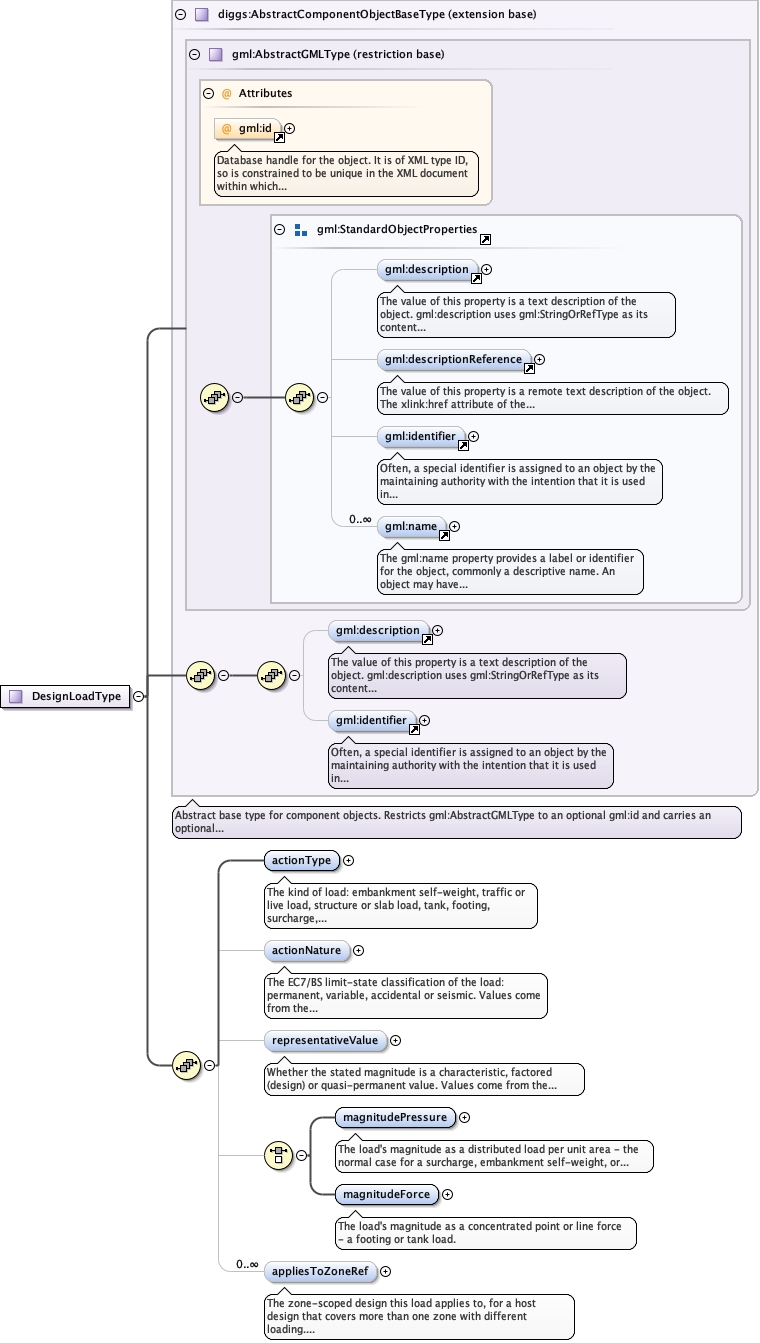
The kind of load: embankment self-weight, traffic or live load,structure or slab load, tank, footing, surcharge, seismic or wind.Use the DIGGS dictionary actionType.xml for the list of values.
<element name="actionType" type="gml:CodeType"><annotation><documentation>The kind of load: embankment self-weight, traffic or live load, structure or slab load, tank, footing, surcharge, seismic or wind. Use the DIGGS dictionary actionType.xml for the list of values.</documentation></annotation></element>
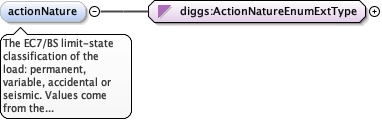
The EC7/BS limit-state classification of the load: permanent,variable, accidental or seismic. Values come from the enumeratedlist, or "Other: xx", where xx is a user-defined term whose meaningdiffers from every listed value (not a synonym of one).
<element minOccurs="0" name="actionNature" type="diggs:ActionNatureEnumExtType"><annotation><documentation>The EC7/BS limit-state classification of the load: permanent, variable, accidental or seismic. Values come from the enumerated list, or "Other: xx", where xx is a user-defined term whose meaning differs from every listed value (not a synonym of one).</documentation></annotation></element>
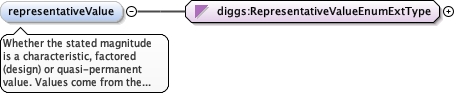
Whether the stated magnitude is a characteristic, factored (design)or quasi-permanent value. Values come from the enumerated list, or"Other: xx", where xx is a user-defined term whose meaning differsfrom every listed value (not a synonym of one).
<element minOccurs="0" name="representativeValue" type="diggs:RepresentativeValueEnumExtType"><annotation><documentation>Whether the stated magnitude is a characteristic, factored (design) or quasi-permanent value. Values come from the enumerated list, or "Other: xx", where xx is a user-defined term whose meaning differs from every listed value (not a synonym of one).</documentation></annotation></element>
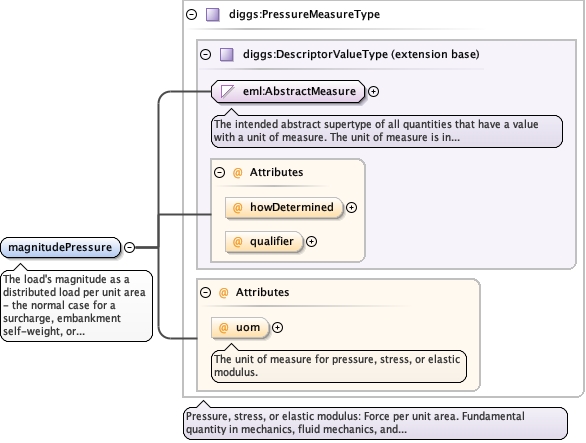
The unit of measure for pressure, stress, or elastic modulus.
Source
<element name="magnitudePressure" type="diggs:PressureMeasureType"><annotation><documentation>The load's magnitude as a distributed load per unit area - the normal case for a surcharge, embankment self-weight, or slab load.</documentation></annotation></element>
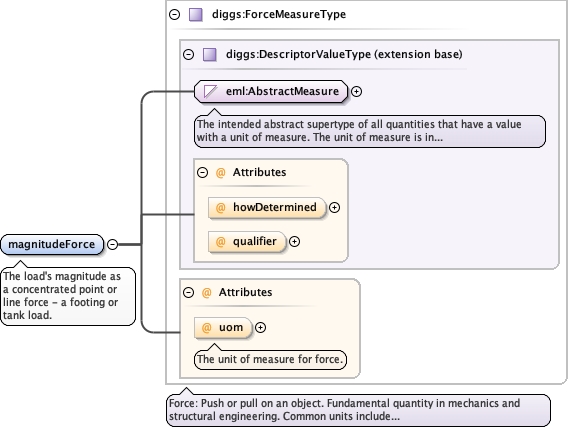
<element name="magnitudeForce" type="diggs:ForceMeasureType"><annotation><documentation>The load's magnitude as a concentrated point or line force - a footing or tank load.</documentation></annotation></element>
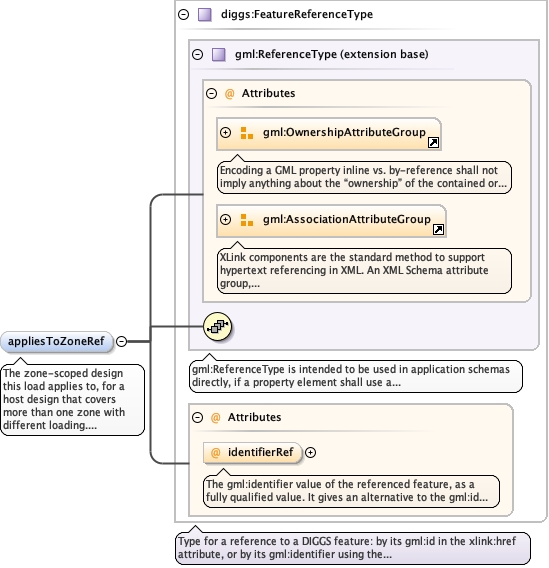
The zone-scoped design this load applies to, for a host design thatcovers more than one zone with different loading. It references thedesign object of the zone, not a separate boundary geometry. Omit itwhere the host design has one loading regime throughout.
The gml:identifier value of the referenced feature, as a fully qualifiedvalue. It gives an alternative to the gml:id in xlink:href for findingthe referenced feature, mainly to reference a feature by a globallyunique identifier and where naming conflicts occur with gml:id whenaccessing data in external files.
<element minOccurs="0" maxOccurs="unbounded" name="appliesToZoneRef" type="diggs:FeatureReferenceType"><annotation><appinfo source="urn:x-gml:targetElement">diggs:AbstractProgramDesign</appinfo><documentation>The zone-scoped design this load applies to, for a host design that covers more than one zone with different loading. It references the design object of the zone, not a separate boundary geometry. Omit it where the host design has one loading regime throughout.</documentation></annotation></element>
Database handle for the object. It is of XML type ID, so is constrained to beunique in the XML document within which it occurs. An external identifier for the object inthe form of a URI may be constructed using standard XML and XPointer methods. This is doneby concatenating the URI for the document, a fragment separator, and the value of the idattribute.
Source
<complexType name="DesignLoadType"><complexContent><extension base="diggs:AbstractComponentObjectBaseType"><sequence><element name="actionType" type="gml:CodeType"><annotation><documentation>The kind of load: embankment self-weight, traffic or live load, structure or slab load, tank, footing, surcharge, seismic or wind. Use the DIGGS dictionary actionType.xml for the list of values.</documentation></annotation></element><element minOccurs="0" name="actionNature" type="diggs:ActionNatureEnumExtType"><annotation><documentation>The EC7/BS limit-state classification of the load: permanent, variable, accidental or seismic. Values come from the enumerated list, or "Other: xx", where xx is a user-defined term whose meaning differs from every listed value (not a synonym of one).</documentation></annotation></element><element minOccurs="0" name="representativeValue" type="diggs:RepresentativeValueEnumExtType"><annotation><documentation>Whether the stated magnitude is a characteristic, factored (design) or quasi-permanent value. Values come from the enumerated list, or "Other: xx", where xx is a user-defined term whose meaning differs from every listed value (not a synonym of one).</documentation></annotation></element><choice minOccurs="0"><element name="magnitudePressure" type="diggs:PressureMeasureType"><annotation><documentation>The load's magnitude as a distributed load per unit area - the normal case for a surcharge, embankment self-weight, or slab load.</documentation></annotation></element><element name="magnitudeForce" type="diggs:ForceMeasureType"><annotation><documentation>The load's magnitude as a concentrated point or line force - a footing or tank load.</documentation></annotation></element></choice><element minOccurs="0" maxOccurs="unbounded" name="appliesToZoneRef" type="diggs:FeatureReferenceType"><annotation><appinfo source="urn:x-gml:targetElement">diggs:AbstractProgramDesign</appinfo><documentation>The zone-scoped design this load applies to, for a host design that covers more than one zone with different loading. It references the design object of the zone, not a separate boundary geometry. Omit it where the host design has one loading regime throughout.</documentation></annotation></element></sequence></extension></complexContent></complexType>