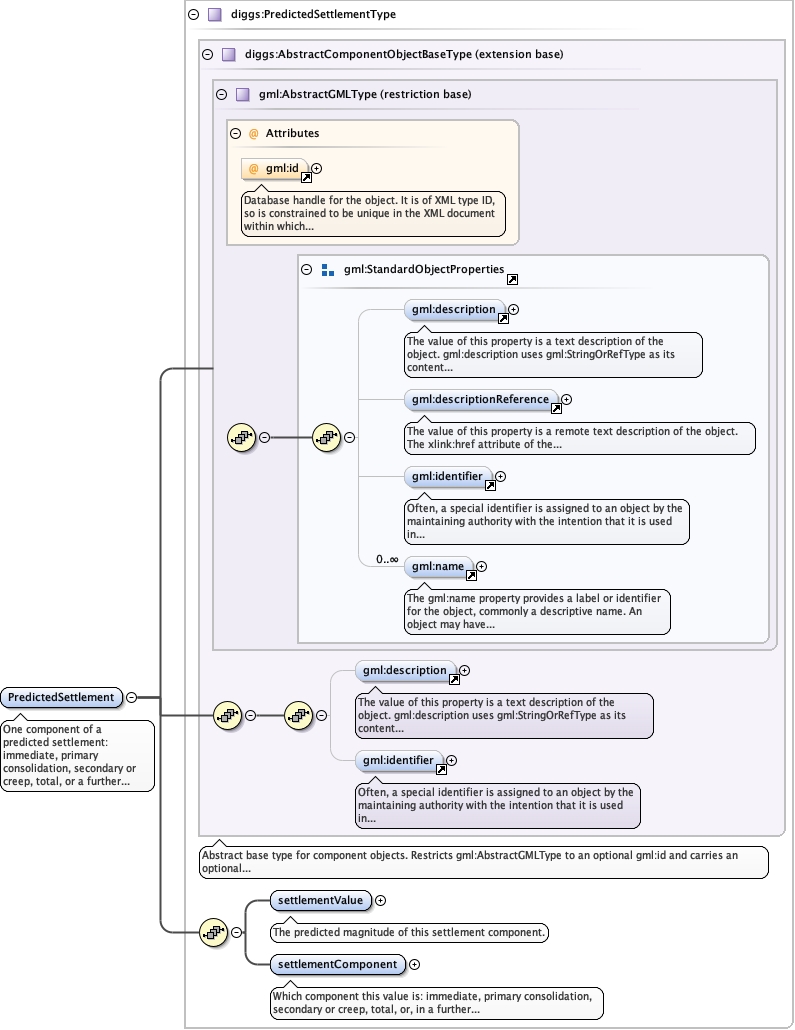
One component of a predicted settlement: immediate, primary consolidation, secondaryor creep, total, or a further breakdown (load transfer platform compression, elasticshortening of the column with downdrag, settlement of the bearing stratum below thetoe), together with which component it is. Generic design-output machinery, notspecific to rigid inclusions: settlement prediction and its component breakdown isstandard ground-improvement and deep-foundation practice. A bare total settlementnumber has nothing for a monitoring result to be checked against component bycomponent, so stating the components makes a measured-versus-predicted comparisonmeaningful. Both fields are required: a settlement value with no stated componentcannot be compared against the right monitoring result, and a component with novalue carries no information.
Database handle for the object. It is of XML type ID, so is constrained to beunique in the XML document within which it occurs. An external identifier for the object inthe form of a URI may be constructed using standard XML and XPointer methods. This is doneby concatenating the URI for the document, a fragment separator, and the value of the idattribute.
Source
<element name="PredictedSettlement" type="diggs:PredictedSettlementType"><annotation><documentation>One component of a predicted settlement: immediate, primary consolidation, secondary or creep, total, or a further breakdown (load transfer platform compression, elastic shortening of the column with downdrag, settlement of the bearing stratum below the toe), together with which component it is. Generic design-output machinery, not specific to rigid inclusions: settlement prediction and its component breakdown is standard ground-improvement and deep-foundation practice. A bare total settlement number has nothing for a monitoring result to be checked against component by component, so stating the components makes a measured-versus-predicted comparison meaningful. Both fields are required: a settlement value with no stated component cannot be compared against the right monitoring result, and a component with no value carries no information.</documentation></annotation></element>