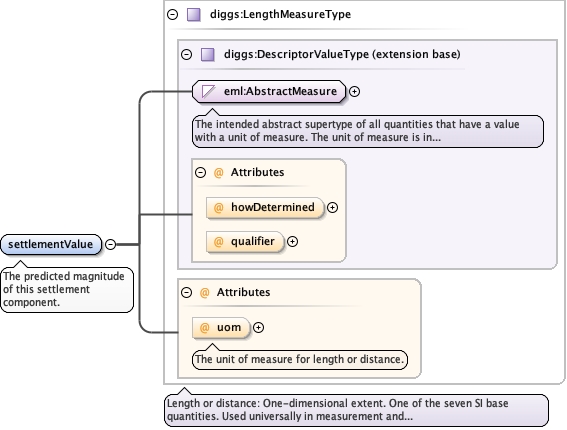
<element name="settlementValue" type="diggs:LengthMeasureType"><annotation><documentation>The predicted magnitude of this settlement component.</documentation></annotation></element>
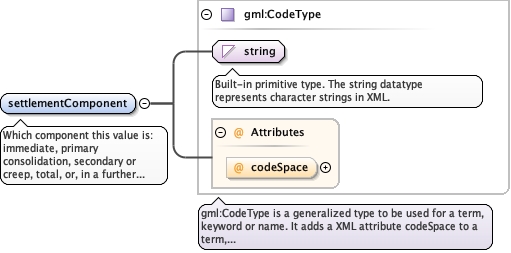
Which component this value is: immediate, primary consolidation,secondary or creep, total, or, in a further decomposition, loadtransfer platform compression, rigid inclusion elastic shortening orbearing-stratum settlement. Use the DIGGS dictionarysettlementComponent.xml for the list of values.
<element name="settlementComponent" type="gml:CodeType"><annotation><documentation>Which component this value is: immediate, primary consolidation, secondary or creep, total, or, in a further decomposition, load transfer platform compression, rigid inclusion elastic shortening or bearing-stratum settlement. Use the DIGGS dictionary settlementComponent.xml for the list of values.</documentation></annotation></element>
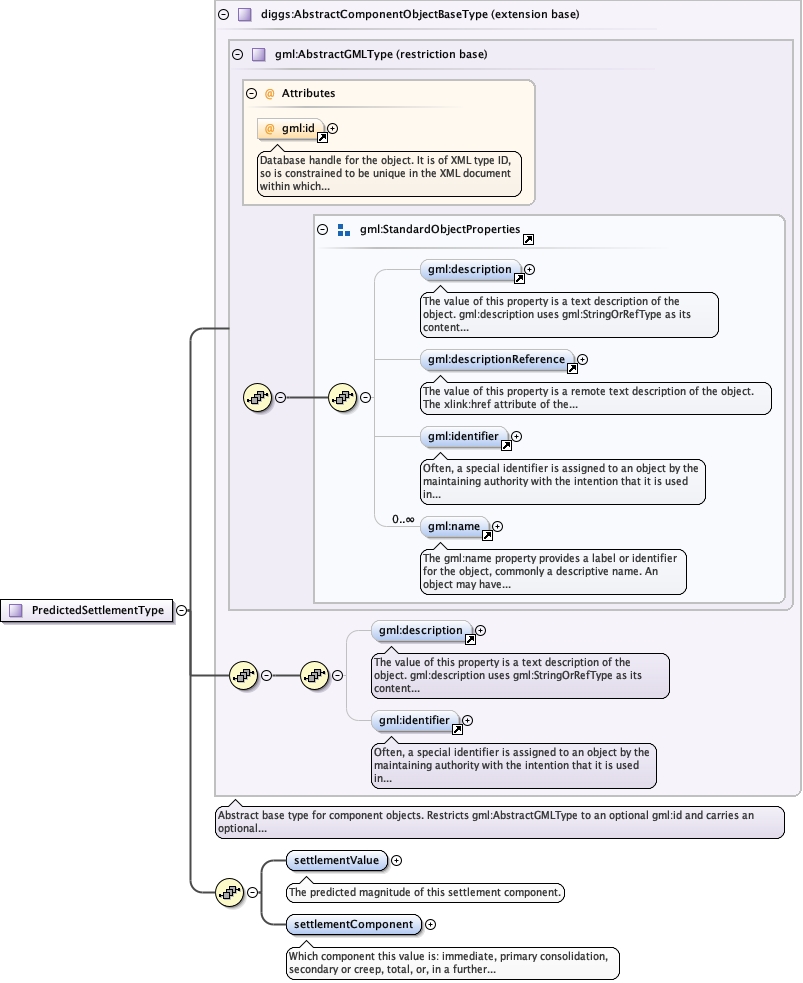
Database handle for the object. It is of XML type ID, so is constrained to beunique in the XML document within which it occurs. An external identifier for the object inthe form of a URI may be constructed using standard XML and XPointer methods. This is doneby concatenating the URI for the document, a fragment separator, and the value of the idattribute.
Source
<complexType name="PredictedSettlementType"><complexContent><extension base="diggs:AbstractComponentObjectBaseType"><sequence><element name="settlementValue" type="diggs:LengthMeasureType"><annotation><documentation>The predicted magnitude of this settlement component.</documentation></annotation></element><element name="settlementComponent" type="gml:CodeType"><annotation><documentation>Which component this value is: immediate, primary consolidation, secondary or creep, total, or, in a further decomposition, load transfer platform compression, rigid inclusion elastic shortening or bearing-stratum settlement. Use the DIGGS dictionary settlementComponent.xml for the list of values.</documentation></annotation></element></sequence></extension></complexContent></complexType>