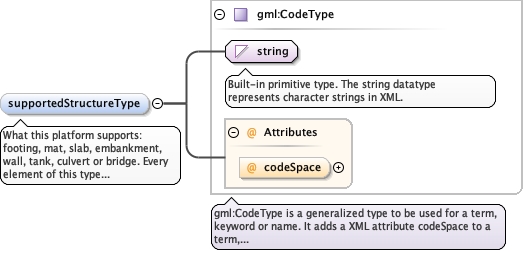
What this platform supports: footing, mat, slab, embankment, wall,tank, culvert or bridge. Every element of this type that isconditional on structure type (sideSlopeRatio, sideSlopeAngle,embankmentHeight) resolves against this element, because adictionary Occurrence condition sees only local containment, as witharchingModel on diggs:ArchingCoefficientType. It is optional: aplatform over ground given only general treatment, with no singleidentifiable loaded structure above it, is real and should not beforced to name one. Give at most one value. Where one platformunderlies more than one structure type (a raft and a tunnel sharinga platform, say), state the structure type that governs the designof the platform, the one with the greatest load demand if that isthe actual basis of the design decision, not an arbitrary orfirst-listed one. Use the DIGGS dictionarysupportedStructureType.xml for the list of values.
<element minOccurs="0" name="supportedStructureType" type="gml:CodeType"><annotation><documentation>What this platform supports: footing, mat, slab, embankment, wall, tank, culvert or bridge. Every element of this type that is conditional on structure type (sideSlopeRatio, sideSlopeAngle, embankmentHeight) resolves against this element, because a dictionary Occurrence condition sees only local containment, as with archingModel on diggs:ArchingCoefficientType. It is optional: a platform over ground given only general treatment, with no single identifiable loaded structure above it, is real and should not be forced to name one. Give at most one value. Where one platform underlies more than one structure type (a raft and a tunnel sharing a platform, say), state the structure type that governs the design of the platform, the one with the greatest load demand if that is the actual basis of the design decision, not an arbitrary or first-listed one. Use the DIGGS dictionary supportedStructureType.xml for the list of values.</documentation></annotation></element>
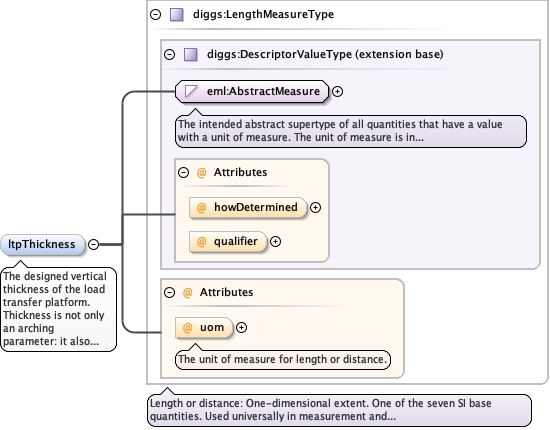
The designed vertical thickness of the load transfer platform.Thickness is not only an arching parameter: it also controls lateralload transfer and column bending (test data show the lateralcapacity of a stiff-column-supported footing increasing roughlylinearly with platform thickness over the range used in practice),so it is an input to the column shear and bending checks as much asto the stress distribution below. Comparediggs:LoadTransferPlatformType/impliedLTPThickness on the as-builtside, which is inferred from the platform top and working platformelevations rather than stated.
<element minOccurs="0" name="ltpThickness" type="diggs:LengthMeasureType"><annotation><documentation>The designed vertical thickness of the load transfer platform. Thickness is not only an arching parameter: it also controls lateral load transfer and column bending (test data show the lateral capacity of a stiff-column-supported footing increasing roughly linearly with platform thickness over the range used in practice), so it is an input to the column shear and bending checks as much as to the stress distribution below. Compare diggs:LoadTransferPlatformType/impliedLTPThickness on the as-built side, which is inferred from the platform top and working platform elevations rather than stated.</documentation></annotation></element>
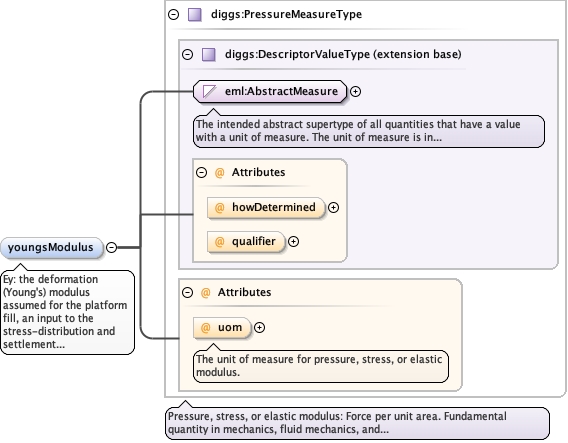
Ey: the deformation (Young's) modulus assumed for the platform fill,an input to the stress-distribution and settlement calculation, notan arching coefficient. It is one of five platform-materialparameters with named elements, with unitWeight, cohesion,frictionAngle and poissonsRatio: the set that design methodliterature (ASIRI, BS 8006-1, EBGEO, FHWA GEC-13) converges on for aplatform-fill statement (unit weight, friction angle, deformationmodulus and Poisson's ratio, with cohesion as the Mohr-Coulombcompanion). They are named elements so that the design object doesnot depend on a ground model that includes the platform.otherProperty remains the route for any platform-material quantitybeyond these five, such as a gradation curve, a compactionrequirement or a dilation angle.
The unit of measure for pressure, stress, or elastic modulus.
Source
<element minOccurs="0" name="youngsModulus" type="diggs:PressureMeasureType"><annotation><documentation>Ey: the deformation (Young's) modulus assumed for the platform fill, an input to the stress-distribution and settlement calculation, not an arching coefficient. It is one of five platform-material parameters with named elements, with unitWeight, cohesion, frictionAngle and poissonsRatio: the set that design method literature (ASIRI, BS 8006-1, EBGEO, FHWA GEC-13) converges on for a platform-fill statement (unit weight, friction angle, deformation modulus and Poisson's ratio, with cohesion as the Mohr-Coulomb companion). They are named elements so that the design object does not depend on a ground model that includes the platform. otherProperty remains the route for any platform-material quantity beyond these five, such as a gradation curve, a compaction requirement or a dilation angle.</documentation></annotation></element>
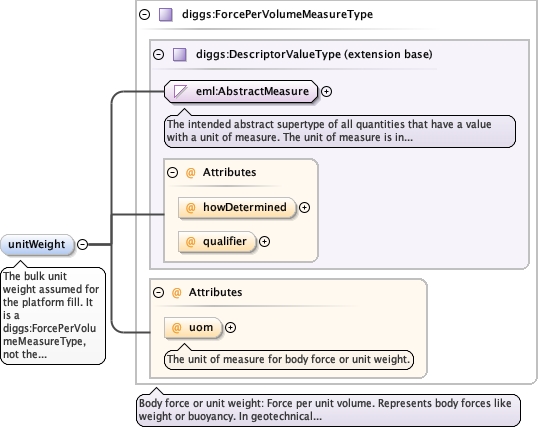
The bulk unit weight assumed for the platform fill. It is adiggs:ForcePerVolumeMeasureType, not the mass-or-force-ambiguousdiggs:DensityOrUnitWeightMeasureType: a design value for an archingor stress calculation is unambiguously a force-based unit weight.See youngsModulus for why this and its siblings are named elements.
The unit of measure for body force or unit weight.
Source
<element minOccurs="0" name="unitWeight" type="diggs:ForcePerVolumeMeasureType"><annotation><documentation>The bulk unit weight assumed for the platform fill. It is a diggs:ForcePerVolumeMeasureType, not the mass-or-force-ambiguous diggs:DensityOrUnitWeightMeasureType: a design value for an arching or stress calculation is unambiguously a force-based unit weight. See youngsModulus for why this and its siblings are named elements.</documentation></annotation></element>
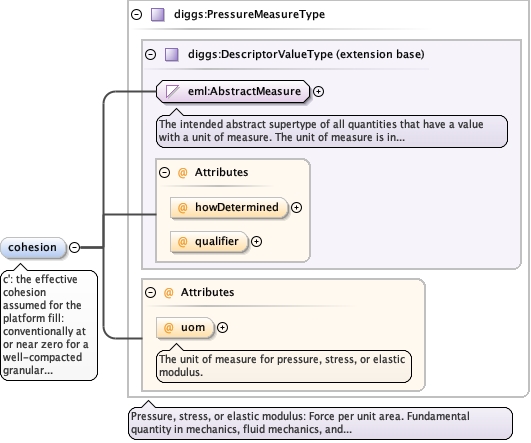
c': the effective cohesion assumed for the platform fill:conventionally at or near zero for a well-compacted granularmaterial, but stated explicitly rather than omitted as obviouslynil. See youngsModulus for why this and its siblings are namedelements.
The unit of measure for pressure, stress, or elastic modulus.
Source
<element minOccurs="0" name="cohesion" type="diggs:PressureMeasureType"><annotation><documentation>c': the effective cohesion assumed for the platform fill: conventionally at or near zero for a well-compacted granular material, but stated explicitly rather than omitted as obviously nil. See youngsModulus for why this and its siblings are named elements.</documentation></annotation></element>
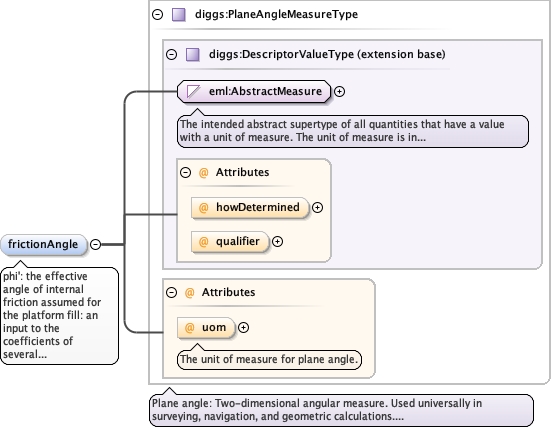
phi': the effective angle of internal friction assumed for theplatform fill: an input to the coefficients of several archingmodels (Marston, Hewlett-Randolph, adapted-Terzaghi, Prandtl) and tothe stress-distribution calculation directly, distinct from anymodel-specific coefficient computed from it. See youngsModulus forwhy this and its siblings are named elements.
<element minOccurs="0" name="frictionAngle" type="diggs:PlaneAngleMeasureType"><annotation><documentation>phi': the effective angle of internal friction assumed for the platform fill: an input to the coefficients of several arching models (Marston, Hewlett-Randolph, adapted-Terzaghi, Prandtl) and to the stress-distribution calculation directly, distinct from any model-specific coefficient computed from it. See youngsModulus for why this and its siblings are named elements.</documentation></annotation></element>
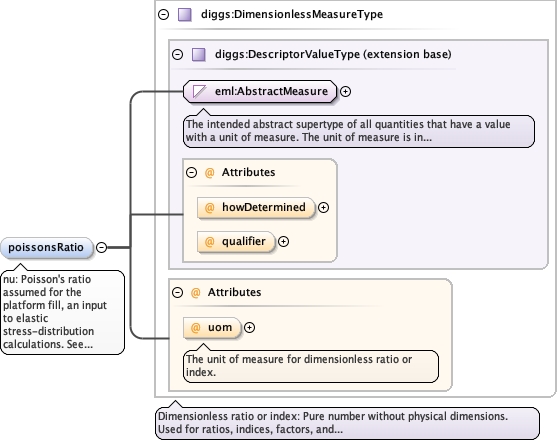
nu: Poisson's ratio assumed for the platform fill, an input toelastic stress-distribution calculations. See youngsModulus for whythis and its siblings are named elements.
The unit of measure for dimensionless ratio or index.
Source
<element minOccurs="0" name="poissonsRatio" type="diggs:DimensionlessMeasureType"><annotation><documentation>nu: Poisson's ratio assumed for the platform fill, an input to elastic stress-distribution calculations. See youngsModulus for why this and its siblings are named elements.</documentation></annotation></element>
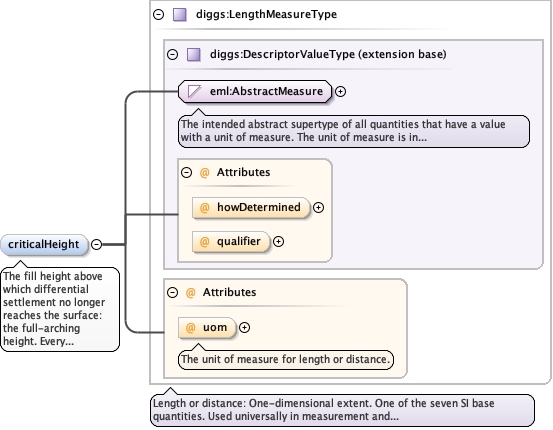
The fill height above which differential settlement no longerreaches the surface: the full-arching height. Every arching practicehas this quantity, so it is a typed element, but its value dependson the arching model used and is not interpretable without it. Statethe model in archingModel of a diggs:ArchingCoefficient on this samedesign, present whether or not that object carries any coefficients,and read the two together; that element is also the one everycoefficient's dictionary Occurrence condition keys on, so it islocally resolvable in a way a basisRef target is not. The model mayalso be stated on a diggs:RIProgramBasis cited through basisRef, asthe program-level record; the two should agree. The element is onthe platform design rather than the column design, although thesource analysis groups it with layout, because it is an output ofthe arching calculation and arching is what the platform is designedto do.
<element minOccurs="0" name="criticalHeight" type="diggs:LengthMeasureType"><annotation><documentation>The fill height above which differential settlement no longer reaches the surface: the full-arching height. Every arching practice has this quantity, so it is a typed element, but its value depends on the arching model used and is not interpretable without it. State the model in archingModel of a diggs:ArchingCoefficient on this same design, present whether or not that object carries any coefficients, and read the two together; that element is also the one every coefficient's dictionary Occurrence condition keys on, so it is locally resolvable in a way a basisRef target is not. The model may also be stated on a diggs:RIProgramBasis cited through basisRef, as the program-level record; the two should agree. The element is on the platform design rather than the column design, although the source analysis groups it with layout, because it is an output of the arching calculation and arching is what the platform is designed to do.</documentation></annotation></element>
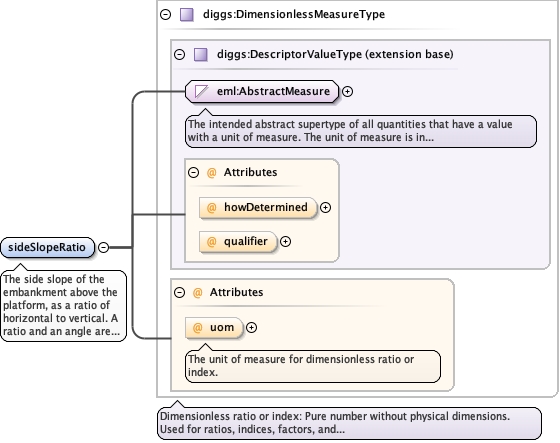
The side slope of the embankment above the platform, as a ratioof horizontal to vertical. A ratio and an angle are differentquantity classes, not two units of one quantity, so they are twoelements in a choice rather than one element with a permissiveuom: state whichever form the design was expressed in, and thechoice makes stating both impossible. It applies only wheresupportedStructureType names an embankment.
The unit of measure for dimensionless ratio or index.
Source
<element name="sideSlopeRatio" type="diggs:DimensionlessMeasureType"><annotation><documentation>The side slope of the embankment above the platform, as a ratio of horizontal to vertical. A ratio and an angle are different quantity classes, not two units of one quantity, so they are two elements in a choice rather than one element with a permissive uom: state whichever form the design was expressed in, and the choice makes stating both impossible. It applies only where supportedStructureType names an embankment.</documentation></annotation></element>
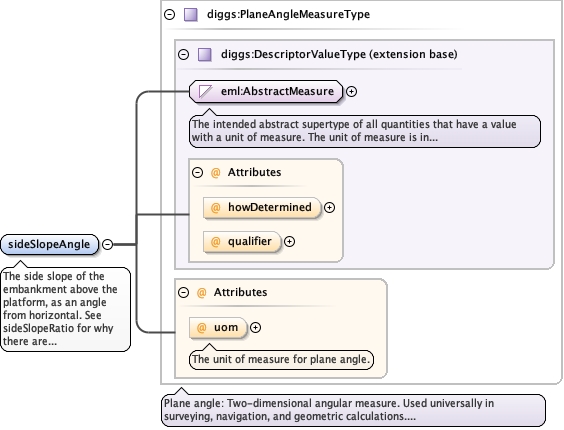
<element name="sideSlopeAngle" type="diggs:PlaneAngleMeasureType"><annotation><documentation>The side slope of the embankment above the platform, as an angle from horizontal. See sideSlopeRatio for why there are two elements.</documentation></annotation></element>
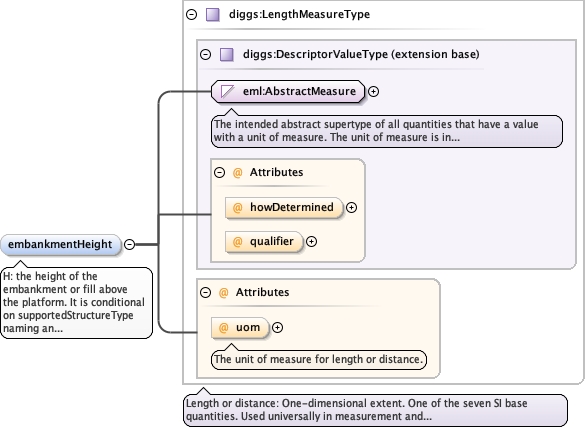
H: the height of the embankment or fill above the platform. It isconditional on supportedStructureType naming an embankment, likesideSlopeRatio and sideSlopeAngle, which it pairs with.
<element minOccurs="0" name="embankmentHeight" type="diggs:LengthMeasureType"><annotation><documentation>H: the height of the embankment or fill above the platform. It is conditional on supportedStructureType naming an embankment, like sideSlopeRatio and sideSlopeAngle, which it pairs with.</documentation></annotation></element>
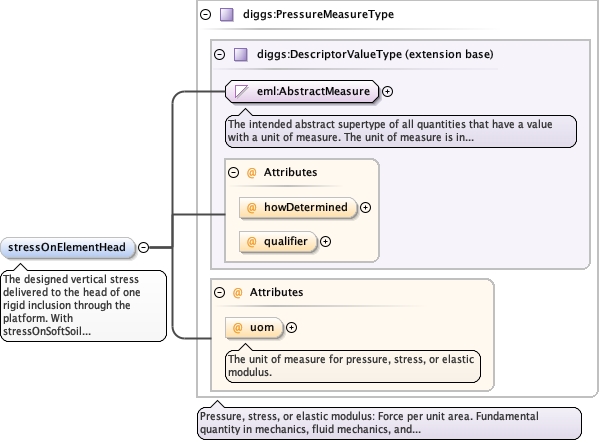
The designed vertical stress delivered to the head of one rigidinclusion through the platform. With stressOnSoftSoil it is the pairthat makes designs comparable across practices, which is why theseare typed elements while the arching coefficients that produce themare dictionary entries: every arching model, whatever its internals,outputs how much stress lands on the head and how much on the soilbetween, so two designs can be compared on those two quantities.
The unit of measure for pressure, stress, or elastic modulus.
Source
<element minOccurs="0" name="stressOnElementHead" type="diggs:PressureMeasureType"><annotation><documentation>The designed vertical stress delivered to the head of one rigid inclusion through the platform. With stressOnSoftSoil it is the pair that makes designs comparable across practices, which is why these are typed elements while the arching coefficients that produce them are dictionary entries: every arching model, whatever its internals, outputs how much stress lands on the head and how much on the soil between, so two designs can be compared on those two quantities.</documentation></annotation></element>
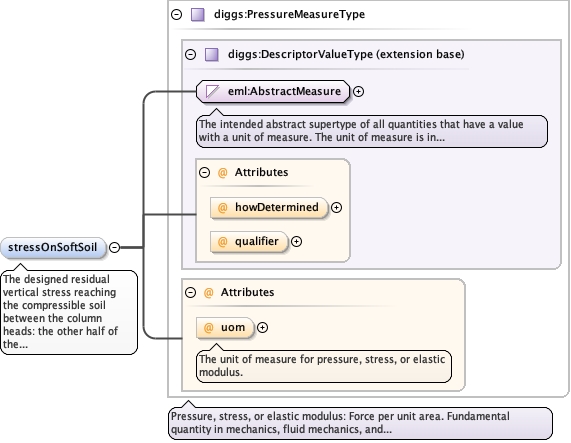
The designed residual vertical stress reaching the compressible soilbetween the column heads: the other half of the arching outcome. SeestressOnElementHead.
The unit of measure for pressure, stress, or elastic modulus.
Source
<element minOccurs="0" name="stressOnSoftSoil" type="diggs:PressureMeasureType"><annotation><documentation>The designed residual vertical stress reaching the compressible soil between the column heads: the other half of the arching outcome. See stressOnElementHead.</documentation></annotation></element>
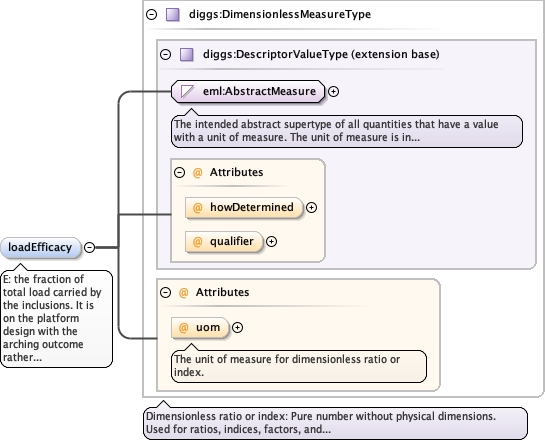
E: the fraction of total load carried by the inclusions. It is onthe platform design with the arching outcome rather than ondiggs:DesignRITreatedAreaType, because load efficacy is defined atleast three ways in the literature (load on column over total load,stress on column over average stress, the complement of thesoil-borne fraction) and each is computed from thestressOnElementHead and stressOnSoftSoil pair, not from asystem-wide quantity. Contrast settlementEfficacy ondiggs:DesignRITreatedAreaType, a site-wide serviceability metric.
The unit of measure for dimensionless ratio or index.
Source
<element minOccurs="0" name="loadEfficacy" type="diggs:DimensionlessMeasureType"><annotation><documentation>E: the fraction of total load carried by the inclusions. It is on the platform design with the arching outcome rather than on diggs:DesignRITreatedAreaType, because load efficacy is defined at least three ways in the literature (load on column over total load, stress on column over average stress, the complement of the soil-borne fraction) and each is computed from the stressOnElementHead and stressOnSoftSoil pair, not from a system-wide quantity. Contrast settlementEfficacy on diggs:DesignRITreatedAreaType, a site-wide serviceability metric.</documentation></annotation></element>
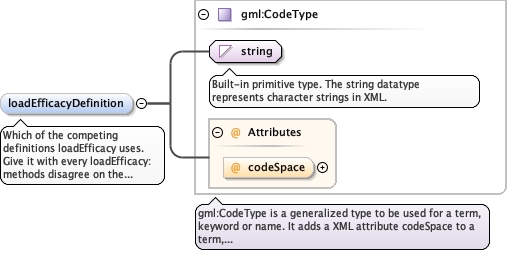
Which of the competing definitions loadEfficacy uses. Give it withevery loadEfficacy: methods disagree on the definition, so a valuereported without it is not comparable across designs. Use the DIGGSdictionary loadEfficacyDefinition.xml for the list of values.
<element minOccurs="0" name="loadEfficacyDefinition" type="gml:CodeType"><annotation><documentation>Which of the competing definitions loadEfficacy uses. Give it with every loadEfficacy: methods disagree on the definition, so a value reported without it is not comparable across designs. Use the DIGGS dictionary loadEfficacyDefinition.xml for the list of values.</documentation></annotation></element>
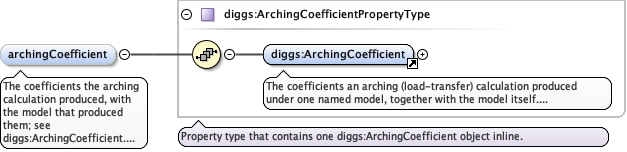
The coefficients the arching calculation produced, with the modelthat produced them; see diggs:ArchingCoefficient. Repeat for theuncommon case of a design comparing coefficients under more than onemodel. Wherever criticalHeight or either stress element is reported,state at least one archingModel, with no coefficient array if needbe, so that those values remain interpretable.
<element minOccurs="0" maxOccurs="unbounded" name="archingCoefficient" type="diggs:ArchingCoefficientPropertyType"><annotation><documentation>The coefficients the arching calculation produced, with the model that produced them; see diggs:ArchingCoefficient. Repeat for the uncommon case of a design comparing coefficients under more than one model. Wherever criticalHeight or either stress element is reported, state at least one archingModel, with no coefficient array if need be, so that those values remain interpretable.</documentation></annotation></element>
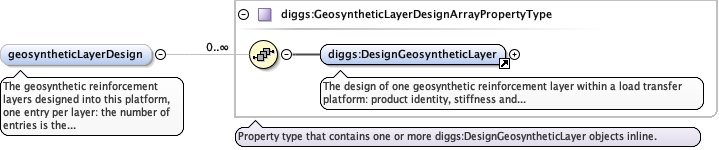
The geosynthetic reinforcement layers designed into this platform,one entry per layer: the number of entries is the layer count, andtheir presence says a geosynthetic is present; seediggs:DesignGeosyntheticLayer. Comparediggs:LoadTransferPlatformType/geosynthetics, the as-builtcounterpart.
<element maxOccurs="1" minOccurs="0" name="geosyntheticLayerDesign" type="diggs:GeosyntheticLayerDesignArrayPropertyType"><annotation><documentation>The geosynthetic reinforcement layers designed into this platform, one entry per layer: the number of entries is the layer count, and their presence says a geosynthetic is present; see diggs:DesignGeosyntheticLayer. Compare diggs:LoadTransferPlatformType/geosynthetics, the as-built counterpart.</documentation></annotation></element>
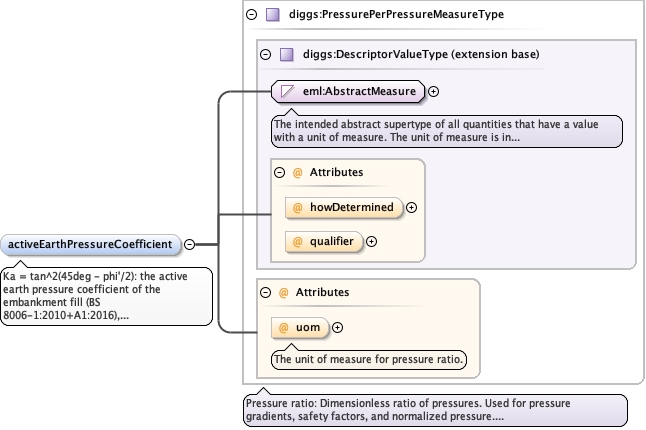
Ka = tan^2(45deg - phi'/2): the active earth pressure coefficient ofthe embankment fill (BS 8006-1:2010+A1:2016), governing lateralthrust and lateral spreading checks. It is a typed element, notdictionary-bound, because it is a single quantity with one formula,in the same category as columnDiameter or spacingX; the dictionaryroute is for an open vocabulary (methodApplicabilityRatio) or aclosed set of per-model values (diggs:ArchingCoefficient). It is inneither of those because it is a property of the fill, used acrosswhichever arching model governs the vertical load transfer, not anoutput specific to one model and not a method-applicabilityjudgment.
<element minOccurs="0" name="activeEarthPressureCoefficient" type="diggs:PressurePerPressureMeasureType"><annotation><documentation>Ka = tan^2(45deg - phi'/2): the active earth pressure coefficient of the embankment fill (BS 8006-1:2010+A1:2016), governing lateral thrust and lateral spreading checks. It is a typed element, not dictionary-bound, because it is a single quantity with one formula, in the same category as columnDiameter or spacingX; the dictionary route is for an open vocabulary (methodApplicabilityRatio) or a closed set of per-model values (diggs:ArchingCoefficient). It is in neither of those because it is a property of the fill, used across whichever arching model governs the vertical load transfer, not an output specific to one model and not a method-applicability judgment.</documentation></annotation></element>
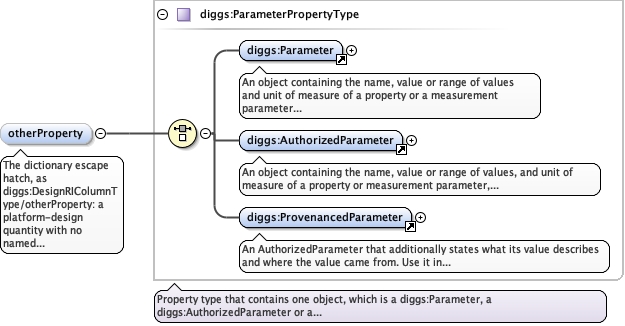
The dictionary escape hatch, asdiggs:DesignRIColumnType/otherProperty: a platform-design quantitywith no named element on this type and no more specificdictionary-bound container, carried as a diggs:AuthorizedParameterbound to a definition in ri_design_properties.xml. Repeat for eachquantity.
<element minOccurs="0" maxOccurs="unbounded" name="otherProperty" type="diggs:ParameterPropertyType"><annotation><documentation>The dictionary escape hatch, as diggs:DesignRIColumnType/otherProperty: a platform-design quantity with no named element on this type and no more specific dictionary-bound container, carried as a diggs:AuthorizedParameter bound to a definition in ri_design_properties.xml. Repeat for each quantity.</documentation></annotation></element>
Database handle for the object. It is of XML type ID, so is constrained to beunique in the XML document within which it occurs. An external identifier for the object inthe form of a URI may be constructed using standard XML and XPointer methods. This is doneby concatenating the URI for the document, a fragment separator, and the value of the idattribute.
Source
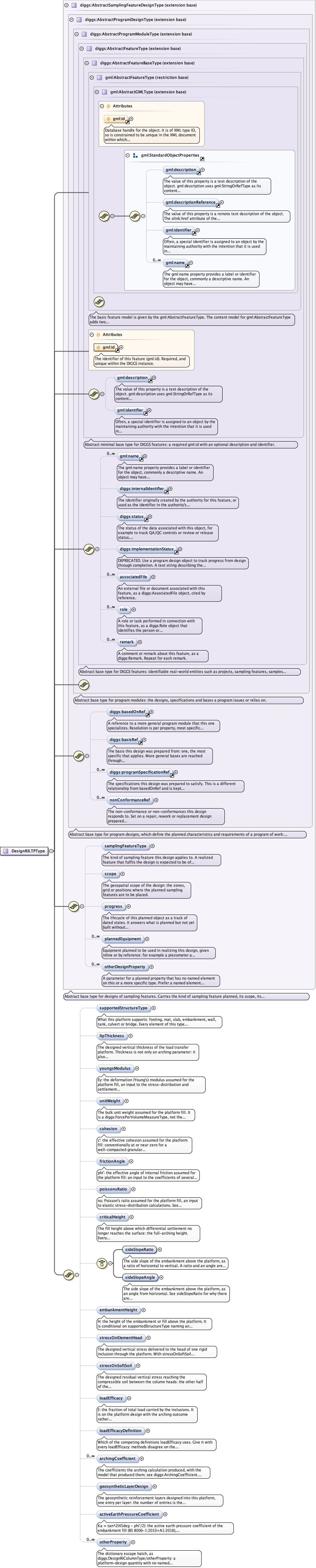
<complexType name="DesignRILTPType"><complexContent><extension base="diggs:AbstractSamplingFeatureDesignType"><sequence><element minOccurs="0" name="supportedStructureType" type="gml:CodeType"><annotation><documentation>What this platform supports: footing, mat, slab, embankment, wall, tank, culvert or bridge. Every element of this type that is conditional on structure type (sideSlopeRatio, sideSlopeAngle, embankmentHeight) resolves against this element, because a dictionary Occurrence condition sees only local containment, as with archingModel on diggs:ArchingCoefficientType. It is optional: a platform over ground given only general treatment, with no single identifiable loaded structure above it, is real and should not be forced to name one. Give at most one value. Where one platform underlies more than one structure type (a raft and a tunnel sharing a platform, say), state the structure type that governs the design of the platform, the one with the greatest load demand if that is the actual basis of the design decision, not an arbitrary or first-listed one. Use the DIGGS dictionary supportedStructureType.xml for the list of values.</documentation></annotation></element><element minOccurs="0" name="ltpThickness" type="diggs:LengthMeasureType"><annotation><documentation>The designed vertical thickness of the load transfer platform. Thickness is not only an arching parameter: it also controls lateral load transfer and column bending (test data show the lateral capacity of a stiff-column-supported footing increasing roughly linearly with platform thickness over the range used in practice), so it is an input to the column shear and bending checks as much as to the stress distribution below. Compare diggs:LoadTransferPlatformType/impliedLTPThickness on the as-built side, which is inferred from the platform top and working platform elevations rather than stated.</documentation></annotation></element><element minOccurs="0" name="youngsModulus" type="diggs:PressureMeasureType"><annotation><documentation>Ey: the deformation (Young's) modulus assumed for the platform fill, an input to the stress-distribution and settlement calculation, not an arching coefficient. It is one of five platform-material parameters with named elements, with unitWeight, cohesion, frictionAngle and poissonsRatio: the set that design method literature (ASIRI, BS 8006-1, EBGEO, FHWA GEC-13) converges on for a platform-fill statement (unit weight, friction angle, deformation modulus and Poisson's ratio, with cohesion as the Mohr-Coulomb companion). They are named elements so that the design object does not depend on a ground model that includes the platform. otherProperty remains the route for any platform-material quantity beyond these five, such as a gradation curve, a compaction requirement or a dilation angle.</documentation></annotation></element><element minOccurs="0" name="unitWeight" type="diggs:ForcePerVolumeMeasureType"><annotation><documentation>The bulk unit weight assumed for the platform fill. It is a diggs:ForcePerVolumeMeasureType, not the mass-or-force-ambiguous diggs:DensityOrUnitWeightMeasureType: a design value for an arching or stress calculation is unambiguously a force-based unit weight. See youngsModulus for why this and its siblings are named elements.</documentation></annotation></element><element minOccurs="0" name="cohesion" type="diggs:PressureMeasureType"><annotation><documentation>c': the effective cohesion assumed for the platform fill: conventionally at or near zero for a well-compacted granular material, but stated explicitly rather than omitted as obviously nil. See youngsModulus for why this and its siblings are named elements.</documentation></annotation></element><element minOccurs="0" name="frictionAngle" type="diggs:PlaneAngleMeasureType"><annotation><documentation>phi': the effective angle of internal friction assumed for the platform fill: an input to the coefficients of several arching models (Marston, Hewlett-Randolph, adapted-Terzaghi, Prandtl) and to the stress-distribution calculation directly, distinct from any model-specific coefficient computed from it. See youngsModulus for why this and its siblings are named elements.</documentation></annotation></element><element minOccurs="0" name="poissonsRatio" type="diggs:DimensionlessMeasureType"><annotation><documentation>nu: Poisson's ratio assumed for the platform fill, an input to elastic stress-distribution calculations. See youngsModulus for why this and its siblings are named elements.</documentation></annotation></element><element minOccurs="0" name="criticalHeight" type="diggs:LengthMeasureType"><annotation><documentation>The fill height above which differential settlement no longer reaches the surface: the full-arching height. Every arching practice has this quantity, so it is a typed element, but its value depends on the arching model used and is not interpretable without it. State the model in archingModel of a diggs:ArchingCoefficient on this same design, present whether or not that object carries any coefficients, and read the two together; that element is also the one every coefficient's dictionary Occurrence condition keys on, so it is locally resolvable in a way a basisRef target is not. The model may also be stated on a diggs:RIProgramBasis cited through basisRef, as the program-level record; the two should agree. The element is on the platform design rather than the column design, although the source analysis groups it with layout, because it is an output of the arching calculation and arching is what the platform is designed to do.</documentation></annotation></element><choice minOccurs="0"><element name="sideSlopeRatio" type="diggs:DimensionlessMeasureType"><annotation><documentation>The side slope of the embankment above the platform, as a ratio of horizontal to vertical. A ratio and an angle are different quantity classes, not two units of one quantity, so they are two elements in a choice rather than one element with a permissive uom: state whichever form the design was expressed in, and the choice makes stating both impossible. It applies only where supportedStructureType names an embankment.</documentation></annotation></element><element name="sideSlopeAngle" type="diggs:PlaneAngleMeasureType"><annotation><documentation>The side slope of the embankment above the platform, as an angle from horizontal. See sideSlopeRatio for why there are two elements.</documentation></annotation></element></choice><element minOccurs="0" name="embankmentHeight" type="diggs:LengthMeasureType"><annotation><documentation>H: the height of the embankment or fill above the platform. It is conditional on supportedStructureType naming an embankment, like sideSlopeRatio and sideSlopeAngle, which it pairs with.</documentation></annotation></element><element minOccurs="0" name="stressOnElementHead" type="diggs:PressureMeasureType"><annotation><documentation>The designed vertical stress delivered to the head of one rigid inclusion through the platform. With stressOnSoftSoil it is the pair that makes designs comparable across practices, which is why these are typed elements while the arching coefficients that produce them are dictionary entries: every arching model, whatever its internals, outputs how much stress lands on the head and how much on the soil between, so two designs can be compared on those two quantities.</documentation></annotation></element><element minOccurs="0" name="stressOnSoftSoil" type="diggs:PressureMeasureType"><annotation><documentation>The designed residual vertical stress reaching the compressible soil between the column heads: the other half of the arching outcome. See stressOnElementHead.</documentation></annotation></element><element minOccurs="0" name="loadEfficacy" type="diggs:DimensionlessMeasureType"><annotation><documentation>E: the fraction of total load carried by the inclusions. It is on the platform design with the arching outcome rather than on diggs:DesignRITreatedAreaType, because load efficacy is defined at least three ways in the literature (load on column over total load, stress on column over average stress, the complement of the soil-borne fraction) and each is computed from the stressOnElementHead and stressOnSoftSoil pair, not from a system-wide quantity. Contrast settlementEfficacy on diggs:DesignRITreatedAreaType, a site-wide serviceability metric.</documentation></annotation></element><element minOccurs="0" name="loadEfficacyDefinition" type="gml:CodeType"><annotation><documentation>Which of the competing definitions loadEfficacy uses. Give it with every loadEfficacy: methods disagree on the definition, so a value reported without it is not comparable across designs. Use the DIGGS dictionary loadEfficacyDefinition.xml for the list of values.</documentation></annotation></element><element minOccurs="0" maxOccurs="unbounded" name="archingCoefficient" type="diggs:ArchingCoefficientPropertyType"><annotation><documentation>The coefficients the arching calculation produced, with the model that produced them; see diggs:ArchingCoefficient. Repeat for the uncommon case of a design comparing coefficients under more than one model. Wherever criticalHeight or either stress element is reported, state at least one archingModel, with no coefficient array if need be, so that those values remain interpretable.</documentation></annotation></element><element maxOccurs="1" minOccurs="0" name="geosyntheticLayerDesign" type="diggs:GeosyntheticLayerDesignArrayPropertyType"><annotation><documentation>The geosynthetic reinforcement layers designed into this platform, one entry per layer: the number of entries is the layer count, and their presence says a geosynthetic is present; see diggs:DesignGeosyntheticLayer. Compare diggs:LoadTransferPlatformType/geosynthetics, the as-built counterpart.</documentation></annotation></element><element minOccurs="0" name="activeEarthPressureCoefficient" type="diggs:PressurePerPressureMeasureType"><annotation><documentation>Ka = tan^2(45deg - phi'/2): the active earth pressure coefficient of the embankment fill (BS 8006-1:2010+A1:2016), governing lateral thrust and lateral spreading checks. It is a typed element, not dictionary-bound, because it is a single quantity with one formula, in the same category as columnDiameter or spacingX; the dictionary route is for an open vocabulary (methodApplicabilityRatio) or a closed set of per-model values (diggs:ArchingCoefficient). It is in neither of those because it is a property of the fill, used across whichever arching model governs the vertical load transfer, not an output specific to one model and not a method-applicability judgment.</documentation></annotation></element><element minOccurs="0" maxOccurs="unbounded" name="otherProperty" type="diggs:ParameterPropertyType"><annotation><documentation>The dictionary escape hatch, as diggs:DesignRIColumnType/otherProperty: a platform-design quantity with no named element on this type and no more specific dictionary-bound container, carried as a diggs:AuthorizedParameter bound to a definition in ri_design_properties.xml. Repeat for each quantity.</documentation></annotation></element></sequence></extension></complexContent></complexType>