Showing:

Annotations
Attributes
Diagrams
Instances
Model
Properties
Source
Used by
Element diggs:DesignGeosyntheticLayer
Namespace http://diggsml.org/schemas/3
Annotations
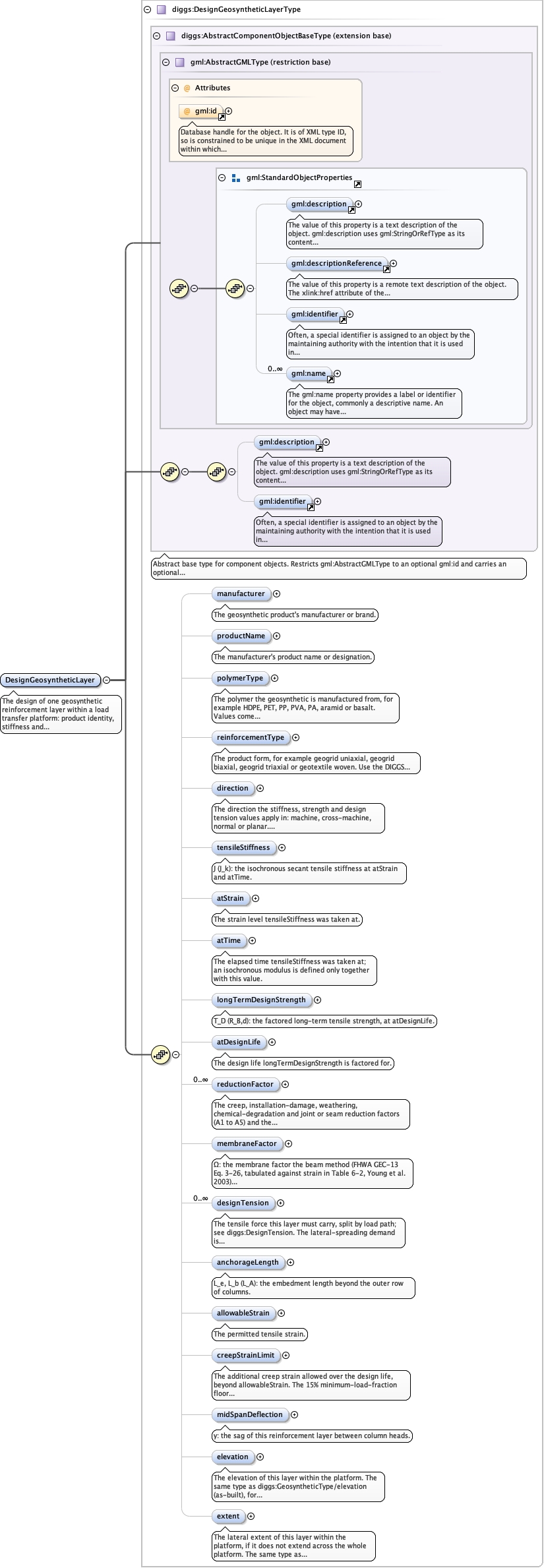
The design of one geosynthetic reinforcement layer within a load transfer platform:
product identity, stiffness and strength (each meaningless without the strain level
and elapsed time they were taken at), the reduction factors applied to reach a
long-term design value, the tension the layer must carry by load path, anchorage,
allowable strain, and where the layer sits within the platform. Generic design
machinery, not specific to rigid inclusions: geosynthetic-reinforced load transfer
platforms are standard practice for column-supported embankments generally,
including stone columns and driven piles. The as-built counterpart,
diggs:GeosyntheticType, is declared in the rigid inclusion schema, so design and
as-built for this concept are in different files. Tensile stiffness (J) is an
isochronous secant modulus, defined only once a strain level and elapsed time are
stated, and long-term design strength depends on design life and the
reduction-factor chain in the same way; both are also direction-dependent, since
machine and cross-machine directions differ substantially in most geogrids. Hence
atStrain, atTime and atDesignLife accompany the stiffness and strength, and
direction is its own field. Repeat this object once per layer: its presence states
that basal reinforcement is used and the number of repeats is the layer count, so
neither is stated as a separate value.
Diagram
Diagramgml3_2Profile_diggs_xsd_Attribute_gml_id.tmp#idgml3_2Profile_diggs_xsd_Element_gml_description.tmp#descriptiongml3_2Profile_diggs_xsd_Element_gml_descriptionReference.tmp#descriptionReferencegml3_2Profile_diggs_xsd_Element_gml_identifier.tmp#identifiergml3_2Profile_diggs_xsd_Element_gml_name.tmp#namegml3_2Profile_diggs_xsd_Element_Group_gml_StandardObjectProperties.tmp#StandardObjectPropertiesgml3_2Profile_diggs_xsd_Complex_Type_gml_AbstractGMLType.tmp#AbstractGMLTypegml3_2Profile_diggs_xsd_Element_gml_description.tmp#descriptiongml3_2Profile_diggs_xsd_Element_gml_identifier.tmp#identifierAbstractTypes_xsd_Complex_Type_diggs_AbstractComponentObjectBaseType.tmp#AbstractComponentObjectBaseTypeCommon_xsd_Complex_Type_diggs_DesignGeosyntheticLayerType.tmp#DesignGeosyntheticLayerType_manufacturerCommon_xsd_Complex_Type_diggs_DesignGeosyntheticLayerType.tmp#DesignGeosyntheticLayerType_productNameCommon_xsd_Complex_Type_diggs_DesignGeosyntheticLayerType.tmp#DesignGeosyntheticLayerType_polymerTypeCommon_xsd_Complex_Type_diggs_DesignGeosyntheticLayerType.tmp#DesignGeosyntheticLayerType_reinforcementTypeCommon_xsd_Complex_Type_diggs_DesignGeosyntheticLayerType.tmp#DesignGeosyntheticLayerType_directionCommon_xsd_Complex_Type_diggs_DesignGeosyntheticLayerType.tmp#DesignGeosyntheticLayerType_tensileStiffnessCommon_xsd_Complex_Type_diggs_DesignGeosyntheticLayerType.tmp#DesignGeosyntheticLayerType_atStrainCommon_xsd_Complex_Type_diggs_DesignGeosyntheticLayerType.tmp#DesignGeosyntheticLayerType_atTimeCommon_xsd_Complex_Type_diggs_DesignGeosyntheticLayerType.tmp#DesignGeosyntheticLayerType_longTermDesignStrengthCommon_xsd_Complex_Type_diggs_DesignGeosyntheticLayerType.tmp#DesignGeosyntheticLayerType_atDesignLifeCommon_xsd_Complex_Type_diggs_DesignGeosyntheticLayerType.tmp#DesignGeosyntheticLayerType_reductionFactorCommon_xsd_Complex_Type_diggs_DesignGeosyntheticLayerType.tmp#DesignGeosyntheticLayerType_membraneFactorCommon_xsd_Complex_Type_diggs_DesignGeosyntheticLayerType.tmp#DesignGeosyntheticLayerType_designTensionCommon_xsd_Complex_Type_diggs_DesignGeosyntheticLayerType.tmp#DesignGeosyntheticLayerType_anchorageLengthCommon_xsd_Complex_Type_diggs_DesignGeosyntheticLayerType.tmp#DesignGeosyntheticLayerType_allowableStrainCommon_xsd_Complex_Type_diggs_DesignGeosyntheticLayerType.tmp#DesignGeosyntheticLayerType_creepStrainLimitCommon_xsd_Complex_Type_diggs_DesignGeosyntheticLayerType.tmp#DesignGeosyntheticLayerType_midSpanDeflectionCommon_xsd_Complex_Type_diggs_DesignGeosyntheticLayerType.tmp#DesignGeosyntheticLayerType_elevationCommon_xsd_Complex_Type_diggs_DesignGeosyntheticLayerType.tmp#DesignGeosyntheticLayerType_extentCommon_xsd_Complex_Type_diggs_DesignGeosyntheticLayerType.tmp#DesignGeosyntheticLayerType
Type diggs:DesignGeosyntheticLayerType
Type hierarchy
Properties
content complex
Used by
Model
Children diggs:allowableStrain, diggs:anchorageLength, diggs:atDesignLife, diggs:atStrain, diggs:atTime, diggs:creepStrainLimit, diggs:designTension, diggs:direction, diggs:elevation, diggs:extent, diggs:longTermDesignStrength, diggs:manufacturer, diggs:membraneFactor, diggs:midSpanDeflection, diggs:polymerType, diggs:productName, diggs:reductionFactor, diggs:reinforcementType, diggs:tensileStiffness, gml:description, gml:identifier
Instance
<diggs:DesignGeosyntheticLayer gml:id="" xmlns:diggs="http://diggsml.org/schemas/3" xmlns:gml="http://www.opengis.net/gml/3.2">
  <gml:description xlink:href="" nilReason="">{0,1}</gml:description>
  <gml:identifier codeSpace="">{0,1}</gml:identifier>
  <diggs:manufacturer>{0,1}</diggs:manufacturer>
  <diggs:productName>{0,1}</diggs:productName>
  <diggs:polymerType>{0,1}</diggs:polymerType>
  <diggs:reinforcementType codeSpace="">{0,1}</diggs:reinforcementType>
  <diggs:direction>{0,1}</diggs:direction>
  <diggs:tensileStiffness howDetermined="" qualifier="" uom="">{0,1}</diggs:tensileStiffness>
  <diggs:atStrain howDetermined="" qualifier="" uom="">{0,1}</diggs:atStrain>
  <diggs:atTime howDetermined="" qualifier="" uom="">{0,1}</diggs:atTime>
  <diggs:longTermDesignStrength howDetermined="" qualifier="" uom="">{0,1}</diggs:longTermDesignStrength>
  <diggs:atDesignLife howDetermined="" qualifier="" uom="">{0,1}</diggs:atDesignLife>
  <diggs:reductionFactor>{0,unbounded}</diggs:reductionFactor>
  <diggs:membraneFactor howDetermined="" qualifier="" uom="">{0,1}</diggs:membraneFactor>
  <diggs:designTension>{0,unbounded}</diggs:designTension>
  <diggs:anchorageLength howDetermined="" qualifier="" uom="">{0,1}</diggs:anchorageLength>
  <diggs:allowableStrain howDetermined="" qualifier="" uom="">{0,1}</diggs:allowableStrain>
  <diggs:creepStrainLimit howDetermined="" qualifier="" uom="">{0,1}</diggs:creepStrainLimit>
  <diggs:midSpanDeflection howDetermined="" qualifier="" uom="">{0,1}</diggs:midSpanDeflection>
  <diggs:elevation owns="false" xlink:href="" nilReason="">{0,1}</diggs:elevation>
  <diggs:extent xlink:href="" nilReason="" owns="false">{0,1}</diggs:extent>
</diggs:DesignGeosyntheticLayer>
Attributes
QName Type Use Annotation
gml:id ID optional
Database handle for the object. It is of XML type ID, so is constrained to be
unique in the XML document within which it occurs. An external identifier for the object in
the form of a URI may be constructed using standard XML and XPointer methods. This is done
by concatenating the URI for the document, a fragment separator, and the value of the id
attribute.
Source
<element name="DesignGeosyntheticLayer" type="diggs:DesignGeosyntheticLayerType">
  <annotation>
    <documentation>The design of one geosynthetic reinforcement layer within a load transfer platform: product identity, stiffness and strength (each meaningless without the strain level and elapsed time they were taken at), the reduction factors applied to reach a long-term design value, the tension the layer must carry by load path, anchorage, allowable strain, and where the layer sits within the platform. Generic design machinery, not specific to rigid inclusions: geosynthetic-reinforced load transfer platforms are standard practice for column-supported embankments generally, including stone columns and driven piles. The as-built counterpart, diggs:GeosyntheticType, is declared in the rigid inclusion schema, so design and as-built for this concept are in different files. Tensile stiffness (J) is an isochronous secant modulus, defined only once a strain level and elapsed time are stated, and long-term design strength depends on design life and the reduction-factor chain in the same way; both are also direction-dependent, since machine and cross-machine directions differ substantially in most geogrids. Hence atStrain, atTime and atDesignLife accompany the stiffness and strength, and direction is its own field. Repeat this object once per layer: its presence states that basal reinforcement is used and the number of repeats is the layer count, so neither is stated as a separate value.</documentation>
  </annotation>
</element>