Showing:

Annotations
Attributes
Diagrams
Instances
Model
Properties
Source
Used by
Element diggs:DesignGeosyntheticLayerType / diggs:manufacturer
Namespace http://diggsml.org/schemas/3
Annotations
The geosynthetic product's manufacturer or
brand.
Diagram
Diagram
Type string
Properties
content simple
minOccurs 0
Source
<element minOccurs="0" name="manufacturer" type="string">
  <annotation>
    <documentation>The geosynthetic product's manufacturer or brand.</documentation>
  </annotation>
</element>
Element diggs:DesignGeosyntheticLayerType / diggs:productName
Namespace http://diggsml.org/schemas/3
Annotations
The manufacturer's product name or designation.
Diagram
Diagram
Type string
Properties
content simple
minOccurs 0
Source
<element minOccurs="0" name="productName" type="string">
  <annotation>
    <documentation>The manufacturer's product name or designation.</documentation>
  </annotation>
</element>
Element diggs:DesignGeosyntheticLayerType / diggs:polymerType
Namespace http://diggsml.org/schemas/3
Annotations
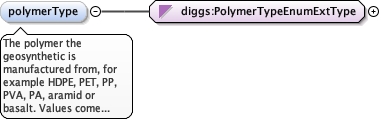
The polymer the geosynthetic is manufactured from, for example HDPE,
PET, PP, PVA, PA, aramid or basalt. Values come from the enumerated
list, or "Other: xx", where xx is a user-defined term whose meaning
differs from every listed value (not a synonym of one).
Diagram
DiagramCommon_xsd_Simple_Type_diggs_PolymerTypeEnumExtType.tmp#PolymerTypeEnumExtType
Type diggs:PolymerTypeEnumExtType
Properties
content simple
minOccurs 0
Source
<element minOccurs="0" name="polymerType" type="diggs:PolymerTypeEnumExtType">
  <annotation>
    <documentation>The polymer the geosynthetic is manufactured from, for example HDPE, PET, PP, PVA, PA, aramid or basalt. Values come from the enumerated list, or "Other: xx", where xx is a user-defined term whose meaning differs from every listed value (not a synonym of one).</documentation>
  </annotation>
</element>
Element diggs:DesignGeosyntheticLayerType / diggs:reinforcementType
Namespace http://diggsml.org/schemas/3
Annotations
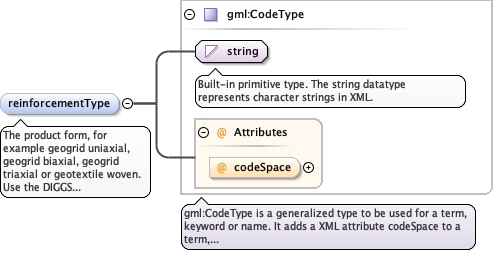
The product form, for example geogrid uniaxial, geogrid biaxial,
geogrid triaxial or geotextile woven. Use the DIGGS dictionary
geosyntheticReinforcementType.xml for the list of values.
Diagram
Diagramgml3_2Profile_diggs_xsd_Complex_Type_gml_CodeType.tmp#CodeType_codeSpacegml3_2Profile_diggs_xsd_Complex_Type_gml_CodeType.tmp#CodeType
Type gml:CodeType
Properties
content complex
minOccurs 0
Attributes
QName Type Use
codeSpace anyURI optional
Source
<element minOccurs="0" name="reinforcementType" type="gml:CodeType">
  <annotation>
    <documentation>The product form, for example geogrid uniaxial, geogrid biaxial, geogrid triaxial or geotextile woven. Use the DIGGS dictionary geosyntheticReinforcementType.xml for the list of values.</documentation>
  </annotation>
</element>
Element diggs:DesignGeosyntheticLayerType / diggs:direction
Namespace http://diggsml.org/schemas/3
Annotations
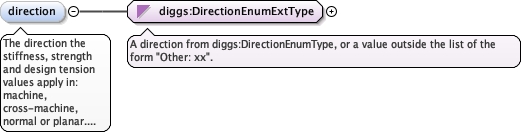
The direction the stiffness, strength and design tension values
apply in: machine, cross-machine, normal or planar.
diggs:GeosyntheticType (as-built) carries a matching direction
field, so the stated orientation of the installed layer can be
compared with the direction this design value governs. Values come
from the enumerated list, or "Other: xx", where xx is a user-defined
term whose meaning differs from every listed value (not a synonym of
one).
Diagram
DiagramCommon_xsd_Simple_Type_diggs_DirectionEnumExtType.tmp#DirectionEnumExtType
Type diggs:DirectionEnumExtType
Properties
content simple
minOccurs 0
Source
<element minOccurs="0" name="direction" type="diggs:DirectionEnumExtType">
  <annotation>
    <documentation>The direction the stiffness, strength and design tension values apply in: machine, cross-machine, normal or planar. diggs:GeosyntheticType (as-built) carries a matching direction field, so the stated orientation of the installed layer can be compared with the direction this design value governs. Values come from the enumerated list, or "Other: xx", where xx is a user-defined term whose meaning differs from every listed value (not a synonym of one).</documentation>
  </annotation>
</element>
Element diggs:DesignGeosyntheticLayerType / diggs:tensileStiffness
Namespace http://diggsml.org/schemas/3
Annotations
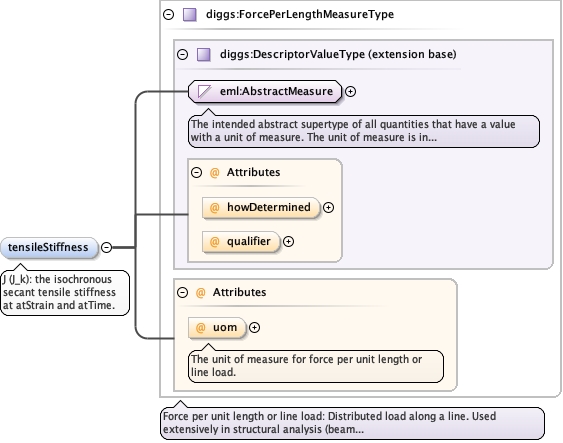
J (J_k): the isochronous secant tensile stiffness at atStrain and
atTime.
Diagram
DiagramEmlAllObjects_xsd_Simple_Type_eml_AbstractMeasure.tmp#AbstractMeasureMeasureTypes_xsd_Complex_Type_diggs_DescriptorValueType.tmp#DescriptorValueType_howDeterminedMeasureTypes_xsd_Complex_Type_diggs_DescriptorValueType.tmp#DescriptorValueType_qualifierMeasureTypes_xsd_Complex_Type_diggs_DescriptorValueType.tmp#DescriptorValueTypeMeasureTypes_xsd_Complex_Type_diggs_ForcePerLengthMeasureType.tmp#ForcePerLengthMeasureType_uomMeasureTypes_xsd_Complex_Type_diggs_ForcePerLengthMeasureType.tmp#ForcePerLengthMeasureType
Type diggs:ForcePerLengthMeasureType
Type hierarchy
Properties
content complex
minOccurs 0
Attributes
QName Type Use Annotation
howDetermined diggs:DescriptorMethodEnumType optional
qualifier diggs:QualifierEnumExtType optional
uom diggs:ForcePerLengthUomEnumType optional
The unit of measure for force per unit length or line load.
Source
<element minOccurs="0" name="tensileStiffness" type="diggs:ForcePerLengthMeasureType">
  <annotation>
    <documentation>J (J_k): the isochronous secant tensile stiffness at atStrain and atTime.</documentation>
  </annotation>
</element>
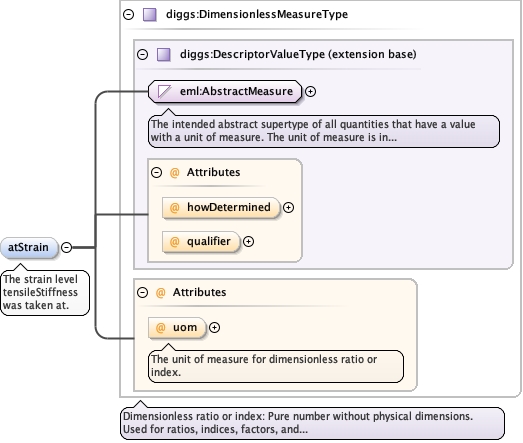
Element diggs:DesignGeosyntheticLayerType / diggs:atStrain
Namespace http://diggsml.org/schemas/3
Annotations
The strain level tensileStiffness was taken
at.
Diagram
DiagramEmlAllObjects_xsd_Simple_Type_eml_AbstractMeasure.tmp#AbstractMeasureMeasureTypes_xsd_Complex_Type_diggs_DescriptorValueType.tmp#DescriptorValueType_howDeterminedMeasureTypes_xsd_Complex_Type_diggs_DescriptorValueType.tmp#DescriptorValueType_qualifierMeasureTypes_xsd_Complex_Type_diggs_DescriptorValueType.tmp#DescriptorValueTypeMeasureTypes_xsd_Complex_Type_diggs_DimensionlessMeasureType.tmp#DimensionlessMeasureType_uomMeasureTypes_xsd_Complex_Type_diggs_DimensionlessMeasureType.tmp#DimensionlessMeasureType
Type diggs:DimensionlessMeasureType
Type hierarchy
Properties
content complex
minOccurs 0
Attributes
QName Type Use Annotation
howDetermined diggs:DescriptorMethodEnumType optional
qualifier diggs:QualifierEnumExtType optional
uom diggs:DimensionlessUomEnumType optional
The unit of measure for dimensionless ratio or index.
Source
<element minOccurs="0" name="atStrain" type="diggs:DimensionlessMeasureType">
  <annotation>
    <documentation>The strain level tensileStiffness was taken at.</documentation>
  </annotation>
</element>
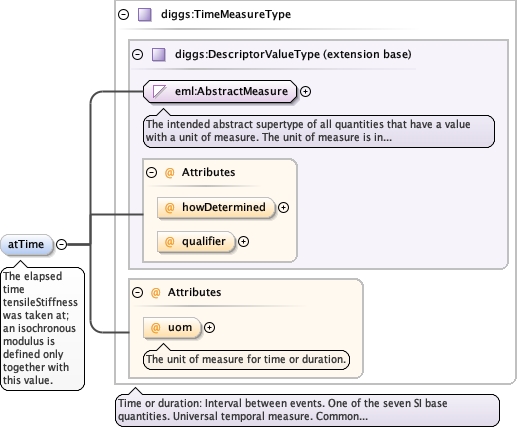
Element diggs:DesignGeosyntheticLayerType / diggs:atTime
Namespace http://diggsml.org/schemas/3
Annotations
The elapsed time tensileStiffness was taken at; an isochronous
modulus is defined only together with this value.
Diagram
DiagramEmlAllObjects_xsd_Simple_Type_eml_AbstractMeasure.tmp#AbstractMeasureMeasureTypes_xsd_Complex_Type_diggs_DescriptorValueType.tmp#DescriptorValueType_howDeterminedMeasureTypes_xsd_Complex_Type_diggs_DescriptorValueType.tmp#DescriptorValueType_qualifierMeasureTypes_xsd_Complex_Type_diggs_DescriptorValueType.tmp#DescriptorValueTypeMeasureTypes_xsd_Complex_Type_diggs_TimeMeasureType.tmp#TimeMeasureType_uomMeasureTypes_xsd_Complex_Type_diggs_TimeMeasureType.tmp#TimeMeasureType
Type diggs:TimeMeasureType
Type hierarchy
Properties
content complex
minOccurs 0
Attributes
QName Type Use Annotation
howDetermined diggs:DescriptorMethodEnumType optional
qualifier diggs:QualifierEnumExtType optional
uom diggs:TimeUomEnumType optional
The unit of measure for time or duration.
Source
<element minOccurs="0" name="atTime" type="diggs:TimeMeasureType">
  <annotation>
    <documentation>The elapsed time tensileStiffness was taken at; an isochronous modulus is defined only together with this value.</documentation>
  </annotation>
</element>
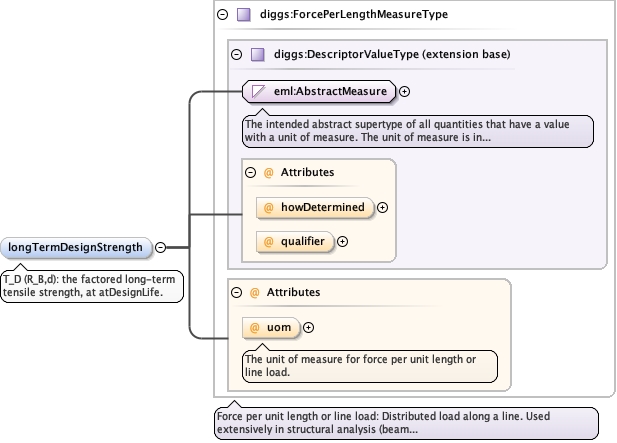
Element diggs:DesignGeosyntheticLayerType / diggs:longTermDesignStrength
Namespace http://diggsml.org/schemas/3
Annotations
T_D (R_B,d): the factored long-term tensile strength, at
atDesignLife.
Diagram
DiagramEmlAllObjects_xsd_Simple_Type_eml_AbstractMeasure.tmp#AbstractMeasureMeasureTypes_xsd_Complex_Type_diggs_DescriptorValueType.tmp#DescriptorValueType_howDeterminedMeasureTypes_xsd_Complex_Type_diggs_DescriptorValueType.tmp#DescriptorValueType_qualifierMeasureTypes_xsd_Complex_Type_diggs_DescriptorValueType.tmp#DescriptorValueTypeMeasureTypes_xsd_Complex_Type_diggs_ForcePerLengthMeasureType.tmp#ForcePerLengthMeasureType_uomMeasureTypes_xsd_Complex_Type_diggs_ForcePerLengthMeasureType.tmp#ForcePerLengthMeasureType
Type diggs:ForcePerLengthMeasureType
Type hierarchy
Properties
content complex
minOccurs 0
Attributes
QName Type Use Annotation
howDetermined diggs:DescriptorMethodEnumType optional
qualifier diggs:QualifierEnumExtType optional
uom diggs:ForcePerLengthUomEnumType optional
The unit of measure for force per unit length or line load.
Source
<element minOccurs="0" name="longTermDesignStrength" type="diggs:ForcePerLengthMeasureType">
  <annotation>
    <documentation>T_D (R_B,d): the factored long-term tensile strength, at atDesignLife.</documentation>
  </annotation>
</element>
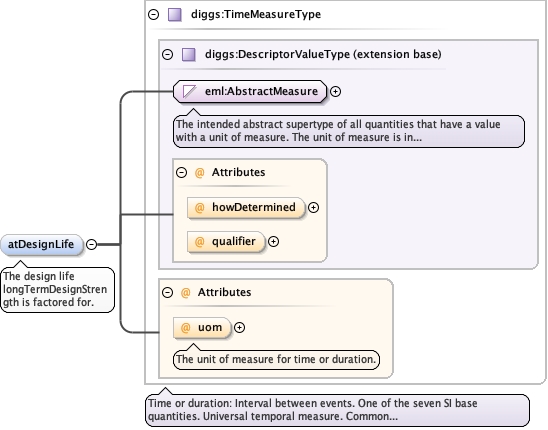
Element diggs:DesignGeosyntheticLayerType / diggs:atDesignLife
Namespace http://diggsml.org/schemas/3
Annotations
The design life longTermDesignStrength is factored
for.
Diagram
DiagramEmlAllObjects_xsd_Simple_Type_eml_AbstractMeasure.tmp#AbstractMeasureMeasureTypes_xsd_Complex_Type_diggs_DescriptorValueType.tmp#DescriptorValueType_howDeterminedMeasureTypes_xsd_Complex_Type_diggs_DescriptorValueType.tmp#DescriptorValueType_qualifierMeasureTypes_xsd_Complex_Type_diggs_DescriptorValueType.tmp#DescriptorValueTypeMeasureTypes_xsd_Complex_Type_diggs_TimeMeasureType.tmp#TimeMeasureType_uomMeasureTypes_xsd_Complex_Type_diggs_TimeMeasureType.tmp#TimeMeasureType
Type diggs:TimeMeasureType
Type hierarchy
Properties
content complex
minOccurs 0
Attributes
QName Type Use Annotation
howDetermined diggs:DescriptorMethodEnumType optional
qualifier diggs:QualifierEnumExtType optional
uom diggs:TimeUomEnumType optional
The unit of measure for time or duration.
Source
<element minOccurs="0" name="atDesignLife" type="diggs:TimeMeasureType">
  <annotation>
    <documentation>The design life longTermDesignStrength is factored for.</documentation>
  </annotation>
</element>
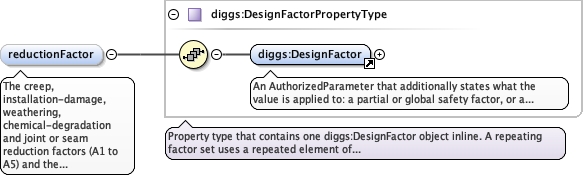
Element diggs:DesignGeosyntheticLayerType / diggs:reductionFactor
Namespace http://diggsml.org/schemas/3
Annotations
The creep, installation-damage, weathering, chemical-degradation and
joint or seam reduction factors (A1 to A5) and the material partial
factor (f_m) applied to reach longTermDesignStrength from the
characteristic strength of the geosynthetic. Each is a
diggs:DesignFactor, the same object used for the partial and global
safety factor set of a design's safety format. Repeat for each
factor.
Diagram
DiagramCommon_xsd_Element_diggs_DesignFactor.tmp#DesignFactorCommon_xsd_Complex_Type_diggs_DesignFactorPropertyType.tmp#DesignFactorPropertyType
Type diggs:DesignFactorPropertyType
Properties
content complex
minOccurs 0
maxOccurs unbounded
Model
Children diggs:DesignFactor
Instance
<diggs:reductionFactor xmlns:diggs="http://diggsml.org/schemas/3">
  <diggs:DesignFactor gml:id="" index="">{1,1}</diggs:DesignFactor>
</diggs:reductionFactor>
Source
<element minOccurs="0" maxOccurs="unbounded" name="reductionFactor" type="diggs:DesignFactorPropertyType">
  <annotation>
    <documentation>The creep, installation-damage, weathering, chemical-degradation and joint or seam reduction factors (A1 to A5) and the material partial factor (f_m) applied to reach longTermDesignStrength from the characteristic strength of the geosynthetic. Each is a diggs:DesignFactor, the same object used for the partial and global safety factor set of a design's safety format. Repeat for each factor.</documentation>
  </annotation>
</element>
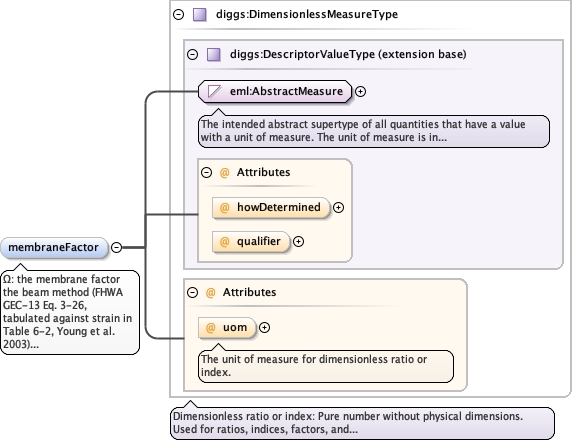
Element diggs:DesignGeosyntheticLayerType / diggs:membraneFactor
Namespace http://diggsml.org/schemas/3
Annotations
Ω: the membrane factor the beam method (FHWA GEC-13 Eq. 3-26,
tabulated against strain in Table 6-2, Young et al. 2003) multiplies
the load carried by this layer and half the design span by to obtain
designTension, where the more general parabolic method (Eq. 3-25)
instead solves for tension from tensileStiffness and atStrain
directly. It is a method-specific input to that output, not a
breakdown of it, and is specific to the FHWA beam method: BS 8006-1
(Eq 3-16) and EBGEO (Eq 3-20) obtain tension as tensileStiffness
times strain directly, and the ASIRI unit-cell method does not
compute geosynthetic membrane tension at all. It is a plain measure
type, not an authorized parameter, because its name alone identifies
it. Nothing in the schema links this value to the method that
produced it, and nothing prevents populating it alongside a design
that otherwise used BS 8006-1 or EBGEO; state the method in remark
or in the designMethod of the design's basis
(diggs:RIProgramBasisType, through basisRef), as for
diggs:DesignRILTPType/criticalHeight and the arching model.
Diagram
DiagramEmlAllObjects_xsd_Simple_Type_eml_AbstractMeasure.tmp#AbstractMeasureMeasureTypes_xsd_Complex_Type_diggs_DescriptorValueType.tmp#DescriptorValueType_howDeterminedMeasureTypes_xsd_Complex_Type_diggs_DescriptorValueType.tmp#DescriptorValueType_qualifierMeasureTypes_xsd_Complex_Type_diggs_DescriptorValueType.tmp#DescriptorValueTypeMeasureTypes_xsd_Complex_Type_diggs_DimensionlessMeasureType.tmp#DimensionlessMeasureType_uomMeasureTypes_xsd_Complex_Type_diggs_DimensionlessMeasureType.tmp#DimensionlessMeasureType
Type diggs:DimensionlessMeasureType
Type hierarchy
Properties
content complex
minOccurs 0
Attributes
QName Type Use Annotation
howDetermined diggs:DescriptorMethodEnumType optional
qualifier diggs:QualifierEnumExtType optional
uom diggs:DimensionlessUomEnumType optional
The unit of measure for dimensionless ratio or index.
Source
<element minOccurs="0" name="membraneFactor" type="diggs:DimensionlessMeasureType">
  <annotation>
    <documentation>Ω: the membrane factor the beam method (FHWA GEC-13 Eq. 3-26, tabulated against strain in Table 6-2, Young et al. 2003) multiplies the load carried by this layer and half the design span by to obtain designTension, where the more general parabolic method (Eq. 3-25) instead solves for tension from tensileStiffness and atStrain directly. It is a method-specific input to that output, not a breakdown of it, and is specific to the FHWA beam method: BS 8006-1 (Eq 3-16) and EBGEO (Eq 3-20) obtain tension as tensileStiffness times strain directly, and the ASIRI unit-cell method does not compute geosynthetic membrane tension at all. It is a plain measure type, not an authorized parameter, because its name alone identifies it. Nothing in the schema links this value to the method that produced it, and nothing prevents populating it alongside a design that otherwise used BS 8006-1 or EBGEO; state the method in remark or in the designMethod of the design's basis (diggs:RIProgramBasisType, through basisRef), as for diggs:DesignRILTPType/criticalHeight and the arching model.</documentation>
  </annotation>
</element>
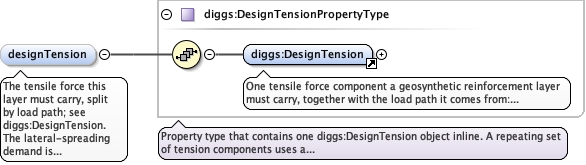
Element diggs:DesignGeosyntheticLayerType / diggs:designTension
Namespace http://diggsml.org/schemas/3
Annotations
The tensile force this layer must carry, split by load path; see
diggs:DesignTension. The lateral-spreading demand is stated as the
lateral spreading component.
Diagram
DiagramCommon_xsd_Element_diggs_DesignTension.tmp#DesignTensionCommon_xsd_Complex_Type_diggs_DesignTensionPropertyType.tmp#DesignTensionPropertyType
Type diggs:DesignTensionPropertyType
Properties
content complex
minOccurs 0
maxOccurs unbounded
Model
Children diggs:DesignTension
Instance
<diggs:designTension xmlns:diggs="http://diggsml.org/schemas/3">
  <diggs:DesignTension gml:id="">{1,1}</diggs:DesignTension>
</diggs:designTension>
Source
<element minOccurs="0" maxOccurs="unbounded" name="designTension" type="diggs:DesignTensionPropertyType">
  <annotation>
    <documentation>The tensile force this layer must carry, split by load path; see diggs:DesignTension. The lateral-spreading demand is stated as the lateral spreading component.</documentation>
  </annotation>
</element>
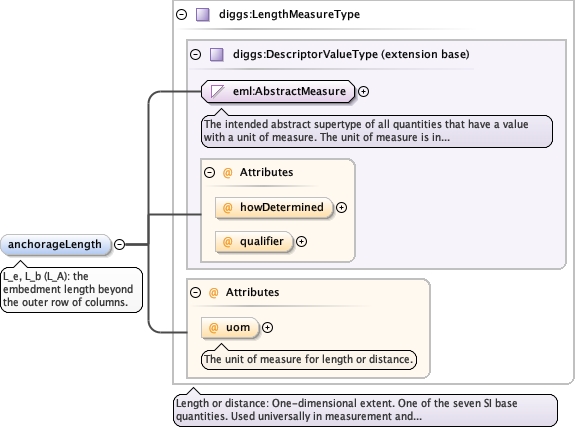
Element diggs:DesignGeosyntheticLayerType / diggs:anchorageLength
Namespace http://diggsml.org/schemas/3
Annotations
L_e, L_b (L_A): the embedment length beyond the outer row of
columns.
Diagram
DiagramEmlAllObjects_xsd_Simple_Type_eml_AbstractMeasure.tmp#AbstractMeasureMeasureTypes_xsd_Complex_Type_diggs_DescriptorValueType.tmp#DescriptorValueType_howDeterminedMeasureTypes_xsd_Complex_Type_diggs_DescriptorValueType.tmp#DescriptorValueType_qualifierMeasureTypes_xsd_Complex_Type_diggs_DescriptorValueType.tmp#DescriptorValueTypeMeasureTypes_xsd_Complex_Type_diggs_LengthMeasureType.tmp#LengthMeasureType_uomMeasureTypes_xsd_Complex_Type_diggs_LengthMeasureType.tmp#LengthMeasureType
Type diggs:LengthMeasureType
Type hierarchy
Properties
content complex
minOccurs 0
Attributes
QName Type Use Annotation
howDetermined diggs:DescriptorMethodEnumType optional
qualifier diggs:QualifierEnumExtType optional
uom diggs:LengthUomEnumType optional
The unit of measure for length or distance.
Source
<element minOccurs="0" name="anchorageLength" type="diggs:LengthMeasureType">
  <annotation>
    <documentation>L_e, L_b (L_A): the embedment length beyond the outer row of columns.</documentation>
  </annotation>
</element>
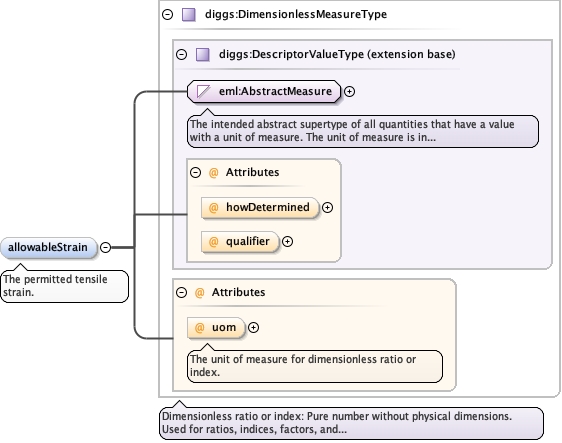
Element diggs:DesignGeosyntheticLayerType / diggs:allowableStrain
Namespace http://diggsml.org/schemas/3
Annotations
The permitted tensile strain.
Diagram
DiagramEmlAllObjects_xsd_Simple_Type_eml_AbstractMeasure.tmp#AbstractMeasureMeasureTypes_xsd_Complex_Type_diggs_DescriptorValueType.tmp#DescriptorValueType_howDeterminedMeasureTypes_xsd_Complex_Type_diggs_DescriptorValueType.tmp#DescriptorValueType_qualifierMeasureTypes_xsd_Complex_Type_diggs_DescriptorValueType.tmp#DescriptorValueTypeMeasureTypes_xsd_Complex_Type_diggs_DimensionlessMeasureType.tmp#DimensionlessMeasureType_uomMeasureTypes_xsd_Complex_Type_diggs_DimensionlessMeasureType.tmp#DimensionlessMeasureType
Type diggs:DimensionlessMeasureType
Type hierarchy
Properties
content complex
minOccurs 0
Attributes
QName Type Use Annotation
howDetermined diggs:DescriptorMethodEnumType optional
qualifier diggs:QualifierEnumExtType optional
uom diggs:DimensionlessUomEnumType optional
The unit of measure for dimensionless ratio or index.
Source
<element minOccurs="0" name="allowableStrain" type="diggs:DimensionlessMeasureType">
  <annotation>
    <documentation>The permitted tensile strain.</documentation>
  </annotation>
</element>
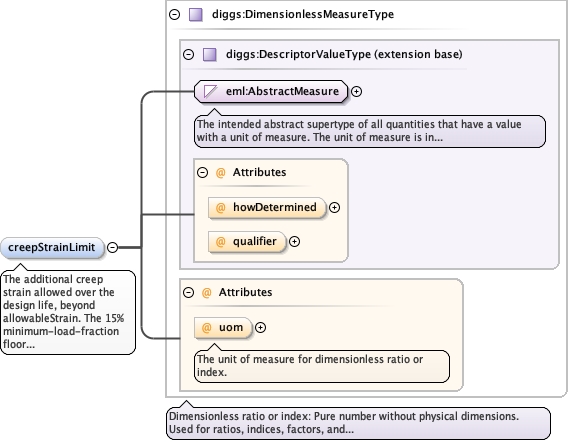
Element diggs:DesignGeosyntheticLayerType / diggs:creepStrainLimit
Namespace http://diggsml.org/schemas/3
Annotations
The additional creep strain allowed over the design life, beyond
allowableStrain. The 15% minimum-load-fraction floor is a criterion,
not a design value, and is not carried here; see
diggs:AbstractAcceptanceCriterionType.
Diagram
DiagramEmlAllObjects_xsd_Simple_Type_eml_AbstractMeasure.tmp#AbstractMeasureMeasureTypes_xsd_Complex_Type_diggs_DescriptorValueType.tmp#DescriptorValueType_howDeterminedMeasureTypes_xsd_Complex_Type_diggs_DescriptorValueType.tmp#DescriptorValueType_qualifierMeasureTypes_xsd_Complex_Type_diggs_DescriptorValueType.tmp#DescriptorValueTypeMeasureTypes_xsd_Complex_Type_diggs_DimensionlessMeasureType.tmp#DimensionlessMeasureType_uomMeasureTypes_xsd_Complex_Type_diggs_DimensionlessMeasureType.tmp#DimensionlessMeasureType
Type diggs:DimensionlessMeasureType
Type hierarchy
Properties
content complex
minOccurs 0
Attributes
QName Type Use Annotation
howDetermined diggs:DescriptorMethodEnumType optional
qualifier diggs:QualifierEnumExtType optional
uom diggs:DimensionlessUomEnumType optional
The unit of measure for dimensionless ratio or index.
Source
<element minOccurs="0" name="creepStrainLimit" type="diggs:DimensionlessMeasureType">
  <annotation>
    <documentation>The additional creep strain allowed over the design life, beyond allowableStrain. The 15% minimum-load-fraction floor is a criterion, not a design value, and is not carried here; see diggs:AbstractAcceptanceCriterionType.</documentation>
  </annotation>
</element>
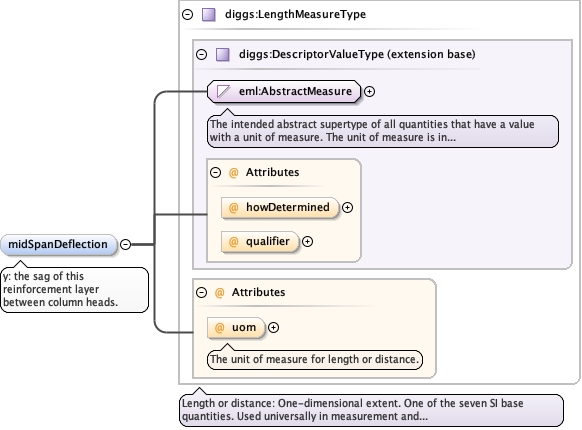
Element diggs:DesignGeosyntheticLayerType / diggs:midSpanDeflection
Namespace http://diggsml.org/schemas/3
Annotations
y: the sag of this reinforcement layer between column heads.
Diagram
DiagramEmlAllObjects_xsd_Simple_Type_eml_AbstractMeasure.tmp#AbstractMeasureMeasureTypes_xsd_Complex_Type_diggs_DescriptorValueType.tmp#DescriptorValueType_howDeterminedMeasureTypes_xsd_Complex_Type_diggs_DescriptorValueType.tmp#DescriptorValueType_qualifierMeasureTypes_xsd_Complex_Type_diggs_DescriptorValueType.tmp#DescriptorValueTypeMeasureTypes_xsd_Complex_Type_diggs_LengthMeasureType.tmp#LengthMeasureType_uomMeasureTypes_xsd_Complex_Type_diggs_LengthMeasureType.tmp#LengthMeasureType
Type diggs:LengthMeasureType
Type hierarchy
Properties
content complex
minOccurs 0
Attributes
QName Type Use Annotation
howDetermined diggs:DescriptorMethodEnumType optional
qualifier diggs:QualifierEnumExtType optional
uom diggs:LengthUomEnumType optional
The unit of measure for length or distance.
Source
<element minOccurs="0" name="midSpanDeflection" type="diggs:LengthMeasureType">
  <annotation>
    <documentation>y: the sag of this reinforcement layer between column heads.</documentation>
  </annotation>
</element>
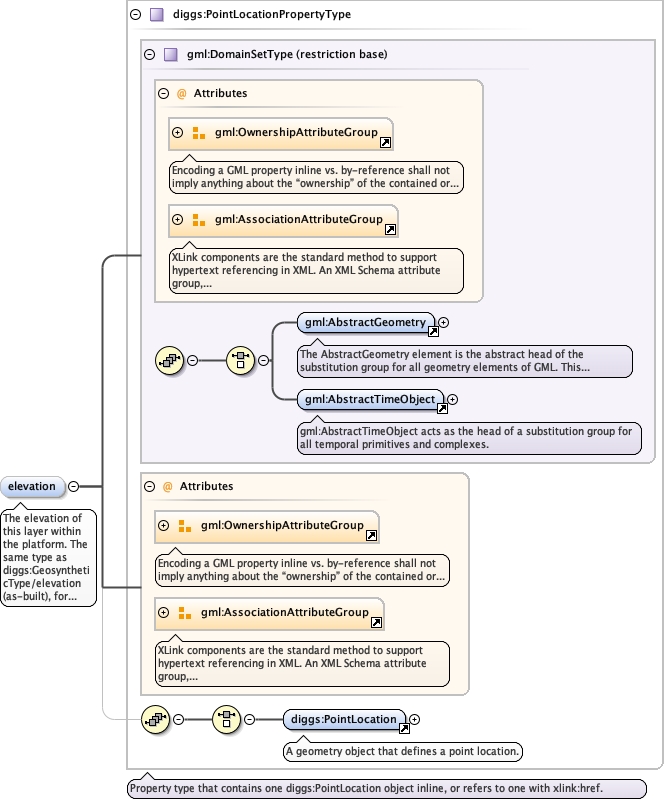
Element diggs:DesignGeosyntheticLayerType / diggs:elevation
Namespace http://diggsml.org/schemas/3
Annotations
The elevation of this layer within the platform. The same type as
diggs:GeosyntheticType/elevation (as-built), for direct comparison.
Diagram
Diagramgml3_2Profile_diggs_xsd_Attribute_Group_gml_OwnershipAttributeGroup.tmp#OwnershipAttributeGroupgml3_2Profile_diggs_xsd_Attribute_Group_gml_AssociationAttributeGroup.tmp#AssociationAttributeGroupgml3_2Profile_diggs_xsd_Element_gml_AbstractGeometry.tmp#AbstractGeometrygml3_2Profile_diggs_xsd_Element_gml_AbstractTimeObject.tmp#AbstractTimeObjectgml3_2Profile_diggs_xsd_Complex_Type_gml_DomainSetType.tmp#DomainSetTypegml3_2Profile_diggs_xsd_Attribute_Group_gml_OwnershipAttributeGroup.tmp#OwnershipAttributeGroupgml3_2Profile_diggs_xsd_Attribute_Group_gml_AssociationAttributeGroup.tmp#AssociationAttributeGroupCore_xsd_Element_diggs_PointLocation.tmp#PointLocationCore_xsd_Complex_Type_diggs_PointLocationPropertyType.tmp#PointLocationPropertyType
Type diggs:PointLocationPropertyType
Type hierarchy
Properties
content complex
minOccurs 0
Model
Children diggs:PointLocation
Instance
<diggs:elevation owns="false" xlink:href="" nilReason="" xmlns:diggs="http://diggsml.org/schemas/3">
  <diggs:PointLocation axisLabels="" gml:id="" srsDimension="" srsName="" uomLabels="">{1,1}</diggs:PointLocation>
</diggs:elevation>
Attributes
QName Type Default Use
nilReason gml:NilReasonType optional
owns boolean false optional
xlink:href anyURI optional
Source
<element minOccurs="0" name="elevation" type="diggs:PointLocationPropertyType">
  <annotation>
    <documentation>The elevation of this layer within the platform. The same type as diggs:GeosyntheticType/elevation (as-built), for direct comparison.</documentation>
  </annotation>
</element>
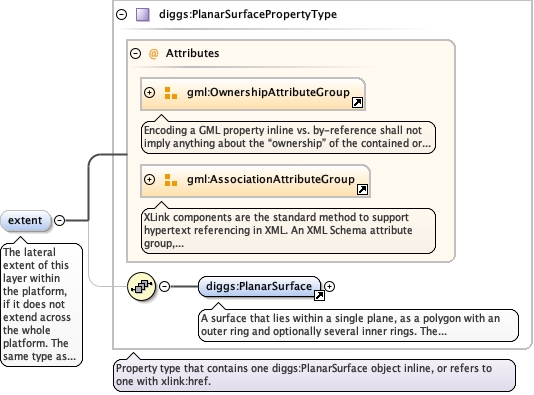
Element diggs:DesignGeosyntheticLayerType / diggs:extent
Namespace http://diggsml.org/schemas/3
Annotations
The lateral extent of this layer within the platform, if it does not
extend across the whole platform. The same type as
diggs:GeosyntheticType/extent (as-built), for direct comparison.
Diagram
Diagramgml3_2Profile_diggs_xsd_Attribute_Group_gml_OwnershipAttributeGroup.tmp#OwnershipAttributeGroupgml3_2Profile_diggs_xsd_Attribute_Group_gml_AssociationAttributeGroup.tmp#AssociationAttributeGroupCore_xsd_Element_diggs_PlanarSurface.tmp#PlanarSurfaceCore_xsd_Complex_Type_diggs_PlanarSurfacePropertyType.tmp#PlanarSurfacePropertyType
Type diggs:PlanarSurfacePropertyType
Properties
content complex
minOccurs 0
Model
Children diggs:PlanarSurface
Instance
<diggs:extent xlink:href="" nilReason="" owns="false" xmlns:diggs="http://diggsml.org/schemas/3">
  <diggs:PlanarSurface axisLabels="" gml:id="" srsDimension="" srsName="" uomLabels="">{1,1}</diggs:PlanarSurface>
</diggs:extent>
Attributes
QName Type Default Use
nilReason gml:NilReasonType optional
owns boolean false optional
xlink:href anyURI optional
Source
<element minOccurs="0" name="extent" type="diggs:PlanarSurfacePropertyType">
  <annotation>
    <documentation>The lateral extent of this layer within the platform, if it does not extend across the whole platform. The same type as diggs:GeosyntheticType/extent (as-built), for direct comparison.</documentation>
  </annotation>
</element>
Complex Type diggs:DesignGeosyntheticLayerType
Namespace http://diggsml.org/schemas/3
Diagram
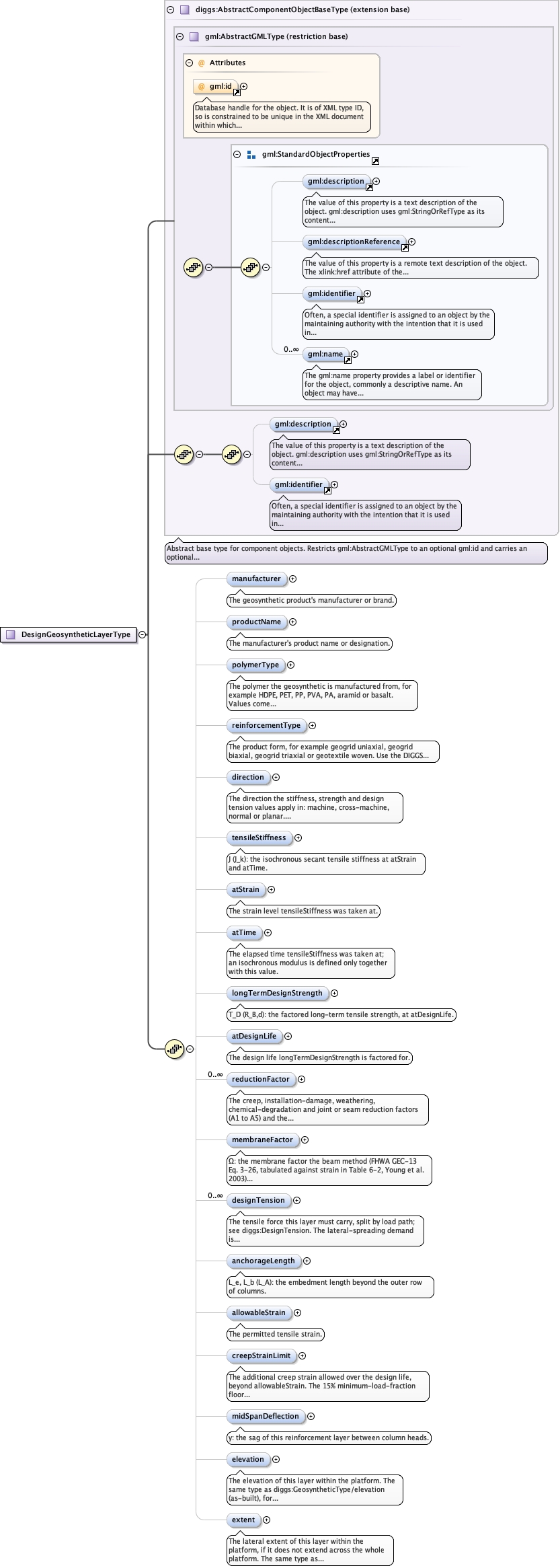
Diagramgml3_2Profile_diggs_xsd_Attribute_gml_id.tmp#idgml3_2Profile_diggs_xsd_Element_gml_description.tmp#descriptiongml3_2Profile_diggs_xsd_Element_gml_descriptionReference.tmp#descriptionReferencegml3_2Profile_diggs_xsd_Element_gml_identifier.tmp#identifiergml3_2Profile_diggs_xsd_Element_gml_name.tmp#namegml3_2Profile_diggs_xsd_Element_Group_gml_StandardObjectProperties.tmp#StandardObjectPropertiesgml3_2Profile_diggs_xsd_Complex_Type_gml_AbstractGMLType.tmp#AbstractGMLTypegml3_2Profile_diggs_xsd_Element_gml_description.tmp#descriptiongml3_2Profile_diggs_xsd_Element_gml_identifier.tmp#identifierAbstractTypes_xsd_Complex_Type_diggs_AbstractComponentObjectBaseType.tmp#AbstractComponentObjectBaseTypeCommon_xsd_Complex_Type_diggs_DesignGeosyntheticLayerType.tmp#DesignGeosyntheticLayerType_manufacturerCommon_xsd_Complex_Type_diggs_DesignGeosyntheticLayerType.tmp#DesignGeosyntheticLayerType_productNameCommon_xsd_Complex_Type_diggs_DesignGeosyntheticLayerType.tmp#DesignGeosyntheticLayerType_polymerTypeCommon_xsd_Complex_Type_diggs_DesignGeosyntheticLayerType.tmp#DesignGeosyntheticLayerType_reinforcementTypeCommon_xsd_Complex_Type_diggs_DesignGeosyntheticLayerType.tmp#DesignGeosyntheticLayerType_directionCommon_xsd_Complex_Type_diggs_DesignGeosyntheticLayerType.tmp#DesignGeosyntheticLayerType_tensileStiffnessCommon_xsd_Complex_Type_diggs_DesignGeosyntheticLayerType.tmp#DesignGeosyntheticLayerType_atStrainCommon_xsd_Complex_Type_diggs_DesignGeosyntheticLayerType.tmp#DesignGeosyntheticLayerType_atTimeCommon_xsd_Complex_Type_diggs_DesignGeosyntheticLayerType.tmp#DesignGeosyntheticLayerType_longTermDesignStrengthCommon_xsd_Complex_Type_diggs_DesignGeosyntheticLayerType.tmp#DesignGeosyntheticLayerType_atDesignLifeCommon_xsd_Complex_Type_diggs_DesignGeosyntheticLayerType.tmp#DesignGeosyntheticLayerType_reductionFactorCommon_xsd_Complex_Type_diggs_DesignGeosyntheticLayerType.tmp#DesignGeosyntheticLayerType_membraneFactorCommon_xsd_Complex_Type_diggs_DesignGeosyntheticLayerType.tmp#DesignGeosyntheticLayerType_designTensionCommon_xsd_Complex_Type_diggs_DesignGeosyntheticLayerType.tmp#DesignGeosyntheticLayerType_anchorageLengthCommon_xsd_Complex_Type_diggs_DesignGeosyntheticLayerType.tmp#DesignGeosyntheticLayerType_allowableStrainCommon_xsd_Complex_Type_diggs_DesignGeosyntheticLayerType.tmp#DesignGeosyntheticLayerType_creepStrainLimitCommon_xsd_Complex_Type_diggs_DesignGeosyntheticLayerType.tmp#DesignGeosyntheticLayerType_midSpanDeflectionCommon_xsd_Complex_Type_diggs_DesignGeosyntheticLayerType.tmp#DesignGeosyntheticLayerType_elevationCommon_xsd_Complex_Type_diggs_DesignGeosyntheticLayerType.tmp#DesignGeosyntheticLayerType_extent
Type extension of diggs:AbstractComponentObjectBaseType
Type hierarchy
Used by
Model
Children diggs:allowableStrain, diggs:anchorageLength, diggs:atDesignLife, diggs:atStrain, diggs:atTime, diggs:creepStrainLimit, diggs:designTension, diggs:direction, diggs:elevation, diggs:extent, diggs:longTermDesignStrength, diggs:manufacturer, diggs:membraneFactor, diggs:midSpanDeflection, diggs:polymerType, diggs:productName, diggs:reductionFactor, diggs:reinforcementType, diggs:tensileStiffness, gml:description, gml:identifier
Attributes
QName Type Use Annotation
gml:id ID optional
Database handle for the object. It is of XML type ID, so is constrained to be
unique in the XML document within which it occurs. An external identifier for the object in
the form of a URI may be constructed using standard XML and XPointer methods. This is done
by concatenating the URI for the document, a fragment separator, and the value of the id
attribute.
Source
<complexType name="DesignGeosyntheticLayerType">
  <complexContent>
    <extension base="diggs:AbstractComponentObjectBaseType">
      <sequence>
        <element minOccurs="0" name="manufacturer" type="string">
          <annotation>
            <documentation>The geosynthetic product's manufacturer or brand.</documentation>
          </annotation>
        </element>
        <element minOccurs="0" name="productName" type="string">
          <annotation>
            <documentation>The manufacturer's product name or designation.</documentation>
          </annotation>
        </element>
        <element minOccurs="0" name="polymerType" type="diggs:PolymerTypeEnumExtType">
          <annotation>
            <documentation>The polymer the geosynthetic is manufactured from, for example HDPE, PET, PP, PVA, PA, aramid or basalt. Values come from the enumerated list, or "Other: xx", where xx is a user-defined term whose meaning differs from every listed value (not a synonym of one).</documentation>
          </annotation>
        </element>
        <element minOccurs="0" name="reinforcementType" type="gml:CodeType">
          <annotation>
            <documentation>The product form, for example geogrid uniaxial, geogrid biaxial, geogrid triaxial or geotextile woven. Use the DIGGS dictionary geosyntheticReinforcementType.xml for the list of values.</documentation>
          </annotation>
        </element>
        <element minOccurs="0" name="direction" type="diggs:DirectionEnumExtType">
          <annotation>
            <documentation>The direction the stiffness, strength and design tension values apply in: machine, cross-machine, normal or planar. diggs:GeosyntheticType (as-built) carries a matching direction field, so the stated orientation of the installed layer can be compared with the direction this design value governs. Values come from the enumerated list, or "Other: xx", where xx is a user-defined term whose meaning differs from every listed value (not a synonym of one).</documentation>
          </annotation>
        </element>
        <element minOccurs="0" name="tensileStiffness" type="diggs:ForcePerLengthMeasureType">
          <annotation>
            <documentation>J (J_k): the isochronous secant tensile stiffness at atStrain and atTime.</documentation>
          </annotation>
        </element>
        <element minOccurs="0" name="atStrain" type="diggs:DimensionlessMeasureType">
          <annotation>
            <documentation>The strain level tensileStiffness was taken at.</documentation>
          </annotation>
        </element>
        <element minOccurs="0" name="atTime" type="diggs:TimeMeasureType">
          <annotation>
            <documentation>The elapsed time tensileStiffness was taken at; an isochronous modulus is defined only together with this value.</documentation>
          </annotation>
        </element>
        <element minOccurs="0" name="longTermDesignStrength" type="diggs:ForcePerLengthMeasureType">
          <annotation>
            <documentation>T_D (R_B,d): the factored long-term tensile strength, at atDesignLife.</documentation>
          </annotation>
        </element>
        <element minOccurs="0" name="atDesignLife" type="diggs:TimeMeasureType">
          <annotation>
            <documentation>The design life longTermDesignStrength is factored for.</documentation>
          </annotation>
        </element>
        <element minOccurs="0" maxOccurs="unbounded" name="reductionFactor" type="diggs:DesignFactorPropertyType">
          <annotation>
            <documentation>The creep, installation-damage, weathering, chemical-degradation and joint or seam reduction factors (A1 to A5) and the material partial factor (f_m) applied to reach longTermDesignStrength from the characteristic strength of the geosynthetic. Each is a diggs:DesignFactor, the same object used for the partial and global safety factor set of a design's safety format. Repeat for each factor.</documentation>
          </annotation>
        </element>
        <element minOccurs="0" name="membraneFactor" type="diggs:DimensionlessMeasureType">
          <annotation>
            <documentation>Ω: the membrane factor the beam method (FHWA GEC-13 Eq. 3-26, tabulated against strain in Table 6-2, Young et al. 2003) multiplies the load carried by this layer and half the design span by to obtain designTension, where the more general parabolic method (Eq. 3-25) instead solves for tension from tensileStiffness and atStrain directly. It is a method-specific input to that output, not a breakdown of it, and is specific to the FHWA beam method: BS 8006-1 (Eq 3-16) and EBGEO (Eq 3-20) obtain tension as tensileStiffness times strain directly, and the ASIRI unit-cell method does not compute geosynthetic membrane tension at all. It is a plain measure type, not an authorized parameter, because its name alone identifies it. Nothing in the schema links this value to the method that produced it, and nothing prevents populating it alongside a design that otherwise used BS 8006-1 or EBGEO; state the method in remark or in the designMethod of the design's basis (diggs:RIProgramBasisType, through basisRef), as for diggs:DesignRILTPType/criticalHeight and the arching model.</documentation>
          </annotation>
        </element>
        <element minOccurs="0" maxOccurs="unbounded" name="designTension" type="diggs:DesignTensionPropertyType">
          <annotation>
            <documentation>The tensile force this layer must carry, split by load path; see diggs:DesignTension. The lateral-spreading demand is stated as the lateral spreading component.</documentation>
          </annotation>
        </element>
        <element minOccurs="0" name="anchorageLength" type="diggs:LengthMeasureType">
          <annotation>
            <documentation>L_e, L_b (L_A): the embedment length beyond the outer row of columns.</documentation>
          </annotation>
        </element>
        <element minOccurs="0" name="allowableStrain" type="diggs:DimensionlessMeasureType">
          <annotation>
            <documentation>The permitted tensile strain.</documentation>
          </annotation>
        </element>
        <element minOccurs="0" name="creepStrainLimit" type="diggs:DimensionlessMeasureType">
          <annotation>
            <documentation>The additional creep strain allowed over the design life, beyond allowableStrain. The 15% minimum-load-fraction floor is a criterion, not a design value, and is not carried here; see diggs:AbstractAcceptanceCriterionType.</documentation>
          </annotation>
        </element>
        <element minOccurs="0" name="midSpanDeflection" type="diggs:LengthMeasureType">
          <annotation>
            <documentation>y: the sag of this reinforcement layer between column heads.</documentation>
          </annotation>
        </element>
        <element minOccurs="0" name="elevation" type="diggs:PointLocationPropertyType">
          <annotation>
            <documentation>The elevation of this layer within the platform. The same type as diggs:GeosyntheticType/elevation (as-built), for direct comparison.</documentation>
          </annotation>
        </element>
        <element minOccurs="0" name="extent" type="diggs:PlanarSurfacePropertyType">
          <annotation>
            <documentation>The lateral extent of this layer within the platform, if it does not extend across the whole platform. The same type as diggs:GeosyntheticType/extent (as-built), for direct comparison.</documentation>
          </annotation>
        </element>
      </sequence>
    </extension>
  </complexContent>
</complexType>