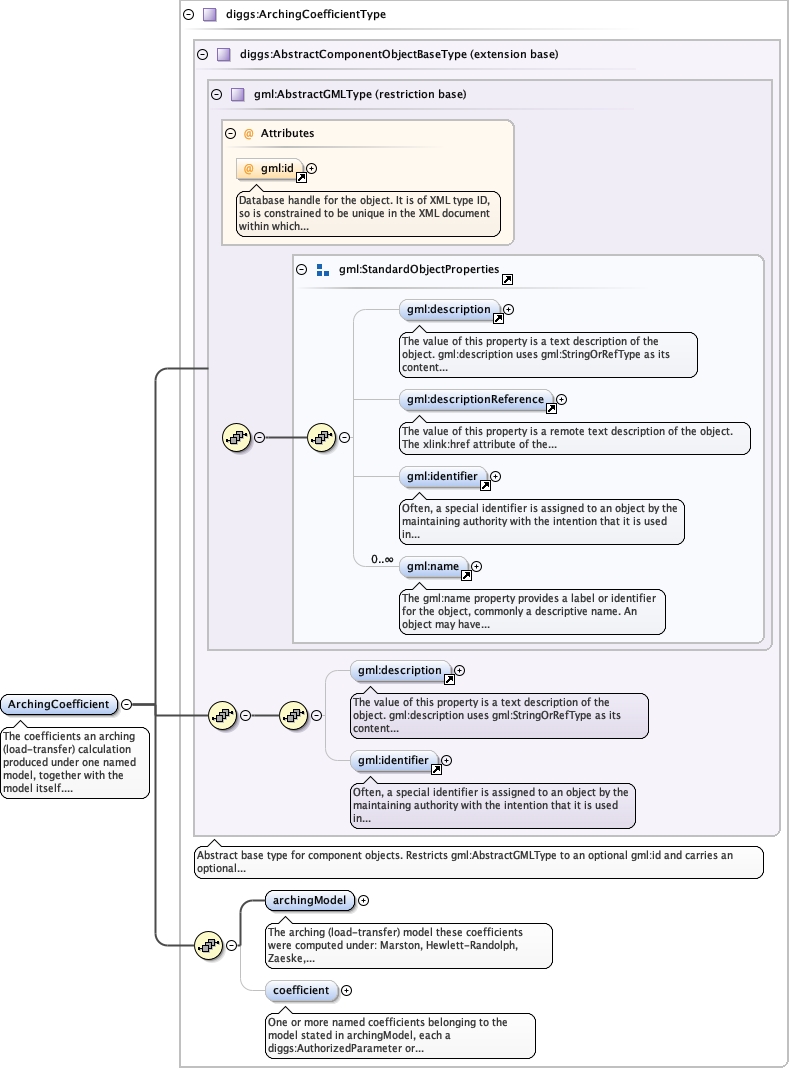
The coefficients an arching (load-transfer) calculation produced under one namedmodel, together with the model itself. It is one object per model, generic acrossall of them: BS 8006-1's Marston coefficient and cap-stress ratio, theHewlett-Randolph dome-arching efficiencies and passive coefficient, EBGEO's Zaeskecritical stress ratio, the adapted-Terzaghi lateral earth-pressure coefficient andASIRI's Prandtl punching factor are intermediate quantities that exist only insideone arching model, and named elements for them would bake competing national methodsinto the namespace and need a schema change for each new method (van Eekelen'sconcentric arches, CUR226). The coefficients themselves are dictionary-bound; thisobject gives each coefficient somewhere to live and gives the dictionary'sOccurrence mechanism a local element to condition on. archingModel is stated hererather than read from a basis object because the conditionalElementXpath of adictionary definition is evaluated on the ancestor axis, which sees containment andnot a basisRef cross-reference: the Occurrence condition of each coefficient readsthe archingModel of the ancestor diggs:ArchingCoefficient. A diggs:RIProgramBasismay also carry archingModel as the program-level record; the two should agree. Adesign repeats this object for the uncommon case of coefficients reported under morethan one model for comparison; normally there is one.
Database handle for the object. It is of XML type ID, so is constrained to beunique in the XML document within which it occurs. An external identifier for the object inthe form of a URI may be constructed using standard XML and XPointer methods. This is doneby concatenating the URI for the document, a fragment separator, and the value of the idattribute.
Source
<element name="ArchingCoefficient" type="diggs:ArchingCoefficientType"><annotation><documentation>The coefficients an arching (load-transfer) calculation produced under one named model, together with the model itself. It is one object per model, generic across all of them: BS 8006-1's Marston coefficient and cap-stress ratio, the Hewlett-Randolph dome-arching efficiencies and passive coefficient, EBGEO's Zaeske critical stress ratio, the adapted-Terzaghi lateral earth-pressure coefficient and ASIRI's Prandtl punching factor are intermediate quantities that exist only inside one arching model, and named elements for them would bake competing national methods into the namespace and need a schema change for each new method (van Eekelen's concentric arches, CUR226). The coefficients themselves are dictionary-bound; this object gives each coefficient somewhere to live and gives the dictionary's Occurrence mechanism a local element to condition on. archingModel is stated here rather than read from a basis object because the conditionalElementXpath of a dictionary definition is evaluated on the ancestor axis, which sees containment and not a basisRef cross-reference: the Occurrence condition of each coefficient reads the archingModel of the ancestor diggs:ArchingCoefficient. A diggs:RIProgramBasis may also carry archingModel as the program-level record; the two should agree. A design repeats this object for the uncommon case of coefficients reported under more than one model for comparison; normally there is one.</documentation></annotation></element>