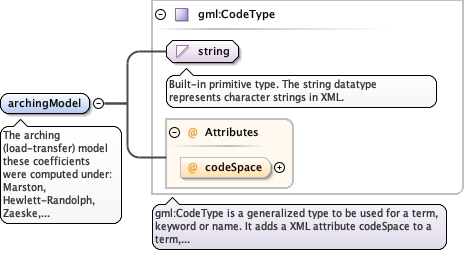
The arching (load-transfer) model these coefficients were computedunder: Marston, Hewlett-Randolph, Zaeske, adapted-Terzaghi, Prandtland so on. A coefficient reported without its model is notinterpretable, and the dictionary Occurrence condition of everycoefficient keys on this element. Use the DIGGS dictionaryarchingModel.xml for the list of values.
<element minOccurs="1" name="archingModel" type="gml:CodeType"><annotation><documentation>The arching (load-transfer) model these coefficients were computed under: Marston, Hewlett-Randolph, Zaeske, adapted-Terzaghi, Prandtl and so on. A coefficient reported without its model is not interpretable, and the dictionary Occurrence condition of every coefficient keys on this element. Use the DIGGS dictionary archingModel.xml for the list of values.</documentation></annotation></element>
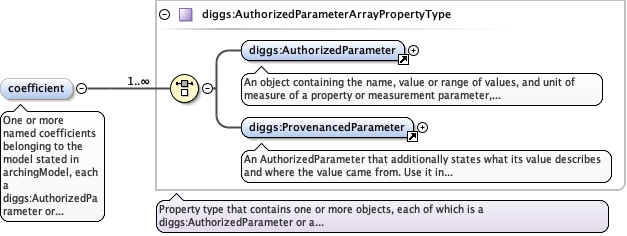
One or more named coefficients belonging to the model stated inarchingModel, each a diggs:AuthorizedParameter ordiggs:ProvenancedParameter whose parameterName codeSpace resolvesinto ri_design_properties.xml. The property type isdiggs:AuthorizedParameterArrayPropertyType, notdiggs:ParameterArrayPropertyType, so the schema itself enforces thedictionary binding: a consumer can type and validate eachcoefficient against its definition rather than infer it from a barename-value pair.
<element minOccurs="0" name="coefficient" type="diggs:AuthorizedParameterArrayPropertyType"><annotation><documentation>One or more named coefficients belonging to the model stated in archingModel, each a diggs:AuthorizedParameter or diggs:ProvenancedParameter whose parameterName codeSpace resolves into ri_design_properties.xml. The property type is diggs:AuthorizedParameterArrayPropertyType, not diggs:ParameterArrayPropertyType, so the schema itself enforces the dictionary binding: a consumer can type and validate each coefficient against its definition rather than infer it from a bare name-value pair.</documentation></annotation></element>
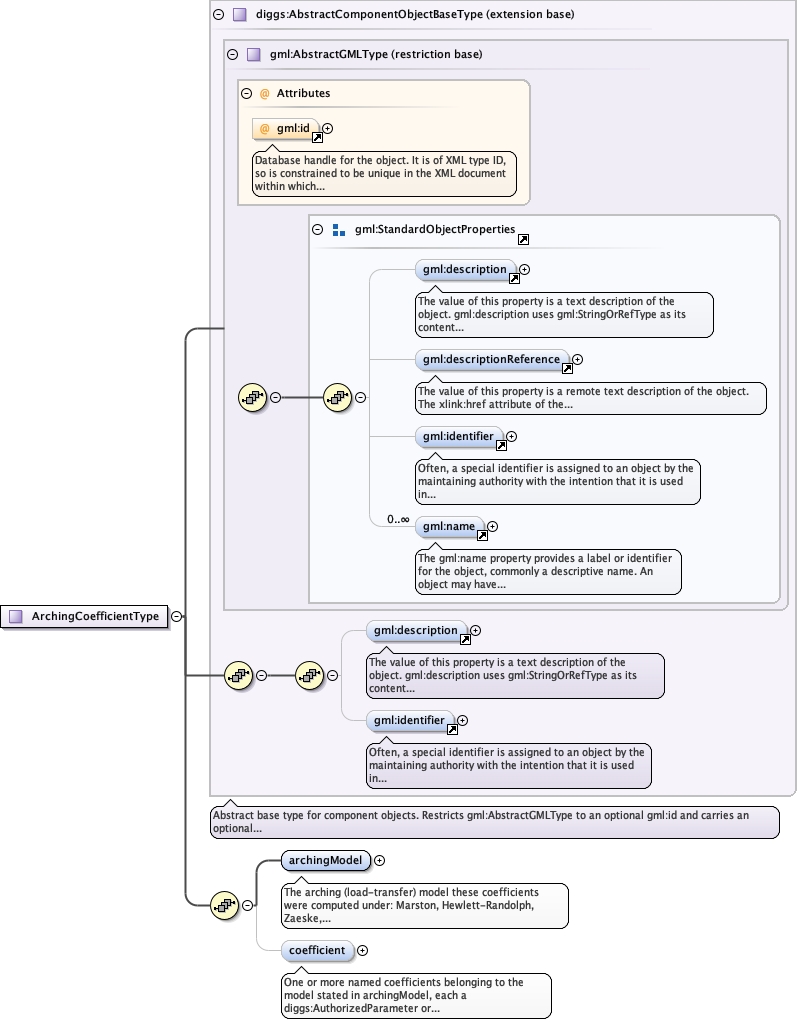
Database handle for the object. It is of XML type ID, so is constrained to beunique in the XML document within which it occurs. An external identifier for the object inthe form of a URI may be constructed using standard XML and XPointer methods. This is doneby concatenating the URI for the document, a fragment separator, and the value of the idattribute.
Source
<complexType name="ArchingCoefficientType"><complexContent><extension base="diggs:AbstractComponentObjectBaseType"><sequence><element minOccurs="1" name="archingModel" type="gml:CodeType"><annotation><documentation>The arching (load-transfer) model these coefficients were computed under: Marston, Hewlett-Randolph, Zaeske, adapted-Terzaghi, Prandtl and so on. A coefficient reported without its model is not interpretable, and the dictionary Occurrence condition of every coefficient keys on this element. Use the DIGGS dictionary archingModel.xml for the list of values.</documentation></annotation></element><element minOccurs="0" name="coefficient" type="diggs:AuthorizedParameterArrayPropertyType"><annotation><documentation>One or more named coefficients belonging to the model stated in archingModel, each a diggs:AuthorizedParameter or diggs:ProvenancedParameter whose parameterName codeSpace resolves into ri_design_properties.xml. The property type is diggs:AuthorizedParameterArrayPropertyType, not diggs:ParameterArrayPropertyType, so the schema itself enforces the dictionary binding: a consumer can type and validate each coefficient against its definition rather than infer it from a bare name-value pair.</documentation></annotation></element></sequence></extension></complexContent></complexType>