Showing:

Annotations
Attributes
Diagrams
Instances
Model
Properties
Source
Used by
Element diggs:RITreatedAreaType / diggs:totalArea
Namespace http://diggsml.org/schemas/3
Annotations
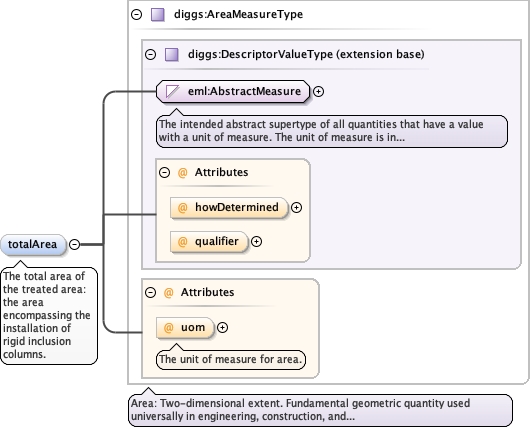
The total area of the treated area: the area encompassing the
installation of rigid inclusion columns.
Diagram
DiagramEmlAllObjects_xsd_Simple_Type_eml_AbstractMeasure.tmp#AbstractMeasureMeasureTypes_xsd_Complex_Type_diggs_DescriptorValueType.tmp#DescriptorValueType_howDeterminedMeasureTypes_xsd_Complex_Type_diggs_DescriptorValueType.tmp#DescriptorValueType_qualifierMeasureTypes_xsd_Complex_Type_diggs_DescriptorValueType.tmp#DescriptorValueTypeMeasureTypes_xsd_Complex_Type_diggs_AreaMeasureType.tmp#AreaMeasureType_uomMeasureTypes_xsd_Complex_Type_diggs_AreaMeasureType.tmp#AreaMeasureType
Type diggs:AreaMeasureType
Type hierarchy
Properties
content complex
minOccurs 0
Attributes
QName Type Use Annotation
howDetermined diggs:DescriptorMethodEnumType optional
qualifier diggs:QualifierEnumExtType optional
uom diggs:AreaUomEnumType optional
The unit of measure for area.
Source
<element minOccurs="0" name="totalArea" type="diggs:AreaMeasureType">
  <annotation>
    <documentation>The total area of the treated area: the area encompassing the installation of rigid inclusion columns.</documentation>
  </annotation>
</element>
Element diggs:RITreatedAreaType / diggs:workingPlatform
Namespace http://diggsml.org/schemas/3
Annotations
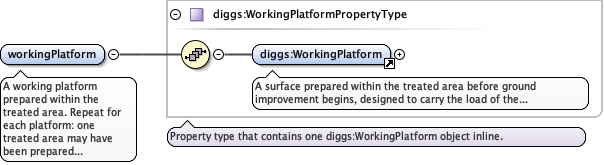
A working platform prepared within the treated area. Repeat for each
platform: one treated area may have been prepared in several stages
or at several levels.
Diagram
DiagramRigidInclusions_xsd_Element_diggs_WorkingPlatform.tmp#WorkingPlatformRigidInclusions_xsd_Complex_Type_diggs_WorkingPlatformPropertyType.tmp#WorkingPlatformPropertyType
Type diggs:WorkingPlatformPropertyType
Properties
content complex
minOccurs 1
maxOccurs unbounded
Model
Children diggs:WorkingPlatform
Instance
<diggs:workingPlatform xmlns:diggs="http://diggsml.org/schemas/3">
  <diggs:WorkingPlatform gml:id="">{1,1}</diggs:WorkingPlatform>
</diggs:workingPlatform>
Source
<element maxOccurs="unbounded" minOccurs="1" name="workingPlatform" type="diggs:WorkingPlatformPropertyType">
  <annotation>
    <documentation>A working platform prepared within the treated area. Repeat for each platform: one treated area may have been prepared in several stages or at several levels.</documentation>
  </annotation>
</element>
Element diggs:RITreatedAreaType / diggs:seismicSiteClass
Namespace http://diggsml.org/schemas/3
Annotations
The seismic site classification (IBC/ASCE 7 Site Class A-F) of the
site after ground improvement, based on the composite properties of
the treated ground mass. It is a classification, not the measurement
it is derived from: the composite shear-wave velocity is a separate
fact, expressible as a measured outcome of diggs:LabVelocityTest or
diggs:GeophysicalFieldSurvey, or as a diggs:PerformanceCriterion
where a minimum Vs is a design requirement. It is the achieved
class, not the intended one; its design-side counterpart is
diggs:DesignRITreatedAreaType/seismicSiteClass, which carries the
predicted class, and where the two differ that divergence is the
finding, so neither value should be edited to match the other.
Values come from the enumerated list, or "Other: xx", where xx is a
user-defined term whose meaning differs from every listed value (not
a synonym of one).
Diagram
DiagramCommon_xsd_Simple_Type_diggs_SeismicSiteClassEnumExtType.tmp#SeismicSiteClassEnumExtType
Type diggs:SeismicSiteClassEnumExtType
Properties
content simple
minOccurs 0
Source
<element minOccurs="0" name="seismicSiteClass" type="diggs:SeismicSiteClassEnumExtType">
  <annotation>
    <documentation>The seismic site classification (IBC/ASCE 7 Site Class A-F) of the site after ground improvement, based on the composite properties of the treated ground mass. It is a classification, not the measurement it is derived from: the composite shear-wave velocity is a separate fact, expressible as a measured outcome of diggs:LabVelocityTest or diggs:GeophysicalFieldSurvey, or as a diggs:PerformanceCriterion where a minimum Vs is a design requirement. It is the achieved class, not the intended one; its design-side counterpart is diggs:DesignRITreatedAreaType/seismicSiteClass, which carries the predicted class, and where the two differ that divergence is the finding, so neither value should be edited to match the other. Values come from the enumerated list, or "Other: xx", where xx is a user-defined term whose meaning differs from every listed value (not a synonym of one).</documentation>
  </annotation>
</element>
Complex Type diggs:RITreatedAreaType
Namespace http://diggsml.org/schemas/3
Diagram
Diagramgml3_2Profile_diggs_xsd_Attribute_gml_id.tmp#idgml3_2Profile_diggs_xsd_Element_gml_description.tmp#descriptiongml3_2Profile_diggs_xsd_Element_gml_descriptionReference.tmp#descriptionReferencegml3_2Profile_diggs_xsd_Element_gml_identifier.tmp#identifiergml3_2Profile_diggs_xsd_Element_gml_name.tmp#namegml3_2Profile_diggs_xsd_Element_Group_gml_StandardObjectProperties.tmp#StandardObjectPropertiesgml3_2Profile_diggs_xsd_Complex_Type_gml_AbstractGMLType.tmp#AbstractGMLTypegml3_2Profile_diggs_xsd_Complex_Type_gml_AbstractFeatureType.tmp#AbstractFeatureTypegml3_2Profile_diggs_xsd_Attribute_gml_id.tmp#idgml3_2Profile_diggs_xsd_Element_gml_description.tmp#descriptiongml3_2Profile_diggs_xsd_Element_gml_identifier.tmp#identifierAbstractTypes_xsd_Complex_Type_diggs_AbstractFeatureBaseType.tmp#AbstractFeatureBaseTypegml3_2Profile_diggs_xsd_Element_gml_name.tmp#nameCommon_xsd_Element_diggs_internalIdentifier.tmp#internalIdentifierCommon_xsd_Element_diggs_status.tmp#statusCommon_xsd_Element_diggs_implementationStatus.tmp#implementationStatusAbstractTypes_xsd_Complex_Type_diggs_AbstractFeatureType.tmp#http___diggsml.org_schemas_3_AbstractFeatureType_associatedFileAbstractTypes_xsd_Complex_Type_diggs_AbstractFeatureType.tmp#http___diggsml.org_schemas_3_AbstractFeatureType_roleAbstractTypes_xsd_Complex_Type_diggs_AbstractFeatureType.tmp#http___diggsml.org_schemas_3_AbstractFeatureType_remarkAbstractTypes_xsd_Complex_Type_diggs_AbstractFeatureType.tmp#http___diggsml.org_schemas_3_AbstractFeatureTypegml3_2Profile_diggs_xsd_Element_gml_description.tmp#descriptiongml3_2Profile_diggs_xsd_Element_gml_identifier.tmp#identifiergml3_2Profile_diggs_xsd_Element_gml_name.tmp#nameCommon_xsd_Element_diggs_internalIdentifier.tmp#internalIdentifierCommon_xsd_Element_diggs_status.tmp#statusCommon_xsd_Element_diggs_implementationStatus.tmp#implementationStatusAbstractTypes_xsd_Complex_Type_diggs_AbstractNamedFeatureType.tmp#AbstractNamedFeatureType_associatedFileAbstractTypes_xsd_Complex_Type_diggs_AbstractNamedFeatureType.tmp#AbstractNamedFeatureType_roleAbstractTypes_xsd_Complex_Type_diggs_AbstractNamedFeatureType.tmp#AbstractNamedFeatureType_remarkAbstractTypes_xsd_Complex_Type_diggs_AbstractNamedFeatureType.tmp#AbstractNamedFeatureTypeCommon_xsd_Element_diggs_investigationTarget.tmp#investigationTargetCommon_xsd_Element_diggs_projectRef.tmp#projectRefCommon_xsd_Element_diggs_originalProjectRef.tmp#originalProjectRefCommon_xsd_Element_diggs_associatedProjectRef.tmp#associatedProjectRefCommon_xsd_Element_diggs_samplingFeatureGroupRef.tmp#samplingFeatureGroupRefCommon_xsd_Element_diggs_programRef.tmp#programRefAbstractTypes_xsd_Complex_Type_diggs_AbstractSamplingFeatureType.tmp#AbstractSamplingFeatureType_currentDesignAbstractTypes_xsd_Complex_Type_diggs_AbstractSamplingFeatureType.tmp#AbstractSamplingFeatureType_previousDesignCommon_xsd_Element_diggs_programSpecificationRef.tmp#programSpecificationRefAbstractTypes_xsd_Complex_Type_diggs_AbstractSamplingFeatureType.tmp#AbstractSamplingFeatureType_realizesGridIndexAbstractTypes_xsd_Complex_Type_diggs_AbstractSamplingFeatureType.tmp#AbstractSamplingFeatureType_environmentAbstractTypes_xsd_Complex_Type_diggs_AbstractSamplingFeatureType.tmp#AbstractSamplingFeatureType_otherSamplingFeaturePropertyAbstractTypes_xsd_Complex_Type_diggs_AbstractSamplingFeatureType.tmp#AbstractSamplingFeatureType_localityAbstractTypes_xsd_Complex_Type_diggs_AbstractSamplingFeatureType.tmp#AbstractSamplingFeatureType_referencePointAbstractTypes_xsd_Complex_Type_diggs_AbstractSamplingFeatureType.tmp#AbstractSamplingFeatureType_localCoordinatesAbstractTypes_xsd_Complex_Type_diggs_AbstractSamplingFeatureType.tmp#AbstractSamplingFeatureTypeExtSamplingFeatures_xsd_Element_diggs_referenceEdge.tmp#referenceEdgeExtSamplingFeatures_xsd_Complex_Type_diggs_AbstractPlanarSamplingFeatureType.tmp#AbstractPlanarSamplingFeatureType_featureExtentExtSamplingFeatures_xsd_Element_diggs_relativeFeatureBoundary.tmp#relativeFeatureBoundaryExtSamplingFeatures_xsd_Element_diggs_planarReferencing.tmp#planarReferencingExtSamplingFeatures_xsd_Complex_Type_diggs_AbstractPlanarSamplingFeatureType.tmp#AbstractPlanarSamplingFeatureTypeRigidInclusions_xsd_Complex_Type_diggs_RITreatedAreaType.tmp#RITreatedAreaType_totalAreaRigidInclusions_xsd_Complex_Type_diggs_RITreatedAreaType.tmp#RITreatedAreaType_workingPlatformRigidInclusions_xsd_Complex_Type_diggs_RITreatedAreaType.tmp#RITreatedAreaType_seismicSiteClass
Type extension of diggs:AbstractPlanarSamplingFeatureType
Type hierarchy
Used by
Model
Children diggs:associatedFile, diggs:associatedProjectRef, diggs:currentDesign, diggs:environment, diggs:featureExtent, diggs:implementationStatus, diggs:internalIdentifier, diggs:investigationTarget, diggs:localCoordinates, diggs:locality, diggs:originalProjectRef, diggs:otherSamplingFeatureProperty, diggs:planarReferencing, diggs:previousDesign, diggs:programRef, diggs:programSpecificationRef, diggs:projectRef, diggs:realizesGridIndex, diggs:referenceEdge, diggs:referencePoint, diggs:relativeFeatureBoundary, diggs:remark, diggs:role, diggs:samplingFeatureGroupRef, diggs:seismicSiteClass, diggs:status, diggs:totalArea, diggs:workingPlatform, gml:description, gml:identifier, gml:name
Attributes
QName Type Use Annotation
gml:id ID required
Database handle for the object. It is of XML type ID, so is constrained to be
unique in the XML document within which it occurs. An external identifier for the object in
the form of a URI may be constructed using standard XML and XPointer methods. This is done
by concatenating the URI for the document, a fragment separator, and the value of the id
attribute.
Source
<complexType name="RITreatedAreaType">
  <complexContent>
    <extension base="diggs:AbstractPlanarSamplingFeatureType">
      <sequence>
        <element minOccurs="0" name="totalArea" type="diggs:AreaMeasureType">
          <annotation>
            <documentation>The total area of the treated area: the area encompassing the installation of rigid inclusion columns.</documentation>
          </annotation>
        </element>
        <element maxOccurs="unbounded" minOccurs="1" name="workingPlatform" type="diggs:WorkingPlatformPropertyType">
          <annotation>
            <documentation>A working platform prepared within the treated area. Repeat for each platform: one treated area may have been prepared in several stages or at several levels.</documentation>
          </annotation>
        </element>
        <element minOccurs="0" name="seismicSiteClass" type="diggs:SeismicSiteClassEnumExtType">
          <annotation>
            <documentation>The seismic site classification (IBC/ASCE 7 Site Class A-F) of the site after ground improvement, based on the composite properties of the treated ground mass. It is a classification, not the measurement it is derived from: the composite shear-wave velocity is a separate fact, expressible as a measured outcome of diggs:LabVelocityTest or diggs:GeophysicalFieldSurvey, or as a diggs:PerformanceCriterion where a minimum Vs is a design requirement. It is the achieved class, not the intended one; its design-side counterpart is diggs:DesignRITreatedAreaType/seismicSiteClass, which carries the predicted class, and where the two differ that divergence is the finding, so neither value should be edited to match the other. Values come from the enumerated list, or "Other: xx", where xx is a user-defined term whose meaning differs from every listed value (not a synonym of one).</documentation>
          </annotation>
        </element>
      </sequence>
    </extension>
  </complexContent>
</complexType>