Showing:

Annotations
Attributes
Diagrams
Instances
Model
Properties
Source
Element diggs:AbstractLoadTestProcedure
Namespace http://diggsml.org/schemas/3
Annotations
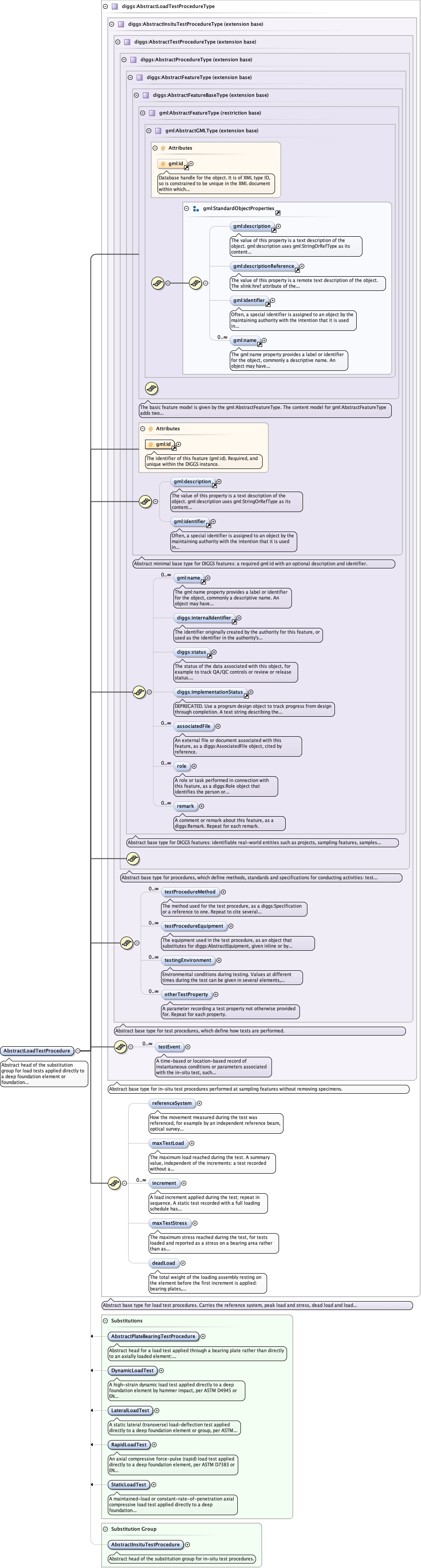
Abstract head of the substitution group for load tests applied directly to a deep
foundation element or foundation system: static, rapid or dynamic. Its members are
diggs:StaticLoadTest, diggs:RapidLoadTest and diggs:DynamicLoadTest. It is not
specific to a sampling feature: a static load test on a driven pile, a drilled shaft
or a rigid inclusion is the same procedure. It is neutral between standards; cite
the standard or standards governing an instance, more than one if needed, in the
inherited testProcedureMethod, for example a rigid-inclusion test governed by ASIRI
and executed to EN ISO 22477-1. Shared by every load test: the reference system for
displacement (referenceSystem), the peak load (maxTestLoad), the peak stress
(maxTestStress), the weight of the loading assembly (deadLoad) and the load
increments applied (increment). Hold criteria differ between static, rapid and
dynamic tests, so increment is expected to be little used on the last two; see
diggs:RapidLoadTestType/pulseDuration and diggs:DynamicLoadTestType/hammerEnergy for
their single-event characterization. The reaction system has no field here: record
the reaction frame and jacks as equipment through the inherited
testProcedureEquipment (equipmentClass.xml includes load_test_reaction_frame and
hydraulic_jack). Readings taken during each increment are carried on the increment
(diggs:LoadTestIncrementType/incrementTimeSeries). Derived values such as the
load-settlement curve and the capacity belong on the results of the measurement that
cites the procedure.
Diagram
Diagramgml3_2Profile_diggs_xsd_Attribute_gml_id.tmp#idgml3_2Profile_diggs_xsd_Element_gml_description.tmp#descriptiongml3_2Profile_diggs_xsd_Element_gml_descriptionReference.tmp#descriptionReferencegml3_2Profile_diggs_xsd_Element_gml_identifier.tmp#identifiergml3_2Profile_diggs_xsd_Element_gml_name.tmp#namegml3_2Profile_diggs_xsd_Element_Group_gml_StandardObjectProperties.tmp#StandardObjectPropertiesgml3_2Profile_diggs_xsd_Complex_Type_gml_AbstractGMLType.tmp#AbstractGMLTypegml3_2Profile_diggs_xsd_Complex_Type_gml_AbstractFeatureType.tmp#AbstractFeatureTypegml3_2Profile_diggs_xsd_Attribute_gml_id.tmp#idgml3_2Profile_diggs_xsd_Element_gml_description.tmp#descriptiongml3_2Profile_diggs_xsd_Element_gml_identifier.tmp#identifierAbstractTypes_xsd_Complex_Type_diggs_AbstractFeatureBaseType.tmp#AbstractFeatureBaseTypegml3_2Profile_diggs_xsd_Element_gml_name.tmp#nameCommon_xsd_Element_diggs_internalIdentifier.tmp#internalIdentifierCommon_xsd_Element_diggs_status.tmp#statusCommon_xsd_Element_diggs_implementationStatus.tmp#implementationStatusAbstractTypes_xsd_Complex_Type_diggs_AbstractFeatureType.tmp#http___diggsml.org_schemas_3_AbstractFeatureType_associatedFileAbstractTypes_xsd_Complex_Type_diggs_AbstractFeatureType.tmp#http___diggsml.org_schemas_3_AbstractFeatureType_roleAbstractTypes_xsd_Complex_Type_diggs_AbstractFeatureType.tmp#http___diggsml.org_schemas_3_AbstractFeatureType_remarkAbstractTypes_xsd_Complex_Type_diggs_AbstractFeatureType.tmp#http___diggsml.org_schemas_3_AbstractFeatureTypeAbstractTypes_xsd_Complex_Type_diggs_AbstractProcedureType.tmp#AbstractProcedureTypeAbstractTypes_xsd_Complex_Type_diggs_AbstractTestProcedureType.tmp#AbstractTestProcedureType_testProcedureMethodAbstractTypes_xsd_Complex_Type_diggs_AbstractTestProcedureType.tmp#AbstractTestProcedureType_testProcedureEquipmentAbstractTypes_xsd_Complex_Type_diggs_AbstractTestProcedureType.tmp#AbstractTestProcedureType_testingEnvironmentAbstractTypes_xsd_Complex_Type_diggs_AbstractTestProcedureType.tmp#AbstractTestProcedureType_otherTestPropertyAbstractTypes_xsd_Complex_Type_diggs_AbstractTestProcedureType.tmp#AbstractTestProcedureTypeAbstractTypes_xsd_Complex_Type_diggs_AbstractInsituTestProcedureType.tmp#AbstractInsituTestProcedureType_testEventAbstractTypes_xsd_Complex_Type_diggs_AbstractInsituTestProcedureType.tmp#AbstractInsituTestProcedureTypeAbstractTypes_xsd_Complex_Type_diggs_AbstractLoadTestProcedureType.tmp#AbstractLoadTestProcedureType_referenceSystemAbstractTypes_xsd_Complex_Type_diggs_AbstractLoadTestProcedureType.tmp#AbstractLoadTestProcedureType_maxTestLoadAbstractTypes_xsd_Complex_Type_diggs_AbstractLoadTestProcedureType.tmp#AbstractLoadTestProcedureType_incrementAbstractTypes_xsd_Complex_Type_diggs_AbstractLoadTestProcedureType.tmp#AbstractLoadTestProcedureType_maxTestStressAbstractTypes_xsd_Complex_Type_diggs_AbstractLoadTestProcedureType.tmp#AbstractLoadTestProcedureType_deadLoadAbstractTypes_xsd_Complex_Type_diggs_AbstractLoadTestProcedureType.tmp#AbstractLoadTestProcedureTypeExtProcedures_xsd_Element_diggs_AbstractPlateBearingTestProcedure.tmp#AbstractPlateBearingTestProcedureExtProcedures_xsd_Element_diggs_DynamicLoadTest.tmp#DynamicLoadTestExtProcedures_xsd_Element_diggs_LateralLoadTest.tmp#LateralLoadTestExtProcedures_xsd_Element_diggs_RapidLoadTest.tmp#RapidLoadTestExtProcedures_xsd_Element_diggs_StaticLoadTest.tmp#StaticLoadTestAbstractTypes_xsd_Element_diggs_AbstractInsituTestProcedure.tmp#AbstractInsituTestProcedure
Type diggs:AbstractLoadTestProcedureType
Type hierarchy
Properties
content complex
abstract true
Substitution Group
Substitution Group Affiliation
Model
Children diggs:associatedFile, diggs:deadLoad, diggs:implementationStatus, diggs:increment, diggs:internalIdentifier, diggs:maxTestLoad, diggs:maxTestStress, diggs:otherTestProperty, diggs:referenceSystem, diggs:remark, diggs:role, diggs:status, diggs:testEvent, diggs:testProcedureEquipment, diggs:testProcedureMethod, diggs:testingEnvironment, gml:description, gml:identifier, gml:name
Instance
<diggs:AbstractLoadTestProcedure gml:id="" xmlns:diggs="http://diggsml.org/schemas/3" xmlns:gml="http://www.opengis.net/gml/3.2">
  <gml:description xlink:href="" nilReason="">{0,1}</gml:description>
  <gml:identifier codeSpace="">{0,1}</gml:identifier>
  <gml:name codeSpace="">{0,unbounded}</gml:name>
  <diggs:internalIdentifier codeSpace="">{0,1}</diggs:internalIdentifier>
  <diggs:status codeSpace="">{0,1}</diggs:status>
  <diggs:implementationStatus codeSpace="">{0,1}</diggs:implementationStatus>
  <diggs:associatedFile xlink:href="" nilReason="" owns="false">{0,unbounded}</diggs:associatedFile>
  <diggs:role>{0,unbounded}</diggs:role>
  <diggs:remark>{0,unbounded}</diggs:remark>
  <diggs:testProcedureMethod xlink:href="" nilReason="" owns="false">{0,unbounded}</diggs:testProcedureMethod>
  <diggs:testProcedureEquipment xlink:href="" nilReason="" owns="false">{0,unbounded}</diggs:testProcedureEquipment>
  <diggs:testingEnvironment xlink:href="" nilReason="" owns="false">{0,unbounded}</diggs:testingEnvironment>
  <diggs:otherTestProperty>{0,unbounded}</diggs:otherTestProperty>
  <diggs:testEvent>{0,unbounded}</diggs:testEvent>
  <diggs:referenceSystem>{0,1}</diggs:referenceSystem>
  <diggs:maxTestLoad howDetermined="" qualifier="" uom="">{0,1}</diggs:maxTestLoad>
  <diggs:increment>{0,unbounded}</diggs:increment>
  <diggs:maxTestStress howDetermined="" qualifier="" uom="">{0,1}</diggs:maxTestStress>
  <diggs:deadLoad howDetermined="" qualifier="" uom="">{0,1}</diggs:deadLoad>
</diggs:AbstractLoadTestProcedure>
Attributes
QName Type Use Annotation
gml:id ID required
Database handle for the object. It is of XML type ID, so is constrained to be
unique in the XML document within which it occurs. An external identifier for the object in
the form of a URI may be constructed using standard XML and XPointer methods. This is done
by concatenating the URI for the document, a fragment separator, and the value of the id
attribute.
Source
<element name="AbstractLoadTestProcedure" type="diggs:AbstractLoadTestProcedureType" substitutionGroup="diggs:AbstractInsituTestProcedure" abstract="true">
  <annotation>
    <documentation>Abstract head of the substitution group for load tests applied directly to a deep foundation element or foundation system: static, rapid or dynamic. Its members are diggs:StaticLoadTest, diggs:RapidLoadTest and diggs:DynamicLoadTest. It is not specific to a sampling feature: a static load test on a driven pile, a drilled shaft or a rigid inclusion is the same procedure. It is neutral between standards; cite the standard or standards governing an instance, more than one if needed, in the inherited testProcedureMethod, for example a rigid-inclusion test governed by ASIRI and executed to EN ISO 22477-1. Shared by every load test: the reference system for displacement (referenceSystem), the peak load (maxTestLoad), the peak stress (maxTestStress), the weight of the loading assembly (deadLoad) and the load increments applied (increment). Hold criteria differ between static, rapid and dynamic tests, so increment is expected to be little used on the last two; see diggs:RapidLoadTestType/pulseDuration and diggs:DynamicLoadTestType/hammerEnergy for their single-event characterization. The reaction system has no field here: record the reaction frame and jacks as equipment through the inherited testProcedureEquipment (equipmentClass.xml includes load_test_reaction_frame and hydraulic_jack). Readings taken during each increment are carried on the increment (diggs:LoadTestIncrementType/incrementTimeSeries). Derived values such as the load-settlement curve and the capacity belong on the results of the measurement that cites the procedure.</documentation>
  </annotation>
</element>