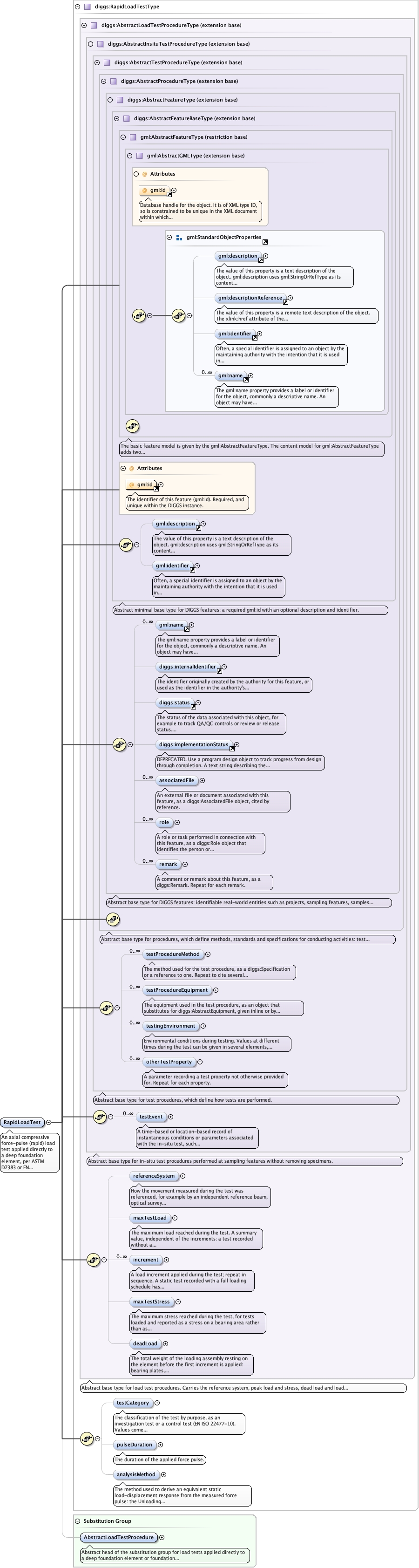
An axial compressive force-pulse (rapid) load test applied directly to a deepfoundation element, per ASTM D7383 or EN ISO 22477-10. The loading lasts tens to afew hundred milliseconds, between the seconds-to-minutes timescale ofdiggs:StaticLoadTest and the millisecond-or-shorter timescale ofdiggs:DynamicLoadTest, and the measured force pulse needs an inertial and dampingcorrection (analysisMethod) to give a load-settlement response. EN ISO 22477-10classifies a rapid test by purpose, as an investigation test (a sacrificial pileloaded to the ultimate limit state) or a control test (a working pile loaded to aspecified load above the serviceability limit state); ASTM D7383 does not name thedistinction, so give testCategory where it applies and leave it out otherwise. Thetwo named analysis methods, the Unloading Point Method and its modified form, areused by the practitioner communities of both standards.
Database handle for the object. It is of XML type ID, so is constrained to beunique in the XML document within which it occurs. An external identifier for the object inthe form of a URI may be constructed using standard XML and XPointer methods. This is doneby concatenating the URI for the document, a fragment separator, and the value of the idattribute.
Source
<element name="RapidLoadTest" type="diggs:RapidLoadTestType" abstract="false" substitutionGroup="diggs:AbstractLoadTestProcedure"><annotation><documentation>An axial compressive force-pulse (rapid) load test applied directly to a deep foundation element, per ASTM D7383 or EN ISO 22477-10. The loading lasts tens to a few hundred milliseconds, between the seconds-to-minutes timescale of diggs:StaticLoadTest and the millisecond-or-shorter timescale of diggs:DynamicLoadTest, and the measured force pulse needs an inertial and damping correction (analysisMethod) to give a load-settlement response. EN ISO 22477-10 classifies a rapid test by purpose, as an investigation test (a sacrificial pile loaded to the ultimate limit state) or a control test (a working pile loaded to a specified load above the serviceability limit state); ASTM D7383 does not name the distinction, so give testCategory where it applies and leave it out otherwise. The two named analysis methods, the Unloading Point Method and its modified form, are used by the practitioner communities of both standards.</documentation></annotation></element>