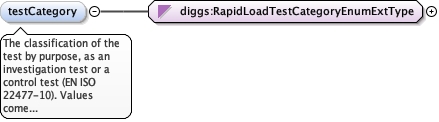
The classification of the test by purpose, as an investigation testor a control test (EN ISO 22477-10). Values come from the enumeratedlist, or "Other: xx", where xx is a user-defined term whose meaningdiffers from every listed value (not a synonym of one).
<element minOccurs="0" name="testCategory" type="diggs:RapidLoadTestCategoryEnumExtType"><annotation><documentation>The classification of the test by purpose, as an investigation test or a control test (EN ISO 22477-10). Values come from the enumerated list, or "Other: xx", where xx is a user-defined term whose meaning differs from every listed value (not a synonym of one).</documentation></annotation></element>
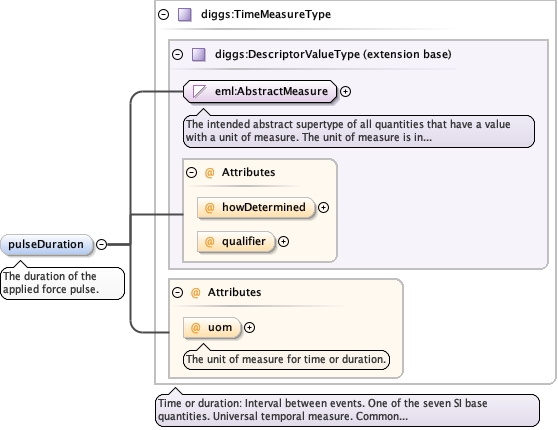
<element minOccurs="0" name="pulseDuration" type="diggs:TimeMeasureType"><annotation><documentation>The duration of the applied force pulse.</documentation></annotation></element>
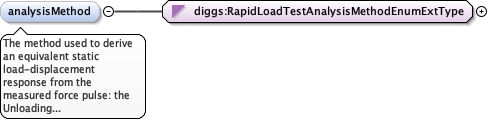
The method used to derive an equivalent static load-displacementresponse from the measured force pulse: the Unloading Point Methodor the Modified Unloading Point Method. Values come from theenumerated list, or "Other: xx", where xx is a user-defined termwhose meaning differs from every listed value (not a synonym ofone).
<element minOccurs="0" name="analysisMethod" type="diggs:RapidLoadTestAnalysisMethodEnumExtType"><annotation><documentation>The method used to derive an equivalent static load-displacement response from the measured force pulse: the Unloading Point Method or the Modified Unloading Point Method. Values come from the enumerated list, or "Other: xx", where xx is a user-defined term whose meaning differs from every listed value (not a synonym of one).</documentation></annotation></element>
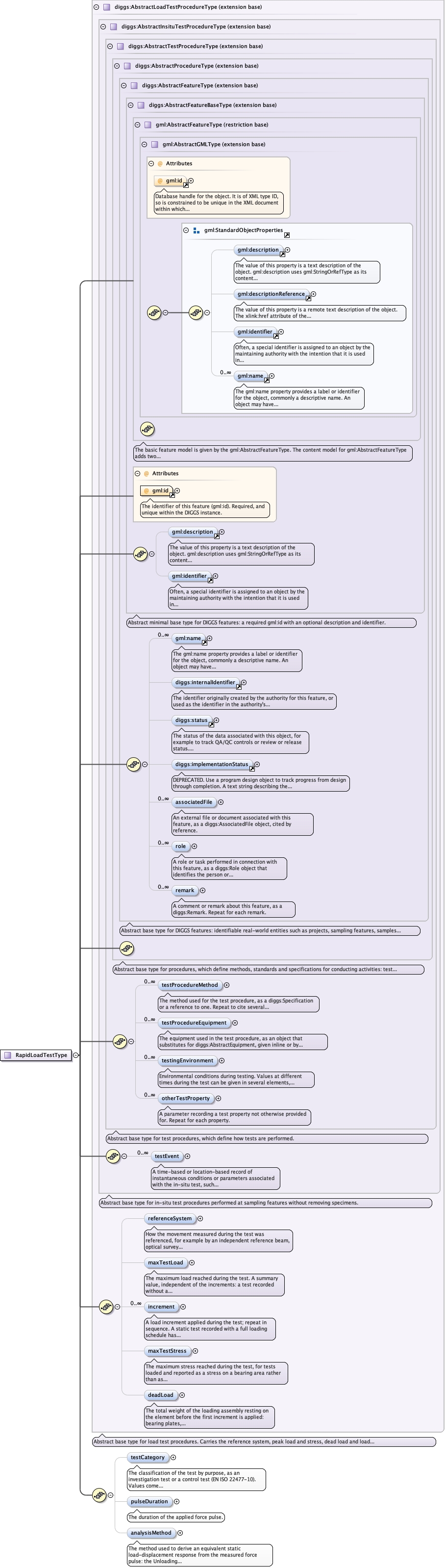
Database handle for the object. It is of XML type ID, so is constrained to beunique in the XML document within which it occurs. An external identifier for the object inthe form of a URI may be constructed using standard XML and XPointer methods. This is doneby concatenating the URI for the document, a fragment separator, and the value of the idattribute.
Source
<complexType name="RapidLoadTestType"><complexContent><extension base="diggs:AbstractLoadTestProcedureType"><sequence><element minOccurs="0" name="testCategory" type="diggs:RapidLoadTestCategoryEnumExtType"><annotation><documentation>The classification of the test by purpose, as an investigation test or a control test (EN ISO 22477-10). Values come from the enumerated list, or "Other: xx", where xx is a user-defined term whose meaning differs from every listed value (not a synonym of one).</documentation></annotation></element><element minOccurs="0" name="pulseDuration" type="diggs:TimeMeasureType"><annotation><documentation>The duration of the applied force pulse.</documentation></annotation></element><element minOccurs="0" name="analysisMethod" type="diggs:RapidLoadTestAnalysisMethodEnumExtType"><annotation><documentation>The method used to derive an equivalent static load-displacement response from the measured force pulse: the Unloading Point Method or the Modified Unloading Point Method. Values come from the enumerated list, or "Other: xx", where xx is a user-defined term whose meaning differs from every listed value (not a synonym of one).</documentation></annotation></element></sequence></extension></complexContent></complexType>