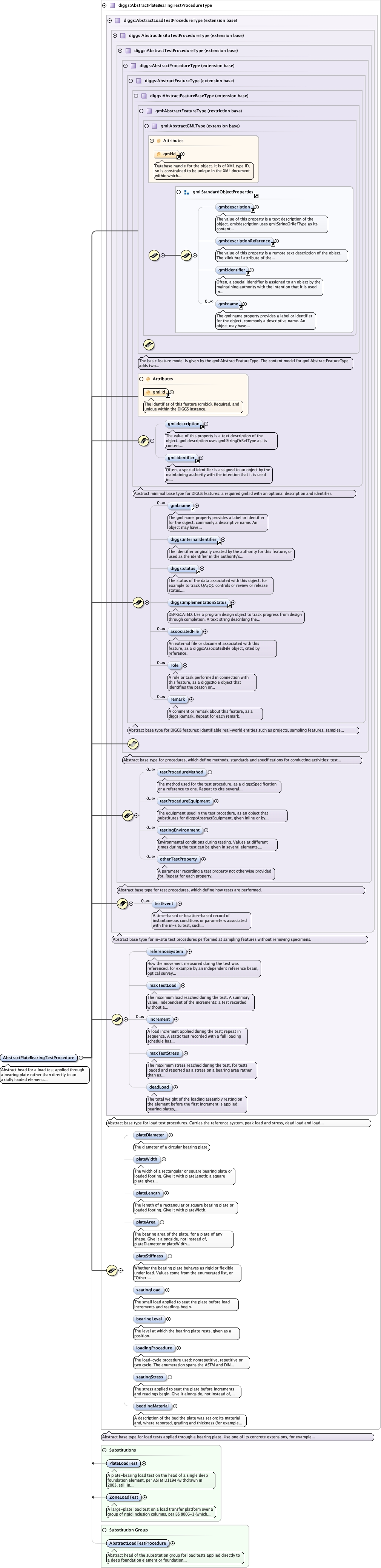
Abstract head for a load test applied through a bearing plate rather than directlyto an axially loaded element: diggs:PlateLoadTest (a single column head) anddiggs:ZoneLoadTest (a platform over a group of columns). It sharesdiggs:AbstractLoadTestProcedureType (referenceSystem, maxTestLoad, increment) andadds the plate (plateDiameter, plateWidth, plateLength, plateArea, plateStiffness),the seating load, the level the plate bears at and the load-cycle procedure. It isdistinct from diggs:StaticLoadTest: ASTM D1143/D1143M and EN ISO 22477-1 measure theaxial capacity of a pile or column by loading it directly, whereas ASTM D1196, D1195and DIN 18134 measure the stiffness of the ground or platform surface by loading itthrough a plate. ASTM D1196 (nonrepetitive static plate load tests) is current; itspredecessor ASTM D1194 was withdrawn in 2003 but remains in wide use and isregistered. ASTM D1195 covers the repetitive variant. DIN 18134 prescribes exactlytwo load cycles and reports two moduli, Ev1 (first loading) and Ev2 (second loading,after initial compression), whose ratio Ev2/Ev1 is itself a reportedcompaction-quality indicator. The enumeration of loadingProcedure spans all threetraditions: nonrepetitive, repetitive and two cycle. BS 8006-1 requires a zone loadtest for reinforced-fill and rigid inclusion platform verification but does notdefine the procedure, so a zone load test usually cites both it and the standard itis executed to (D1196, D1195 or DIN 18134) through the repeatable inheritedtestProcedureMethod. The moduli are results: give Ev1, Ev2 and the modulus ofsubgrade reaction on the ResultSet of Test/outcome with the propertiesdeformation_modulus_first_load, deformation_modulus_second_load andmodulus_of_subgrade_reaction from properties.xml.
Database handle for the object. It is of XML type ID, so is constrained to beunique in the XML document within which it occurs. An external identifier for the object inthe form of a URI may be constructed using standard XML and XPointer methods. This is doneby concatenating the URI for the document, a fragment separator, and the value of the idattribute.
Source
<element name="AbstractPlateBearingTestProcedure" type="diggs:AbstractPlateBearingTestProcedureType" abstract="true" substitutionGroup="diggs:AbstractLoadTestProcedure"><annotation><documentation>Abstract head for a load test applied through a bearing plate rather than directly to an axially loaded element: diggs:PlateLoadTest (a single column head) and diggs:ZoneLoadTest (a platform over a group of columns). It shares diggs:AbstractLoadTestProcedureType (referenceSystem, maxTestLoad, increment) and adds the plate (plateDiameter, plateWidth, plateLength, plateArea, plateStiffness), the seating load, the level the plate bears at and the load-cycle procedure. It is distinct from diggs:StaticLoadTest: ASTM D1143/D1143M and EN ISO 22477-1 measure the axial capacity of a pile or column by loading it directly, whereas ASTM D1196, D1195 and DIN 18134 measure the stiffness of the ground or platform surface by loading it through a plate. ASTM D1196 (nonrepetitive static plate load tests) is current; its predecessor ASTM D1194 was withdrawn in 2003 but remains in wide use and is registered. ASTM D1195 covers the repetitive variant. DIN 18134 prescribes exactly two load cycles and reports two moduli, Ev1 (first loading) and Ev2 (second loading, after initial compression), whose ratio Ev2/Ev1 is itself a reported compaction-quality indicator. The enumeration of loadingProcedure spans all three traditions: nonrepetitive, repetitive and two cycle. BS 8006-1 requires a zone load test for reinforced-fill and rigid inclusion platform verification but does not define the procedure, so a zone load test usually cites both it and the standard it is executed to (D1196, D1195 or DIN 18134) through the repeatable inherited testProcedureMethod. The moduli are results: give Ev1, Ev2 and the modulus of subgrade reaction on the ResultSet of Test/outcome with the properties deformation_modulus_first_load, deformation_modulus_second_load and modulus_of_subgrade_reaction from properties.xml.</documentation></annotation></element>