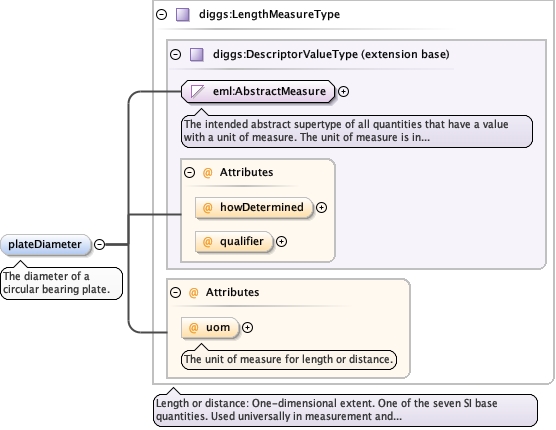
<element minOccurs="0" name="plateDiameter" type="diggs:LengthMeasureType"><annotation><documentation>The diameter of a circular bearing plate.</documentation></annotation></element>
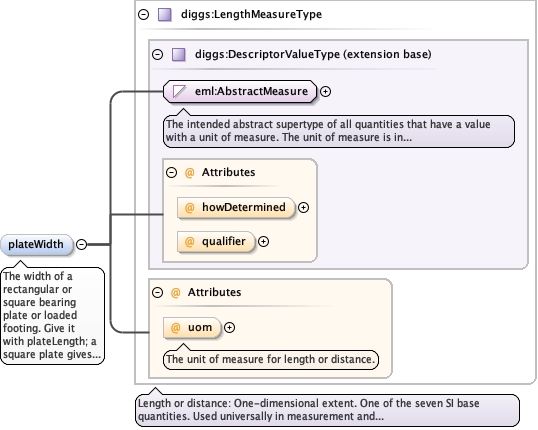
<element minOccurs="0" name="plateWidth" type="diggs:LengthMeasureType"><annotation><documentation>The width of a rectangular or square bearing plate or loaded footing. Give it with plateLength; a square plate gives the same value for both.</documentation></annotation></element>
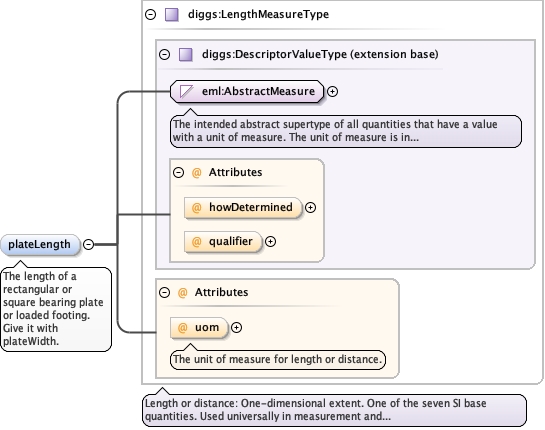
<element minOccurs="0" name="plateLength" type="diggs:LengthMeasureType"><annotation><documentation>The length of a rectangular or square bearing plate or loaded footing. Give it with plateWidth.</documentation></annotation></element>
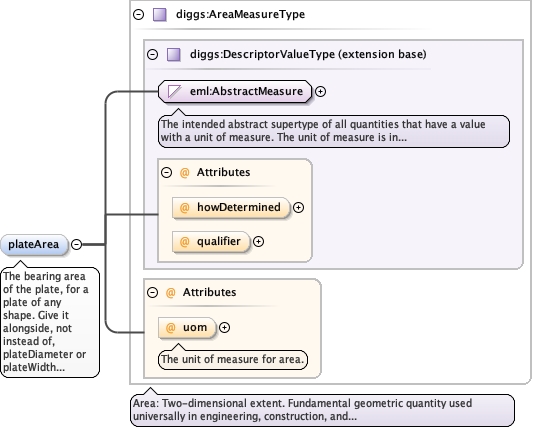
The bearing area of the plate, for a plate of any shape. Give italongside, not instead of, plateDiameter or plateWidth andplateLength; where they disagree, the dimensions prevail.
<element minOccurs="0" name="plateArea" type="diggs:AreaMeasureType"><annotation><documentation>The bearing area of the plate, for a plate of any shape. Give it alongside, not instead of, plateDiameter or plateWidth and plateLength; where they disagree, the dimensions prevail.</documentation></annotation></element>
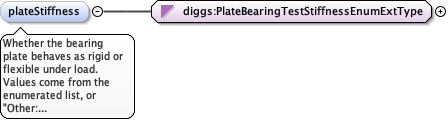
Whether the bearing plate behaves as rigid or flexible under load.Values come from the enumerated list, or "Other: xx", where xx is auser-defined term whose meaning differs from every listed value (nota synonym of one).
<element minOccurs="0" name="plateStiffness" type="diggs:PlateBearingTestStiffnessEnumExtType"><annotation><documentation>Whether the bearing plate behaves as rigid or flexible under load. Values come from the enumerated list, or "Other: xx", where xx is a user-defined term whose meaning differs from every listed value (not a synonym of one).</documentation></annotation></element>
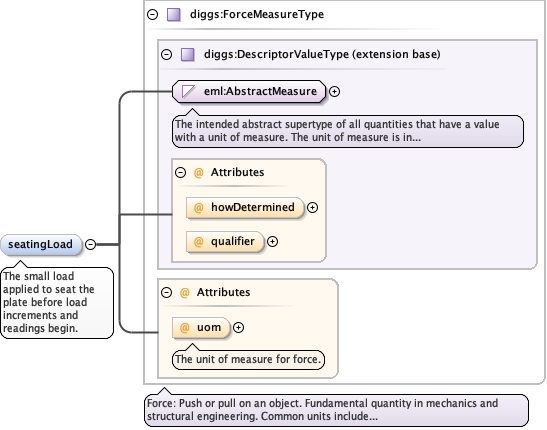
<element minOccurs="0" name="seatingLoad" type="diggs:ForceMeasureType"><annotation><documentation>The small load applied to seat the plate before load increments and readings begin.</documentation></annotation></element>
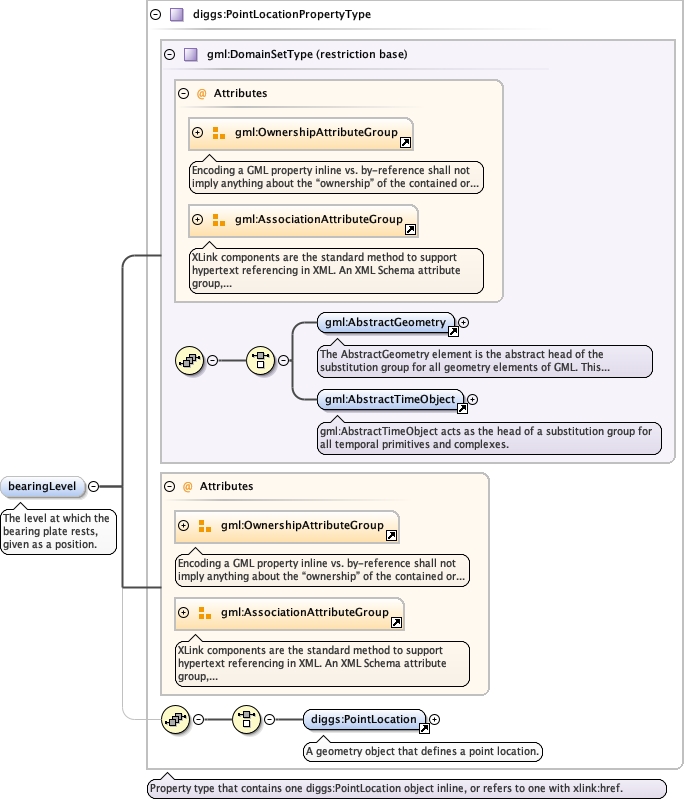
<element minOccurs="0" name="bearingLevel" type="diggs:PointLocationPropertyType"><annotation><documentation>The level at which the bearing plate rests, given as a position.</documentation></annotation></element>
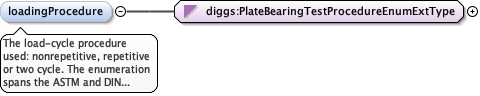
The load-cycle procedure used: nonrepetitive, repetitive or twocycle. The enumeration spans the ASTM and DIN traditions describedat diggs:AbstractPlateBearingTestProcedure. Values come from theenumerated list, or "Other: xx", where xx is a user-defined termwhose meaning differs from every listed value (not a synonym ofone).
<element minOccurs="0" name="loadingProcedure" type="diggs:PlateBearingTestProcedureEnumExtType"><annotation><documentation>The load-cycle procedure used: nonrepetitive, repetitive or two cycle. The enumeration spans the ASTM and DIN traditions described at diggs:AbstractPlateBearingTestProcedure. Values come from the enumerated list, or "Other: xx", where xx is a user-defined term whose meaning differs from every listed value (not a synonym of one).</documentation></annotation></element>
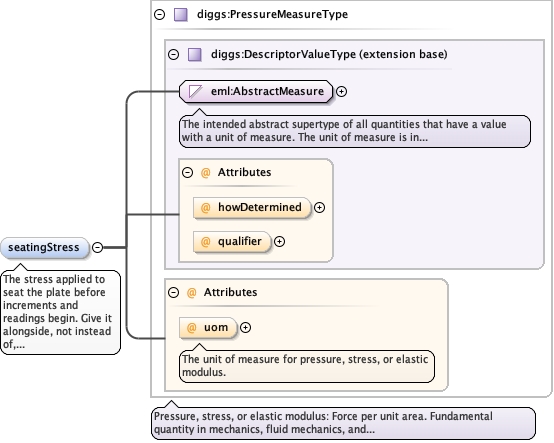
The unit of measure for pressure, stress, or elastic modulus.
Source
<element minOccurs="0" name="seatingStress" type="diggs:PressureMeasureType"><annotation><documentation>The stress applied to seat the plate before increments and readings begin. Give it alongside, not instead of, seatingLoad.</documentation></annotation></element>
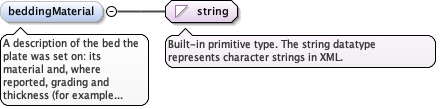
A description of the bed the plate was set on: its material and,where reported, grading and thickness (for example "dry medium sand,25 mm maximum" or "gypsum plaster").
Diagram
Type
string
Properties
content
simple
minOccurs
0
Source
<element minOccurs="0" name="beddingMaterial" type="string"><annotation><documentation>A description of the bed the plate was set on: its material and, where reported, grading and thickness (for example "dry medium sand, 25 mm maximum" or "gypsum plaster").</documentation></annotation></element>
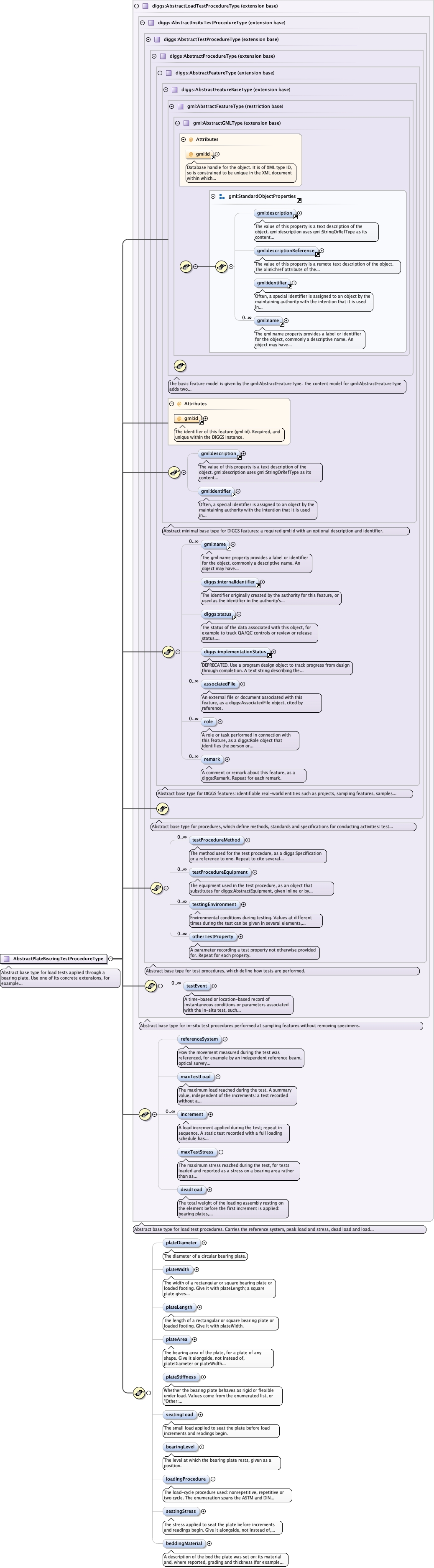
Complex Type diggs:AbstractPlateBearingTestProcedureType
Namespace
http://diggsml.org/schemas/3
Annotations
Abstract base type for load tests applied through a bearing plate. Use one of itsconcrete extensions, for example diggs:PlateLoadTest.
Database handle for the object. It is of XML type ID, so is constrained to beunique in the XML document within which it occurs. An external identifier for the object inthe form of a URI may be constructed using standard XML and XPointer methods. This is doneby concatenating the URI for the document, a fragment separator, and the value of the idattribute.
Source
<complexType abstract="true" name="AbstractPlateBearingTestProcedureType"><annotation><documentation>Abstract base type for load tests applied through a bearing plate. Use one of its concrete extensions, for example diggs:PlateLoadTest.</documentation></annotation><complexContent><extension base="diggs:AbstractLoadTestProcedureType"><sequence><element minOccurs="0" name="plateDiameter" type="diggs:LengthMeasureType"><annotation><documentation>The diameter of a circular bearing plate.</documentation></annotation></element><element minOccurs="0" name="plateWidth" type="diggs:LengthMeasureType"><annotation><documentation>The width of a rectangular or square bearing plate or loaded footing. Give it with plateLength; a square plate gives the same value for both.</documentation></annotation></element><element minOccurs="0" name="plateLength" type="diggs:LengthMeasureType"><annotation><documentation>The length of a rectangular or square bearing plate or loaded footing. Give it with plateWidth.</documentation></annotation></element><element minOccurs="0" name="plateArea" type="diggs:AreaMeasureType"><annotation><documentation>The bearing area of the plate, for a plate of any shape. Give it alongside, not instead of, plateDiameter or plateWidth and plateLength; where they disagree, the dimensions prevail.</documentation></annotation></element><element minOccurs="0" name="plateStiffness" type="diggs:PlateBearingTestStiffnessEnumExtType"><annotation><documentation>Whether the bearing plate behaves as rigid or flexible under load. Values come from the enumerated list, or "Other: xx", where xx is a user-defined term whose meaning differs from every listed value (not a synonym of one).</documentation></annotation></element><element minOccurs="0" name="seatingLoad" type="diggs:ForceMeasureType"><annotation><documentation>The small load applied to seat the plate before load increments and readings begin.</documentation></annotation></element><element minOccurs="0" name="bearingLevel" type="diggs:PointLocationPropertyType"><annotation><documentation>The level at which the bearing plate rests, given as a position.</documentation></annotation></element><element minOccurs="0" name="loadingProcedure" type="diggs:PlateBearingTestProcedureEnumExtType"><annotation><documentation>The load-cycle procedure used: nonrepetitive, repetitive or two cycle. The enumeration spans the ASTM and DIN traditions described at diggs:AbstractPlateBearingTestProcedure. Values come from the enumerated list, or "Other: xx", where xx is a user-defined term whose meaning differs from every listed value (not a synonym of one).</documentation></annotation></element><element minOccurs="0" name="seatingStress" type="diggs:PressureMeasureType"><annotation><documentation>The stress applied to seat the plate before increments and readings begin. Give it alongside, not instead of, seatingLoad.</documentation></annotation></element><element minOccurs="0" name="beddingMaterial" type="string"><annotation><documentation>A description of the bed the plate was set on: its material and, where reported, grading and thickness (for example "dry medium sand, 25 mm maximum" or "gypsum plaster").</documentation></annotation></element></sequence></extension></complexContent></complexType>