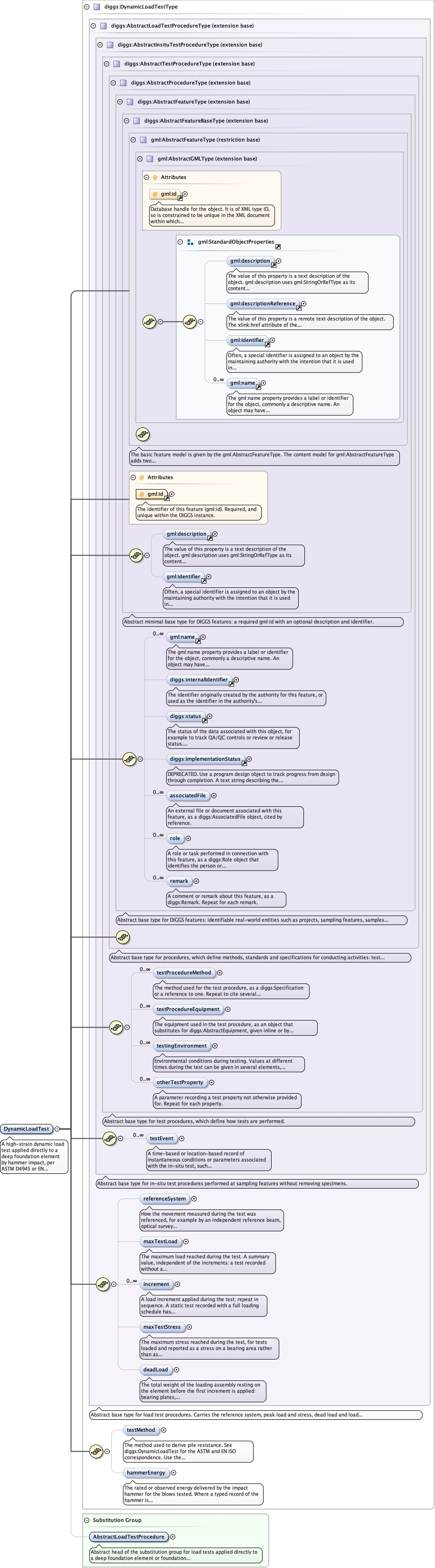
A high-strain dynamic load test applied directly to a deep foundation element byhammer impact, per ASTM D4945 or EN ISO 22477-4. ASTM D4945 isstrain-and-acceleration ("PDA") impact testing, in US practice almost always pairedwith CAPWAP or an equivalent signal-matching analysis (a form of wave equationanalysis) to derive static capacity. EN ISO 22477-4 names four methods under onestandard: dynamic impact testing (the ASTM D4945 method), driving formulae, waveequation analysis, and multi-blow dynamic testing (capacity derived from a series ofblows at different displacement and velocity levels). The vocabulary of testMethodcarries all four, plus signal_matching for the CAPWAP-style analysis that ASTMpractice names separately from the base impact method. The results of a dynamic loadtest on a completed element are carried by Test/outcome as a ResultSet of force,velocity and capacity values; diggs:PDARecordType belongs to pile drivingactivities.
Database handle for the object. It is of XML type ID, so is constrained to beunique in the XML document within which it occurs. An external identifier for the object inthe form of a URI may be constructed using standard XML and XPointer methods. This is doneby concatenating the URI for the document, a fragment separator, and the value of the idattribute.
Source
<element name="DynamicLoadTest" type="diggs:DynamicLoadTestType" abstract="false" substitutionGroup="diggs:AbstractLoadTestProcedure"><annotation><documentation>A high-strain dynamic load test applied directly to a deep foundation element by hammer impact, per ASTM D4945 or EN ISO 22477-4. ASTM D4945 is strain-and-acceleration ("PDA") impact testing, in US practice almost always paired with CAPWAP or an equivalent signal-matching analysis (a form of wave equation analysis) to derive static capacity. EN ISO 22477-4 names four methods under one standard: dynamic impact testing (the ASTM D4945 method), driving formulae, wave equation analysis, and multi-blow dynamic testing (capacity derived from a series of blows at different displacement and velocity levels). The vocabulary of testMethod carries all four, plus signal_matching for the CAPWAP-style analysis that ASTM practice names separately from the base impact method. The results of a dynamic load test on a completed element are carried by Test/outcome as a ResultSet of force, velocity and capacity values; diggs:PDARecordType belongs to pile driving activities.</documentation></annotation></element>