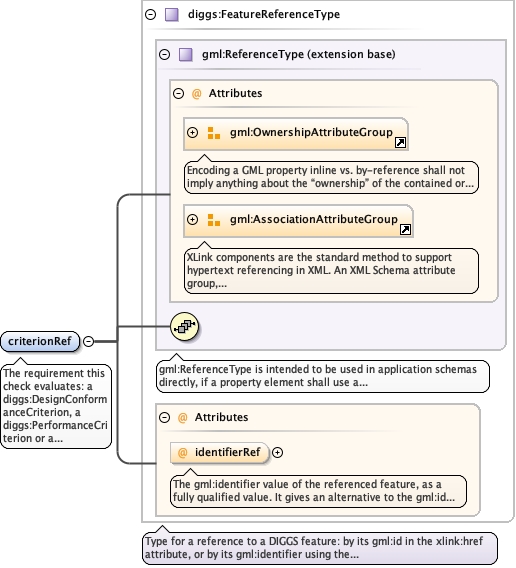
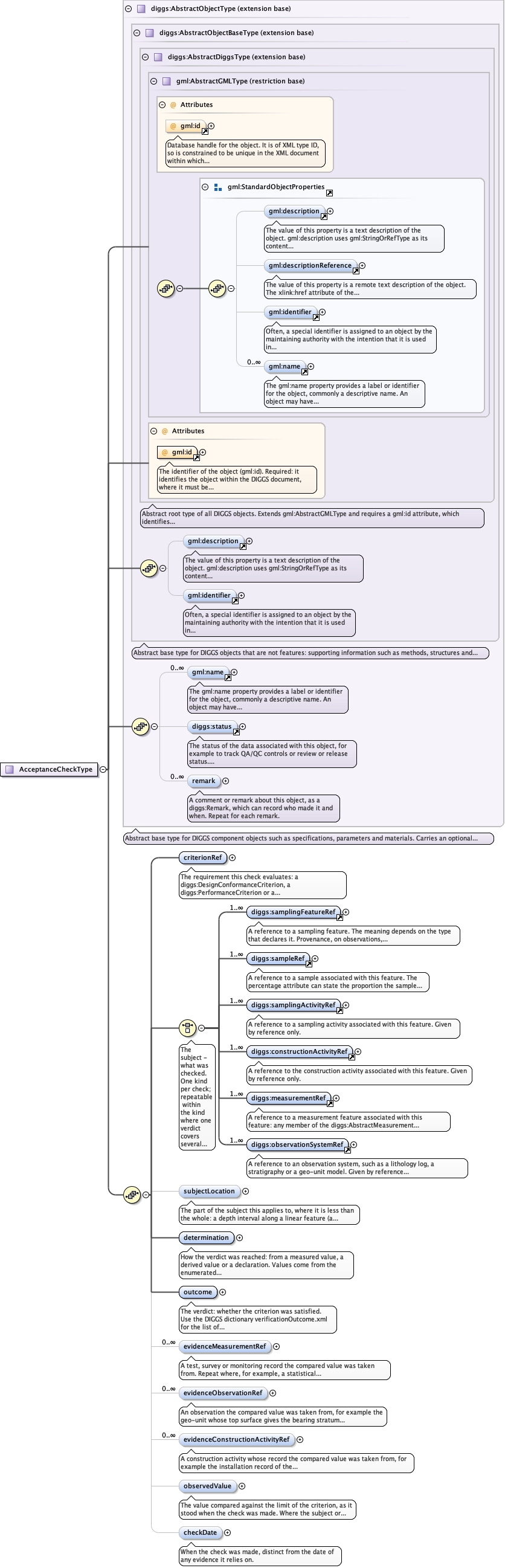
The requirement this check evaluates: adiggs:DesignConformanceCriterion, a diggs:PerformanceCriterion or adiggs:CompositeAcceptanceCriterion. The criterion is theauthoritative statement of the property, operator and limit. Toevaluate several criteria as one requirement, cite a compositecriterion. Given by reference only.
The gml:identifier value of the referenced feature, as a fully qualifiedvalue. It gives an alternative to the gml:id in xlink:href for findingthe referenced feature, mainly to reference a feature by a globallyunique identifier and where naming conflicts occur with gml:id whenaccessing data in external files.
<element name="criterionRef" type="diggs:FeatureReferenceType"><annotation><appinfo source="urn:x-gml:targetElement">diggs:AbstractProgramSpecification</appinfo><documentation>The requirement this check evaluates: a diggs:DesignConformanceCriterion, a diggs:PerformanceCriterion or a diggs:CompositeAcceptanceCriterion. The criterion is the authoritative statement of the property, operator and limit. To evaluate several criteria as one requirement, cite a composite criterion. Given by reference only.</documentation></annotation></element>
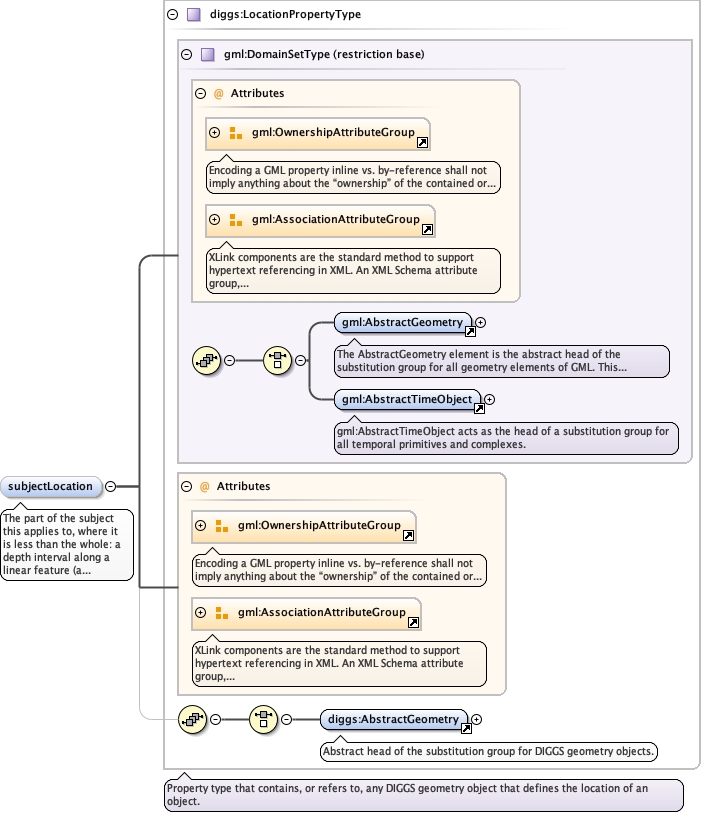
The part of the subject this applies to, where it is less than thewhole: a depth interval along a linear feature (a grout stage, ananchor bond length or a column segment), an elevation band (a filllift) or an area. Omit it where it applies to the whole subject.
<element minOccurs="0" name="subjectLocation" type="diggs:LocationPropertyType"><annotation><documentation>The part of the subject this applies to, where it is less than the whole: a depth interval along a linear feature (a grout stage, an anchor bond length or a column segment), an elevation band (a fill lift) or an area. Omit it where it applies to the whole subject.</documentation></annotation></element>
The compared value was measured or recorded directly - on thesubject itself or in cited evidence.
enumeration
derived
The compared value was computed from recorded values - forexample an as-built position against its design position, or theembedment of a column toe below a modelled unit surface.
enumeration
declared
No value was compared; conformance was asserted by the partyidentified on the evaluation - for example by inspection.
Source
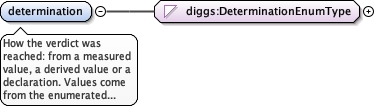
<element name="determination" type="diggs:DeterminationEnumType"><annotation><documentation>How the verdict was reached: from a measured value, a derived value or a declaration. Values come from the enumerated list.</documentation></annotation></element>
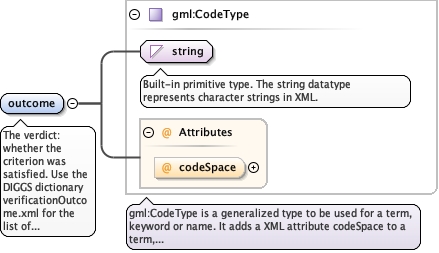
The verdict: whether the criterion was satisfied. Use the DIGGSdictionary verificationOutcome.xml for the list of values; it isshared with diggs:DesignVerification so that a design-side and anas-built verdict read the same way.
<element name="outcome" type="gml:CodeType"><annotation><documentation>The verdict: whether the criterion was satisfied. Use the DIGGS dictionary verificationOutcome.xml for the list of values; it is shared with diggs:DesignVerification so that a design-side and an as-built verdict read the same way.</documentation></annotation></element>
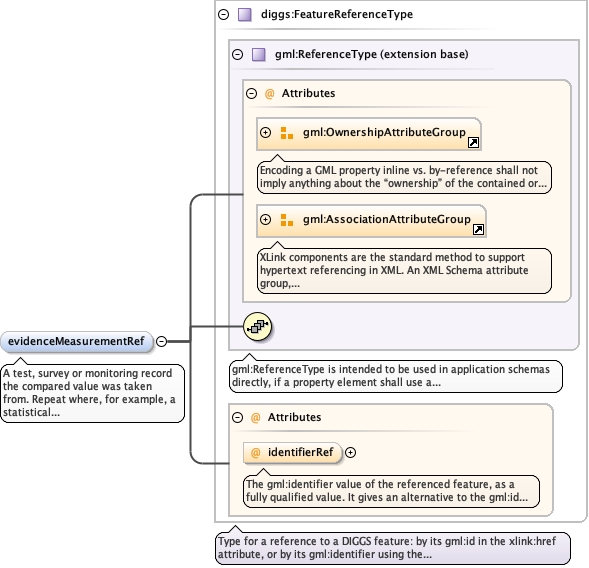
A test, survey or monitoring record the compared value was takenfrom. Repeat where, for example, a statistical criterion draws onseveral tests. Absent where the value is read from the subjectitself, or where the determination is declared. Given by referenceonly.
The gml:identifier value of the referenced feature, as a fully qualifiedvalue. It gives an alternative to the gml:id in xlink:href for findingthe referenced feature, mainly to reference a feature by a globallyunique identifier and where naming conflicts occur with gml:id whenaccessing data in external files.
<element minOccurs="0" maxOccurs="unbounded" name="evidenceMeasurementRef" type="diggs:FeatureReferenceType"><annotation><appinfo source="urn:x-gml:targetElement">diggs:AbstractMeasurement</appinfo><documentation>A test, survey or monitoring record the compared value was taken from. Repeat where, for example, a statistical criterion draws on several tests. Absent where the value is read from the subject itself, or where the determination is declared. Given by reference only.</documentation></annotation></element>
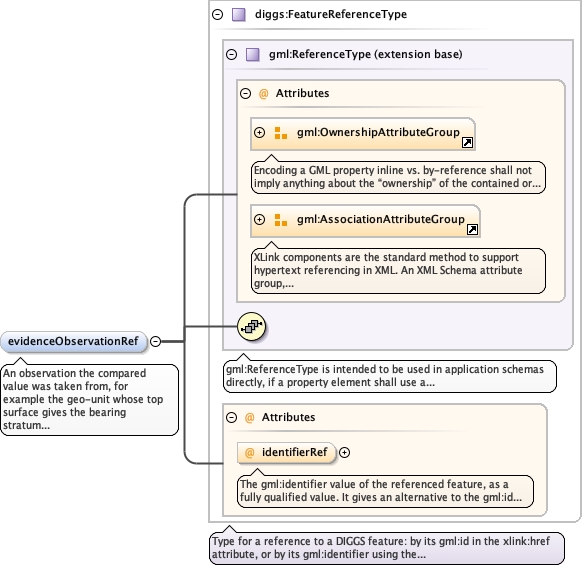
An observation the compared value was taken from, for example thegeo-unit whose top surface gives the bearing stratum level at acolumn. Repeat for several. Given by reference only.
The gml:identifier value of the referenced feature, as a fully qualifiedvalue. It gives an alternative to the gml:id in xlink:href for findingthe referenced feature, mainly to reference a feature by a globallyunique identifier and where naming conflicts occur with gml:id whenaccessing data in external files.
<element minOccurs="0" maxOccurs="unbounded" name="evidenceObservationRef" type="diggs:FeatureReferenceType"><annotation><appinfo source="urn:x-gml:targetElement">diggs:AbstractObservation</appinfo><documentation>An observation the compared value was taken from, for example the geo-unit whose top surface gives the bearing stratum level at a column. Repeat for several. Given by reference only.</documentation></annotation></element>
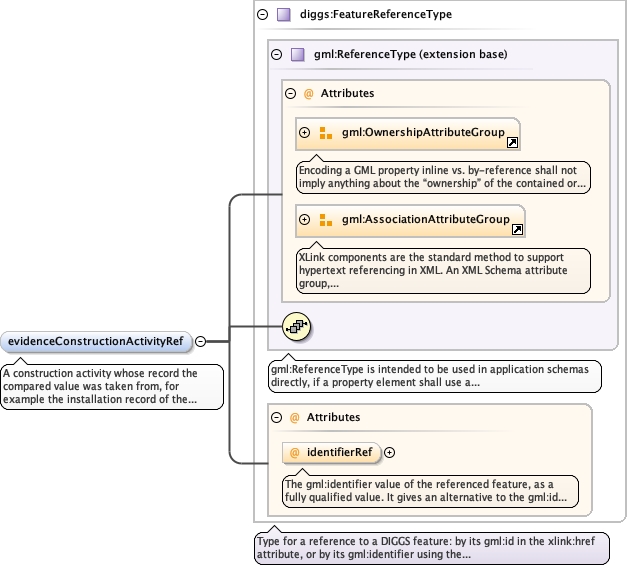
A construction activity whose record the compared value was takenfrom, for example the installation record of the activity thatformed a column, from which the depth gained in the last minutes ofdrilling is read. The activity is cited, not the record inside it.Repeat for several. Given by reference only.
The gml:identifier value of the referenced feature, as a fully qualifiedvalue. It gives an alternative to the gml:id in xlink:href for findingthe referenced feature, mainly to reference a feature by a globallyunique identifier and where naming conflicts occur with gml:id whenaccessing data in external files.
<element minOccurs="0" maxOccurs="unbounded" name="evidenceConstructionActivityRef" type="diggs:FeatureReferenceType"><annotation><appinfo source="urn:x-gml:targetElement">diggs:AbstractConstructionActivity</appinfo><documentation>A construction activity whose record the compared value was taken from, for example the installation record of the activity that formed a column, from which the depth gained in the last minutes of drilling is read. The activity is cited, not the record inside it. Repeat for several. Given by reference only.</documentation></annotation></element>
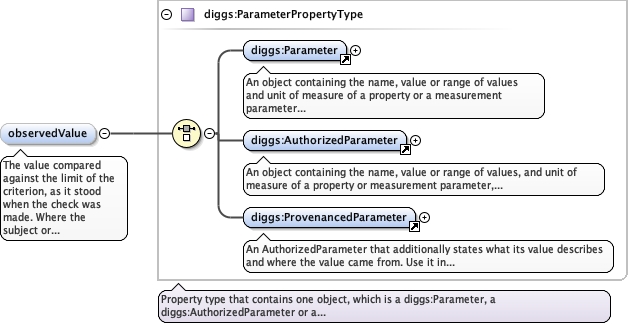
The value compared against the limit of the criterion, as it stoodwhen the check was made. Where the subject or evidence travels withthe file it is the authority; this value lets the verdict be readwithout it. Normally absent for a declared determination.
<element minOccurs="0" name="observedValue" type="diggs:ParameterPropertyType"><annotation><documentation>The value compared against the limit of the criterion, as it stood when the check was made. Where the subject or evidence travels with the file it is the authority; this value lets the verdict be read without it. Normally absent for a declared determination.</documentation></annotation></element>
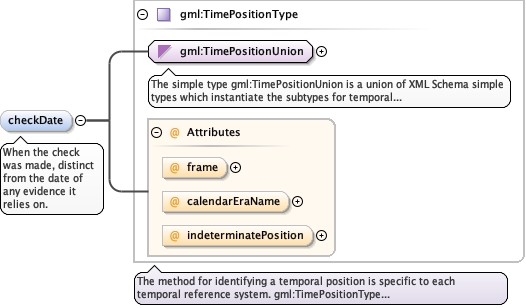
<element minOccurs="0" name="checkDate" type="gml:TimePositionType"><annotation><documentation>When the check was made, distinct from the date of any evidence it relies on.</documentation></annotation></element>
Database handle for the object. It is of XML type ID, so is constrained to beunique in the XML document within which it occurs. An external identifier for the object inthe form of a URI may be constructed using standard XML and XPointer methods. This is doneby concatenating the URI for the document, a fragment separator, and the value of the idattribute.
Source
<complexType name="AcceptanceCheckType"><complexContent><extension base="diggs:AbstractObjectType"><sequence><element name="criterionRef" type="diggs:FeatureReferenceType"><annotation><appinfo source="urn:x-gml:targetElement">diggs:AbstractProgramSpecification</appinfo><documentation>The requirement this check evaluates: a diggs:DesignConformanceCriterion, a diggs:PerformanceCriterion or a diggs:CompositeAcceptanceCriterion. The criterion is the authoritative statement of the property, operator and limit. To evaluate several criteria as one requirement, cite a composite criterion. Given by reference only.</documentation></annotation></element><choice><annotation><documentation>The subject - what was checked. One kind per check; repeatable within the kind where one verdict covers several subjects, as a criterion evaluated over a population does.</documentation></annotation><element maxOccurs="unbounded" ref="diggs:samplingFeatureRef"/><element maxOccurs="unbounded" ref="diggs:sampleRef"/><element maxOccurs="unbounded" ref="diggs:samplingActivityRef"/><element maxOccurs="unbounded" ref="diggs:constructionActivityRef"/><element maxOccurs="unbounded" ref="diggs:measurementRef"/><element maxOccurs="unbounded" ref="diggs:observationSystemRef"/></choice><element minOccurs="0" name="subjectLocation" type="diggs:LocationPropertyType"><annotation><documentation>The part of the subject this applies to, where it is less than the whole: a depth interval along a linear feature (a grout stage, an anchor bond length or a column segment), an elevation band (a fill lift) or an area. Omit it where it applies to the whole subject.</documentation></annotation></element><element name="determination" type="diggs:DeterminationEnumType"><annotation><documentation>How the verdict was reached: from a measured value, a derived value or a declaration. Values come from the enumerated list.</documentation></annotation></element><element name="outcome" type="gml:CodeType"><annotation><documentation>The verdict: whether the criterion was satisfied. Use the DIGGS dictionary verificationOutcome.xml for the list of values; it is shared with diggs:DesignVerification so that a design-side and an as-built verdict read the same way.</documentation></annotation></element><element minOccurs="0" maxOccurs="unbounded" name="evidenceMeasurementRef" type="diggs:FeatureReferenceType"><annotation><appinfo source="urn:x-gml:targetElement">diggs:AbstractMeasurement</appinfo><documentation>A test, survey or monitoring record the compared value was taken from. Repeat where, for example, a statistical criterion draws on several tests. Absent where the value is read from the subject itself, or where the determination is declared. Given by reference only.</documentation></annotation></element><element minOccurs="0" maxOccurs="unbounded" name="evidenceObservationRef" type="diggs:FeatureReferenceType"><annotation><appinfo source="urn:x-gml:targetElement">diggs:AbstractObservation</appinfo><documentation>An observation the compared value was taken from, for example the geo-unit whose top surface gives the bearing stratum level at a column. Repeat for several. Given by reference only.</documentation></annotation></element><element minOccurs="0" maxOccurs="unbounded" name="evidenceConstructionActivityRef" type="diggs:FeatureReferenceType"><annotation><appinfo source="urn:x-gml:targetElement">diggs:AbstractConstructionActivity</appinfo><documentation>A construction activity whose record the compared value was taken from, for example the installation record of the activity that formed a column, from which the depth gained in the last minutes of drilling is read. The activity is cited, not the record inside it. Repeat for several. Given by reference only.</documentation></annotation></element><element minOccurs="0" name="observedValue" type="diggs:ParameterPropertyType"><annotation><documentation>The value compared against the limit of the criterion, as it stood when the check was made. Where the subject or evidence travels with the file it is the authority; this value lets the verdict be read without it. Normally absent for a declared determination.</documentation></annotation></element><element minOccurs="0" name="checkDate" type="gml:TimePositionType"><annotation><documentation>When the check was made, distinct from the date of any evidence it relies on.</documentation></annotation></element></sequence></extension></complexContent></complexType>