Showing:

Annotations
Attributes
Diagrams
Instances
Model
Properties
Source
Element diggs:AbstractObservation
Namespace http://diggsml.org/schemas/3
Annotations
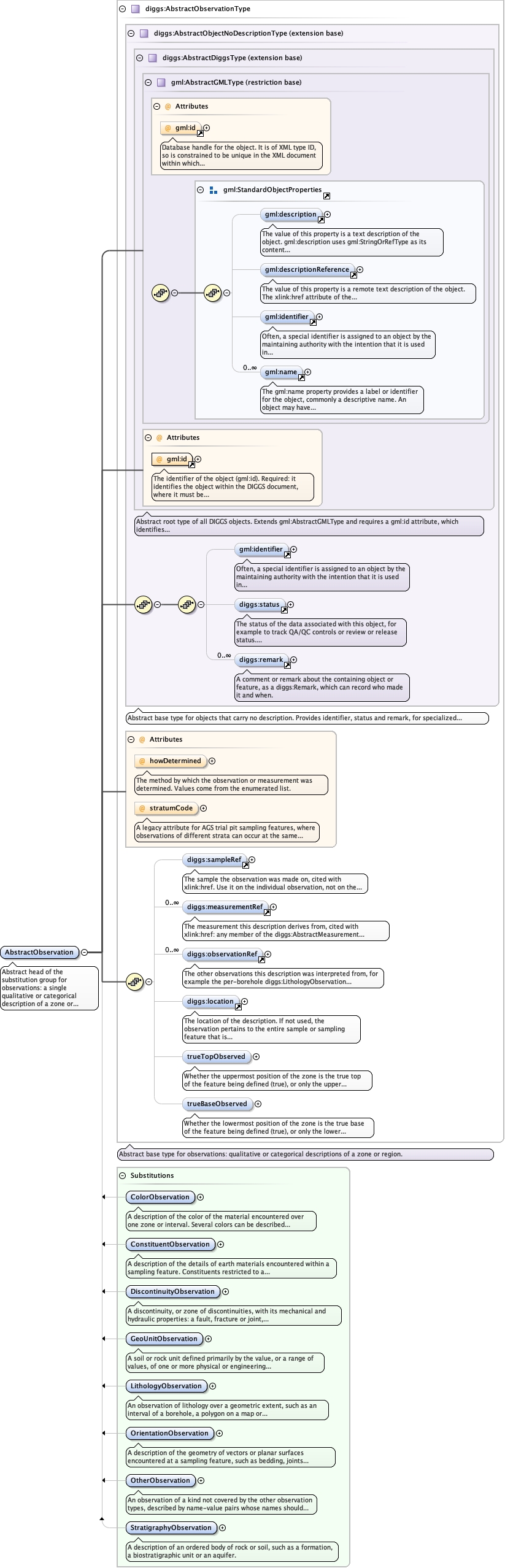
Abstract head of the substitution group for observations: a single qualitative or
categorical description of a zone or region, as opposed to the
diggs:AbstractObservationSystem that collects many of them.
diggs:FractureObservation and diggs:PlacedObservation are not members despite their
names: FractureObservationType descends from diggs:AbstractObjectType and
PlacedObservationType from diggs:AbstractComponentObjectBaseType.
Diagram
Diagramgml3_2Profile_diggs_xsd_Attribute_gml_id.tmp#idgml3_2Profile_diggs_xsd_Element_gml_description.tmp#descriptiongml3_2Profile_diggs_xsd_Element_gml_descriptionReference.tmp#descriptionReferencegml3_2Profile_diggs_xsd_Element_gml_identifier.tmp#identifiergml3_2Profile_diggs_xsd_Element_gml_name.tmp#namegml3_2Profile_diggs_xsd_Element_Group_gml_StandardObjectProperties.tmp#StandardObjectPropertiesgml3_2Profile_diggs_xsd_Complex_Type_gml_AbstractGMLType.tmp#AbstractGMLTypegml3_2Profile_diggs_xsd_Attribute_gml_id.tmp#idAbstractTypes_xsd_Complex_Type_diggs_AbstractDiggsType.tmp#AbstractDiggsTypegml3_2Profile_diggs_xsd_Element_gml_identifier.tmp#identifierCommon_xsd_Element_diggs_status.tmp#statusCommon_xsd_Element_diggs_remark_1.tmp#http___diggsml.org_schemas_3_remarkAbstractTypes_xsd_Complex_Type_diggs_AbstractObjectNoDescriptionType.tmp#AbstractObjectNoDescriptionTypeAbstractTypes_xsd_Complex_Type_diggs_AbstractObservationType.tmp#AbstractObservationType_howDeterminedAbstractTypes_xsd_Complex_Type_diggs_AbstractObservationType.tmp#AbstractObservationType_stratumCodeCommon_xsd_Element_diggs_sampleRef.tmp#sampleRefCommon_xsd_Element_diggs_measurementRef.tmp#measurementRefCommon_xsd_Element_diggs_observationRef.tmp#observationRefCommon_xsd_Element_diggs_location.tmp#locationAbstractTypes_xsd_Complex_Type_diggs_AbstractObservationType.tmp#AbstractObservationType_trueTopObservedAbstractTypes_xsd_Complex_Type_diggs_AbstractObservationType.tmp#AbstractObservationType_trueBaseObservedAbstractTypes_xsd_Complex_Type_diggs_AbstractObservationType.tmp#AbstractObservationTypeExtObservation_xsd_Element_diggs_ColorObservation.tmp#ColorObservationExtObservation_xsd_Element_diggs_ConstituentObservation.tmp#ConstituentObservationCore_xsd_Element_diggs_DiscontinuityObservation.tmp#DiscontinuityObservationCore_xsd_Element_diggs_GeoUnitObservation.tmp#GeoUnitObservationCore_xsd_Element_diggs_LithologyObservation.tmp#LithologyObservationExtObservation_xsd_Element_diggs_OrientationObservation.tmp#OrientationObservationExtObservation_xsd_Element_diggs_OtherObservation.tmp#OtherObservationCore_xsd_Element_diggs_StratigraphyObservation.tmp#StratigraphyObservation
Type diggs:AbstractObservationType
Type hierarchy
Properties
content complex
abstract true
Substitution Group
Model
Children diggs:location, diggs:measurementRef, diggs:observationRef, diggs:remark, diggs:sampleRef, diggs:status, diggs:trueBaseObserved, diggs:trueTopObserved, gml:identifier
Instance
<diggs:AbstractObservation howDetermined="" gml:id="" stratumCode="" xmlns:diggs="http://diggsml.org/schemas/3" xmlns:gml="http://www.opengis.net/gml/3.2">
  <gml:identifier codeSpace="">{0,1}</gml:identifier>
  <diggs:status codeSpace="">{0,1}</diggs:status>
  <diggs:remark>{0,unbounded}</diggs:remark>
  <diggs:sampleRef xlink:href="" identifierRef="" nilReason="" owns="false" percentage="">{0,1}</diggs:sampleRef>
  <diggs:measurementRef xlink:href="" identifierRef="" nilReason="" owns="false">{0,unbounded}</diggs:measurementRef>
  <diggs:observationRef xlink:href="" identifierRef="" nilReason="" owns="false">{0,unbounded}</diggs:observationRef>
  <diggs:location owns="false" xlink:href="" nilReason="">{0,1}</diggs:location>
  <diggs:trueTopObserved>{0,1}</diggs:trueTopObserved>
  <diggs:trueBaseObserved>{0,1}</diggs:trueBaseObserved>
</diggs:AbstractObservation>
Attributes
QName Type Use Annotation
gml:id ID required
Database handle for the object. It is of XML type ID, so is constrained to be
unique in the XML document within which it occurs. An external identifier for the object in
the form of a URI may be constructed using standard XML and XPointer methods. This is done
by concatenating the URI for the document, a fragment separator, and the value of the id
attribute.
howDetermined diggs:DescriptorMethodEnumType optional
The method by which the observation or measurement was determined.
Values come from the enumerated list.
stratumCode string optional
A legacy attribute for AGS trial pit sampling features, where
observations of different strata can occur at the same depth in a pit: a
reference letter or number whose sole purpose is to link the stratum on
the face sketch of the trial pit to the observation.
Source
<element abstract="true" name="AbstractObservation" type="diggs:AbstractObservationType">
  <annotation>
    <documentation>Abstract head of the substitution group for observations: a single qualitative or categorical description of a zone or region, as opposed to the diggs:AbstractObservationSystem that collects many of them. diggs:FractureObservation and diggs:PlacedObservation are not members despite their names: FractureObservationType descends from diggs:AbstractObjectType and PlacedObservationType from diggs:AbstractComponentObjectBaseType.</documentation>
  </annotation>
</element>