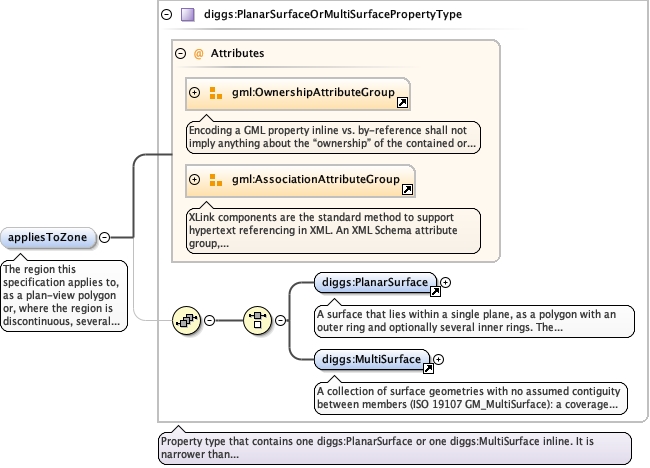
The region this specification applies to, as a plan-view polygon or,where the region is discontinuous, several polygons. A check, not amembership test: it does not establish which features thespecification governs, which is asserted only from the realized sidethrough programSpecificationRef, or from a design that adopts thespecification. Where stated, every feature so established isexpected to have its referencePoint within the region (a node on theboundary counts as inside); one that does not is a finding, not areason to exclude it. Where absent, no spatial check applies.Independent of the scope of any citing design: a specificationshared across designs, or cited directly by a feature, has no singledesign scope to inherit the check from.
<element minOccurs="0" name="appliesToZone" type="diggs:PlanarSurfaceOrMultiSurfacePropertyType"><annotation><documentation>The region this specification applies to, as a plan-view polygon or, where the region is discontinuous, several polygons. A check, not a membership test: it does not establish which features the specification governs, which is asserted only from the realized side through programSpecificationRef, or from a design that adopts the specification. Where stated, every feature so established is expected to have its referencePoint within the region (a node on the boundary counts as inside); one that does not is a finding, not a reason to exclude it. Where absent, no spatial check applies. Independent of the scope of any citing design: a specification shared across designs, or cited directly by a feature, has no single design scope to inherit the check from.</documentation></annotation></element>
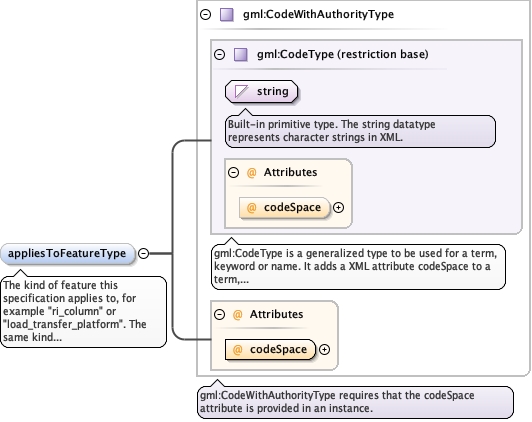
The kind of feature this specification applies to, for example"ri_column" or "load_transfer_platform". The same kind of check asappliesToZone: every feature established as a member throughprogramSpecificationRef or an adopting design is expected to be ofthis type; one that is not is a finding. Where absent, no type checkapplies. The codeSpace is required. For a specification whosesubject is a construction activity, the kind of feature the activitybuilds or acts on. Use the DIGGS dictionary samplingFeatureTypes.xmlfor the list of values.
<element minOccurs="0" name="appliesToFeatureType" type="gml:CodeWithAuthorityType"><annotation><documentation>The kind of feature this specification applies to, for example "ri_column" or "load_transfer_platform". The same kind of check as appliesToZone: every feature established as a member through programSpecificationRef or an adopting design is expected to be of this type; one that is not is a finding. Where absent, no type check applies. The codeSpace is required. For a specification whose subject is a construction activity, the kind of feature the activity builds or acts on. Use the DIGGS dictionary samplingFeatureTypes.xml for the list of values.</documentation></annotation></element>
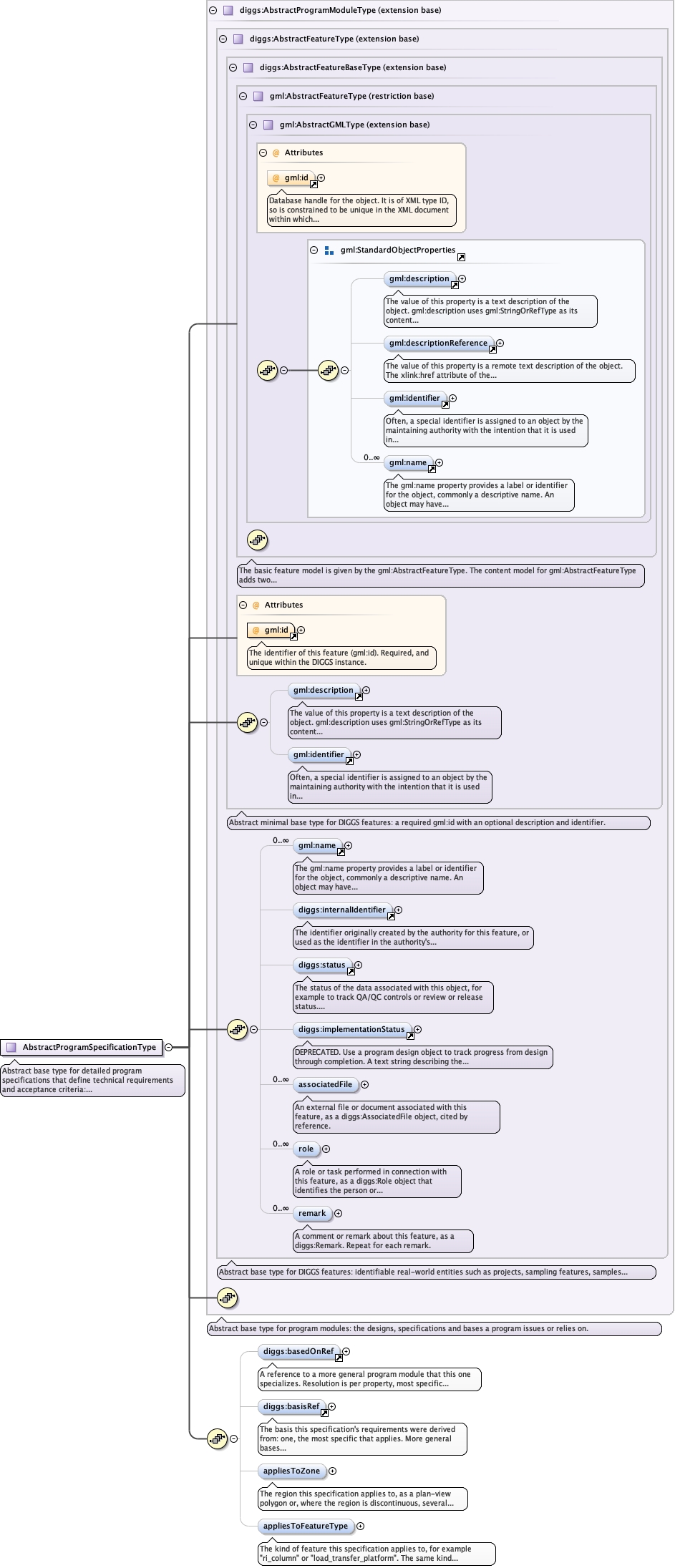
Complex Type diggs:AbstractProgramSpecificationType
Namespace
http://diggsml.org/schemas/3
Annotations
Abstract base type for detailed program specifications that define technicalrequirements and acceptance criteria: references to specific standards (for exampleASTM or AASHTO), numerical acceptance criteria, testing methods and frequencies, andquality control requirements. Unlike designs, specifications are typicallycontractual and establish enforceable requirements. basedOnRef cites a more generalspecification of the same kind that this one specializes; an acceptance criterioncites the specification it elaborates through diggs:partOfSpecificationRef instead,which is a component relationship rather than specialization. basisRef cites thebasis the requirements were derived from.
Database handle for the object. It is of XML type ID, so is constrained to beunique in the XML document within which it occurs. An external identifier for the object inthe form of a URI may be constructed using standard XML and XPointer methods. This is doneby concatenating the URI for the document, a fragment separator, and the value of the idattribute.
Source
<complexType abstract="true" name="AbstractProgramSpecificationType"><annotation><documentation>Abstract base type for detailed program specifications that define technical requirements and acceptance criteria: references to specific standards (for example ASTM or AASHTO), numerical acceptance criteria, testing methods and frequencies, and quality control requirements. Unlike designs, specifications are typically contractual and establish enforceable requirements. basedOnRef cites a more general specification of the same kind that this one specializes; an acceptance criterion cites the specification it elaborates through diggs:partOfSpecificationRef instead, which is a component relationship rather than specialization. basisRef cites the basis the requirements were derived from.</documentation></annotation><complexContent><extension base="diggs:AbstractProgramModuleType"><sequence><element minOccurs="0" ref="diggs:basedOnRef"/><element minOccurs="0" maxOccurs="1" ref="diggs:basisRef"><annotation><documentation>The basis this specification's requirements were derived from: one, the most specific that applies. More general bases are reached through that basis's own basedOnRef chain.</documentation></annotation></element><element minOccurs="0" name="appliesToZone" type="diggs:PlanarSurfaceOrMultiSurfacePropertyType"><annotation><documentation>The region this specification applies to, as a plan-view polygon or, where the region is discontinuous, several polygons. A check, not a membership test: it does not establish which features the specification governs, which is asserted only from the realized side through programSpecificationRef, or from a design that adopts the specification. Where stated, every feature so established is expected to have its referencePoint within the region (a node on the boundary counts as inside); one that does not is a finding, not a reason to exclude it. Where absent, no spatial check applies. Independent of the scope of any citing design: a specification shared across designs, or cited directly by a feature, has no single design scope to inherit the check from.</documentation></annotation></element><element minOccurs="0" name="appliesToFeatureType" type="gml:CodeWithAuthorityType"><annotation><documentation>The kind of feature this specification applies to, for example "ri_column" or "load_transfer_platform". The same kind of check as appliesToZone: every feature established as a member through programSpecificationRef or an adopting design is expected to be of this type; one that is not is a finding. Where absent, no type check applies. The codeSpace is required. For a specification whose subject is a construction activity, the kind of feature the activity builds or acts on. Use the DIGGS dictionary samplingFeatureTypes.xml for the list of values.</documentation></annotation></element></sequence></extension></complexContent></complexType>