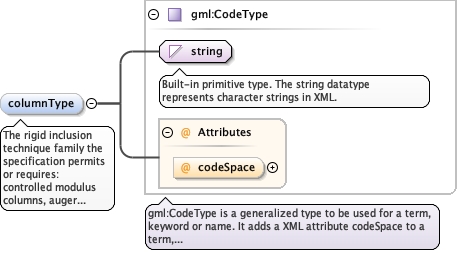
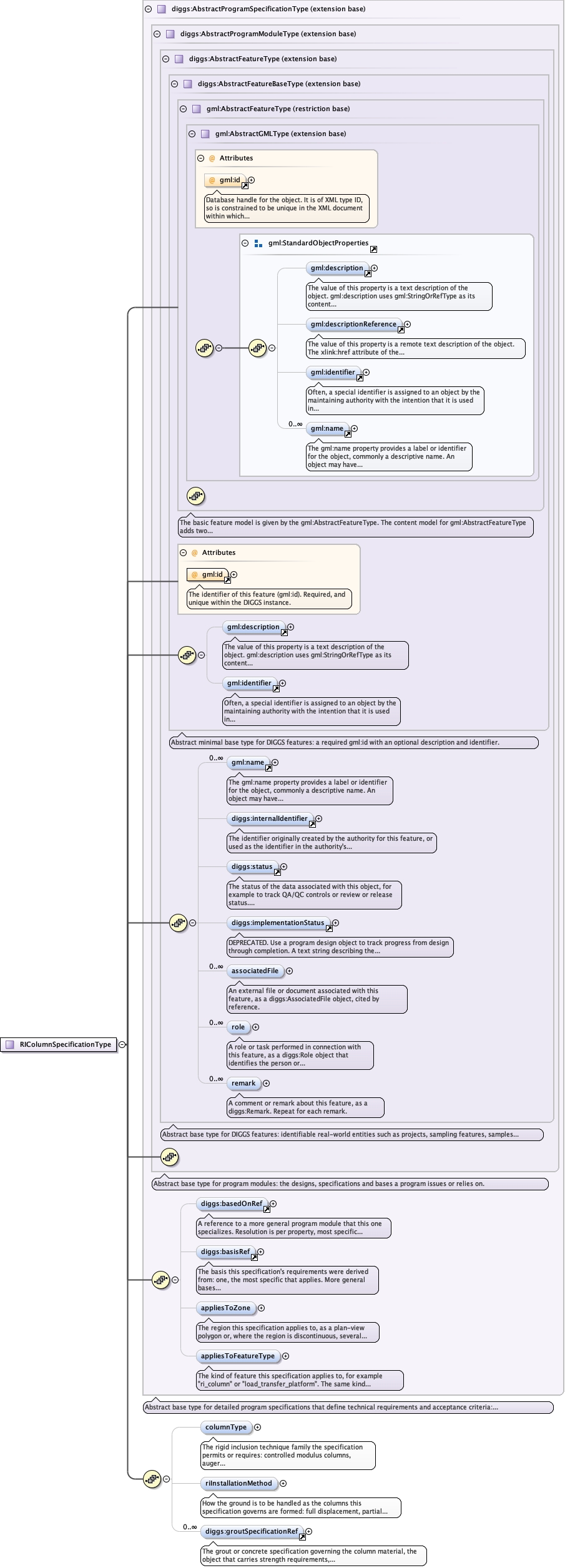
The rigid inclusion technique family the specification permits orrequires: controlled modulus columns, auger cast-in-place,continuous flight auger, vibrated concrete columns, driven precastand so on. It is named and typed like diggs:RIColumnType/columnType,the as-built counterpart. Technique families proliferate underproprietary names, so the vocabulary is a dictionary rather than anenumeration. Use the DIGGS dictionary columnType.xml for the list ofvalues.
<element minOccurs="0" name="columnType" type="gml:CodeType"><annotation><documentation>The rigid inclusion technique family the specification permits or requires: controlled modulus columns, auger cast-in-place, continuous flight auger, vibrated concrete columns, driven precast and so on. It is named and typed like diggs:RIColumnType/columnType, the as-built counterpart. Technique families proliferate under proprietary names, so the vocabulary is a dictionary rather than an enumeration. Use the DIGGS dictionary columnType.xml for the list of values.</documentation></annotation></element>
How the ground is to be handled as the columns this specificationgoverns are formed: full displacement, partial displacement orreplacement. It is the specification-side counterpart ofdiggs:RIColumnType/riInstallationMethod, named and typed to match sothat what is specified and what is recorded share one vocabulary;see that element for why the family is the primary classifier andhow it is constrained against columnType. It is a specificationconcern, not a basis one: it states what the contractor is requiredto do, an output of the design rather than a premise it rests on, sodiggs:RIProgramBasisType carries no technique or family element.Values come from the enumerated list, or "Other: xx", where xx is auser-defined term whose meaning differs from every listed value (nota synonym of one).
<element minOccurs="0" name="riInstallationMethod" type="diggs:RIInstallationMethodEnumExtType"><annotation><documentation>How the ground is to be handled as the columns this specification governs are formed: full displacement, partial displacement or replacement. It is the specification-side counterpart of diggs:RIColumnType/riInstallationMethod, named and typed to match so that what is specified and what is recorded share one vocabulary; see that element for why the family is the primary classifier and how it is constrained against columnType. It is a specification concern, not a basis one: it states what the contractor is required to do, an output of the design rather than a premise it rests on, so diggs:RIProgramBasisType carries no technique or family element. Values come from the enumerated list, or "Other: xx", where xx is a user-defined term whose meaning differs from every listed value (not a synonym of one).</documentation></annotation></element>
Database handle for the object. It is of XML type ID, so is constrained to beunique in the XML document within which it occurs. An external identifier for the object inthe form of a URI may be constructed using standard XML and XPointer methods. This is doneby concatenating the URI for the document, a fragment separator, and the value of the idattribute.
Source
<complexType name="RIColumnSpecificationType"><complexContent><extension base="diggs:AbstractProgramSpecificationType"><sequence><element minOccurs="0" name="columnType" type="gml:CodeType"><annotation><documentation>The rigid inclusion technique family the specification permits or requires: controlled modulus columns, auger cast-in-place, continuous flight auger, vibrated concrete columns, driven precast and so on. It is named and typed like diggs:RIColumnType/columnType, the as-built counterpart. Technique families proliferate under proprietary names, so the vocabulary is a dictionary rather than an enumeration. Use the DIGGS dictionary columnType.xml for the list of values.</documentation></annotation></element><element minOccurs="0" name="riInstallationMethod" type="diggs:RIInstallationMethodEnumExtType"><annotation><documentation>How the ground is to be handled as the columns this specification governs are formed: full displacement, partial displacement or replacement. It is the specification-side counterpart of diggs:RIColumnType/riInstallationMethod, named and typed to match so that what is specified and what is recorded share one vocabulary; see that element for why the family is the primary classifier and how it is constrained against columnType. It is a specification concern, not a basis one: it states what the contractor is required to do, an output of the design rather than a premise it rests on, so diggs:RIProgramBasisType carries no technique or family element. Values come from the enumerated list, or "Other: xx", where xx is a user-defined term whose meaning differs from every listed value (not a synonym of one).</documentation></annotation></element><element minOccurs="0" maxOccurs="unbounded" ref="diggs:groutSpecificationRef"><annotation><appinfo source="urn:x-gml:targetElement">diggs:GroutSpecification</appinfo><documentation>The grout or concrete specification governing the column material, the object that carries strength requirements, permitted deviations and gradation limits. It cites the existing diggs:GroutSpecification, which already carries strengthMinimum, strengthAverage and strength90Percent, rather than a concrete strength class code here. It is a plain reference rather than basedOnRef even though both objects are specifications: a material specification is a component of the column specification, not a generalization of it, so inheritance would be the wrong relation and would pull grout constraints into the resolution chain of this object. Given by reference only. Repeat for each specification.</documentation></annotation></element></sequence></extension></complexContent></complexType>