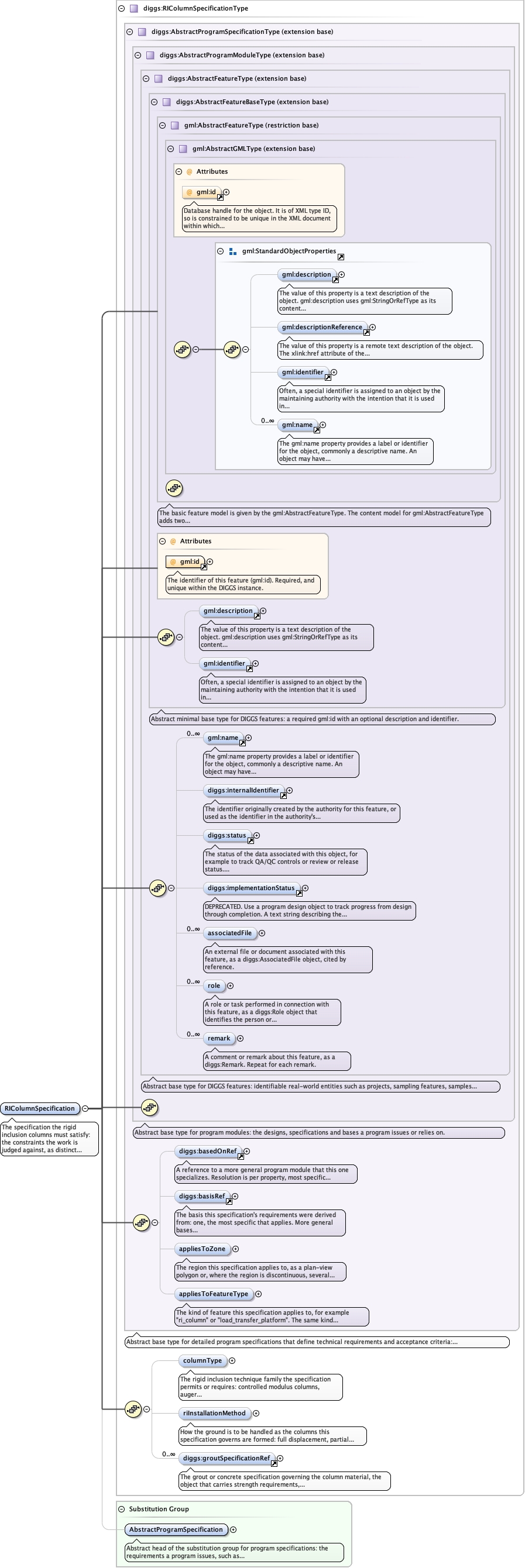
The specification the rigid inclusion columns must satisfy: the constraints the workis judged against, as distinct from the design prepared to satisfy them. It isdeliberately thin. Most of what a column specification says is limits (positiontolerance, verticality tolerance, minimum embedment into the bearing stratum,permitted diameter and length ranges), and each is adiggs:DesignConformanceCriterion or diggs:PerformanceCriterion declared as a siblingunder the specification slot of the program, with an operator, a limit with min,value and max and units, a statistic, and a basis that can express "two times thediameter" as readily as an absolute length. What remains here is the non-limitcontent: what technique is permitted and what material specification governs. It isalso a single stable reference target: a diggs:RIColumn and a design cite it throughprogramSpecificationRef, and each criterion cites it through basedOnRef, which is awithin-head chain and therefore legal.
Database handle for the object. It is of XML type ID, so is constrained to beunique in the XML document within which it occurs. An external identifier for the object inthe form of a URI may be constructed using standard XML and XPointer methods. This is doneby concatenating the URI for the document, a fragment separator, and the value of the idattribute.
Source
<element name="RIColumnSpecification" type="diggs:RIColumnSpecificationType" substitutionGroup="diggs:AbstractProgramSpecification"><annotation><documentation>The specification the rigid inclusion columns must satisfy: the constraints the work is judged against, as distinct from the design prepared to satisfy them. It is deliberately thin. Most of what a column specification says is limits (position tolerance, verticality tolerance, minimum embedment into the bearing stratum, permitted diameter and length ranges), and each is a diggs:DesignConformanceCriterion or diggs:PerformanceCriterion declared as a sibling under the specification slot of the program, with an operator, a limit with min, value and max and units, a statistic, and a basis that can express "two times the diameter" as readily as an absolute length. What remains here is the non-limit content: what technique is permitted and what material specification governs. It is also a single stable reference target: a diggs:RIColumn and a design cite it through programSpecificationRef, and each criterion cites it through basedOnRef, which is a within-head chain and therefore legal.</documentation></annotation></element>