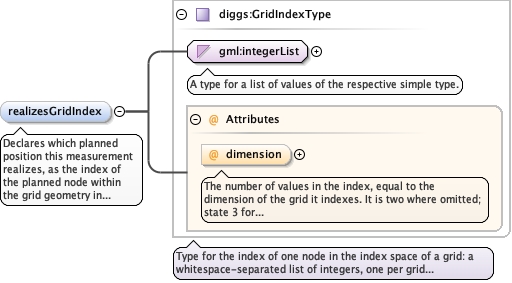
Declares which planned position this measurement realizes, as theindex of the planned node within the grid geometry in themeasurementLocation of the design cited by programDesignRef. Thesame form as on a sampling feature; see diggs:GridIndexType. Itserves a planned set of tests stated as adiggs:ReferenceableGridByArray, using a one-dimensional grid(dimension="1" on the index) for scattered planned positions: a gridnode is not an object and has no gml:id to point at, so the realizedmeasurement carries its index. Omit it for a measurement that wasnot planned or whose design states no grid. A measurement made at aposition other than the planned one states the index of the plannedposition it stands in for. Do not match a realized measurement toits planned position by proximity: a test made away from its plannedposition is what a conformance check exists to catch, and it may lienearer another node.
The number of values in the index, equal to the dimension of the grid itindexes. It is two where omitted; state 3 for an index into athree-dimensional grid.
Source
<element minOccurs="0" name="realizesGridIndex" type="diggs:GridIndexType"><annotation><documentation>Declares which planned position this measurement realizes, as the index of the planned node within the grid geometry in the measurementLocation of the design cited by programDesignRef. The same form as on a sampling feature; see diggs:GridIndexType. It serves a planned set of tests stated as a diggs:ReferenceableGridByArray, using a one-dimensional grid (dimension="1" on the index) for scattered planned positions: a grid node is not an object and has no gml:id to point at, so the realized measurement carries its index. Omit it for a measurement that was not planned or whose design states no grid. A measurement made at a position other than the planned one states the index of the planned position it stands in for. Do not match a realized measurement to its planned position by proximity: a test made away from its planned position is what a conformance check exists to catch, and it may lie nearer another node.</documentation></annotation></element>
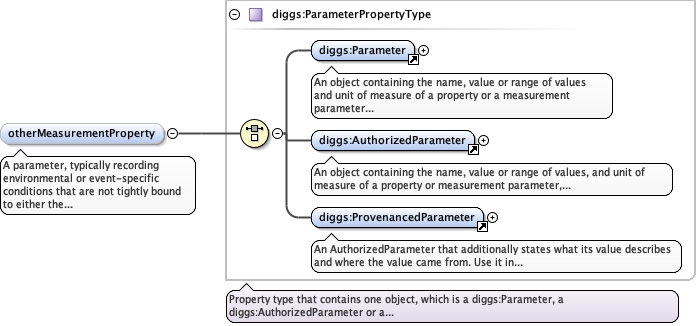
A parameter, typically recording environmental or event-specificconditions that are not tightly bound to either the earth materialswhose properties are estimated or the procedure. Parameters tightlybound to the procedure belong in the procedure object. Repeat foreach parameter.
<element minOccurs="0" name="otherMeasurementProperty" type="diggs:ParameterPropertyType" maxOccurs="unbounded"><annotation><documentation>A parameter, typically recording environmental or event-specific conditions that are not tightly bound to either the earth materials whose properties are estimated or the procedure. Parameters tightly bound to the procedure belong in the procedure object. Repeat for each parameter.</documentation></annotation></element>
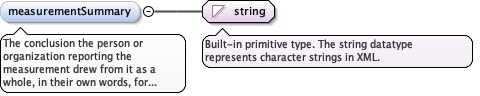
The conclusion the person or organization reporting the measurementdrew from it as a whole, in their own words, for example theintegrity comment of a pile integrity test or the interpretationstated for a load test. It states what the reporter concluded; it isnot an acceptance outcome, which an acceptance evaluation statesagainst a criterion.
Diagram
Type
string
Properties
content
simple
minOccurs
0
Source
<element minOccurs="0" name="measurementSummary" type="string"><annotation><documentation>The conclusion the person or organization reporting the measurement drew from it as a whole, in their own words, for example the integrity comment of a pile integrity test or the interpretation stated for a load test. It states what the reporter concluded; it is not an acceptance outcome, which an acceptance evaluation states against a criterion.</documentation></annotation></element>
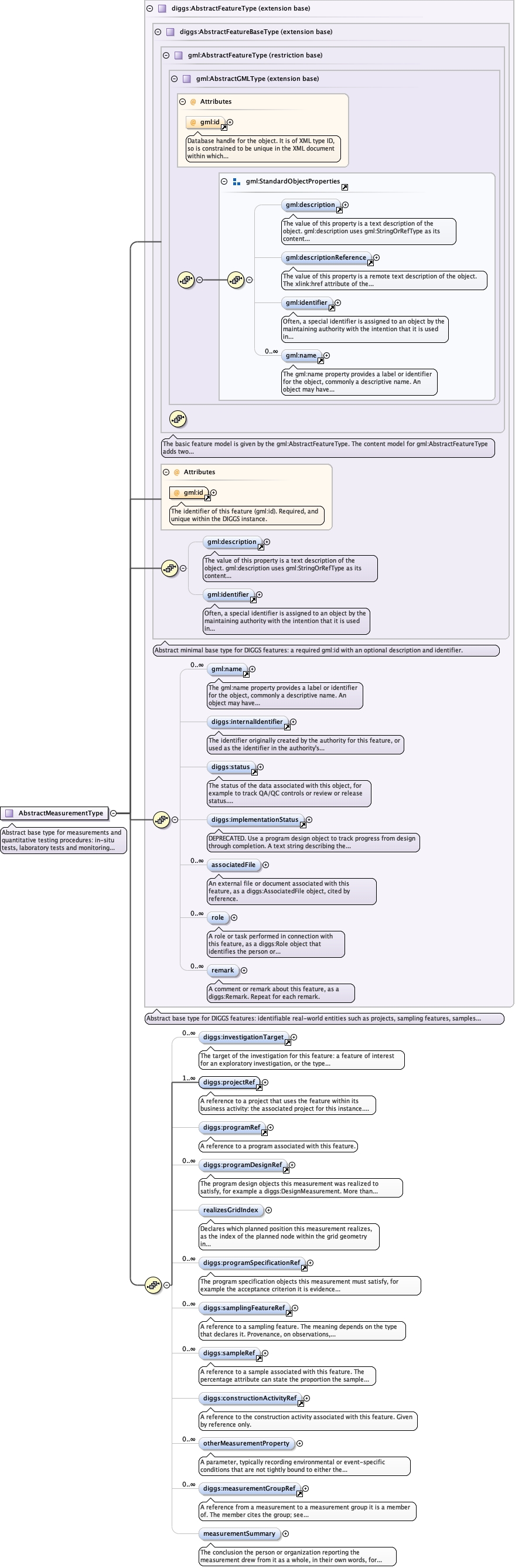
Complex Type diggs:AbstractMeasurementType
Namespace
http://diggsml.org/schemas/3
Annotations
Abstract base type for measurements and quantitative testing procedures: in-situtests, laboratory tests and monitoring activities that produce quantitative data.Concrete extensions include diggs:Test, diggs:MaterialTest and diggs:Monitor.
Database handle for the object. It is of XML type ID, so is constrained to beunique in the XML document within which it occurs. An external identifier for the object inthe form of a URI may be constructed using standard XML and XPointer methods. This is doneby concatenating the URI for the document, a fragment separator, and the value of the idattribute.
Source
<complexType name="AbstractMeasurementType" abstract="true"><annotation><documentation>Abstract base type for measurements and quantitative testing procedures: in-situ tests, laboratory tests and monitoring activities that produce quantitative data. Concrete extensions include diggs:Test, diggs:MaterialTest and diggs:Monitor.</documentation></annotation><complexContent><extension base="diggs:AbstractFeatureType"><sequence><element ref="diggs:investigationTarget" maxOccurs="unbounded" minOccurs="0"/><element ref="diggs:projectRef" maxOccurs="unbounded"/><element minOccurs="0" ref="diggs:programRef" maxOccurs="1"/><element minOccurs="0" maxOccurs="unbounded" ref="diggs:programDesignRef"><annotation><documentation>The program design objects this measurement was realized to satisfy, for example a diggs:DesignMeasurement. More than one may apply where several planning strands govern different aspects of the measurement.</documentation></annotation></element><element minOccurs="0" name="realizesGridIndex" type="diggs:GridIndexType"><annotation><documentation>Declares which planned position this measurement realizes, as the index of the planned node within the grid geometry in the measurementLocation of the design cited by programDesignRef. The same form as on a sampling feature; see diggs:GridIndexType. It serves a planned set of tests stated as a diggs:ReferenceableGridByArray, using a one-dimensional grid (dimension="1" on the index) for scattered planned positions: a grid node is not an object and has no gml:id to point at, so the realized measurement carries its index. Omit it for a measurement that was not planned or whose design states no grid. A measurement made at a position other than the planned one states the index of the planned position it stands in for. Do not match a realized measurement to its planned position by proximity: a test made away from its planned position is what a conformance check exists to catch, and it may lie nearer another node.</documentation></annotation></element><element minOccurs="0" maxOccurs="unbounded" ref="diggs:programSpecificationRef"><annotation><documentation>The program specification objects this measurement must satisfy, for example the acceptance criterion it is evidence for.</documentation></annotation></element><element minOccurs="0" ref="diggs:samplingFeatureRef" maxOccurs="unbounded"/><element maxOccurs="unbounded" minOccurs="0" ref="diggs:sampleRef"/><element minOccurs="0" ref="diggs:constructionActivityRef"/><element minOccurs="0" name="otherMeasurementProperty" type="diggs:ParameterPropertyType" maxOccurs="unbounded"><annotation><documentation>A parameter, typically recording environmental or event-specific conditions that are not tightly bound to either the earth materials whose properties are estimated or the procedure. Parameters tightly bound to the procedure belong in the procedure object. Repeat for each parameter.</documentation></annotation></element><element minOccurs="0" maxOccurs="unbounded" ref="diggs:measurementGroupRef"/><element minOccurs="0" name="measurementSummary" type="string"><annotation><documentation>The conclusion the person or organization reporting the measurement drew from it as a whole, in their own words, for example the integrity comment of a pile integrity test or the interpretation stated for a load test. It states what the reporter concluded; it is not an acceptance outcome, which an acceptance evaluation states against a criterion.</documentation></annotation></element></sequence></extension></complexContent></complexType>