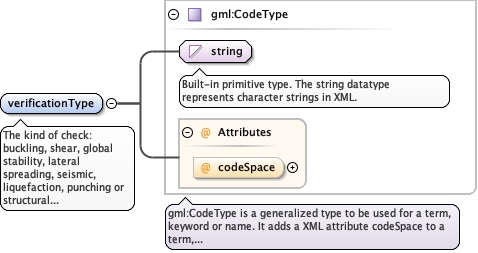
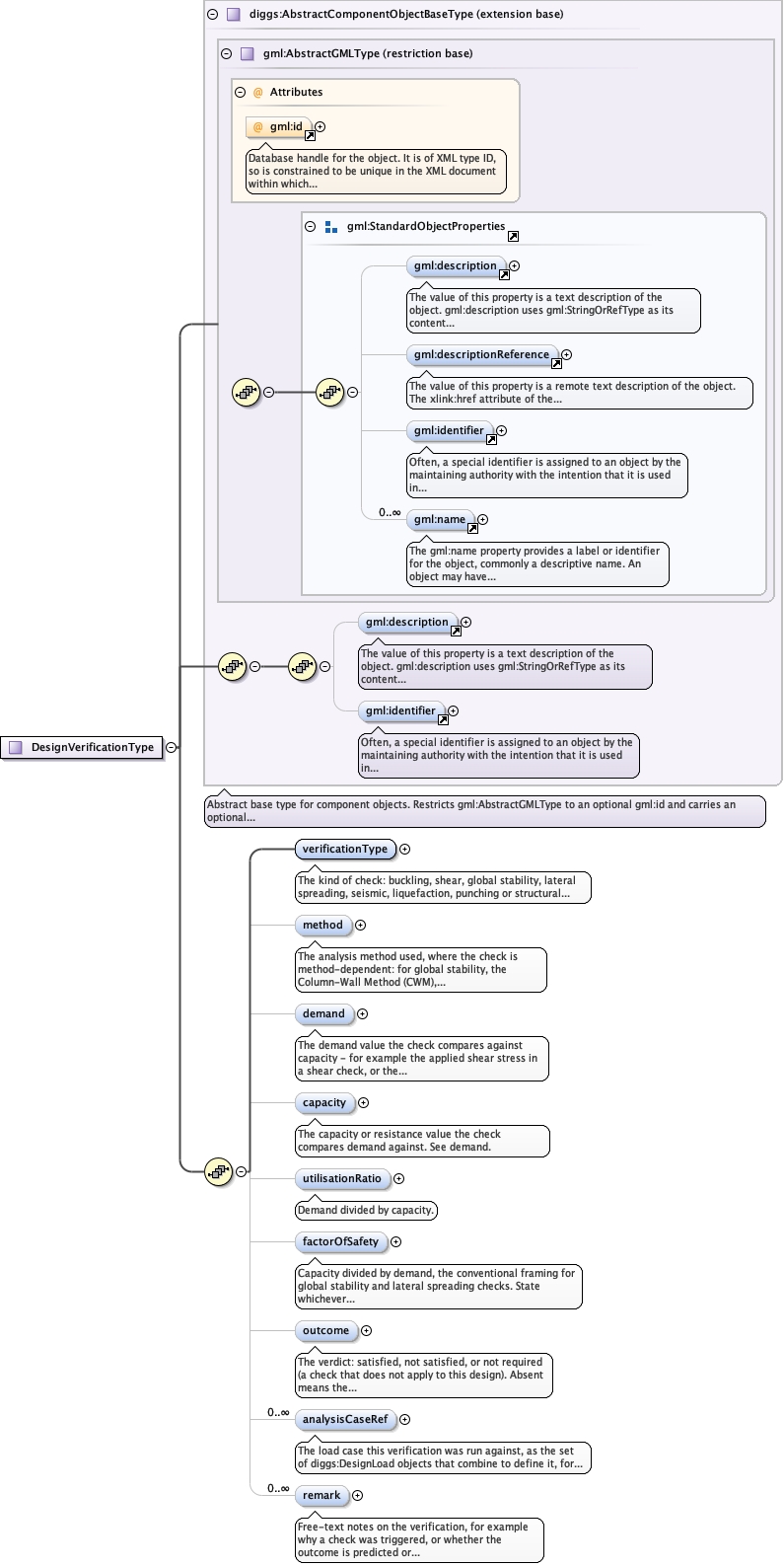
The kind of check: buckling, shear, global stability, lateralspreading, seismic, liquefaction, punching or structural axial. Usethe DIGGS dictionary verificationType.xml for the list of values.
<element name="verificationType" type="gml:CodeType"><annotation><documentation>The kind of check: buckling, shear, global stability, lateral spreading, seismic, liquefaction, punching or structural axial. Use the DIGGS dictionary verificationType.xml for the list of values.</documentation></annotation></element>
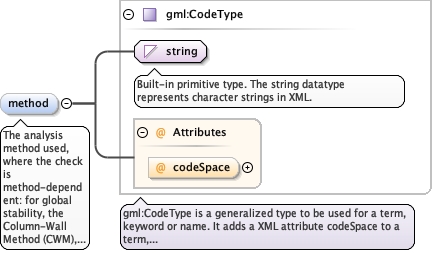
The analysis method used, where the check is method-dependent: forglobal stability, the Column-Wall Method (CWM), Equivalent StrengthMethod (ESM), Stress Reduction Method (SRM), Pile Support Method(PSM) or numerical analysis with the actual RI layout. Use the DIGGSdictionary verificationMethod.xml for the list of values.
<element minOccurs="0" name="method" type="gml:CodeType"><annotation><documentation>The analysis method used, where the check is method-dependent: for global stability, the Column-Wall Method (CWM), Equivalent Strength Method (ESM), Stress Reduction Method (SRM), Pile Support Method (PSM) or numerical analysis with the actual RI layout. Use the DIGGS dictionary verificationMethod.xml for the list of values.</documentation></annotation></element>
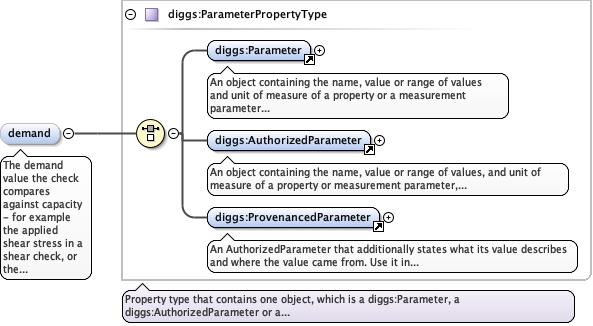
The demand value the check compares against capacity - forexample the applied shear stress in a shear check, or the appliedaxial force in a buckling check. A Parameter rather than a fixedmeasure type because the quantity class varies withverificationType.
<element minOccurs="0" name="demand" type="diggs:ParameterPropertyType"><annotation><documentation>The demand value the check compares against capacity - for example the applied shear stress in a shear check, or the applied axial force in a buckling check. A Parameter rather than a fixed measure type because the quantity class varies with verificationType.</documentation></annotation></element>
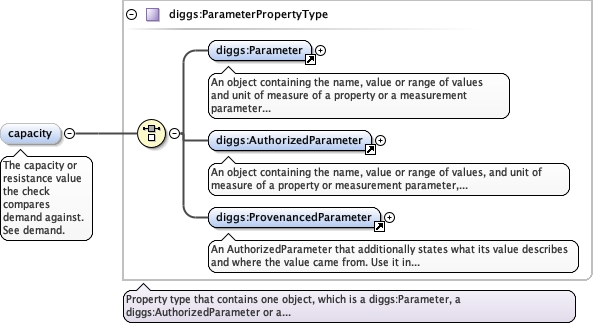
<element minOccurs="0" name="capacity" type="diggs:ParameterPropertyType"><annotation><documentation>The capacity or resistance value the check compares demand against. See demand.</documentation></annotation></element>
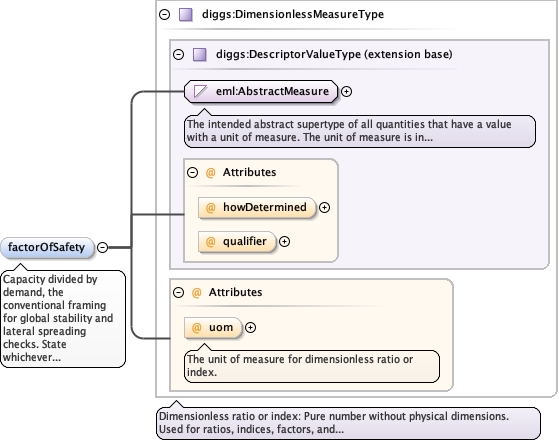
Capacity divided by demand, the conventional framing for globalstability and lateral spreading checks. State whichever ofutilisationRatio or factorOfSafety the analysis produced, or both.
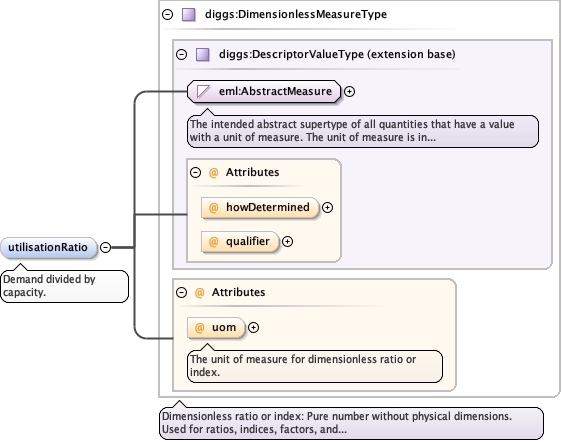
The unit of measure for dimensionless ratio or index.
Source
<element minOccurs="0" name="factorOfSafety" type="diggs:DimensionlessMeasureType"><annotation><documentation>Capacity divided by demand, the conventional framing for global stability and lateral spreading checks. State whichever of utilisationRatio or factorOfSafety the analysis produced, or both.</documentation></annotation></element>
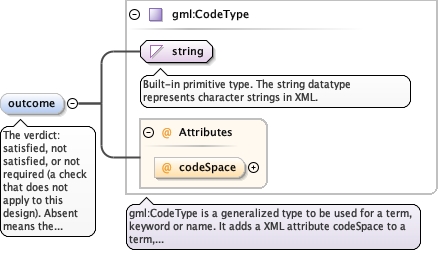
The verdict: satisfied, not satisfied, or not required (a check thatdoes not apply to this design). Absent means the check has not yetbeen run. Use the DIGGS dictionary verificationOutcome.xml for thelist of values.
<element minOccurs="0" name="outcome" type="gml:CodeType"><annotation><documentation>The verdict: satisfied, not satisfied, or not required (a check that does not apply to this design). Absent means the check has not yet been run. Use the DIGGS dictionary verificationOutcome.xml for the list of values.</documentation></annotation></element>
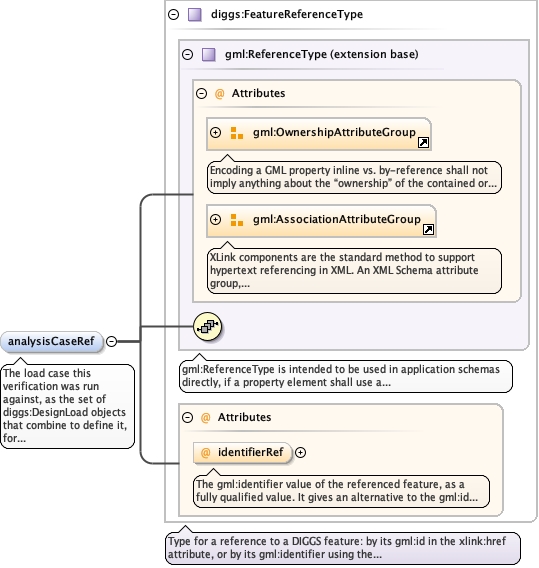
The load case this verification was run against, as the set ofdiggs:DesignLoad objects that combine to define it, for example thepermanent and seismic loads active in a seismic buckling check, asdistinct from the permanent and variable loads active in a staticone. Repeat for each load in the case. Given by reference only.
The gml:identifier value of the referenced feature, as a fully qualifiedvalue. It gives an alternative to the gml:id in xlink:href for findingthe referenced feature, mainly to reference a feature by a globallyunique identifier and where naming conflicts occur with gml:id whenaccessing data in external files.
<element minOccurs="0" maxOccurs="unbounded" name="analysisCaseRef" type="diggs:FeatureReferenceType"><annotation><appinfo source="urn:x-gml:targetElement">diggs:DesignLoad</appinfo><documentation>The load case this verification was run against, as the set of diggs:DesignLoad objects that combine to define it, for example the permanent and seismic loads active in a seismic buckling check, as distinct from the permanent and variable loads active in a static one. Repeat for each load in the case. Given by reference only.</documentation></annotation></element>
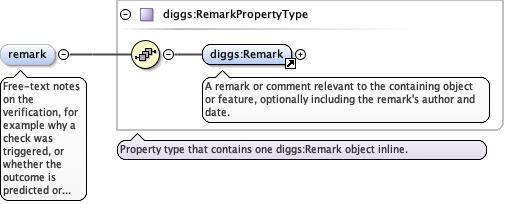
Free-text notes on the verification, for example why a check wastriggered, or whether the outcome is predicted or verified bypost-installation testing.
<element name="remark" type="diggs:RemarkPropertyType" minOccurs="0" maxOccurs="unbounded"><annotation><documentation>Free-text notes on the verification, for example why a check was triggered, or whether the outcome is predicted or verified by post-installation testing.</documentation></annotation></element>
Database handle for the object. It is of XML type ID, so is constrained to beunique in the XML document within which it occurs. An external identifier for the object inthe form of a URI may be constructed using standard XML and XPointer methods. This is doneby concatenating the URI for the document, a fragment separator, and the value of the idattribute.
Source
<complexType name="DesignVerificationType"><complexContent><extension base="diggs:AbstractComponentObjectBaseType"><sequence><element name="verificationType" type="gml:CodeType"><annotation><documentation>The kind of check: buckling, shear, global stability, lateral spreading, seismic, liquefaction, punching or structural axial. Use the DIGGS dictionary verificationType.xml for the list of values.</documentation></annotation></element><element minOccurs="0" name="method" type="gml:CodeType"><annotation><documentation>The analysis method used, where the check is method-dependent: for global stability, the Column-Wall Method (CWM), Equivalent Strength Method (ESM), Stress Reduction Method (SRM), Pile Support Method (PSM) or numerical analysis with the actual RI layout. Use the DIGGS dictionary verificationMethod.xml for the list of values.</documentation></annotation></element><element minOccurs="0" name="demand" type="diggs:ParameterPropertyType"><annotation><documentation>The demand value the check compares against capacity - for example the applied shear stress in a shear check, or the applied axial force in a buckling check. A Parameter rather than a fixed measure type because the quantity class varies with verificationType.</documentation></annotation></element><element minOccurs="0" name="capacity" type="diggs:ParameterPropertyType"><annotation><documentation>The capacity or resistance value the check compares demand against. See demand.</documentation></annotation></element><element minOccurs="0" name="utilisationRatio" type="diggs:DimensionlessMeasureType"><annotation><documentation>Demand divided by capacity.</documentation></annotation></element><element minOccurs="0" name="factorOfSafety" type="diggs:DimensionlessMeasureType"><annotation><documentation>Capacity divided by demand, the conventional framing for global stability and lateral spreading checks. State whichever of utilisationRatio or factorOfSafety the analysis produced, or both.</documentation></annotation></element><element minOccurs="0" name="outcome" type="gml:CodeType"><annotation><documentation>The verdict: satisfied, not satisfied, or not required (a check that does not apply to this design). Absent means the check has not yet been run. Use the DIGGS dictionary verificationOutcome.xml for the list of values.</documentation></annotation></element><element minOccurs="0" maxOccurs="unbounded" name="analysisCaseRef" type="diggs:FeatureReferenceType"><annotation><appinfo source="urn:x-gml:targetElement">diggs:DesignLoad</appinfo><documentation>The load case this verification was run against, as the set of diggs:DesignLoad objects that combine to define it, for example the permanent and seismic loads active in a seismic buckling check, as distinct from the permanent and variable loads active in a static one. Repeat for each load in the case. Given by reference only.</documentation></annotation></element><element name="remark" type="diggs:RemarkPropertyType" minOccurs="0" maxOccurs="unbounded"><annotation><documentation>Free-text notes on the verification, for example why a check was triggered, or whether the outcome is predicted or verified by post-installation testing.</documentation></annotation></element></sequence></extension></complexContent></complexType>