Showing:

Annotations
Attributes
Diagrams
Instances
Model
Properties
Source
Element diggs:AbstractProjectScopedGroup
Namespace http://diggsml.org/schemas/3
Annotations
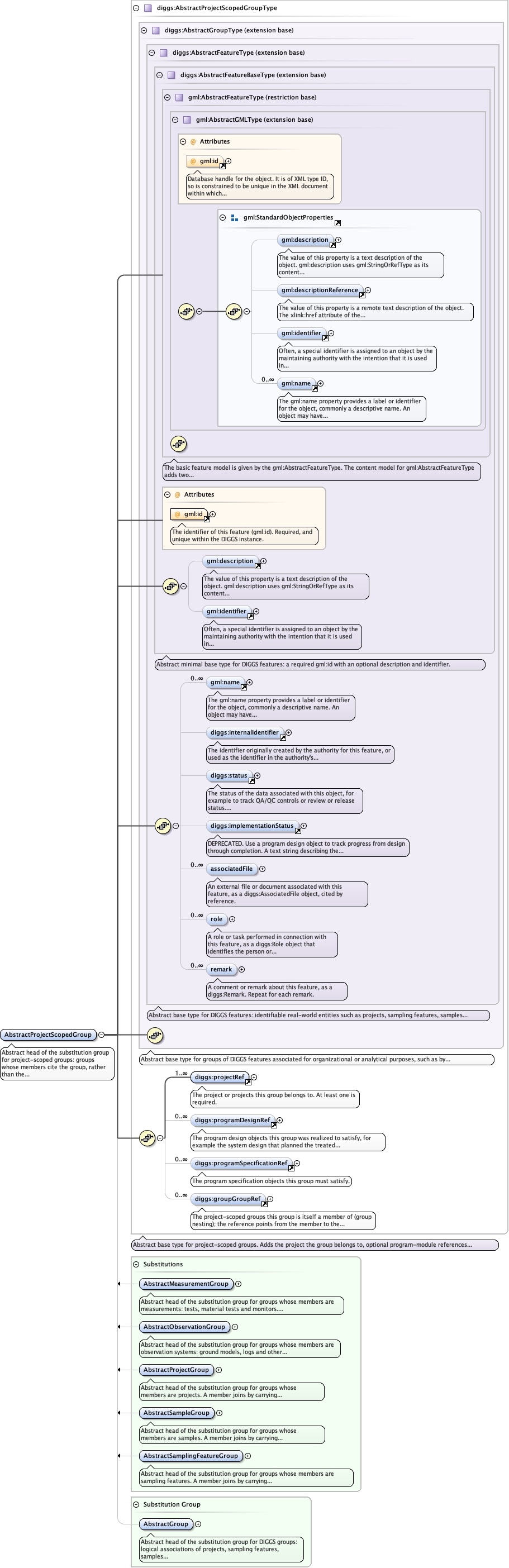
Abstract head of the substitution group for project-scoped groups: groups whose
members cite the group, rather than the group listing its members. A member carries
a reference to its group (diggs:samplingFeatureGroupRef, diggs:sampleGroupRef,
diggs:measurementGroupRef, diggs:observationGroupRef or diggs:projectGroupRef, each
declared on the corresponding family base type) and diggs:groupGroupRef for a nested
group. This differs from the groups that substitute diggs:AbstractGroup directly
(diggs:SamplingFeatureGroup, diggs:GroupGroup, diggs:ProjectGroup,
diggs:MeasurementGroup and diggs:SampleGroup, all deprecated), which hold arrays of
references to their members. A group is a collection of related features whose
information can be evaluated and compared together as part of one analysis: it
carries the assumption that justifies interpreting its members jointly. A borehole
and a CPT sounding treated as one dataset under a proximity assumption form a group;
two boreholes that merely lie on the same site do not. The schema cannot constrain
which feature types a group admits or how many; that is a context-validation concern
driven from a dictionary.
Diagram
Diagramgml3_2Profile_diggs_xsd_Attribute_gml_id.tmp#idgml3_2Profile_diggs_xsd_Element_gml_description.tmp#descriptiongml3_2Profile_diggs_xsd_Element_gml_descriptionReference.tmp#descriptionReferencegml3_2Profile_diggs_xsd_Element_gml_identifier.tmp#identifiergml3_2Profile_diggs_xsd_Element_gml_name.tmp#namegml3_2Profile_diggs_xsd_Element_Group_gml_StandardObjectProperties.tmp#StandardObjectPropertiesgml3_2Profile_diggs_xsd_Complex_Type_gml_AbstractGMLType.tmp#AbstractGMLTypegml3_2Profile_diggs_xsd_Complex_Type_gml_AbstractFeatureType.tmp#AbstractFeatureTypegml3_2Profile_diggs_xsd_Attribute_gml_id.tmp#idgml3_2Profile_diggs_xsd_Element_gml_description.tmp#descriptiongml3_2Profile_diggs_xsd_Element_gml_identifier.tmp#identifierAbstractTypes_xsd_Complex_Type_diggs_AbstractFeatureBaseType.tmp#AbstractFeatureBaseTypegml3_2Profile_diggs_xsd_Element_gml_name.tmp#nameCommon_xsd_Element_diggs_internalIdentifier.tmp#internalIdentifierCommon_xsd_Element_diggs_status.tmp#statusCommon_xsd_Element_diggs_implementationStatus.tmp#implementationStatusAbstractTypes_xsd_Complex_Type_diggs_AbstractFeatureType.tmp#http___diggsml.org_schemas_3_AbstractFeatureType_associatedFileAbstractTypes_xsd_Complex_Type_diggs_AbstractFeatureType.tmp#http___diggsml.org_schemas_3_AbstractFeatureType_roleAbstractTypes_xsd_Complex_Type_diggs_AbstractFeatureType.tmp#http___diggsml.org_schemas_3_AbstractFeatureType_remarkAbstractTypes_xsd_Complex_Type_diggs_AbstractFeatureType.tmp#http___diggsml.org_schemas_3_AbstractFeatureTypeAbstractTypes_xsd_Complex_Type_diggs_AbstractGroupType.tmp#AbstractGroupTypeCommon_xsd_Element_diggs_projectRef.tmp#projectRefCommon_xsd_Element_diggs_programDesignRef.tmp#programDesignRefCommon_xsd_Element_diggs_programSpecificationRef.tmp#programSpecificationRefCommon_xsd_Element_diggs_groupGroupRef.tmp#groupGroupRefAbstractTypes_xsd_Complex_Type_diggs_AbstractProjectScopedGroupType.tmp#AbstractProjectScopedGroupTypeAbstractTypes_xsd_Element_diggs_AbstractMeasurementGroup.tmp#AbstractMeasurementGroupAbstractTypes_xsd_Element_diggs_AbstractObservationGroup.tmp#AbstractObservationGroupAbstractTypes_xsd_Element_diggs_AbstractProjectGroup.tmp#AbstractProjectGroupAbstractTypes_xsd_Element_diggs_AbstractSampleGroup.tmp#AbstractSampleGroupAbstractTypes_xsd_Element_diggs_AbstractSamplingFeatureGroup.tmp#AbstractSamplingFeatureGroupAbstractTypes_xsd_Element_diggs_AbstractGroup.tmp#AbstractGroup
Type diggs:AbstractProjectScopedGroupType
Type hierarchy
Properties
content complex
abstract true
Substitution Group
Substitution Group Affiliation
Model
Children diggs:associatedFile, diggs:groupGroupRef, diggs:implementationStatus, diggs:internalIdentifier, diggs:programDesignRef, diggs:programSpecificationRef, diggs:projectRef, diggs:remark, diggs:role, diggs:status, gml:description, gml:identifier, gml:name
Instance
<diggs:AbstractProjectScopedGroup gml:id="" xmlns:diggs="http://diggsml.org/schemas/3" xmlns:gml="http://www.opengis.net/gml/3.2">
  <gml:description xlink:href="" nilReason="">{0,1}</gml:description>
  <gml:identifier codeSpace="">{0,1}</gml:identifier>
  <gml:name codeSpace="">{0,unbounded}</gml:name>
  <diggs:internalIdentifier codeSpace="">{0,1}</diggs:internalIdentifier>
  <diggs:status codeSpace="">{0,1}</diggs:status>
  <diggs:implementationStatus codeSpace="">{0,1}</diggs:implementationStatus>
  <diggs:associatedFile xlink:href="" nilReason="" owns="false">{0,unbounded}</diggs:associatedFile>
  <diggs:role>{0,unbounded}</diggs:role>
  <diggs:remark>{0,unbounded}</diggs:remark>
  <diggs:projectRef xlink:href="" identifierRef="" nilReason="" owns="false">{1,unbounded}</diggs:projectRef>
  <diggs:programDesignRef xlink:href="" identifierRef="" nilReason="" owns="false">{0,unbounded}</diggs:programDesignRef>
  <diggs:programSpecificationRef xlink:href="" identifierRef="" nilReason="" owns="false">{0,unbounded}</diggs:programSpecificationRef>
  <diggs:groupGroupRef xlink:href="" identifierRef="" nilReason="" owns="false">{0,unbounded}</diggs:groupGroupRef>
</diggs:AbstractProjectScopedGroup>
Attributes
QName Type Use Annotation
gml:id ID required
Database handle for the object. It is of XML type ID, so is constrained to be
unique in the XML document within which it occurs. An external identifier for the object in
the form of a URI may be constructed using standard XML and XPointer methods. This is done
by concatenating the URI for the document, a fragment separator, and the value of the id
attribute.
Source
<element name="AbstractProjectScopedGroup" type="diggs:AbstractProjectScopedGroupType" substitutionGroup="diggs:AbstractGroup" abstract="true">
  <annotation>
    <documentation>Abstract head of the substitution group for project-scoped groups: groups whose members cite the group, rather than the group listing its members. A member carries a reference to its group (diggs:samplingFeatureGroupRef, diggs:sampleGroupRef, diggs:measurementGroupRef, diggs:observationGroupRef or diggs:projectGroupRef, each declared on the corresponding family base type) and diggs:groupGroupRef for a nested group. This differs from the groups that substitute diggs:AbstractGroup directly (diggs:SamplingFeatureGroup, diggs:GroupGroup, diggs:ProjectGroup, diggs:MeasurementGroup and diggs:SampleGroup, all deprecated), which hold arrays of references to their members. A group is a collection of related features whose information can be evaluated and compared together as part of one analysis: it carries the assumption that justifies interpreting its members jointly. A borehole and a CPT sounding treated as one dataset under a proximity assumption form a group; two boreholes that merely lie on the same site do not. The schema cannot constrain which feature types a group admits or how many; that is a context-validation concern driven from a dictionary.</documentation>
  </annotation>
</element>