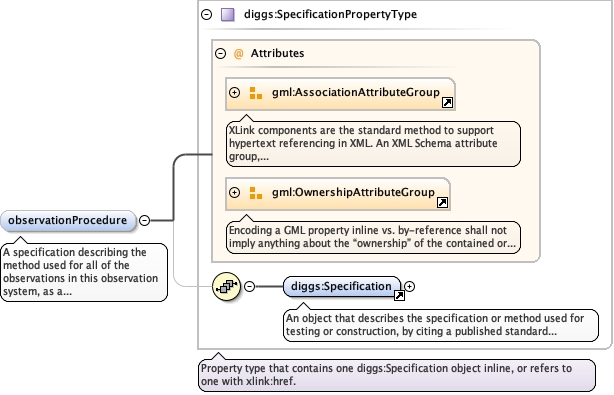
A specification describing the method used for all of theobservations in this observation system, as a diggs:Specification.Where procedures vary among individual observations, use theproperties and attributes of the observation objects instead.
<element minOccurs="0" name="observationProcedure" type="diggs:SpecificationPropertyType" maxOccurs="unbounded"><annotation><documentation>A specification describing the method used for all of the observations in this observation system, as a diggs:Specification. Where procedures vary among individual observations, use the properties and attributes of the observation objects instead.</documentation></annotation></element>
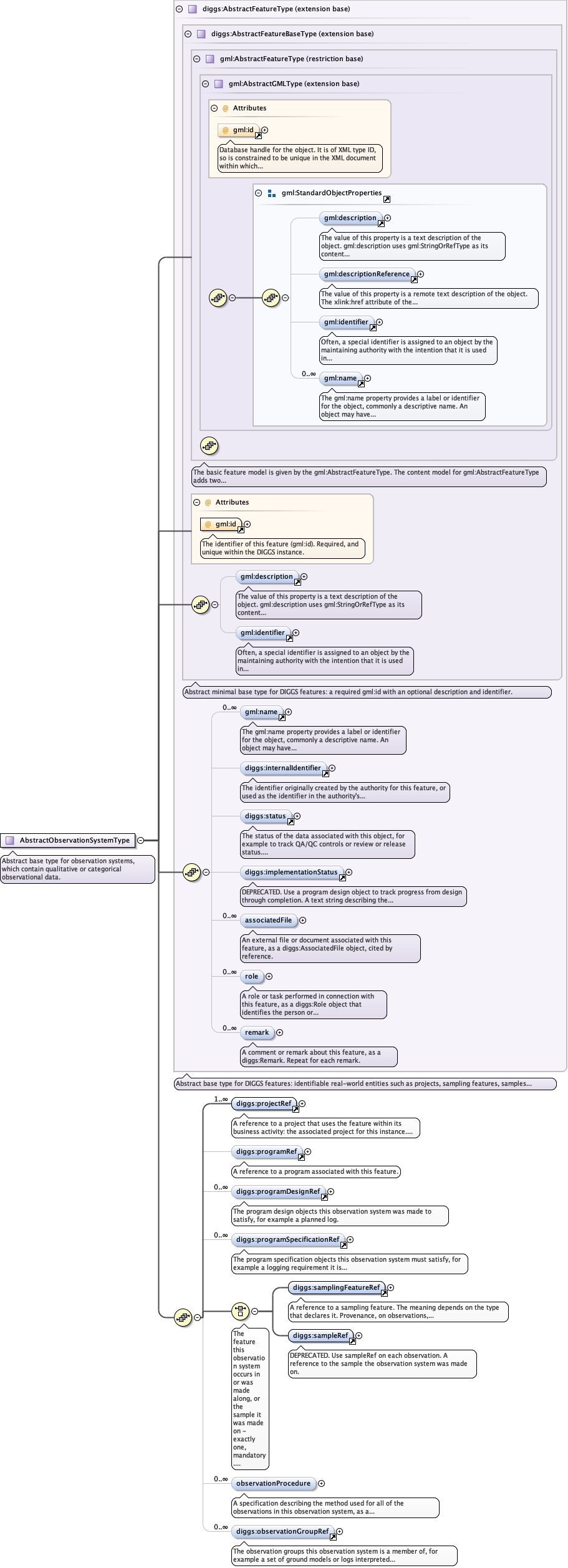
Complex Type diggs:AbstractObservationSystemType
Namespace
http://diggsml.org/schemas/3
Annotations
Abstract base type for observation systems, which contain qualitative or categoricalobservational data.
Database handle for the object. It is of XML type ID, so is constrained to beunique in the XML document within which it occurs. An external identifier for the object inthe form of a URI may be constructed using standard XML and XPointer methods. This is doneby concatenating the URI for the document, a fragment separator, and the value of the idattribute.
Source
<complexType abstract="true" name="AbstractObservationSystemType"><annotation><documentation>Abstract base type for observation systems, which contain qualitative or categorical observational data.</documentation></annotation><complexContent><extension base="diggs:AbstractFeatureType"><sequence><element ref="diggs:projectRef" maxOccurs="unbounded"/><element minOccurs="0" ref="diggs:programRef"/><element minOccurs="0" maxOccurs="unbounded" ref="diggs:programDesignRef"><annotation><documentation>The program design objects this observation system was made to satisfy, for example a planned log.</documentation></annotation></element><element minOccurs="0" maxOccurs="unbounded" ref="diggs:programSpecificationRef"><annotation><documentation>The program specification objects this observation system must satisfy, for example a logging requirement it is evaluated against.</documentation></annotation></element><choice><annotation><documentation>The feature this observation system occurs in or was made along, or the sample it was made on - exactly one, mandatory. What is referenced here is the SUBJECT of the system: the thing being described. REVERTED 9/26 to this, the 3.0.0 cardinality, retracting S10's widening to [0..*] (RI_Program_Architecture.md §6.3(a)). S10 widened the choice so that a synthesized site-wide ground model could cite the several features it was built from, reading the choice as provenance - "this model was built from these fourteen borings." That conflated two distinct things. This reference says what is being described; the data an observation was DERIVED FROM is stated per observation, through diggs:measurementRef ([0..*] on diggs:AbstractObservationType). A unit whose unit weight derives from a series of SPT or CPT tests cites those measurements there, on the observation whose property they bear on - which a reference here could not do, since a system spans many observations and could not say which one each source bore on. That is the same defect that deprecated the sampleRef branch below. A site-wide interpretation still has one honest subject: the sampling feature whose ground it describes. Where the system is a log it is the borehole; where it is a ground model over a site it is a feature spanning that site - diggs:RITreatedArea, diggs:PlanarSamplingFeature or diggs:VolumetricSamplingFeature. AS OF 9/26 THE sampleRef BRANCH IS DEPRECATED and only samplingFeatureRef should be used here; see that element's own annotation. The sample being observed is now stated on the individual observation, diggs:sampleRef on diggs:AbstractObservationType. Nothing about samplingFeatureRef changes.</documentation></annotation><element ref="diggs:samplingFeatureRef"/><element ref="diggs:sampleRef"><annotation><appinfo><diggs:deprecated since="3.1.0" replacedBy="diggs:sampleRef" note="on each observation (diggs:AbstractObservationType)"/></appinfo><documentation>DEPRECATED. Use sampleRef on each observation. A reference to the sample the observation system was made on.</documentation></annotation></element></choice><element minOccurs="0" name="observationProcedure" type="diggs:SpecificationPropertyType" maxOccurs="unbounded"><annotation><documentation>A specification describing the method used for all of the observations in this observation system, as a diggs:Specification. Where procedures vary among individual observations, use the properties and attributes of the observation objects instead.</documentation></annotation></element><element minOccurs="0" maxOccurs="unbounded" ref="diggs:observationGroupRef"><annotation><documentation>The observation groups this observation system is a member of, for example a set of ground models or logs interpreted together. The member cites the group; see diggs:AbstractProjectScopedGroup. This states membership: the other observation systems this one is read alongside, such as one of three competing interpretations of the same site. It is not the subject of the system, which samplingFeatureRef gives, and it is not provenance, which each observation cites through measurementRef.</documentation></annotation></element></sequence></extension></complexContent></complexType>