Showing:

Annotations
Attributes
Diagrams
Instances
Model
Properties
Source
Used by
Element diggs:OrientationSystemType / diggs:orientationFeatureType
Namespace http://diggsml.org/schemas/3
Annotations
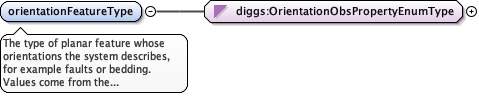
The type of planar feature whose orientations the system describes,
for example faults or bedding. Values come from the enumerated list,
or "Other: xx", where xx is a user-defined term whose meaning
differs from every listed value (not a synonym of one).
Diagram
DiagramExtObservation_xsd_Simple_Type_diggs_OrientationObsPropertyEnumType.tmp#OrientationObsPropertyEnumType
Type diggs:OrientationObsPropertyEnumType
Properties
content simple
Source
<element name="orientationFeatureType" type="diggs:OrientationObsPropertyEnumType">
  <annotation>
    <documentation>The type of planar feature whose orientations the system describes, for example faults or bedding. Values come from the enumerated list, or "Other: xx", where xx is a user-defined term whose meaning differs from every listed value (not a synonym of one).</documentation>
  </annotation>
</element>
Element diggs:OrientationSystemType / diggs:orientationFeatureObservation
Namespace http://diggsml.org/schemas/3
Annotations
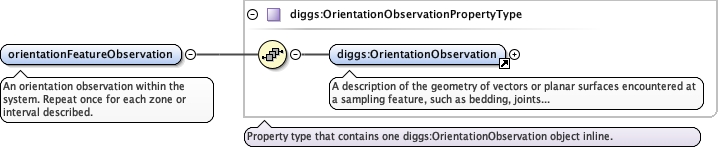
An orientation observation within the system. Repeat once for each
zone or interval described.
Diagram
DiagramExtObservation_xsd_Element_diggs_OrientationObservation.tmp#OrientationObservationExtObservation_xsd_Complex_Type_diggs_OrientationObservationPropertyType.tmp#OrientationObservationPropertyType
Type diggs:OrientationObservationPropertyType
Properties
content complex
maxOccurs unbounded
Model
Children diggs:OrientationObservation
Instance
<diggs:orientationFeatureObservation xmlns:diggs="http://diggsml.org/schemas/3">
  <diggs:OrientationObservation howDetermined="" gml:id="" stratumCode="">{1,1}</diggs:OrientationObservation>
</diggs:orientationFeatureObservation>
Source
<element maxOccurs="unbounded" name="orientationFeatureObservation" type="diggs:OrientationObservationPropertyType">
  <annotation>
    <documentation>An orientation observation within the system. Repeat once for each zone or interval described.</documentation>
  </annotation>
</element>
Complex Type diggs:OrientationSystemType
Namespace http://diggsml.org/schemas/3
Diagram
Diagramgml3_2Profile_diggs_xsd_Attribute_gml_id.tmp#idgml3_2Profile_diggs_xsd_Element_gml_description.tmp#descriptiongml3_2Profile_diggs_xsd_Element_gml_descriptionReference.tmp#descriptionReferencegml3_2Profile_diggs_xsd_Element_gml_identifier.tmp#identifiergml3_2Profile_diggs_xsd_Element_gml_name.tmp#namegml3_2Profile_diggs_xsd_Element_Group_gml_StandardObjectProperties.tmp#StandardObjectPropertiesgml3_2Profile_diggs_xsd_Complex_Type_gml_AbstractGMLType.tmp#AbstractGMLTypegml3_2Profile_diggs_xsd_Complex_Type_gml_AbstractFeatureType.tmp#AbstractFeatureTypegml3_2Profile_diggs_xsd_Attribute_gml_id.tmp#idgml3_2Profile_diggs_xsd_Element_gml_description.tmp#descriptiongml3_2Profile_diggs_xsd_Element_gml_identifier.tmp#identifierAbstractTypes_xsd_Complex_Type_diggs_AbstractFeatureBaseType.tmp#AbstractFeatureBaseTypegml3_2Profile_diggs_xsd_Element_gml_name.tmp#nameCommon_xsd_Element_diggs_internalIdentifier.tmp#internalIdentifierCommon_xsd_Element_diggs_status.tmp#statusCommon_xsd_Element_diggs_implementationStatus.tmp#implementationStatusAbstractTypes_xsd_Complex_Type_diggs_AbstractFeatureType.tmp#http___diggsml.org_schemas_3_AbstractFeatureType_associatedFileAbstractTypes_xsd_Complex_Type_diggs_AbstractFeatureType.tmp#http___diggsml.org_schemas_3_AbstractFeatureType_roleAbstractTypes_xsd_Complex_Type_diggs_AbstractFeatureType.tmp#http___diggsml.org_schemas_3_AbstractFeatureType_remarkAbstractTypes_xsd_Complex_Type_diggs_AbstractFeatureType.tmp#http___diggsml.org_schemas_3_AbstractFeatureTypeCommon_xsd_Element_diggs_projectRef.tmp#projectRefCommon_xsd_Element_diggs_programRef.tmp#programRefCommon_xsd_Element_diggs_programDesignRef.tmp#programDesignRefCommon_xsd_Element_diggs_programSpecificationRef.tmp#programSpecificationRefCommon_xsd_Element_diggs_samplingFeatureRef.tmp#samplingFeatureRefCommon_xsd_Element_diggs_sampleRef.tmp#sampleRefAbstractTypes_xsd_Complex_Type_diggs_AbstractObservationSystemType.tmp#AbstractObservationSystemType_observationProcedureCommon_xsd_Element_diggs_observationGroupRef.tmp#observationGroupRefAbstractTypes_xsd_Complex_Type_diggs_AbstractObservationSystemType.tmp#AbstractObservationSystemTypeExtObservation_xsd_Complex_Type_diggs_OrientationSystemType.tmp#OrientationSystemType_orientationFeatureTypeExtObservation_xsd_Complex_Type_diggs_OrientationSystemType.tmp#OrientationSystemType_orientationFeatureObservation
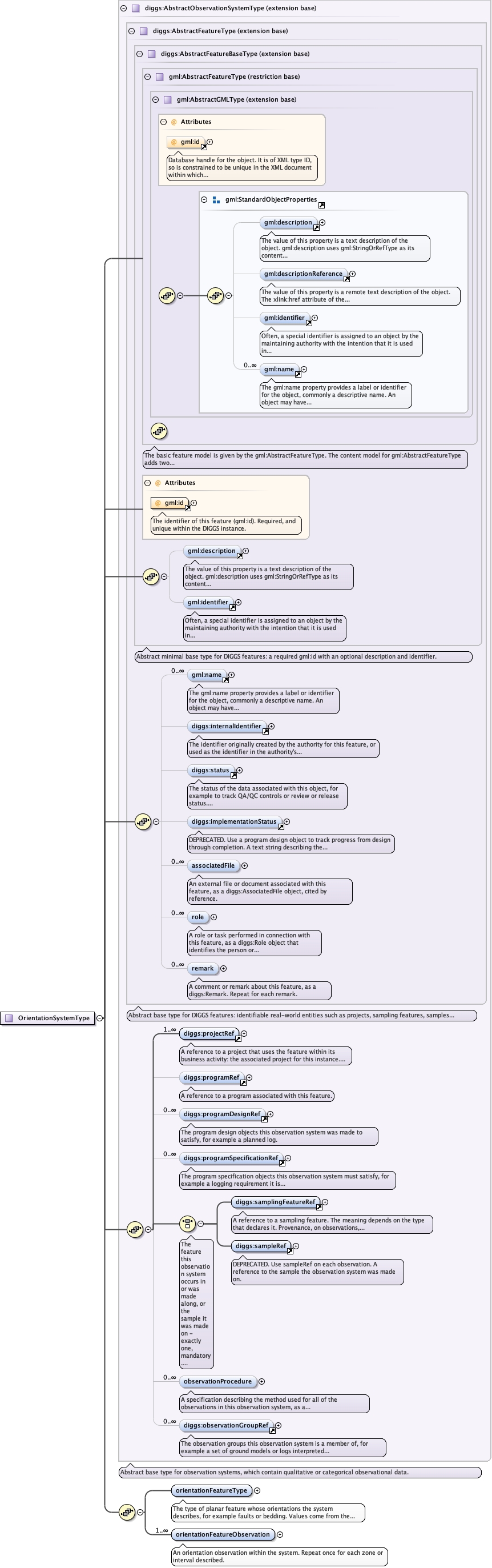
Type extension of diggs:AbstractObservationSystemType
Type hierarchy
Used by
Model
Children diggs:associatedFile, diggs:implementationStatus, diggs:internalIdentifier, diggs:observationGroupRef, diggs:observationProcedure, diggs:orientationFeatureObservation, diggs:orientationFeatureType, diggs:programDesignRef, diggs:programRef, diggs:programSpecificationRef, diggs:projectRef, diggs:remark, diggs:role, diggs:sampleRef, diggs:samplingFeatureRef, diggs:status, gml:description, gml:identifier, gml:name
Attributes
QName Type Use Annotation
gml:id ID required
Database handle for the object. It is of XML type ID, so is constrained to be
unique in the XML document within which it occurs. An external identifier for the object in
the form of a URI may be constructed using standard XML and XPointer methods. This is done
by concatenating the URI for the document, a fragment separator, and the value of the id
attribute.
Source
<complexType name="OrientationSystemType">
  <complexContent>
    <extension base="diggs:AbstractObservationSystemType">
      <sequence>
        <element name="orientationFeatureType" type="diggs:OrientationObsPropertyEnumType">
          <annotation>
            <documentation>The type of planar feature whose orientations the system describes, for example faults or bedding. Values come from the enumerated list, or "Other: xx", where xx is a user-defined term whose meaning differs from every listed value (not a synonym of one).</documentation>
          </annotation>
        </element>
        <element maxOccurs="unbounded" name="orientationFeatureObservation" type="diggs:OrientationObservationPropertyType">
          <annotation>
            <documentation>An orientation observation within the system. Repeat once for each zone or interval described.</documentation>
          </annotation>
        </element>
      </sequence>
    </extension>
  </complexContent>
</complexType>