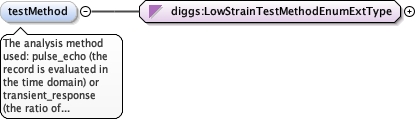
The analysis method used: pulse_echo (the record is evaluated in thetime domain) or transient_response (the ratio of velocity to forceis evaluated in the frequency domain). Seediggs:LowStrainIntegrityTest for how they relate to the ASTM andFrench standards. Values come from the enumerated list, or "Other:xx", where xx is a user-defined term whose meaning differs fromevery listed value (not a synonym of one).
<element minOccurs="0" name="testMethod" type="diggs:LowStrainTestMethodEnumExtType"><annotation><documentation>The analysis method used: pulse_echo (the record is evaluated in the time domain) or transient_response (the ratio of velocity to force is evaluated in the frequency domain). See diggs:LowStrainIntegrityTest for how they relate to the ASTM and French standards. Values come from the enumerated list, or "Other: xx", where xx is a user-defined term whose meaning differs from every listed value (not a synonym of one).</documentation></annotation></element>
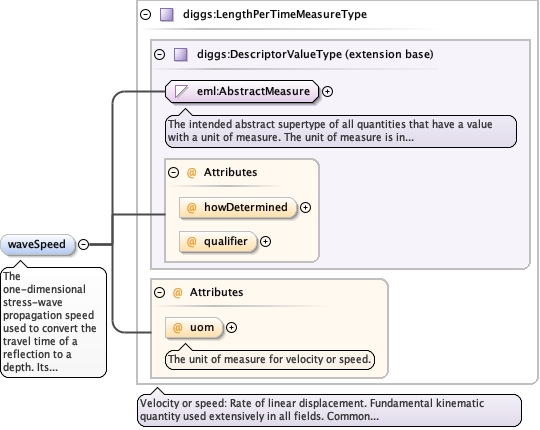
The one-dimensional stress-wave propagation speed used to convertthe travel time of a reflection to a depth. Its howDeterminedattribute states how it was obtained: assigned for a value takenfrom experience or literature for the concrete (the usual case),calculated where it was taken from a known pile length and themeasured travel time of the toe reflection.
<element minOccurs="0" name="waveSpeed" type="diggs:LengthPerTimeMeasureType"><annotation><documentation>The one-dimensional stress-wave propagation speed used to convert the travel time of a reflection to a depth. Its howDetermined attribute states how it was obtained: assigned for a value taken from experience or literature for the concrete (the usual case), calculated where it was taken from a known pile length and the measured travel time of the toe reflection.</documentation></annotation></element>
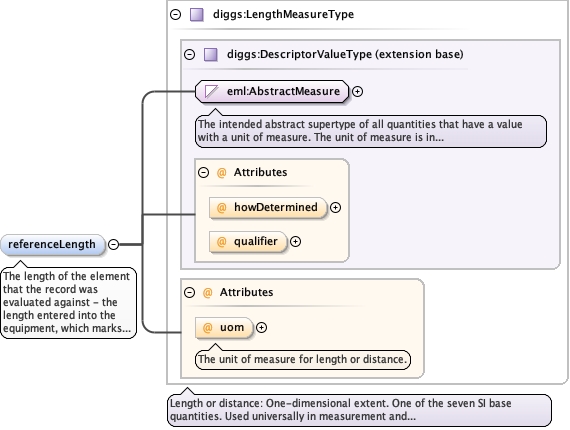
The length of the element that the record was evaluatedagainst - the length entered into the equipment, which marks wherethe toe reflection is expected. It is not the as-built length of theelement, which the sampling feature carries.
<element minOccurs="0" name="referenceLength" type="diggs:LengthMeasureType"><annotation><documentation>The length of the element that the record was evaluated against - the length entered into the equipment, which marks where the toe reflection is expected. It is not the as-built length of the element, which the sampling feature carries.</documentation></annotation></element>
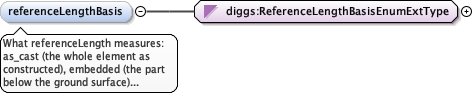
What referenceLength measures: as_cast (the whole element asconstructed), embedded (the part below the ground surface) orbelow_sensor (from the sensor position down). Values come from theenumerated list, or "Other: xx", where xx is a user-defined termwhose meaning differs from every listed value (not a synonym ofone).
<element minOccurs="0" name="referenceLengthBasis" type="diggs:ReferenceLengthBasisEnumExtType"><annotation><documentation>What referenceLength measures: as_cast (the whole element as constructed), embedded (the part below the ground surface) or below_sensor (from the sensor position down). Values come from the enumerated list, or "Other: xx", where xx is a user-defined term whose meaning differs from every listed value (not a synonym of one).</documentation></annotation></element>
The ratio of the length of the element to its diameter,a number without a unit. The accuracy of a low strain integritymeasurement falls as the ratio rises; the Hong Kong Code ofPractice for Foundations (s.8.7) states a limit of 30. A limit ischecked by a performance criterion on this value.
Diagram
Type
double
Properties
content
simple
minOccurs
0
Source
<element minOccurs="0" name="lengthToDiameterRatio" type="double"><annotation><documentation>The ratio of the length of the element to its diameter, a number without a unit. The accuracy of a low strain integrity measurement falls as the ratio rises; the Hong Kong Code of Practice for Foundations (s.8.7) states a limit of 30. A limit is checked by a performance criterion on this value.</documentation></annotation></element>
The number of hammer impacts averaged into the record ofthis test, as reported by the test equipment - one value for thetest, not one per result. Averaging suppresses random noise, andthe count is the figure a requirement on the minimum number ofimpacts is checked against.
Diagram
Type
positiveInteger
Properties
content
simple
minOccurs
0
Source
<element minOccurs="0" name="averagedImpactCount" type="positiveInteger"><annotation><documentation>The number of hammer impacts averaged into the record of this test, as reported by the test equipment - one value for the test, not one per result. Averaging suppresses random noise, and the count is the figure a requirement on the minimum number of impacts is checked against.</documentation></annotation></element>
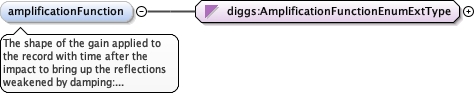
The shape of the gain applied to the record with time after theimpact to bring up the reflections weakened by damping: exponential,linear or none. Values come from the enumerated list, or "Other:xx", where xx is a user-defined term whose meaning differs fromevery listed value (not a synonym of one).
<element minOccurs="0" name="amplificationFunction" type="diggs:AmplificationFunctionEnumExtType"><annotation><documentation>The shape of the gain applied to the record with time after the impact to bring up the reflections weakened by damping: exponential, linear or none. Values come from the enumerated list, or "Other: xx", where xx is a user-defined term whose meaning differs from every listed value (not a synonym of one).</documentation></annotation></element>
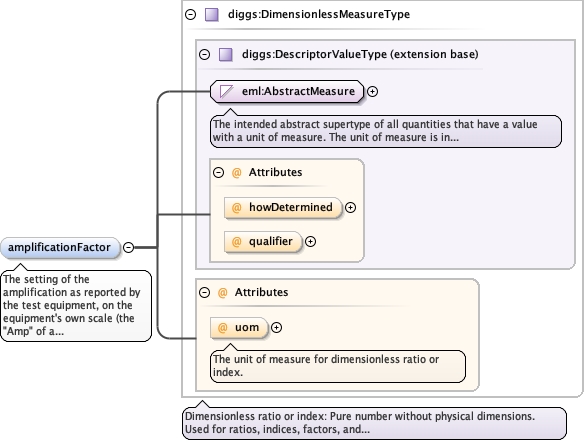
The setting of the amplification as reported by the testequipment, on the equipment's own scale (the "Amp" of a Piletestrecord, the magnification factor of a PDI record). A number with nounit of its own, comparable between records of one equipment andone set of settings only.
The unit of measure for dimensionless ratio or index.
Source
<element minOccurs="0" name="amplificationFactor" type="diggs:DimensionlessMeasureType"><annotation><documentation>The setting of the amplification as reported by the test equipment, on the equipment's own scale (the "Amp" of a Piletest record, the magnification factor of a PDI record). A number with no unit of its own, comparable between records of one equipment and one set of settings only.</documentation></annotation></element>
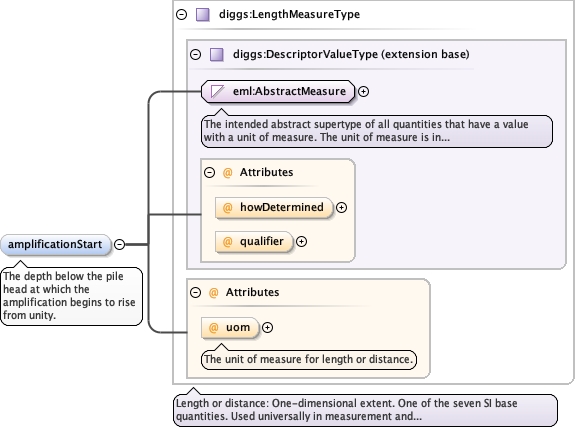
<element minOccurs="0" name="amplificationStart" type="diggs:LengthMeasureType"><annotation><documentation>The depth below the pile head at which the amplification begins to rise from unity.</documentation></annotation></element>
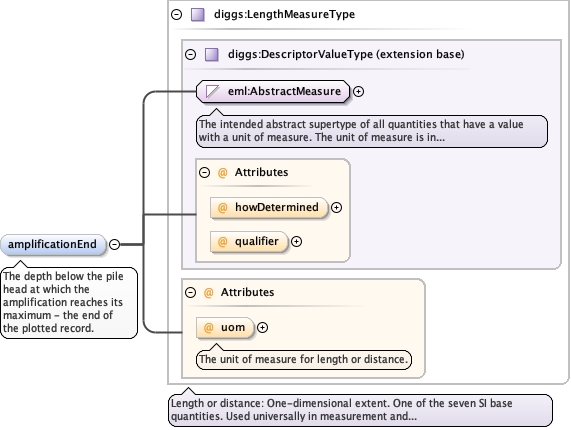
<element minOccurs="0" name="amplificationEnd" type="diggs:LengthMeasureType"><annotation><documentation>The depth below the pile head at which the amplification reaches its maximum - the end of the plotted record.</documentation></annotation></element>
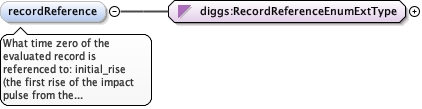
What time zero of the evaluated record is referenced to:initial_rise (the first rise of the impact pulse from the baseline)or first_peak (the peak of the impact pulse). Depths read from therecord are measured from this time. Values come from the enumeratedlist, or "Other: xx", where xx is a user-defined term whose meaningdiffers from every listed value (not a synonym of one).
<element minOccurs="0" name="recordReference" type="diggs:RecordReferenceEnumExtType"><annotation><documentation>What time zero of the evaluated record is referenced to: initial_rise (the first rise of the impact pulse from the baseline) or first_peak (the peak of the impact pulse). Depths read from the record are measured from this time. Values come from the enumerated list, or "Other: xx", where xx is a user-defined term whose meaning differs from every listed value (not a synonym of one).</documentation></annotation></element>
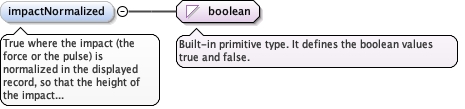
True where the impact (the force or the pulse) is normalized in the displayed record, so that the height of the impact is not comparable between records.
Diagram
Type
boolean
Properties
content
simple
minOccurs
0
Source
<element minOccurs="0" name="impactNormalized" type="boolean"><annotation><documentation>True where the impact (the force or the pulse) is normalized in the displayed record, so that the height of the impact is not comparable between records.</documentation></annotation></element>
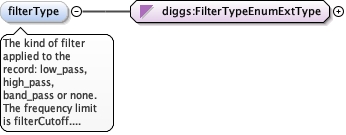
The kind of filter applied to the record: low_pass, high_pass,band_pass or none. The frequency limit is filterCutoff. Values comefrom the enumerated list, or "Other: xx", where xx is a user-definedterm whose meaning differs from every listed value (not a synonym ofone).
<element minOccurs="0" name="filterType" type="diggs:FilterTypeEnumExtType"><annotation><documentation>The kind of filter applied to the record: low_pass, high_pass, band_pass or none. The frequency limit is filterCutoff. Values come from the enumerated list, or "Other: xx", where xx is a user-defined term whose meaning differs from every listed value (not a synonym of one).</documentation></annotation></element>
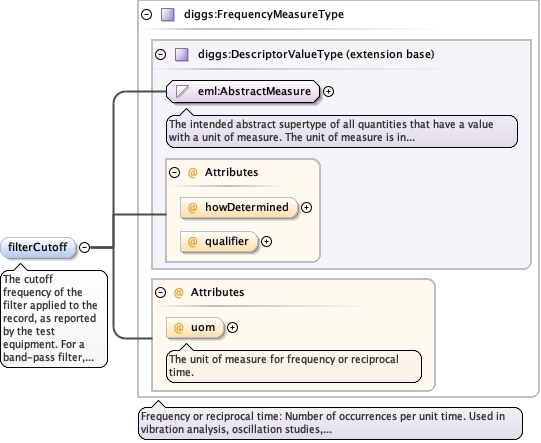
The cutoff frequency of the filter applied to the record,as reported by the test equipment. For a band-pass filter, the upperlimit; a lower limit is stated in otherTestProperty. A filter settingon the equipment's own scale, not a frequency, is stated inotherTestProperty together with the filterType.
The unit of measure for frequency or reciprocal time.
Source
<element minOccurs="0" name="filterCutoff" type="diggs:FrequencyMeasureType"><annotation><documentation>The cutoff frequency of the filter applied to the record, as reported by the test equipment. For a band-pass filter, the upper limit; a lower limit is stated in otherTestProperty. A filter setting on the equipment's own scale, not a frequency, is stated in otherTestProperty together with the filterType.</documentation></annotation></element>
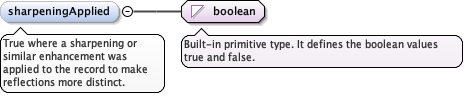
True where a sharpening or similar enhancement was applied to the record to make reflections more distinct.
Diagram
Type
boolean
Properties
content
simple
minOccurs
0
Source
<element minOccurs="0" name="sharpeningApplied" type="boolean"><annotation><documentation>True where a sharpening or similar enhancement was applied to the record to make reflections more distinct.</documentation></annotation></element>
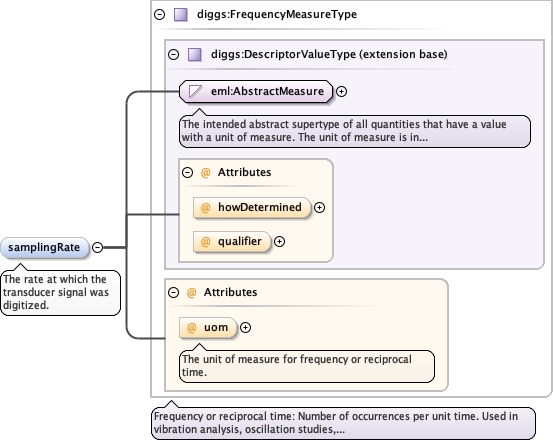
The unit of measure for frequency or reciprocal time.
Source
<element minOccurs="0" name="samplingRate" type="diggs:FrequencyMeasureType"><annotation><documentation>The rate at which the transducer signal was digitized.</documentation></annotation></element>
The resolution of the analog-to-digital conversion, in bits.
Diagram
Type
positiveInteger
Properties
content
simple
minOccurs
0
Source
<element minOccurs="0" name="sampleResolution" type="positiveInteger"><annotation><documentation>The resolution of the analog-to-digital conversion, in bits.</documentation></annotation></element>
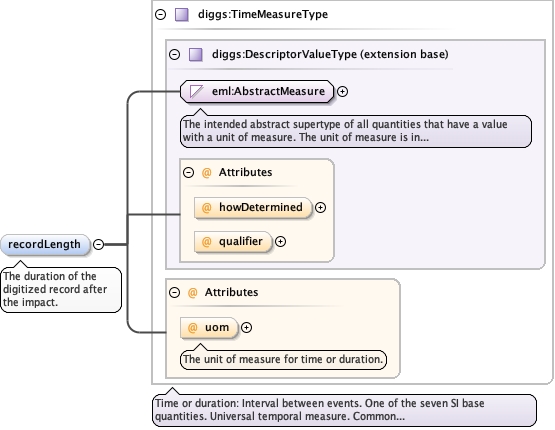
<element minOccurs="0" name="recordLength" type="diggs:TimeMeasureType"><annotation><documentation>The duration of the digitized record after the impact.</documentation></annotation></element>
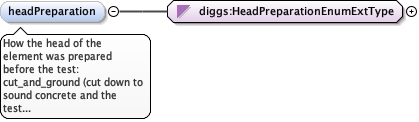
How the head of the element was prepared before the test:cut_and_ground (cut down to sound concrete and the test surfaceground smooth), cut (cut down to sound concrete, not ground), ground(the test surface ground smooth without cutting) or none (tested onthe head as found). Values come from the enumerated list, or "Other:xx", where xx is a user-defined term whose meaning differs fromevery listed value (not a synonym of one).
<element minOccurs="0" name="headPreparation" type="diggs:HeadPreparationEnumExtType"><annotation><documentation>How the head of the element was prepared before the test: cut_and_ground (cut down to sound concrete and the test surface ground smooth), cut (cut down to sound concrete, not ground), ground (the test surface ground smooth without cutting) or none (tested on the head as found). Values come from the enumerated list, or "Other: xx", where xx is a user-defined term whose meaning differs from every listed value (not a synonym of one).</documentation></annotation></element>
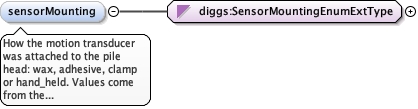
How the motion transducer was attached to the pile head: wax,adhesive, clamp or hand_held. Values come from the enumerated list,or "Other: xx", where xx is a user-defined term whose meaningdiffers from every listed value (not a synonym of one).
<element minOccurs="0" name="sensorMounting" type="diggs:SensorMountingEnumExtType"><annotation><documentation>How the motion transducer was attached to the pile head: wax, adhesive, clamp or hand_held. Values come from the enumerated list, or "Other: xx", where xx is a user-defined term whose meaning differs from every listed value (not a synonym of one).</documentation></annotation></element>
The number of positions on the pile head at which the motion transducer was placed for this test.
Diagram
Type
positiveInteger
Properties
content
simple
minOccurs
0
Source
<element minOccurs="0" name="sensorPositionCount" type="positiveInteger"><annotation><documentation>The number of positions on the pile head at which the motion transducer was placed for this test.</documentation></annotation></element>
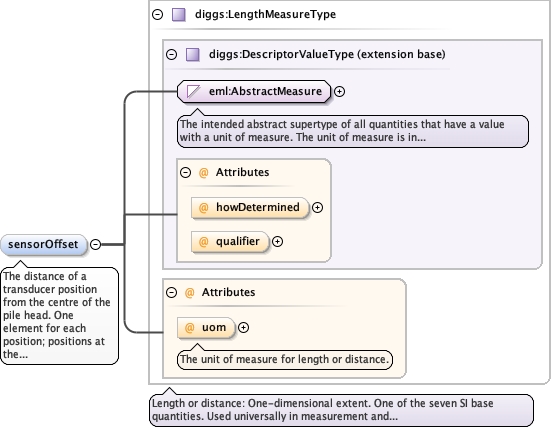
<element minOccurs="0" maxOccurs="unbounded" name="sensorOffset" type="diggs:LengthMeasureType"><annotation><documentation>The distance of a transducer position from the centre of the pile head. One element for each position; positions at the same distance are stated once.</documentation></annotation></element>
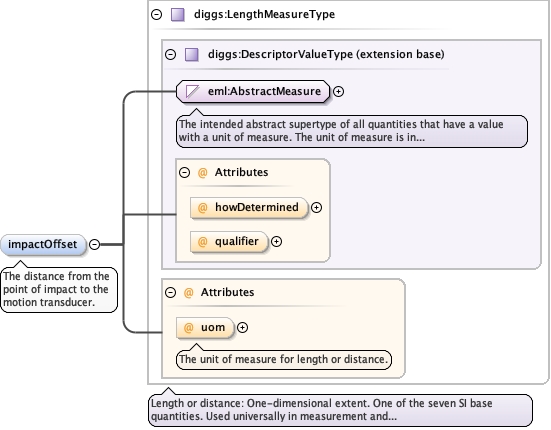
<element minOccurs="0" name="impactOffset" type="diggs:LengthMeasureType"><annotation><documentation>The distance from the point of impact to the motion transducer.</documentation></annotation></element>
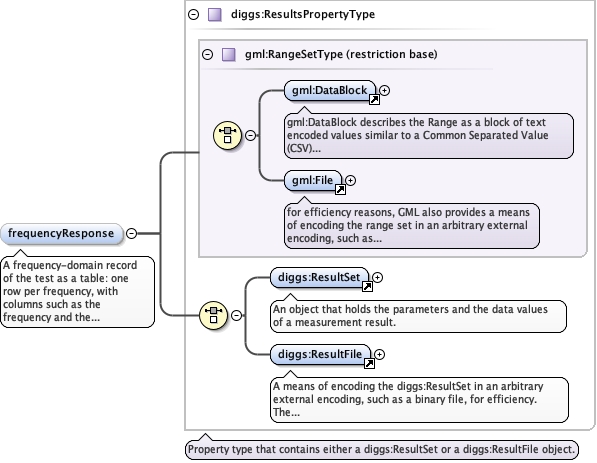
A frequency-domain record of the test as a table: one rowper frequency, with columns such as the frequency and the mobility(the velocity transform over the force transform). The columns,their units and their order are declared by the table's parameters.A record evaluated in more than one way carries one table foreach.
<element minOccurs="0" maxOccurs="unbounded" name="frequencyResponse" type="diggs:ResultsPropertyType"><annotation><documentation>A frequency-domain record of the test as a table: one row per frequency, with columns such as the frequency and the mobility (the velocity transform over the force transform). The columns, their units and their order are declared by the table's parameters. A record evaluated in more than one way carries one table for each.</documentation></annotation></element>
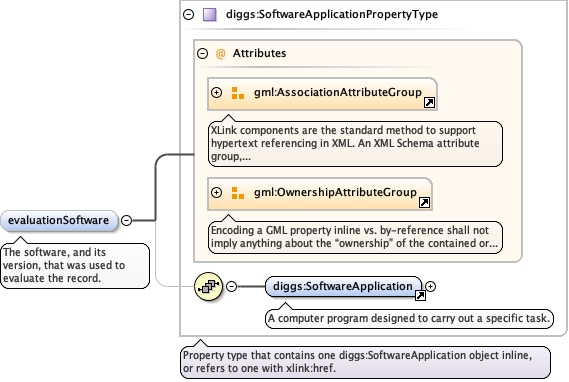
<element minOccurs="0" name="evaluationSoftware" type="diggs:SoftwareApplicationPropertyType"><annotation><documentation>The software, and its version, that was used to evaluate the record.</documentation></annotation></element>
Database handle for the object. It is of XML type ID, so is constrained to beunique in the XML document within which it occurs. An external identifier for the object inthe form of a URI may be constructed using standard XML and XPointer methods. This is doneby concatenating the URI for the document, a fragment separator, and the value of the idattribute.
Source
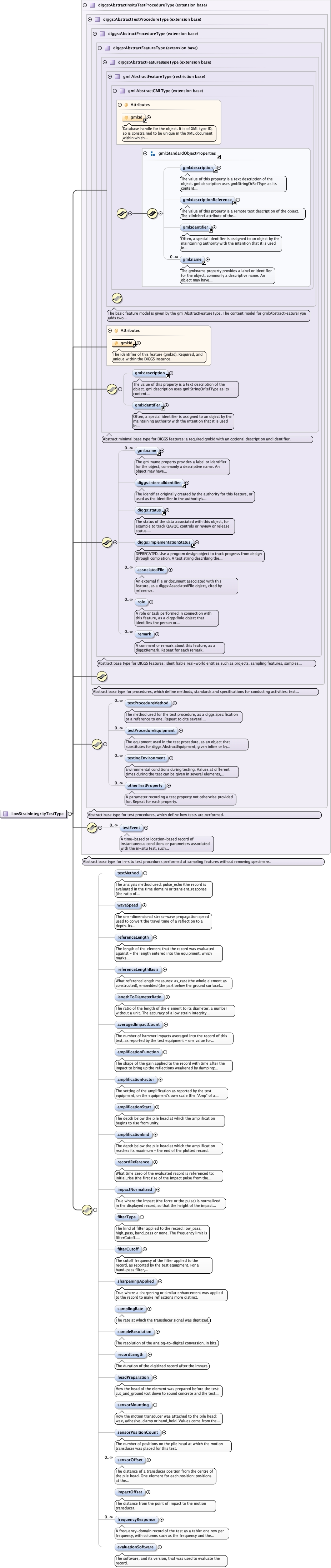
<complexType name="LowStrainIntegrityTestType"><complexContent><extension base="diggs:AbstractInsituTestProcedureType"><sequence><element minOccurs="0" name="testMethod" type="diggs:LowStrainTestMethodEnumExtType"><annotation><documentation>The analysis method used: pulse_echo (the record is evaluated in the time domain) or transient_response (the ratio of velocity to force is evaluated in the frequency domain). See diggs:LowStrainIntegrityTest for how they relate to the ASTM and French standards. Values come from the enumerated list, or "Other: xx", where xx is a user-defined term whose meaning differs from every listed value (not a synonym of one).</documentation></annotation></element><element minOccurs="0" name="waveSpeed" type="diggs:LengthPerTimeMeasureType"><annotation><documentation>The one-dimensional stress-wave propagation speed used to convert the travel time of a reflection to a depth. Its howDetermined attribute states how it was obtained: assigned for a value taken from experience or literature for the concrete (the usual case), calculated where it was taken from a known pile length and the measured travel time of the toe reflection.</documentation></annotation></element><element minOccurs="0" name="referenceLength" type="diggs:LengthMeasureType"><annotation><documentation>The length of the element that the record was evaluated against - the length entered into the equipment, which marks where the toe reflection is expected. It is not the as-built length of the element, which the sampling feature carries.</documentation></annotation></element><element minOccurs="0" name="referenceLengthBasis" type="diggs:ReferenceLengthBasisEnumExtType"><annotation><documentation>What referenceLength measures: as_cast (the whole element as constructed), embedded (the part below the ground surface) or below_sensor (from the sensor position down). Values come from the enumerated list, or "Other: xx", where xx is a user-defined term whose meaning differs from every listed value (not a synonym of one).</documentation></annotation></element><element minOccurs="0" name="lengthToDiameterRatio" type="double"><annotation><documentation>The ratio of the length of the element to its diameter, a number without a unit. The accuracy of a low strain integrity measurement falls as the ratio rises; the Hong Kong Code of Practice for Foundations (s.8.7) states a limit of 30. A limit is checked by a performance criterion on this value.</documentation></annotation></element><element minOccurs="0" name="averagedImpactCount" type="positiveInteger"><annotation><documentation>The number of hammer impacts averaged into the record of this test, as reported by the test equipment - one value for the test, not one per result. Averaging suppresses random noise, and the count is the figure a requirement on the minimum number of impacts is checked against.</documentation></annotation></element><element minOccurs="0" name="amplificationFunction" type="diggs:AmplificationFunctionEnumExtType"><annotation><documentation>The shape of the gain applied to the record with time after the impact to bring up the reflections weakened by damping: exponential, linear or none. Values come from the enumerated list, or "Other: xx", where xx is a user-defined term whose meaning differs from every listed value (not a synonym of one).</documentation></annotation></element><element minOccurs="0" name="amplificationFactor" type="diggs:DimensionlessMeasureType"><annotation><documentation>The setting of the amplification as reported by the test equipment, on the equipment's own scale (the "Amp" of a Piletest record, the magnification factor of a PDI record). A number with no unit of its own, comparable between records of one equipment and one set of settings only.</documentation></annotation></element><element minOccurs="0" name="amplificationStart" type="diggs:LengthMeasureType"><annotation><documentation>The depth below the pile head at which the amplification begins to rise from unity.</documentation></annotation></element><element minOccurs="0" name="amplificationEnd" type="diggs:LengthMeasureType"><annotation><documentation>The depth below the pile head at which the amplification reaches its maximum - the end of the plotted record.</documentation></annotation></element><element minOccurs="0" name="recordReference" type="diggs:RecordReferenceEnumExtType"><annotation><documentation>What time zero of the evaluated record is referenced to: initial_rise (the first rise of the impact pulse from the baseline) or first_peak (the peak of the impact pulse). Depths read from the record are measured from this time. Values come from the enumerated list, or "Other: xx", where xx is a user-defined term whose meaning differs from every listed value (not a synonym of one).</documentation></annotation></element><element minOccurs="0" name="impactNormalized" type="boolean"><annotation><documentation>True where the impact (the force or the pulse) is normalized in the displayed record, so that the height of the impact is not comparable between records.</documentation></annotation></element><element minOccurs="0" name="filterType" type="diggs:FilterTypeEnumExtType"><annotation><documentation>The kind of filter applied to the record: low_pass, high_pass, band_pass or none. The frequency limit is filterCutoff. Values come from the enumerated list, or "Other: xx", where xx is a user-defined term whose meaning differs from every listed value (not a synonym of one).</documentation></annotation></element><element minOccurs="0" name="filterCutoff" type="diggs:FrequencyMeasureType"><annotation><documentation>The cutoff frequency of the filter applied to the record, as reported by the test equipment. For a band-pass filter, the upper limit; a lower limit is stated in otherTestProperty. A filter setting on the equipment's own scale, not a frequency, is stated in otherTestProperty together with the filterType.</documentation></annotation></element><element minOccurs="0" name="sharpeningApplied" type="boolean"><annotation><documentation>True where a sharpening or similar enhancement was applied to the record to make reflections more distinct.</documentation></annotation></element><element minOccurs="0" name="samplingRate" type="diggs:FrequencyMeasureType"><annotation><documentation>The rate at which the transducer signal was digitized.</documentation></annotation></element><element minOccurs="0" name="sampleResolution" type="positiveInteger"><annotation><documentation>The resolution of the analog-to-digital conversion, in bits.</documentation></annotation></element><element minOccurs="0" name="recordLength" type="diggs:TimeMeasureType"><annotation><documentation>The duration of the digitized record after the impact.</documentation></annotation></element><element minOccurs="0" name="headPreparation" type="diggs:HeadPreparationEnumExtType"><annotation><documentation>How the head of the element was prepared before the test: cut_and_ground (cut down to sound concrete and the test surface ground smooth), cut (cut down to sound concrete, not ground), ground (the test surface ground smooth without cutting) or none (tested on the head as found). Values come from the enumerated list, or "Other: xx", where xx is a user-defined term whose meaning differs from every listed value (not a synonym of one).</documentation></annotation></element><element minOccurs="0" name="sensorMounting" type="diggs:SensorMountingEnumExtType"><annotation><documentation>How the motion transducer was attached to the pile head: wax, adhesive, clamp or hand_held. Values come from the enumerated list, or "Other: xx", where xx is a user-defined term whose meaning differs from every listed value (not a synonym of one).</documentation></annotation></element><element minOccurs="0" name="sensorPositionCount" type="positiveInteger"><annotation><documentation>The number of positions on the pile head at which the motion transducer was placed for this test.</documentation></annotation></element><element minOccurs="0" maxOccurs="unbounded" name="sensorOffset" type="diggs:LengthMeasureType"><annotation><documentation>The distance of a transducer position from the centre of the pile head. One element for each position; positions at the same distance are stated once.</documentation></annotation></element><element minOccurs="0" name="impactOffset" type="diggs:LengthMeasureType"><annotation><documentation>The distance from the point of impact to the motion transducer.</documentation></annotation></element><element minOccurs="0" maxOccurs="unbounded" name="frequencyResponse" type="diggs:ResultsPropertyType"><annotation><documentation>A frequency-domain record of the test as a table: one row per frequency, with columns such as the frequency and the mobility (the velocity transform over the force transform). The columns, their units and their order are declared by the table's parameters. A record evaluated in more than one way carries one table for each.</documentation></annotation></element><element minOccurs="0" name="evaluationSoftware" type="diggs:SoftwareApplicationPropertyType"><annotation><documentation>The software, and its version, that was used to evaluate the record.</documentation></annotation></element></sequence></extension></complexContent></complexType>