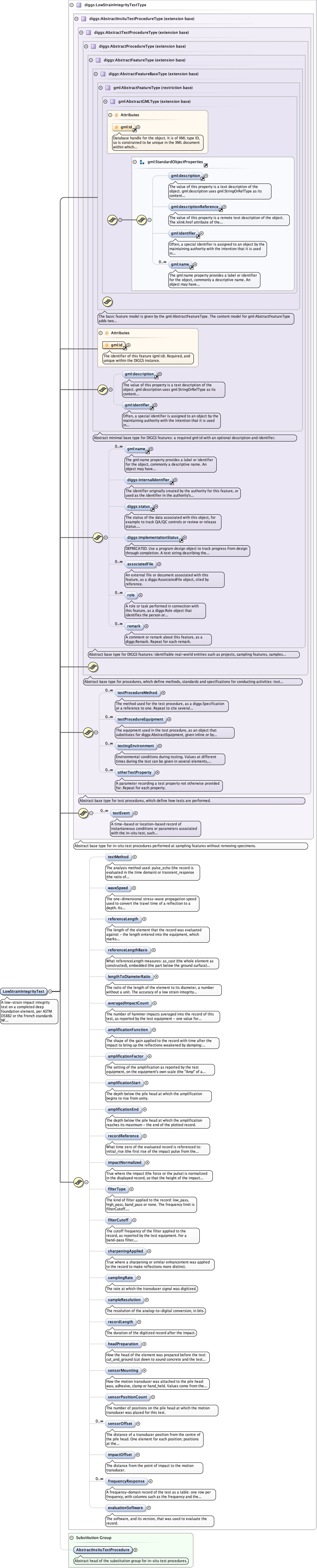
A low-strain impact integrity test on a completed deep foundation element, per ASTMD5882 or the French standards NF P94-160-2 (reflection/sonic-echo method) and NFP94-160-4 (impedance method). It is typically applied to a population of productionelements (commonly around 5 % in US DOT practice) rather than to selected elements.It substitutes diggs:AbstractInsituTestProcedure directly, notdiggs:AbstractLoadTestProcedure, because no sustained load is applied and there isno reaction system or load-increment schedule. ASTM D5882 names two methods in onedocument, the Pulse Echo Method (time domain, "sonic echo") and the TransientResponse Method (frequency domain, "impedance" or "impulse response"); Frenchpractice splits them into two standards. Cite the governing standard through theinherited testProcedureMethod; testMethod records which physical method was used.ASTM D5882 was withdrawn by ASTM in 2025 with no replacement named (a reinstatementeffort, ASTM work item WK93548, was in progress); the specification registry marksit withdrawn, and instances that cite it keep resolving. EN 12699 requires integritytesting of displacement piles but defines no test method, so cite it throughdiggs:RIProgramBasis/governingStandard rather than testProcedureMethod. The impacthammer and the motion transducer are equipment objects carried through the inheritedtestProcedureEquipment, classified with equipmentClass.xml#low_strain_impact_hammerand equipmentClass.xml#accelerometer. headPreparation, sensorMounting,sensorPositionCount, sensorOffset and impactOffset state how the head was preparedand where the transducer and impact were placed, and lengthToDiameterRatio theslenderness of the element. State the amplification applied to the record, becausethe height of a reflection can be read only against it: amplificationFunction givesits shape, amplificationFactor the equipment setting, and amplificationStart andamplificationEnd the depths over which it rises. The other settings a report statesare filterType, filterCutoff, sharpeningApplied, impactNormalized, recordReference,samplingRate, sampleResolution and recordLength; processing specific to oneequipment goes in otherTestProperty. evaluationSoftware names the software thatevaluated the record, and the inherited role states who evaluated it. The record isthe result: the diggs:Test on the element tested has as its outcome the evaluatedrecord as a depth-indexed result, whose location is a MultiPoint of the recorddepths along the element and whose ResultSet holds one column per curve sampled atthose depths: the amplified, normalized velocity(properties.xml#normalized_velocity) and, where reported, the force, the time afterimpact (properties.xml#elapsed_time) and a reconstructed relative impedance. Depthand time are related by waveSpeed (depth = waveSpeed x time / 2), so a recordreported against time is stated at the depths that waveSpeed gives, with the time asa column. One test with one set of procedure values is one Test, however manyreflections it shows. Values picked from the record, such as the toe depth, thedepth of a reflection above it or its relative amplitude, go inotherMeasurementProperty or in a column of the result (on every row, or only on therow at the depth where picked); the conclusion the tester draws from the wholerecord is measurementSummary. A frequency-domain record has no depth or time domain:the mobility of a transient response test (velocity over force against frequency)goes in frequencyResponse, a table whose columns its parameters declare, and valuesread from it, such as the characteristic mobility or the dynamic stiffness, go inotherMeasurementProperty.
Database handle for the object. It is of XML type ID, so is constrained to beunique in the XML document within which it occurs. An external identifier for the object inthe form of a URI may be constructed using standard XML and XPointer methods. This is doneby concatenating the URI for the document, a fragment separator, and the value of the idattribute.
Source
<element name="LowStrainIntegrityTest" type="diggs:LowStrainIntegrityTestType" abstract="false" substitutionGroup="diggs:AbstractInsituTestProcedure"><annotation><documentation>A low-strain impact integrity test on a completed deep foundation element, per ASTM D5882 or the French standards NF P94-160-2 (reflection/sonic-echo method) and NF P94-160-4 (impedance method). It is typically applied to a population of production elements (commonly around 5 % in US DOT practice) rather than to selected elements. It substitutes diggs:AbstractInsituTestProcedure directly, not diggs:AbstractLoadTestProcedure, because no sustained load is applied and there is no reaction system or load-increment schedule. ASTM D5882 names two methods in one document, the Pulse Echo Method (time domain, "sonic echo") and the Transient Response Method (frequency domain, "impedance" or "impulse response"); French practice splits them into two standards. Cite the governing standard through the inherited testProcedureMethod; testMethod records which physical method was used. ASTM D5882 was withdrawn by ASTM in 2025 with no replacement named (a reinstatement effort, ASTM work item WK93548, was in progress); the specification registry marks it withdrawn, and instances that cite it keep resolving. EN 12699 requires integrity testing of displacement piles but defines no test method, so cite it through diggs:RIProgramBasis/governingStandard rather than testProcedureMethod. The impact hammer and the motion transducer are equipment objects carried through the inherited testProcedureEquipment, classified with equipmentClass.xml#low_strain_impact_hammer and equipmentClass.xml#accelerometer. headPreparation, sensorMounting, sensorPositionCount, sensorOffset and impactOffset state how the head was prepared and where the transducer and impact were placed, and lengthToDiameterRatio the slenderness of the element. State the amplification applied to the record, because the height of a reflection can be read only against it: amplificationFunction gives its shape, amplificationFactor the equipment setting, and amplificationStart and amplificationEnd the depths over which it rises. The other settings a report states are filterType, filterCutoff, sharpeningApplied, impactNormalized, recordReference, samplingRate, sampleResolution and recordLength; processing specific to one equipment goes in otherTestProperty. evaluationSoftware names the software that evaluated the record, and the inherited role states who evaluated it. The record is the result: the diggs:Test on the element tested has as its outcome the evaluated record as a depth-indexed result, whose location is a MultiPoint of the record depths along the element and whose ResultSet holds one column per curve sampled at those depths: the amplified, normalized velocity (properties.xml#normalized_velocity) and, where reported, the force, the time after impact (properties.xml#elapsed_time) and a reconstructed relative impedance. Depth and time are related by waveSpeed (depth = waveSpeed x time / 2), so a record reported against time is stated at the depths that waveSpeed gives, with the time as a column. One test with one set of procedure values is one Test, however many reflections it shows. Values picked from the record, such as the toe depth, the depth of a reflection above it or its relative amplitude, go in otherMeasurementProperty or in a column of the result (on every row, or only on the row at the depth where picked); the conclusion the tester draws from the whole record is measurementSummary. A frequency-domain record has no depth or time domain: the mobility of a transient response test (velocity over force against frequency) goes in frequencyResponse, a table whose columns its parameters declare, and values read from it, such as the characteristic mobility or the dynamic stiffness, go in otherMeasurementProperty.</documentation></annotation></element>