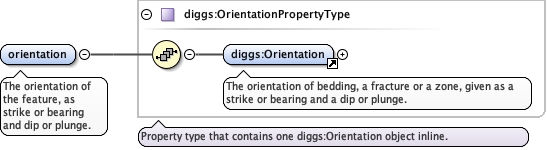
<element name="orientation" type="diggs:OrientationPropertyType"><annotation><documentation>The orientation of the feature, as strike or bearing and dip or plunge.</documentation></annotation></element>
Database handle for the object. It is of XML type ID, so is constrained to beunique in the XML document within which it occurs. An external identifier for the object inthe form of a URI may be constructed using standard XML and XPointer methods. This is doneby concatenating the URI for the document, a fragment separator, and the value of the idattribute.
A legacy attribute for AGS trial pit sampling features, whereobservations of different strata can occur at the same depth in a pit: areference letter or number whose sole purpose is to link the stratum onthe face sketch of the trial pit to the observation.
Source
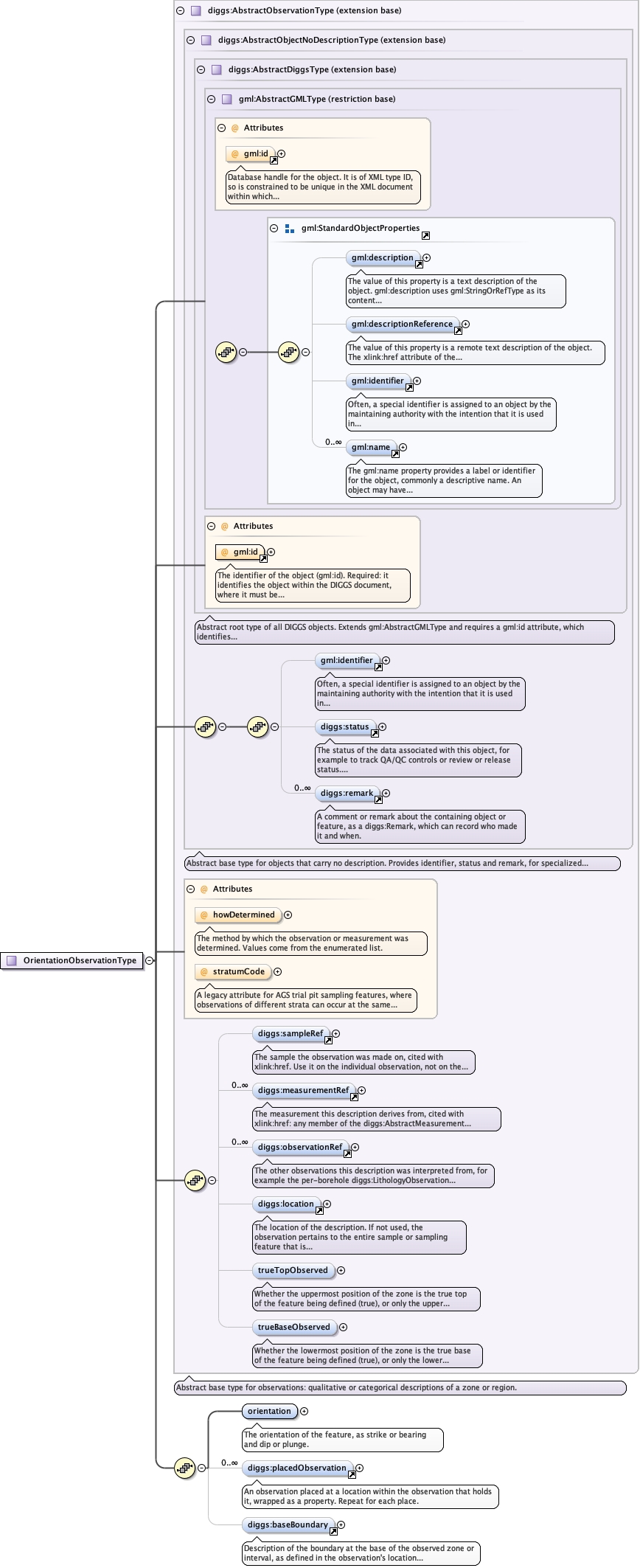
<complexType name="OrientationObservationType"><complexContent><extension base="diggs:AbstractObservationType"><sequence><element name="orientation" type="diggs:OrientationPropertyType"><annotation><documentation>The orientation of the feature, as strike or bearing and dip or plunge.</documentation></annotation></element><element maxOccurs="unbounded" minOccurs="0" ref="diggs:placedObservation"/><element minOccurs="0" ref="diggs:baseBoundary"><annotation><documentation>Description of the boundary at the base of the observed zone or interval, as defined in the observation's location property. Only one baseBoundary may be given.</documentation></annotation></element></sequence></extension></complexContent></complexType>