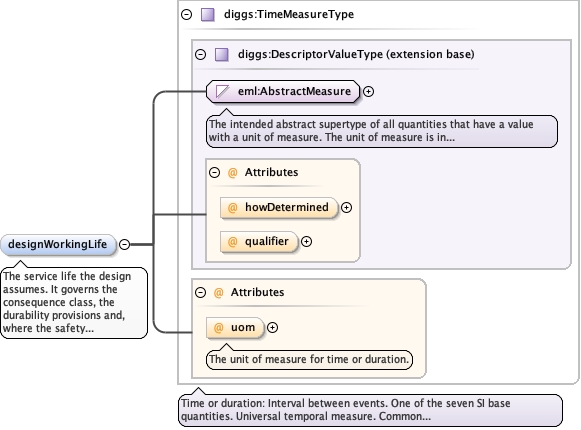
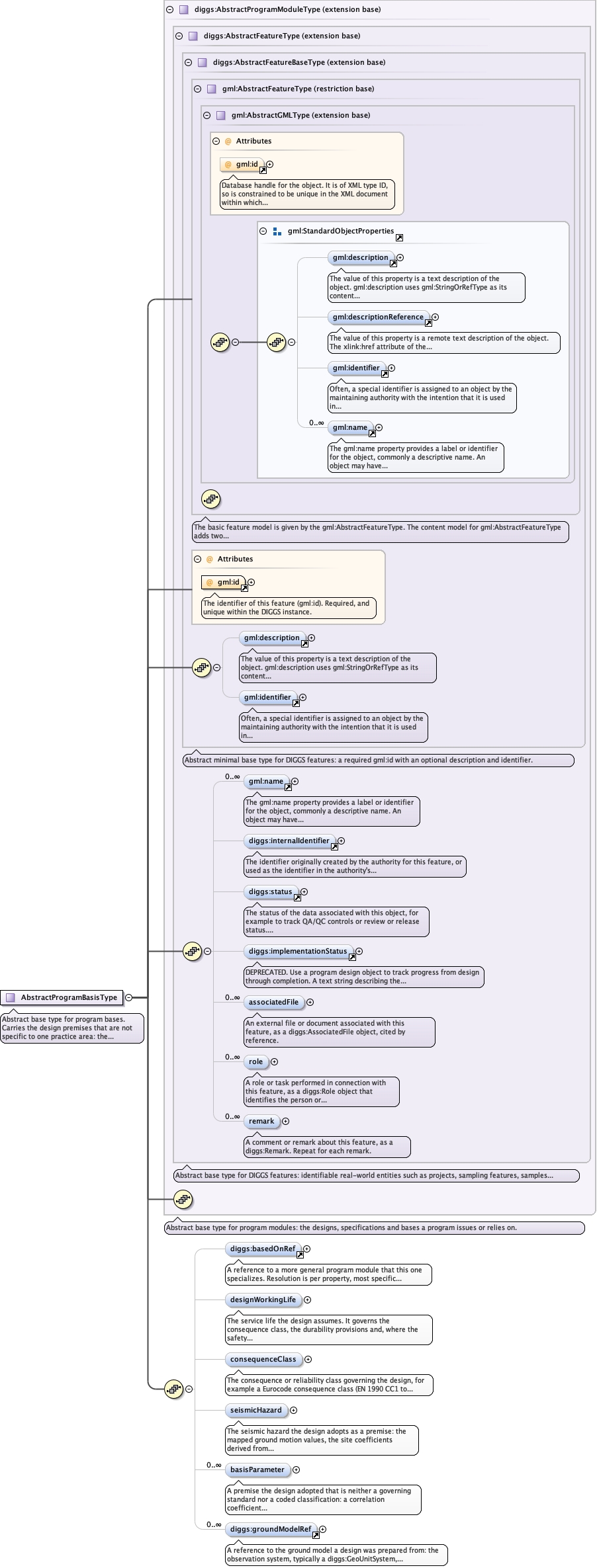
The service life the design assumes. It governs the consequenceclass, the durability provisions and, where the safety format isEurocode-based, which partial factors apply.
<element minOccurs="0" name="designWorkingLife" type="diggs:TimeMeasureType"><annotation><documentation>The service life the design assumes. It governs the consequence class, the durability provisions and, where the safety format is Eurocode-based, which partial factors apply.</documentation></annotation></element>
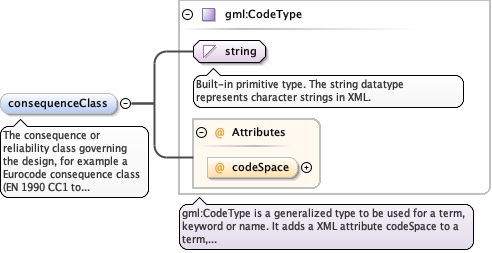
The consequence or reliability class governing the design, forexample a Eurocode consequence class (EN 1990 CC1 to CC3) or anequivalent national scheme. Several national schemes use this slotfor concepts that are not directly interchangeable with each otheror with the Eurocode classes. Use the DIGGS dictionaryconsequenceClass.xml for the list of values; it contains Eurocode(EN 1990) classes only, so for another scheme give a term andcodeSpace from that scheme.
<element minOccurs="0" name="consequenceClass" type="gml:CodeType"><annotation><documentation>The consequence or reliability class governing the design, for example a Eurocode consequence class (EN 1990 CC1 to CC3) or an equivalent national scheme. Several national schemes use this slot for concepts that are not directly interchangeable with each other or with the Eurocode classes. Use the DIGGS dictionary consequenceClass.xml for the list of values; it contains Eurocode (EN 1990) classes only, so for another scheme give a term and codeSpace from that scheme.</documentation></annotation></element>
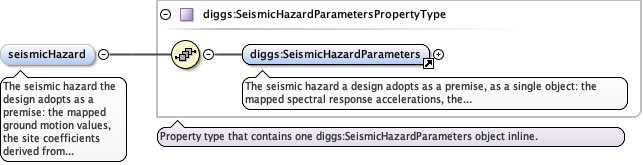
The seismic hazard the design adopts as a premise: the mapped groundmotion values, the site coefficients derived from them, the siteclass those coefficients were read against, and the design peakground acceleration. Everything here is a basis input with noachieved counterpart; contrastdiggs:RITreatedAreaType/seismicSiteClass. Ground improvement canchange the Vs30 of a site and so its site class, but it cannotchange the hazard at the site, which is fixed by regional seismicityand the chosen return period.
<element minOccurs="0" name="seismicHazard" type="diggs:SeismicHazardParametersPropertyType"><annotation><documentation>The seismic hazard the design adopts as a premise: the mapped ground motion values, the site coefficients derived from them, the site class those coefficients were read against, and the design peak ground acceleration. Everything here is a basis input with no achieved counterpart; contrast diggs:RITreatedAreaType/seismicSiteClass. Ground improvement can change the Vs30 of a site and so its site class, but it cannot change the hazard at the site, which is fixed by regional seismicity and the chosen return period.</documentation></annotation></element>
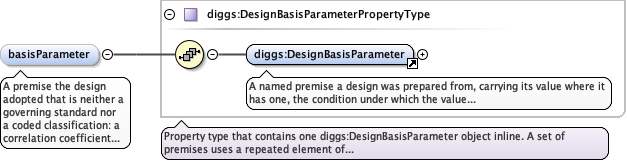
A premise the design adopted that is neither a governing standardnor a coded classification: a correlation coefficient taken from apublished method, a value assumed for a calculation input, or anadopted design groundwater or ground level. Give onediggs:DesignBasisParameter per named premise. A premise is not afactor: diggs:DesignFactor, and the factor element on the concretebases, are for the partial or global safety factor set a safetyformat applies. A penetrometer bearing factor or mobilizationcoefficient is a premise the calculation consumes, not a safetymargin applied to it.
<element minOccurs="0" maxOccurs="unbounded" name="basisParameter" type="diggs:DesignBasisParameterPropertyType"><annotation><documentation>A premise the design adopted that is neither a governing standard nor a coded classification: a correlation coefficient taken from a published method, a value assumed for a calculation input, or an adopted design groundwater or ground level. Give one diggs:DesignBasisParameter per named premise. A premise is not a factor: diggs:DesignFactor, and the factor element on the concrete bases, are for the partial or global safety factor set a safety format applies. A penetrometer bearing factor or mobilization coefficient is a premise the calculation consumes, not a safety margin applied to it.</documentation></annotation></element>
Complex Type diggs:AbstractProgramBasisType
Namespace
http://diggsml.org/schemas/3
Annotations
Abstract base type for program bases. Carries the design premises that are notspecific to one practice area: the service life assumed, the consequence classgoverning reliability and the seismic hazard adopted. Concrete bases add their owndomain-specific content.
Database handle for the object. It is of XML type ID, so is constrained to beunique in the XML document within which it occurs. An external identifier for the object inthe form of a URI may be constructed using standard XML and XPointer methods. This is doneby concatenating the URI for the document, a fragment separator, and the value of the idattribute.
Source
<complexType abstract="true" name="AbstractProgramBasisType"><annotation><documentation>Abstract base type for program bases. Carries the design premises that are not specific to one practice area: the service life assumed, the consequence class governing reliability and the seismic hazard adopted. Concrete bases add their own domain-specific content.</documentation></annotation><complexContent><extension base="diggs:AbstractProgramModuleType"><sequence><element minOccurs="0" ref="diggs:basedOnRef"/><element minOccurs="0" name="designWorkingLife" type="diggs:TimeMeasureType"><annotation><documentation>The service life the design assumes. It governs the consequence class, the durability provisions and, where the safety format is Eurocode-based, which partial factors apply.</documentation></annotation></element><element minOccurs="0" name="consequenceClass" type="gml:CodeType"><annotation><documentation>The consequence or reliability class governing the design, for example a Eurocode consequence class (EN 1990 CC1 to CC3) or an equivalent national scheme. Several national schemes use this slot for concepts that are not directly interchangeable with each other or with the Eurocode classes. Use the DIGGS dictionary consequenceClass.xml for the list of values; it contains Eurocode (EN 1990) classes only, so for another scheme give a term and codeSpace from that scheme.</documentation></annotation></element><element minOccurs="0" name="seismicHazard" type="diggs:SeismicHazardParametersPropertyType"><annotation><documentation>The seismic hazard the design adopts as a premise: the mapped ground motion values, the site coefficients derived from them, the site class those coefficients were read against, and the design peak ground acceleration. Everything here is a basis input with no achieved counterpart; contrast diggs:RITreatedAreaType/seismicSiteClass. Ground improvement can change the Vs30 of a site and so its site class, but it cannot change the hazard at the site, which is fixed by regional seismicity and the chosen return period.</documentation></annotation></element><element minOccurs="0" maxOccurs="unbounded" name="basisParameter" type="diggs:DesignBasisParameterPropertyType"><annotation><documentation>A premise the design adopted that is neither a governing standard nor a coded classification: a correlation coefficient taken from a published method, a value assumed for a calculation input, or an adopted design groundwater or ground level. Give one diggs:DesignBasisParameter per named premise. A premise is not a factor: diggs:DesignFactor, and the factor element on the concrete bases, are for the partial or global safety factor set a safety format applies. A penetrometer bearing factor or mobilization coefficient is a premise the calculation consumes, not a safety margin applied to it.</documentation></annotation></element><element minOccurs="0" maxOccurs="unbounded" ref="diggs:groundModelRef"/></sequence></extension></complexContent></complexType>