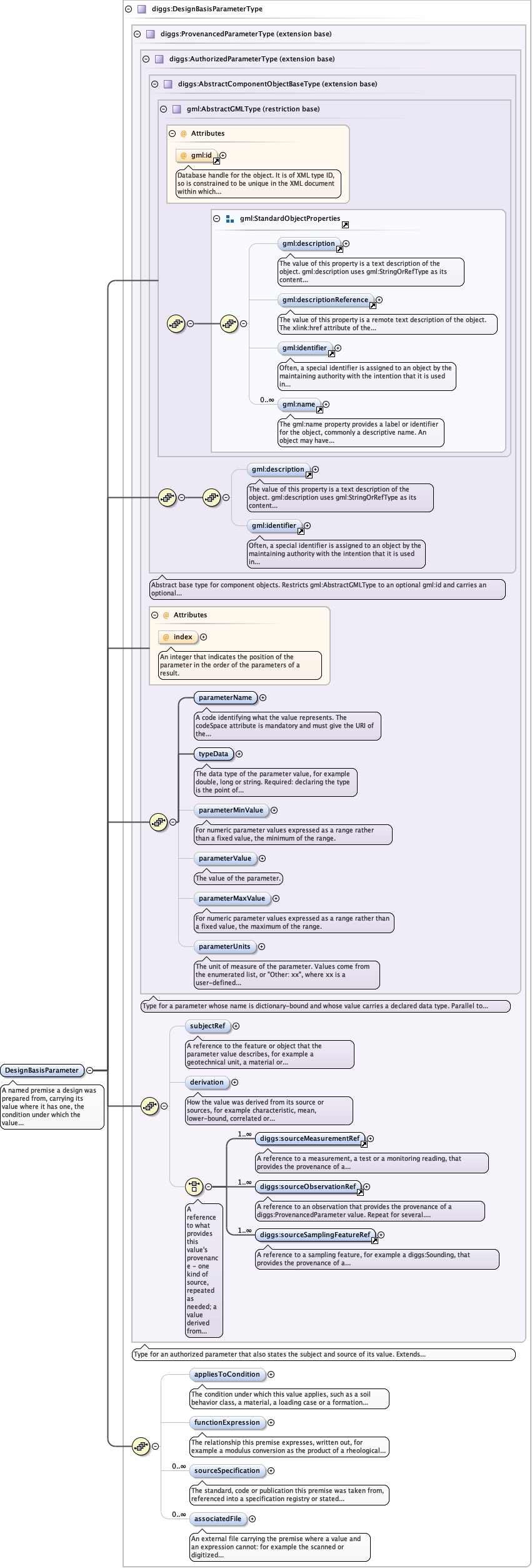
A named premise a design was prepared from, carrying its value where it has one, thecondition under which the value applies, and where it came from: a correlationcoefficient adopted from a published method, a calculation input assumed rather thanmeasured, or an adopted design groundwater or ground level. One type servescoefficients and assumptions alike, because the distinction between them is notstructural: an embedment depth conservatively assumed to be zero is both acalculation coefficient and a design assumption; the inherited derivation elementseparates an assumed value from a correlated one. It is not a diggs:DesignFactor,which is for the partial or global safety factor set a safety format applies and formaterial reduction factors: a bearing factor or mobilization coefficient is apremise the calculation consumes, not a margin applied to its result. It is generic,not tied to any practice area, and attaches to diggs:AbstractProgramBasisType: adeep foundation program adopting an alpha-method adhesion factor, a grouting programadopting a permeation radius correlation and a rigid inclusion program adopting apenetrometer bearing factor all state the same thing. The type extendsdiggs:ProvenancedParameterType, so parameterName, typeData, the minimum, value andmaximum, parameterUnits, subjectRef, derivation and the source references areinherited. The minimum, value and maximum state a premise as a single value or arange, and typeData allows a premise with no numeric value to be stated as text.Where the premise is a relationship rather than a scalar, state it infunctionExpression; where it is a published chart, cite it throughsourceSpecification and associatedFile and leave the value elements absent.
Database handle for the object. It is of XML type ID, so is constrained to beunique in the XML document within which it occurs. An external identifier for the object inthe form of a URI may be constructed using standard XML and XPointer methods. This is doneby concatenating the URI for the document, a fragment separator, and the value of the idattribute.
An integer that indicates the position of the parameter in the order ofthe parameters of a result.
Source
<element name="DesignBasisParameter" type="diggs:DesignBasisParameterType"><annotation><documentation>A named premise a design was prepared from, carrying its value where it has one, the condition under which the value applies, and where it came from: a correlation coefficient adopted from a published method, a calculation input assumed rather than measured, or an adopted design groundwater or ground level. One type serves coefficients and assumptions alike, because the distinction between them is not structural: an embedment depth conservatively assumed to be zero is both a calculation coefficient and a design assumption; the inherited derivation element separates an assumed value from a correlated one. It is not a diggs:DesignFactor, which is for the partial or global safety factor set a safety format applies and for material reduction factors: a bearing factor or mobilization coefficient is a premise the calculation consumes, not a margin applied to its result. It is generic, not tied to any practice area, and attaches to diggs:AbstractProgramBasisType: a deep foundation program adopting an alpha-method adhesion factor, a grouting program adopting a permeation radius correlation and a rigid inclusion program adopting a penetrometer bearing factor all state the same thing. The type extends diggs:ProvenancedParameterType, so parameterName, typeData, the minimum, value and maximum, parameterUnits, subjectRef, derivation and the source references are inherited. The minimum, value and maximum state a premise as a single value or a range, and typeData allows a premise with no numeric value to be stated as text. Where the premise is a relationship rather than a scalar, state it in functionExpression; where it is a published chart, cite it through sourceSpecification and associatedFile and leave the value elements absent.</documentation></annotation></element>