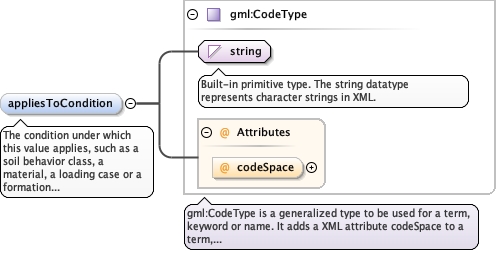
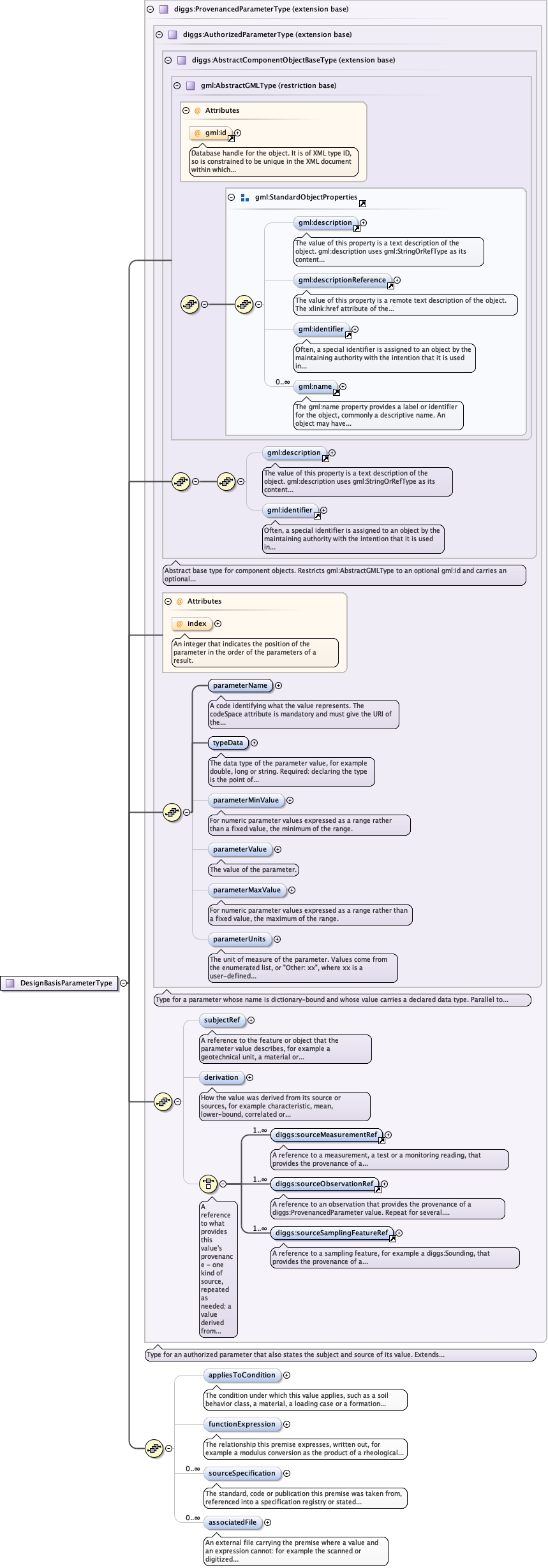
The condition under which this value applies, such as a soilbehavior class, a material, a loading case or a formation level.Omit it where the premise is unconditional. Where one named premisetakes several values under different conditions, state onediggs:DesignBasisParameter per condition rather than one carrying arange, since the values are alternatives selected by condition andnot bounds on a single quantity. No DIGGS-authored dictionarycurrently exists for this element.
<element minOccurs="0" name="appliesToCondition" type="gml:CodeType"><annotation><documentation>The condition under which this value applies, such as a soil behavior class, a material, a loading case or a formation level. Omit it where the premise is unconditional. Where one named premise takes several values under different conditions, state one diggs:DesignBasisParameter per condition rather than one carrying a range, since the values are alternatives selected by condition and not bounds on a single quantity. No DIGGS-authored dictionary currently exists for this element.</documentation></annotation></element>
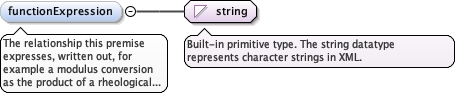
The relationship this premise expresses, written out, for example amodulus conversion as the product of a rheological factor and aYoung's modulus, or an end bearing pressure as a bearing factortimes a cone resistance. Free text, for human reading and citation:no expression language is implied or parsed. Where the relationshipis published as a chart with no closed form, leave this absent andcite the chart through sourceSpecification, naming the figure in thestandardClause of the referenced Specification.
Diagram
Type
string
Properties
content
simple
minOccurs
0
Source
<element minOccurs="0" name="functionExpression" type="string"><annotation><documentation>The relationship this premise expresses, written out, for example a modulus conversion as the product of a rheological factor and a Young's modulus, or an end bearing pressure as a bearing factor times a cone resistance. Free text, for human reading and citation: no expression language is implied or parsed. Where the relationship is published as a chart with no closed form, leave this absent and cite the chart through sourceSpecification, naming the figure in the standardClause of the referenced Specification.</documentation></annotation></element>
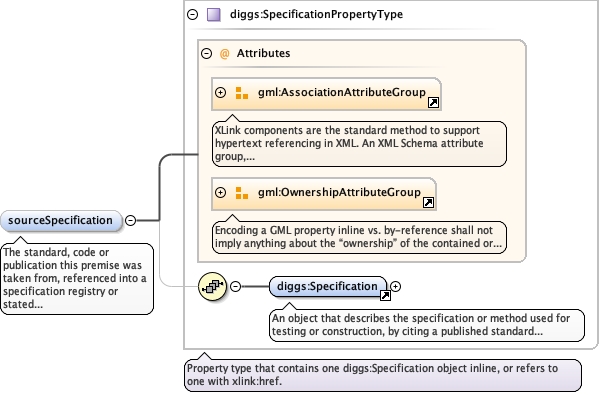
The standard, code or publication this premise was taken from,referenced into a specification registry or stated inline. Repeatwhere a value rests on more than one published source.
<element minOccurs="0" maxOccurs="unbounded" name="sourceSpecification" type="diggs:SpecificationPropertyType"><annotation><documentation>The standard, code or publication this premise was taken from, referenced into a specification registry or stated inline. Repeat where a value rests on more than one published source.</documentation></annotation></element>
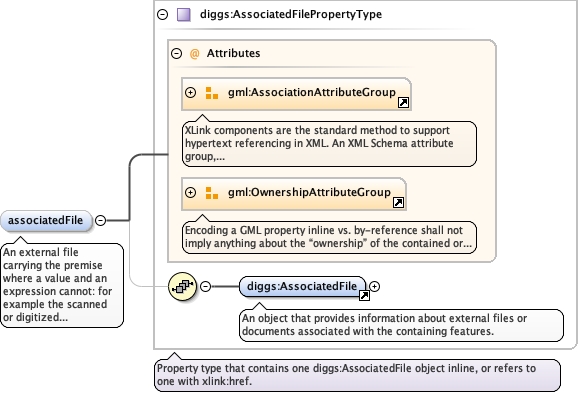
An external file carrying the premise where a value and anexpression cannot: for example the scanned or digitized chart afactor is read from, or the spreadsheet a correlation wasimplemented in.
<element minOccurs="0" maxOccurs="unbounded" name="associatedFile" type="diggs:AssociatedFilePropertyType"><annotation><appinfo source="urn:x-gml:targetElement">diggs:AssociatedFile</appinfo><documentation>An external file carrying the premise where a value and an expression cannot: for example the scanned or digitized chart a factor is read from, or the spreadsheet a correlation was implemented in.</documentation></annotation></element>
Database handle for the object. It is of XML type ID, so is constrained to beunique in the XML document within which it occurs. An external identifier for the object inthe form of a URI may be constructed using standard XML and XPointer methods. This is doneby concatenating the URI for the document, a fragment separator, and the value of the idattribute.
An integer that indicates the position of the parameter in the order ofthe parameters of a result.
Source
<complexType name="DesignBasisParameterType"><complexContent><extension base="diggs:ProvenancedParameterType"><sequence><element minOccurs="0" name="appliesToCondition" type="gml:CodeType"><annotation><documentation>The condition under which this value applies, such as a soil behavior class, a material, a loading case or a formation level. Omit it where the premise is unconditional. Where one named premise takes several values under different conditions, state one diggs:DesignBasisParameter per condition rather than one carrying a range, since the values are alternatives selected by condition and not bounds on a single quantity. No DIGGS-authored dictionary currently exists for this element.</documentation></annotation></element><element minOccurs="0" name="functionExpression" type="string"><annotation><documentation>The relationship this premise expresses, written out, for example a modulus conversion as the product of a rheological factor and a Young's modulus, or an end bearing pressure as a bearing factor times a cone resistance. Free text, for human reading and citation: no expression language is implied or parsed. Where the relationship is published as a chart with no closed form, leave this absent and cite the chart through sourceSpecification, naming the figure in the standardClause of the referenced Specification.</documentation></annotation></element><element minOccurs="0" maxOccurs="unbounded" name="sourceSpecification" type="diggs:SpecificationPropertyType"><annotation><documentation>The standard, code or publication this premise was taken from, referenced into a specification registry or stated inline. Repeat where a value rests on more than one published source.</documentation></annotation></element><element minOccurs="0" maxOccurs="unbounded" name="associatedFile" type="diggs:AssociatedFilePropertyType"><annotation><appinfo source="urn:x-gml:targetElement">diggs:AssociatedFile</appinfo><documentation>An external file carrying the premise where a value and an expression cannot: for example the scanned or digitized chart a factor is read from, or the spreadsheet a correlation was implemented in.</documentation></annotation></element></sequence></extension></complexContent></complexType>