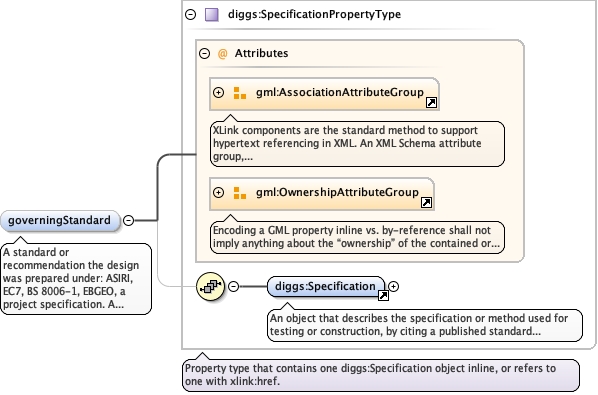
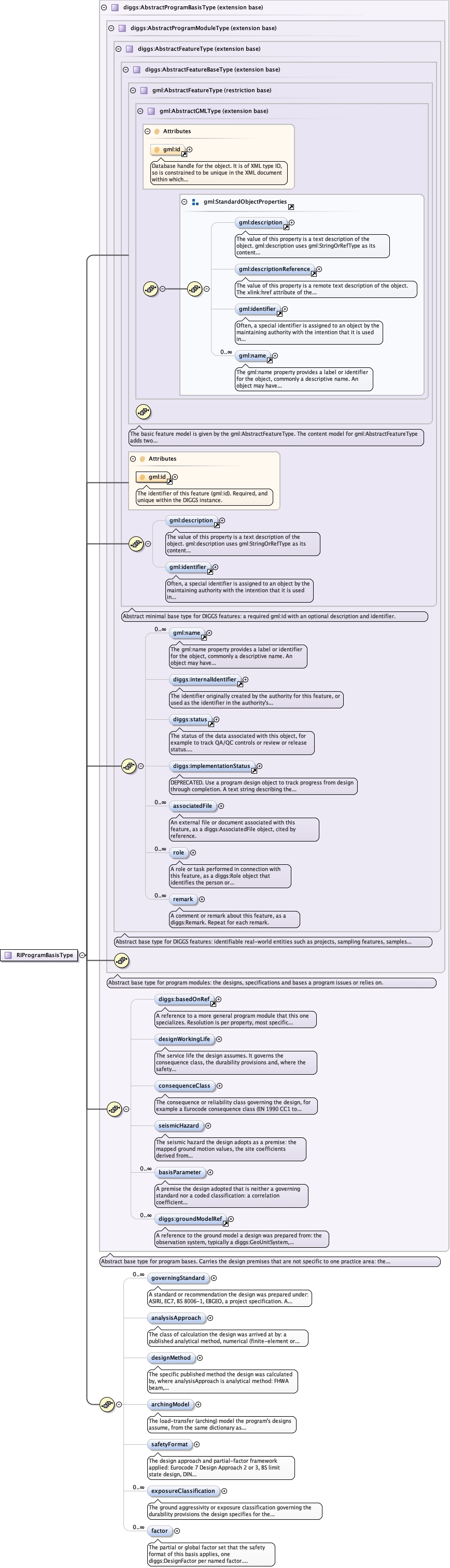
A standard or recommendation the design was prepared under: ASIRI,EC7, BS 8006-1, EBGEO, a project specification. A multi-national orhybrid-method project may cite several, each with its own editionand clause through standardVersion and standardClause of thereferenced diggs:Specification. Repeat for each standard.
<element minOccurs="0" maxOccurs="unbounded" name="governingStandard" type="diggs:SpecificationPropertyType"><annotation><documentation>A standard or recommendation the design was prepared under: ASIRI, EC7, BS 8006-1, EBGEO, a project specification. A multi-national or hybrid-method project may cite several, each with its own edition and clause through standardVersion and standardClause of the referenced diggs:Specification. Repeat for each standard.</documentation></annotation></element>
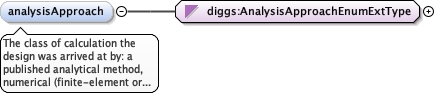
The class of calculation the design was arrived at by: a publishedanalytical method, numerical (finite-element or finite-difference)analysis, engineering judgment or precedent, or pre-production orproof load testing. It is distinct from designMethod: this stateswhich class of calculation was used, and designMethod states whichpublished method, and applies only when this element is analyticalmethod, since numerical analysis, personal experience and loadtesting select no named method. State this first. It is not nameddesignApproach because the vocabulary of safetyFormat already uses"design approach" for the Eurocode 7 DA2 and DA3 partial-factorcombinations, a different concept (which factors to apply, not howthe calculation was performed). Values come from the enumeratedlist, or "Other: xx", where xx is a user-defined term whose meaningdiffers from every listed value (not a synonym of one).
<element minOccurs="0" name="analysisApproach" type="diggs:AnalysisApproachEnumExtType"><annotation><documentation>The class of calculation the design was arrived at by: a published analytical method, numerical (finite-element or finite-difference) analysis, engineering judgment or precedent, or pre-production or proof load testing. It is distinct from designMethod: this states which class of calculation was used, and designMethod states which published method, and applies only when this element is analytical method, since numerical analysis, personal experience and load testing select no named method. State this first. It is not named designApproach because the vocabulary of safetyFormat already uses "design approach" for the Eurocode 7 DA2 and DA3 partial-factor combinations, a different concept (which factors to apply, not how the calculation was performed). Values come from the enumerated list, or "Other: xx", where xx is a user-defined term whose meaning differs from every listed value (not a synonym of one).</documentation></annotation></element>
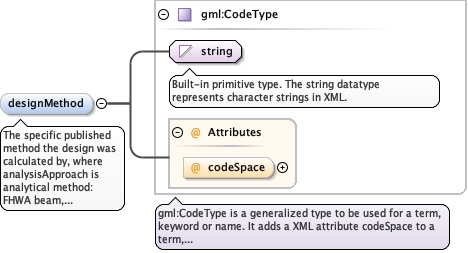
The specific published method the design was calculated by, whereanalysisApproach is analytical method: FHWA beam, FHWAstrain-compatibility, BS 8006-1, EBGEO, CUR226, Nordic or other.Leave it absent where analysisApproach names numerical analysis,personal experience or load testing, none of which selects a methodfrom this list. The dictionary also keeps its earlier, broadervocabulary (unit-cell method, arching, finite element analysis,load-displacement-compatibility method), which names a mechanismfamily rather than a method. Use the DIGGS dictionarydesignMethod.xml for the list of values.
<element minOccurs="0" name="designMethod" type="gml:CodeType"><annotation><documentation>The specific published method the design was calculated by, where analysisApproach is analytical method: FHWA beam, FHWA strain-compatibility, BS 8006-1, EBGEO, CUR226, Nordic or other. Leave it absent where analysisApproach names numerical analysis, personal experience or load testing, none of which selects a method from this list. The dictionary also keeps its earlier, broader vocabulary (unit-cell method, arching, finite element analysis, load-displacement-compatibility method), which names a mechanism family rather than a method. Use the DIGGS dictionary designMethod.xml for the list of values.</documentation></annotation></element>
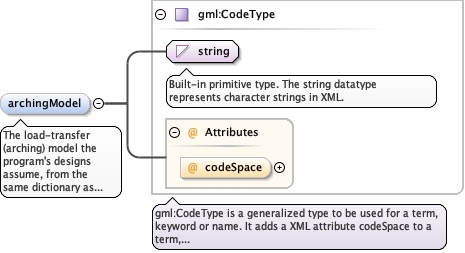
The load-transfer (arching) model the program's designs assume, fromthe same dictionary as diggs:ArchingCoefficientType/archingModel. Itis the program-level record that the design-level statement shouldagree with. The element on the design, not this one, is what thedictionary Occurrence condition of every arching coefficient keyson, since a conditionalElementXpath cannot reach across basisRef;see diggs:DesignRILTPType/criticalHeight and archingCoefficient. Usethe DIGGS dictionary archingModel.xml for the list of values.
<element minOccurs="0" name="archingModel" type="gml:CodeType"><annotation><documentation>The load-transfer (arching) model the program's designs assume, from the same dictionary as diggs:ArchingCoefficientType/archingModel. It is the program-level record that the design-level statement should agree with. The element on the design, not this one, is what the dictionary Occurrence condition of every arching coefficient keys on, since a conditionalElementXpath cannot reach across basisRef; see diggs:DesignRILTPType/criticalHeight and archingCoefficient. Use the DIGGS dictionary archingModel.xml for the list of values.</documentation></annotation></element>
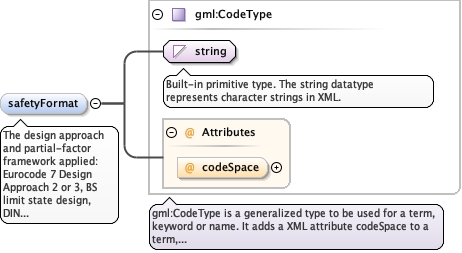
The design approach and partial-factor framework applied: Eurocode 7Design Approach 2 or 3, BS limit state design, DIN load cases, or anallowable-stress method with a global factor of safety. It governshow the values reported elsewhere in the design are meant to bechecked. Use the DIGGS dictionary safetyFormat.xml for the list ofvalues.
<element minOccurs="0" name="safetyFormat" type="gml:CodeType"><annotation><documentation>The design approach and partial-factor framework applied: Eurocode 7 Design Approach 2 or 3, BS limit state design, DIN load cases, or an allowable-stress method with a global factor of safety. It governs how the values reported elsewhere in the design are meant to be checked. Use the DIGGS dictionary safetyFormat.xml for the list of values.</documentation></annotation></element>
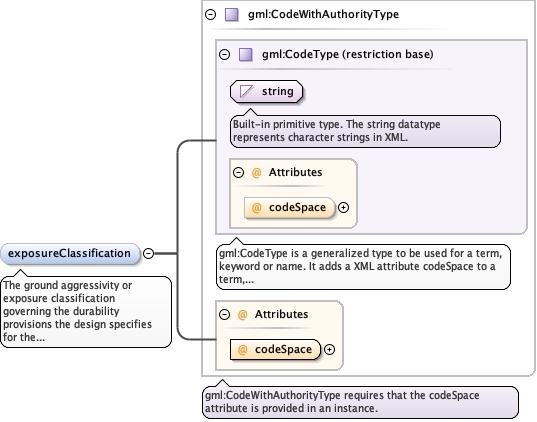
The ground aggressivity or exposure classification governing thedurability provisions the design specifies for the concrete or groutand for any embedded steel reinforcement, derived from the sulfate,chloride and pH results that a diggs:LabChemicalTest reports. It issomething the design was prepared from, an environmental conditionestablished before design, so it is on a basis rather than ondiggs:DesignRITreatedAreaType. The companion durability inputsdesignWorkingLife and consequenceClass are inherited fromdiggs:AbstractProgramBasisType. Ground aggressivity has twoindependent axes: chemical attack on the concrete or grout, gradedfrom sulfate, magnesium, chloride and acidity; and electricalcorrosivity to embedded steel, graded from soil resistivity. A siteroutinely carries a rating on each, from different authorities, sorepeat for each classification. The codeSpace is mandatory: severalschemes use the same severity words on completely different criteria(an ACI 318 S3, a BS 8500 AC-5, a Palmer resistivity rating and aclient standard may all read "very severe"), so a bare severity wordis uninterpretable. Use the DIGGS dictionaryexposureClassification.xml, whose codes are scoped to theirauthority: EN 206 XA classes, ACI 318 S and C categories, BS 8500ACEC classes and a client standard.
<element minOccurs="0" maxOccurs="unbounded" name="exposureClassification" type="gml:CodeWithAuthorityType"><annotation><documentation>The ground aggressivity or exposure classification governing the durability provisions the design specifies for the concrete or grout and for any embedded steel reinforcement, derived from the sulfate, chloride and pH results that a diggs:LabChemicalTest reports. It is something the design was prepared from, an environmental condition established before design, so it is on a basis rather than on diggs:DesignRITreatedAreaType. The companion durability inputs designWorkingLife and consequenceClass are inherited from diggs:AbstractProgramBasisType. Ground aggressivity has two independent axes: chemical attack on the concrete or grout, graded from sulfate, magnesium, chloride and acidity; and electrical corrosivity to embedded steel, graded from soil resistivity. A site routinely carries a rating on each, from different authorities, so repeat for each classification. The codeSpace is mandatory: several schemes use the same severity words on completely different criteria (an ACI 318 S3, a BS 8500 AC-5, a Palmer resistivity rating and a client standard may all read "very severe"), so a bare severity word is uninterpretable. Use the DIGGS dictionary exposureClassification.xml, whose codes are scoped to their authority: EN 206 XA classes, ACI 318 S and C categories, BS 8500 ACEC classes and a client standard.</documentation></annotation></element>
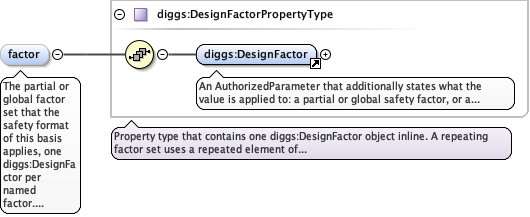
<element minOccurs="0" maxOccurs="unbounded" name="factor" type="diggs:DesignFactorPropertyType"><annotation><documentation>The partial or global factor set that the safety format of this basis applies, one diggs:DesignFactor per named factor. Repeat for each factor.</documentation></annotation></element>
Database handle for the object. It is of XML type ID, so is constrained to beunique in the XML document within which it occurs. An external identifier for the object inthe form of a URI may be constructed using standard XML and XPointer methods. This is doneby concatenating the URI for the document, a fragment separator, and the value of the idattribute.
Source
<complexType name="RIProgramBasisType"><complexContent><extension base="diggs:AbstractProgramBasisType"><sequence><element minOccurs="0" maxOccurs="unbounded" name="governingStandard" type="diggs:SpecificationPropertyType"><annotation><documentation>A standard or recommendation the design was prepared under: ASIRI, EC7, BS 8006-1, EBGEO, a project specification. A multi-national or hybrid-method project may cite several, each with its own edition and clause through standardVersion and standardClause of the referenced diggs:Specification. Repeat for each standard.</documentation></annotation></element><element minOccurs="0" name="analysisApproach" type="diggs:AnalysisApproachEnumExtType"><annotation><documentation>The class of calculation the design was arrived at by: a published analytical method, numerical (finite-element or finite-difference) analysis, engineering judgment or precedent, or pre-production or proof load testing. It is distinct from designMethod: this states which class of calculation was used, and designMethod states which published method, and applies only when this element is analytical method, since numerical analysis, personal experience and load testing select no named method. State this first. It is not named designApproach because the vocabulary of safetyFormat already uses "design approach" for the Eurocode 7 DA2 and DA3 partial-factor combinations, a different concept (which factors to apply, not how the calculation was performed). Values come from the enumerated list, or "Other: xx", where xx is a user-defined term whose meaning differs from every listed value (not a synonym of one).</documentation></annotation></element><element minOccurs="0" name="designMethod" type="gml:CodeType"><annotation><documentation>The specific published method the design was calculated by, where analysisApproach is analytical method: FHWA beam, FHWA strain-compatibility, BS 8006-1, EBGEO, CUR226, Nordic or other. Leave it absent where analysisApproach names numerical analysis, personal experience or load testing, none of which selects a method from this list. The dictionary also keeps its earlier, broader vocabulary (unit-cell method, arching, finite element analysis, load-displacement-compatibility method), which names a mechanism family rather than a method. Use the DIGGS dictionary designMethod.xml for the list of values.</documentation></annotation></element><element minOccurs="0" name="archingModel" type="gml:CodeType"><annotation><documentation>The load-transfer (arching) model the program's designs assume, from the same dictionary as diggs:ArchingCoefficientType/archingModel. It is the program-level record that the design-level statement should agree with. The element on the design, not this one, is what the dictionary Occurrence condition of every arching coefficient keys on, since a conditionalElementXpath cannot reach across basisRef; see diggs:DesignRILTPType/criticalHeight and archingCoefficient. Use the DIGGS dictionary archingModel.xml for the list of values.</documentation></annotation></element><element minOccurs="0" name="safetyFormat" type="gml:CodeType"><annotation><documentation>The design approach and partial-factor framework applied: Eurocode 7 Design Approach 2 or 3, BS limit state design, DIN load cases, or an allowable-stress method with a global factor of safety. It governs how the values reported elsewhere in the design are meant to be checked. Use the DIGGS dictionary safetyFormat.xml for the list of values.</documentation></annotation></element><element minOccurs="0" maxOccurs="unbounded" name="exposureClassification" type="gml:CodeWithAuthorityType"><annotation><documentation>The ground aggressivity or exposure classification governing the durability provisions the design specifies for the concrete or grout and for any embedded steel reinforcement, derived from the sulfate, chloride and pH results that a diggs:LabChemicalTest reports. It is something the design was prepared from, an environmental condition established before design, so it is on a basis rather than on diggs:DesignRITreatedAreaType. The companion durability inputs designWorkingLife and consequenceClass are inherited from diggs:AbstractProgramBasisType. Ground aggressivity has two independent axes: chemical attack on the concrete or grout, graded from sulfate, magnesium, chloride and acidity; and electrical corrosivity to embedded steel, graded from soil resistivity. A site routinely carries a rating on each, from different authorities, so repeat for each classification. The codeSpace is mandatory: several schemes use the same severity words on completely different criteria (an ACI 318 S3, a BS 8500 AC-5, a Palmer resistivity rating and a client standard may all read "very severe"), so a bare severity word is uninterpretable. Use the DIGGS dictionary exposureClassification.xml, whose codes are scoped to their authority: EN 206 XA classes, ACI 318 S and C categories, BS 8500 ACEC classes and a client standard.</documentation></annotation></element><element minOccurs="0" maxOccurs="unbounded" name="factor" type="diggs:DesignFactorPropertyType"><annotation><documentation>The partial or global factor set that the safety format of this basis applies, one diggs:DesignFactor per named factor. Repeat for each factor.</documentation></annotation></element></sequence></extension></complexContent></complexType>