Showing:

Annotations
Attributes
Diagrams
Instances
Model
Properties
Source
Used by
Element diggs:SeismicHazardParameters
Namespace http://diggsml.org/schemas/3
Annotations
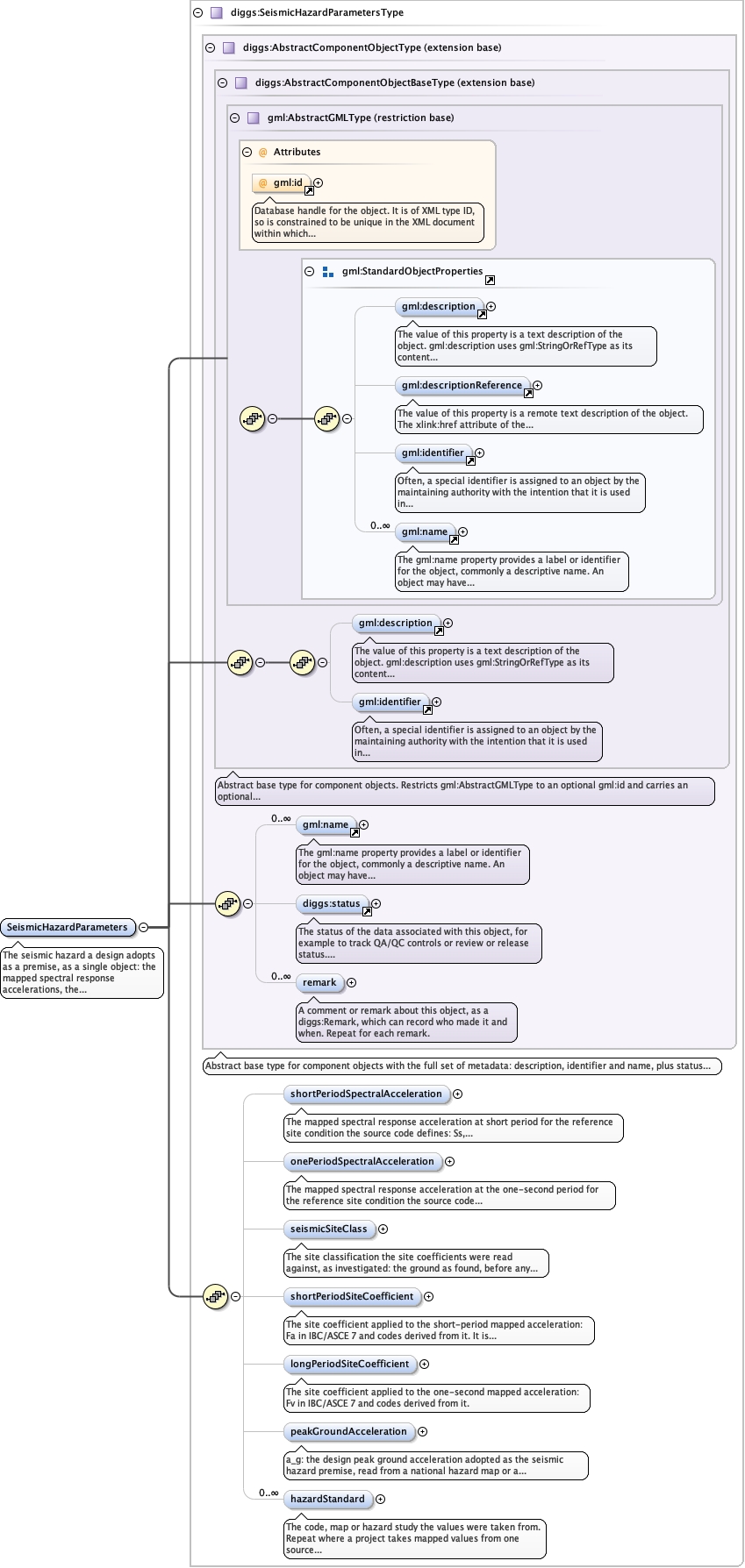
The seismic hazard a design adopts as a premise, as a single object: the mapped
spectral response accelerations, the site class, the site coefficients read against
that class, and the design peak ground acceleration. They form one object because
these values are a derivation chain and are close to meaningless apart: site
coefficients are read from a code table as a function of the site class and the
mapped accelerations, and a coefficient quoted without its class cannot be checked.
The object keeps the chain together and lets the standard that supplied it be cited
once. The element names are code-agnostic, with the familiar symbols given in the
documentation, so that a design under Eurocode 8, which states a reference peak
ground acceleration, a ground type and a soil factor, uses the same slots. Every
element is optional, because codes differ in what they publish; an object that
states only what its own code supplies is complete. The object carries description,
name, status and remark, since a hazard statement usually needs to record which map
edition, return period or study it came from, and remark is where a per-value clause
citation goes when the values come from several figures of one code.
Diagram
Diagramgml3_2Profile_diggs_xsd_Attribute_gml_id.tmp#idgml3_2Profile_diggs_xsd_Element_gml_description.tmp#descriptiongml3_2Profile_diggs_xsd_Element_gml_descriptionReference.tmp#descriptionReferencegml3_2Profile_diggs_xsd_Element_gml_identifier.tmp#identifiergml3_2Profile_diggs_xsd_Element_gml_name.tmp#namegml3_2Profile_diggs_xsd_Element_Group_gml_StandardObjectProperties.tmp#StandardObjectPropertiesgml3_2Profile_diggs_xsd_Complex_Type_gml_AbstractGMLType.tmp#AbstractGMLTypegml3_2Profile_diggs_xsd_Element_gml_description.tmp#descriptiongml3_2Profile_diggs_xsd_Element_gml_identifier.tmp#identifierAbstractTypes_xsd_Complex_Type_diggs_AbstractComponentObjectBaseType.tmp#AbstractComponentObjectBaseTypegml3_2Profile_diggs_xsd_Element_gml_name.tmp#nameCommon_xsd_Element_diggs_status.tmp#statusAbstractTypes_xsd_Complex_Type_diggs_AbstractComponentObjectType.tmp#AbstractComponentObjectType_remarkAbstractTypes_xsd_Complex_Type_diggs_AbstractComponentObjectType.tmp#AbstractComponentObjectTypeCommon_xsd_Complex_Type_diggs_SeismicHazardParametersType.tmp#SeismicHazardParametersType_shortPeriodSpectralAccelerationCommon_xsd_Complex_Type_diggs_SeismicHazardParametersType.tmp#SeismicHazardParametersType_onePeriodSpectralAccelerationCommon_xsd_Complex_Type_diggs_SeismicHazardParametersType.tmp#SeismicHazardParametersType_seismicSiteClassCommon_xsd_Complex_Type_diggs_SeismicHazardParametersType.tmp#SeismicHazardParametersType_shortPeriodSiteCoefficientCommon_xsd_Complex_Type_diggs_SeismicHazardParametersType.tmp#SeismicHazardParametersType_longPeriodSiteCoefficientCommon_xsd_Complex_Type_diggs_SeismicHazardParametersType.tmp#SeismicHazardParametersType_peakGroundAccelerationCommon_xsd_Complex_Type_diggs_SeismicHazardParametersType.tmp#SeismicHazardParametersType_hazardStandardCommon_xsd_Complex_Type_diggs_SeismicHazardParametersType.tmp#SeismicHazardParametersType
Type diggs:SeismicHazardParametersType
Type hierarchy
Properties
content complex
Used by
Model
Children diggs:hazardStandard, diggs:longPeriodSiteCoefficient, diggs:onePeriodSpectralAcceleration, diggs:peakGroundAcceleration, diggs:remark, diggs:seismicSiteClass, diggs:shortPeriodSiteCoefficient, diggs:shortPeriodSpectralAcceleration, diggs:status, gml:description, gml:identifier, gml:name
Instance
<diggs:SeismicHazardParameters gml:id="" xmlns:diggs="http://diggsml.org/schemas/3" xmlns:gml="http://www.opengis.net/gml/3.2">
  <gml:description xlink:href="" nilReason="">{0,1}</gml:description>
  <gml:identifier codeSpace="">{0,1}</gml:identifier>
  <gml:name codeSpace="">{0,unbounded}</gml:name>
  <diggs:status codeSpace="">{0,1}</diggs:status>
  <diggs:remark>{0,unbounded}</diggs:remark>
  <diggs:shortPeriodSpectralAcceleration howDetermined="" qualifier="" uom="">{0,1}</diggs:shortPeriodSpectralAcceleration>
  <diggs:onePeriodSpectralAcceleration howDetermined="" qualifier="" uom="">{0,1}</diggs:onePeriodSpectralAcceleration>
  <diggs:seismicSiteClass>{0,1}</diggs:seismicSiteClass>
  <diggs:shortPeriodSiteCoefficient howDetermined="" qualifier="" uom="">{0,1}</diggs:shortPeriodSiteCoefficient>
  <diggs:longPeriodSiteCoefficient howDetermined="" qualifier="" uom="">{0,1}</diggs:longPeriodSiteCoefficient>
  <diggs:peakGroundAcceleration howDetermined="" qualifier="" uom="">{0,1}</diggs:peakGroundAcceleration>
  <diggs:hazardStandard xlink:href="" nilReason="" owns="false">{0,unbounded}</diggs:hazardStandard>
</diggs:SeismicHazardParameters>
Attributes
QName Type Use Annotation
gml:id ID optional
Database handle for the object. It is of XML type ID, so is constrained to be
unique in the XML document within which it occurs. An external identifier for the object in
the form of a URI may be constructed using standard XML and XPointer methods. This is done
by concatenating the URI for the document, a fragment separator, and the value of the id
attribute.
Source
<element name="SeismicHazardParameters" type="diggs:SeismicHazardParametersType">
  <annotation>
    <documentation>The seismic hazard a design adopts as a premise, as a single object: the mapped spectral response accelerations, the site class, the site coefficients read against that class, and the design peak ground acceleration. They form one object because these values are a derivation chain and are close to meaningless apart: site coefficients are read from a code table as a function of the site class and the mapped accelerations, and a coefficient quoted without its class cannot be checked. The object keeps the chain together and lets the standard that supplied it be cited once. The element names are code-agnostic, with the familiar symbols given in the documentation, so that a design under Eurocode 8, which states a reference peak ground acceleration, a ground type and a soil factor, uses the same slots. Every element is optional, because codes differ in what they publish; an object that states only what its own code supplies is complete. The object carries description, name, status and remark, since a hazard statement usually needs to record which map edition, return period or study it came from, and remark is where a per-value clause citation goes when the values come from several figures of one code.</documentation>
  </annotation>
</element>