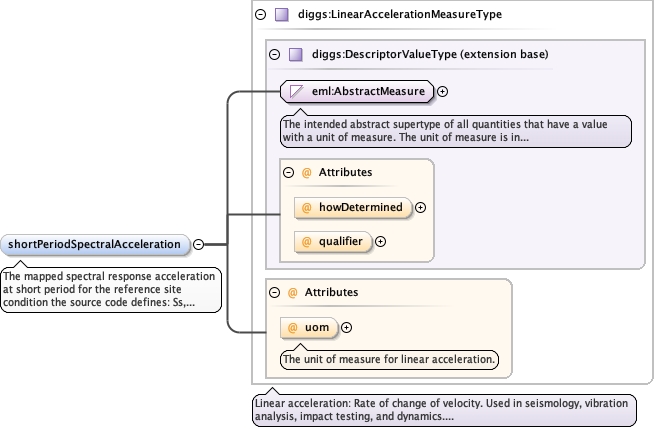
The mapped spectral response acceleration at short period for thereference site condition the source code defines: Ss, conventionallyat 0.2 s, in IBC/ASCE 7 and codes derived from it. A mapped valuebefore any site adjustment.
<element minOccurs="0" name="shortPeriodSpectralAcceleration" type="diggs:LinearAccelerationMeasureType"><annotation><documentation>The mapped spectral response acceleration at short period for the reference site condition the source code defines: Ss, conventionally at 0.2 s, in IBC/ASCE 7 and codes derived from it. A mapped value before any site adjustment.</documentation></annotation></element>
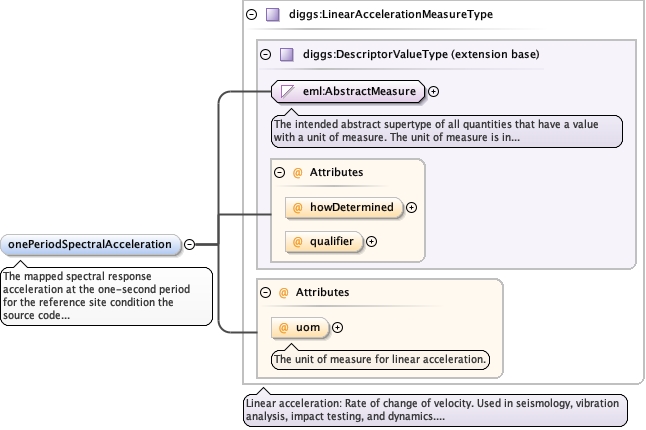
The mapped spectral response acceleration at the one-second periodfor the reference site condition the source code defines: S1 inIBC/ASCE 7 and codes derived from it. A mapped value before any siteadjustment.
<element minOccurs="0" name="onePeriodSpectralAcceleration" type="diggs:LinearAccelerationMeasureType"><annotation><documentation>The mapped spectral response acceleration at the one-second period for the reference site condition the source code defines: S1 in IBC/ASCE 7 and codes derived from it. A mapped value before any site adjustment.</documentation></annotation></element>
The site classification the site coefficients were read against, asinvestigated: the ground as found, before any improvement. The sameelement name is used on diggs:RITreatedAreaType anddiggs:DesignRITreatedAreaType so that one enumeration governs allthree, but they state different facts about the same scale: this oneis what the investigation found and the hazard lookup used, thedesign-side one is what the design predicts improvement willachieve, and the treated-area one is what was achieved. A projectthat improves the ground enough to change its class states all threeand they will not agree; that is the finding, not an error. Valuescome from the enumerated list, or "Other: xx", where xx is auser-defined term whose meaning differs from every listed value (nota synonym of one).
<element minOccurs="0" name="seismicSiteClass" type="diggs:SeismicSiteClassEnumExtType"><annotation><documentation>The site classification the site coefficients were read against, as investigated: the ground as found, before any improvement. The same element name is used on diggs:RITreatedAreaType and diggs:DesignRITreatedAreaType so that one enumeration governs all three, but they state different facts about the same scale: this one is what the investigation found and the hazard lookup used, the design-side one is what the design predicts improvement will achieve, and the treated-area one is what was achieved. A project that improves the ground enough to change its class states all three and they will not agree; that is the finding, not an error. Values come from the enumerated list, or "Other: xx", where xx is a user-defined term whose meaning differs from every listed value (not a synonym of one).</documentation></annotation></element>
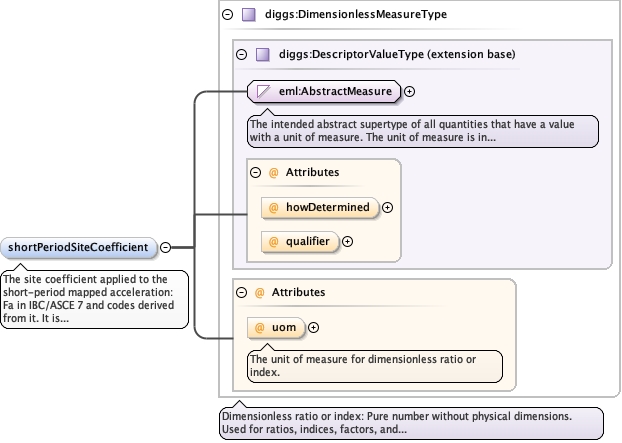
The site coefficient applied to the short-period mappedacceleration: Fa in IBC/ASCE 7 and codes derived from it. It is readfrom a code table as a function of the site class and the mappedvalue, which is why it is stated alongside both.
The unit of measure for dimensionless ratio or index.
Source
<element minOccurs="0" name="shortPeriodSiteCoefficient" type="diggs:DimensionlessMeasureType"><annotation><documentation>The site coefficient applied to the short-period mapped acceleration: Fa in IBC/ASCE 7 and codes derived from it. It is read from a code table as a function of the site class and the mapped value, which is why it is stated alongside both.</documentation></annotation></element>
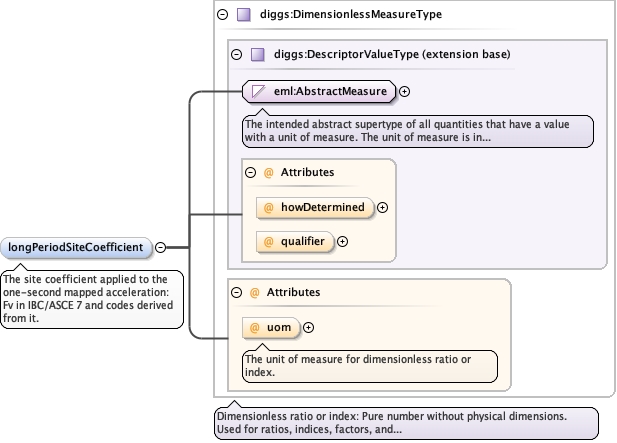
The unit of measure for dimensionless ratio or index.
Source
<element minOccurs="0" name="longPeriodSiteCoefficient" type="diggs:DimensionlessMeasureType"><annotation><documentation>The site coefficient applied to the one-second mapped acceleration: Fv in IBC/ASCE 7 and codes derived from it.</documentation></annotation></element>
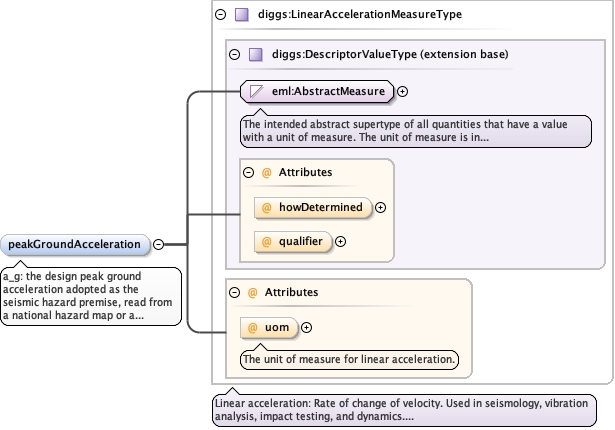
a_g: the design peak ground acceleration adopted as the seismichazard premise, read from a national hazard map or a site-specifichazard study for the return period implied by the design workinglife and consequence class. It is not derivable from the valuesabove and must not be synthesized from them: in ASCE 7 and the codesderived from it, a site-adjusted peak ground acceleration comes froma separately mapped peak ground acceleration and its own sitecoefficient, and the coefficients above apply to spectral ordinates,not to it. Where a source states spectral values but no peak groundacceleration, leave this absent. It is adiggs:LinearAccelerationMeasureType rather than a dimensionlessvalue because peak ground acceleration is quoted as a fraction ofstandard gravity at least as often as in m/s2; the mandatory uom,"gn" for the former and "m/s2" for the latter, keeps 0.3 g frombeing read as 0.3 m/s2. A measured strong-motion record is adifferent thing in a different domain and is not modelled here.
<element minOccurs="0" name="peakGroundAcceleration" type="diggs:LinearAccelerationMeasureType"><annotation><documentation>a_g: the design peak ground acceleration adopted as the seismic hazard premise, read from a national hazard map or a site-specific hazard study for the return period implied by the design working life and consequence class. It is not derivable from the values above and must not be synthesized from them: in ASCE 7 and the codes derived from it, a site-adjusted peak ground acceleration comes from a separately mapped peak ground acceleration and its own site coefficient, and the coefficients above apply to spectral ordinates, not to it. Where a source states spectral values but no peak ground acceleration, leave this absent. It is a diggs:LinearAccelerationMeasureType rather than a dimensionless value because peak ground acceleration is quoted as a fraction of standard gravity at least as often as in m/s2; the mandatory uom, "gn" for the former and "m/s2" for the latter, keeps 0.3 g from being read as 0.3 m/s2. A measured strong-motion record is a different thing in a different domain and is not modelled here.</documentation></annotation></element>
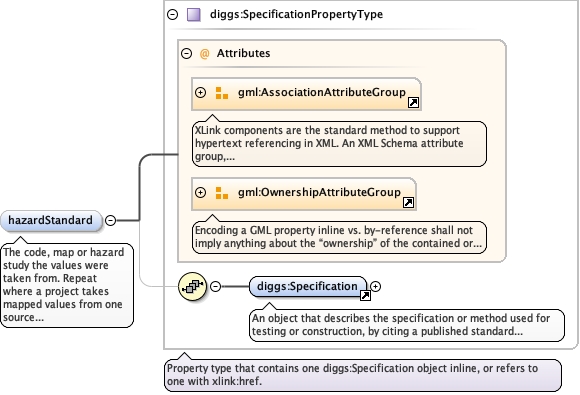
The code, map or hazard study the values were taken from. Repeatwhere a project takes mapped values from one source and a siteclassification procedure from another. Where every value comes fromone code but from different figures or tables within it, cite thecode once here and record the per-value clauses in remark.
<element minOccurs="0" maxOccurs="unbounded" name="hazardStandard" type="diggs:SpecificationPropertyType"><annotation><documentation>The code, map or hazard study the values were taken from. Repeat where a project takes mapped values from one source and a site classification procedure from another. Where every value comes from one code but from different figures or tables within it, cite the code once here and record the per-value clauses in remark.</documentation></annotation></element>
Database handle for the object. It is of XML type ID, so is constrained to beunique in the XML document within which it occurs. An external identifier for the object inthe form of a URI may be constructed using standard XML and XPointer methods. This is doneby concatenating the URI for the document, a fragment separator, and the value of the idattribute.
Source
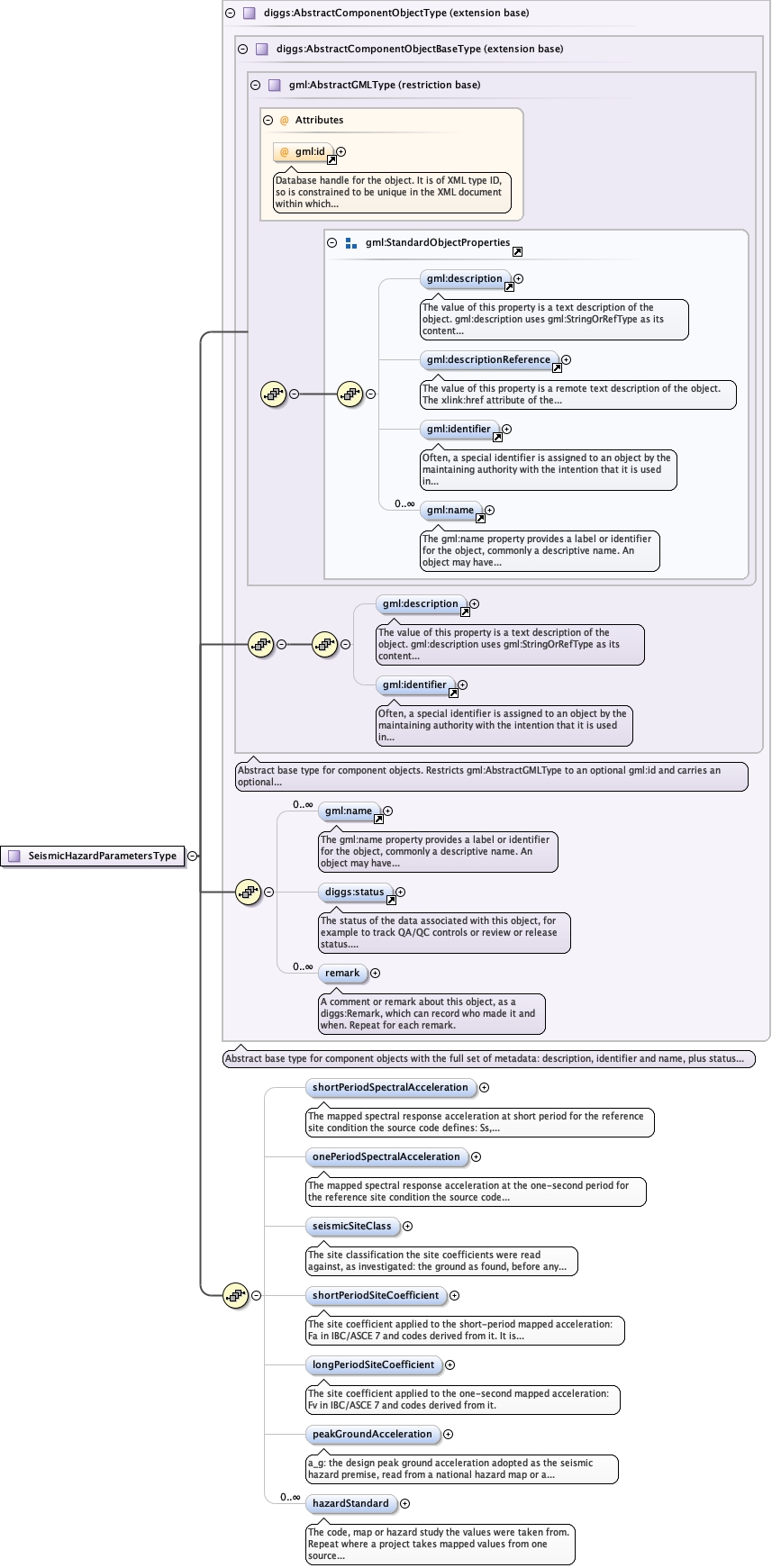
<complexType name="SeismicHazardParametersType"><complexContent><extension base="diggs:AbstractComponentObjectType"><sequence><element minOccurs="0" name="shortPeriodSpectralAcceleration" type="diggs:LinearAccelerationMeasureType"><annotation><documentation>The mapped spectral response acceleration at short period for the reference site condition the source code defines: Ss, conventionally at 0.2 s, in IBC/ASCE 7 and codes derived from it. A mapped value before any site adjustment.</documentation></annotation></element><element minOccurs="0" name="onePeriodSpectralAcceleration" type="diggs:LinearAccelerationMeasureType"><annotation><documentation>The mapped spectral response acceleration at the one-second period for the reference site condition the source code defines: S1 in IBC/ASCE 7 and codes derived from it. A mapped value before any site adjustment.</documentation></annotation></element><element minOccurs="0" name="seismicSiteClass" type="diggs:SeismicSiteClassEnumExtType"><annotation><documentation>The site classification the site coefficients were read against, as investigated: the ground as found, before any improvement. The same element name is used on diggs:RITreatedAreaType and diggs:DesignRITreatedAreaType so that one enumeration governs all three, but they state different facts about the same scale: this one is what the investigation found and the hazard lookup used, the design-side one is what the design predicts improvement will achieve, and the treated-area one is what was achieved. A project that improves the ground enough to change its class states all three and they will not agree; that is the finding, not an error. Values come from the enumerated list, or "Other: xx", where xx is a user-defined term whose meaning differs from every listed value (not a synonym of one).</documentation></annotation></element><element minOccurs="0" name="shortPeriodSiteCoefficient" type="diggs:DimensionlessMeasureType"><annotation><documentation>The site coefficient applied to the short-period mapped acceleration: Fa in IBC/ASCE 7 and codes derived from it. It is read from a code table as a function of the site class and the mapped value, which is why it is stated alongside both.</documentation></annotation></element><element minOccurs="0" name="longPeriodSiteCoefficient" type="diggs:DimensionlessMeasureType"><annotation><documentation>The site coefficient applied to the one-second mapped acceleration: Fv in IBC/ASCE 7 and codes derived from it.</documentation></annotation></element><element minOccurs="0" name="peakGroundAcceleration" type="diggs:LinearAccelerationMeasureType"><annotation><documentation>a_g: the design peak ground acceleration adopted as the seismic hazard premise, read from a national hazard map or a site-specific hazard study for the return period implied by the design working life and consequence class. It is not derivable from the values above and must not be synthesized from them: in ASCE 7 and the codes derived from it, a site-adjusted peak ground acceleration comes from a separately mapped peak ground acceleration and its own site coefficient, and the coefficients above apply to spectral ordinates, not to it. Where a source states spectral values but no peak ground acceleration, leave this absent. It is a diggs:LinearAccelerationMeasureType rather than a dimensionless value because peak ground acceleration is quoted as a fraction of standard gravity at least as often as in m/s2; the mandatory uom, "gn" for the former and "m/s2" for the latter, keeps 0.3 g from being read as 0.3 m/s2. A measured strong-motion record is a different thing in a different domain and is not modelled here.</documentation></annotation></element><element minOccurs="0" maxOccurs="unbounded" name="hazardStandard" type="diggs:SpecificationPropertyType"><annotation><documentation>The code, map or hazard study the values were taken from. Repeat where a project takes mapped values from one source and a site classification procedure from another. Where every value comes from one code but from different figures or tables within it, cite the code once here and record the per-value clauses in remark.</documentation></annotation></element></sequence></extension></complexContent></complexType>