Showing:

Annotations
Attributes
Diagrams
Instances
Model
Properties
Source
Used by
Element diggs:ProcessingStepType / diggs:associatedFile
Namespace http://diggsml.org/schema-dev
Annotations
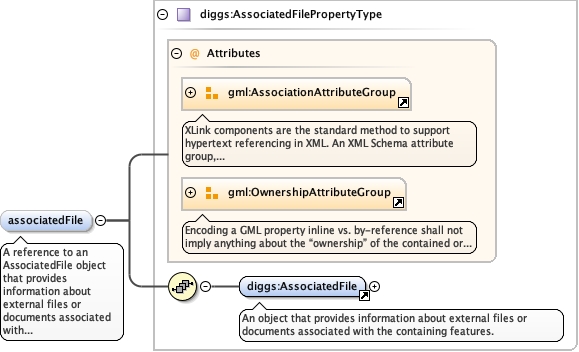
A reference to an AssociatedFile object that provides
information about external files or documents associated with this
processing step. The target value is indicated in the appinfo
element.
Diagram
Diagramgml3_2Profile_diggs_xsd_Attribute_Group_gml_AssociationAttributeGroup.tmp#AssociationAttributeGroupgml3_2Profile_diggs_xsd_Attribute_Group_gml_OwnershipAttributeGroup.tmp#OwnershipAttributeGroupKernel_xsd_Element_diggs_AssociatedFile.tmp#AssociatedFileKernel_xsd_Complex_Type_diggs_AssociatedFilePropertyType.tmp#AssociatedFilePropertyType
Type diggs:AssociatedFilePropertyType
Properties
content complex
minOccurs 0
maxOccurs unbounded
Model
Children diggs:AssociatedFile
Instance
<diggs:associatedFile xlink:actuate="" xlink:arcrole="" xlink:href="" nilReason="" owns="false" xlink:role="" xlink:show="" xlink:title="" xlink:type="simple" xmlns:diggs="http://diggsml.org/schema-dev">
  <diggs:AssociatedFile gml:id="" xml:lang="">{1,1}</diggs:AssociatedFile>
</diggs:associatedFile>
Attributes
QName Type Fixed Default Use Annotation
nilReason gml:NilReasonType optional
owns boolean false optional
xlink:actuate restriction of string optional
The 'actuate' attribute is used to communicate the desired timing 
of traversal from the starting resource to the ending resource; 
it's value should be treated as follows:
onLoad - traverse to the ending resource immediately on loading 
         the starting resource 
onRequest - traverse from the starting resource to the ending 
            resource only on a post-loading event triggered for 
            this purpose 
other - behavior is unconstrained; examine other markup in link 
        for hints 
none - behavior is unconstrained
xlink:arcrole anyURI optional
xlink:href anyURI optional
xlink:role anyURI optional
xlink:show restriction of string optional
The 'show' attribute is used to communicate the desired presentation 
of the ending resource on traversal from the starting resource; it's 
value should be treated as follows: 
new - load ending resource in a new window, frame, pane, or other 
      presentation context
replace - load the resource in the same window, frame, pane, or 
          other presentation context
embed - load ending resource in place of the presentation of the 
        starting resource
other - behavior is unconstrained; examine other markup in the 
        link for hints 
none - behavior is unconstrained
xlink:title string optional
xlink:type string simple optional
Source
<element maxOccurs="unbounded" minOccurs="0" name="associatedFile" type="diggs:AssociatedFilePropertyType">
  <annotation>
    <appinfo source="urn:x-gml:targetElement">diggs:AssociatedFile</appinfo>
    <documentation>A reference to an AssociatedFile object that provides information about external files or documents associated with this processing step. The target value is indicated in the appinfo element.</documentation>
  </annotation>
</element>
Element diggs:ProcessingStepType / diggs:role
Namespace http://diggsml.org/schema-dev
Annotations
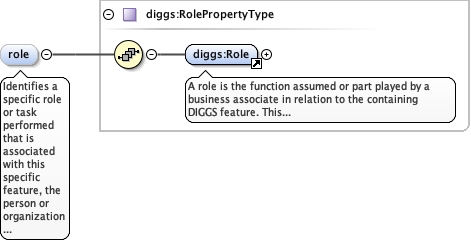
Identifies a specific role or task performed that is
associated with this specific feature, the person or organization
that performed the role, and associated time frame, if
applicable.
Diagram
DiagramKernel_xsd_Element_diggs_Role.tmp#http___diggsml.org_schema-dev_RoleKernel_xsd_Complex_Type_diggs_RolePropertyType.tmp#RolePropertyType
Type diggs:RolePropertyType
Properties
content complex
minOccurs 0
maxOccurs unbounded
Model
Children diggs:Role
Instance
<diggs:role xmlns:diggs="http://diggsml.org/schema-dev">
  <diggs:Role owns="false">{1,1}</diggs:Role>
</diggs:role>
Source
<element maxOccurs="unbounded" minOccurs="0" name="role" type="diggs:RolePropertyType">
  <annotation>
    <documentation>Identifies a specific role or task performed that is associated with this specific feature, the person or organization that performed the role, and associated time frame, if applicable.</documentation>
  </annotation>
</element>
Element diggs:ProcessingStepType / diggs:remark
Namespace http://diggsml.org/schema-dev
Annotations
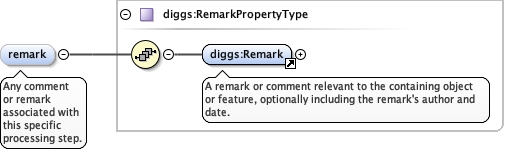
Any comment or remark associated with this specific
processing step.
Diagram
DiagramKernel_xsd_Element_diggs_Remark.tmp#RemarkKernel_xsd_Complex_Type_diggs_RemarkPropertyType.tmp#RemarkPropertyType
Type diggs:RemarkPropertyType
Properties
content complex
minOccurs 0
maxOccurs unbounded
Model
Children diggs:Remark
Instance
<diggs:remark xmlns:diggs="http://diggsml.org/schema-dev">
  <diggs:Remark owns="false">{1,1}</diggs:Remark>
</diggs:remark>
Source
<element maxOccurs="unbounded" minOccurs="0" name="remark" type="diggs:RemarkPropertyType">
  <annotation>
    <documentation>Any comment or remark associated with this specific processing step.</documentation>
  </annotation>
</element>
Element diggs:ProcessingStepType / diggs:equipment
Namespace http://diggsml.org/schema-dev
Annotations
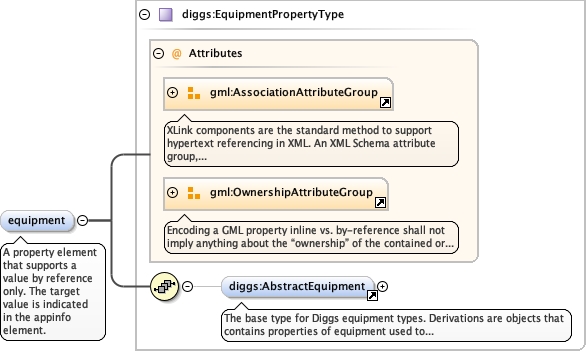
A property element that supports a value by reference
only. The target value is indicated in the appinfo
element.
Diagram
Diagramgml3_2Profile_diggs_xsd_Attribute_Group_gml_AssociationAttributeGroup.tmp#AssociationAttributeGroupgml3_2Profile_diggs_xsd_Attribute_Group_gml_OwnershipAttributeGroup.tmp#OwnershipAttributeGroupKernel_xsd_Element_diggs_AbstractEquipment.tmp#AbstractEquipmentKernel_xsd_Complex_Type_diggs_EquipmentPropertyType.tmp#EquipmentPropertyType
Type diggs:EquipmentPropertyType
Properties
content complex
minOccurs 0
maxOccurs unbounded
Model
Children diggs:AbstractEquipment
Instance
<diggs:equipment xlink:actuate="" xlink:arcrole="" xlink:href="" nilReason="" owns="false" xlink:role="" xlink:show="" xlink:title="" xlink:type="simple" xmlns:diggs="http://diggsml.org/schema-dev">
  <diggs:AbstractEquipment gml:id="" xml:lang="">{0,1}</diggs:AbstractEquipment>
</diggs:equipment>
Attributes
QName Type Fixed Default Use Annotation
nilReason gml:NilReasonType optional
owns boolean false optional
xlink:actuate restriction of string optional
The 'actuate' attribute is used to communicate the desired timing 
of traversal from the starting resource to the ending resource; 
it's value should be treated as follows:
onLoad - traverse to the ending resource immediately on loading 
         the starting resource 
onRequest - traverse from the starting resource to the ending 
            resource only on a post-loading event triggered for 
            this purpose 
other - behavior is unconstrained; examine other markup in link 
        for hints 
none - behavior is unconstrained
xlink:arcrole anyURI optional
xlink:href anyURI optional
xlink:role anyURI optional
xlink:show restriction of string optional
The 'show' attribute is used to communicate the desired presentation 
of the ending resource on traversal from the starting resource; it's 
value should be treated as follows: 
new - load ending resource in a new window, frame, pane, or other 
      presentation context
replace - load the resource in the same window, frame, pane, or 
          other presentation context
embed - load ending resource in place of the presentation of the 
        starting resource
other - behavior is unconstrained; examine other markup in the 
        link for hints 
none - behavior is unconstrained
xlink:title string optional
xlink:type string simple optional
Source
<element maxOccurs="unbounded" minOccurs="0" name="equipment" type="diggs:EquipmentPropertyType">
  <annotation>
    <appinfo>diggs:AbstractEquipment</appinfo>
    <documentation>A property element that supports a value by reference only. The target value is indicated in the appinfo element.</documentation>
  </annotation>
</element>
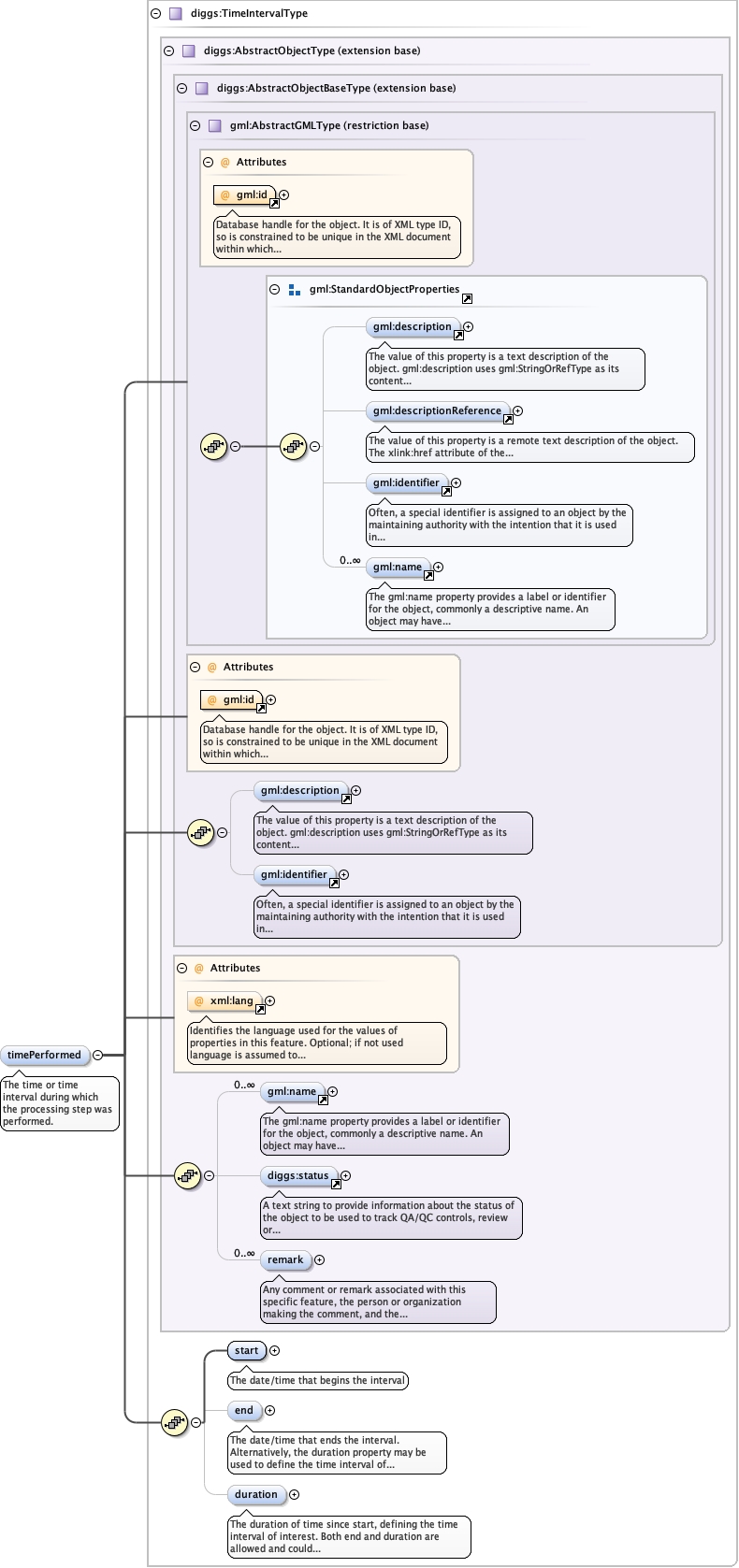
Element diggs:ProcessingStepType / diggs:timePerformed
Namespace http://diggsml.org/schema-dev
Annotations
The time or time interval during which the processing
step was performed.
Diagram
Diagramgml3_2Profile_diggs_xsd_Attribute_gml_id.tmp#idgml3_2Profile_diggs_xsd_Element_gml_description.tmp#descriptiongml3_2Profile_diggs_xsd_Element_gml_descriptionReference.tmp#descriptionReferencegml3_2Profile_diggs_xsd_Element_gml_identifier.tmp#identifiergml3_2Profile_diggs_xsd_Element_gml_name.tmp#namegml3_2Profile_diggs_xsd_Element_Group_gml_StandardObjectProperties.tmp#StandardObjectPropertiesgml3_2Profile_diggs_xsd_Complex_Type_gml_AbstractGMLType.tmp#AbstractGMLTypegml3_2Profile_diggs_xsd_Attribute_gml_id.tmp#idgml3_2Profile_diggs_xsd_Element_gml_description.tmp#descriptiongml3_2Profile_diggs_xsd_Element_gml_identifier.tmp#identifierKernel_xsd_Complex_Type_diggs_AbstractObjectBaseType.tmp#AbstractObjectBaseTypexml_xsd_Attribute_xml_lang.tmp#langgml3_2Profile_diggs_xsd_Element_gml_name.tmp#nameKernel_xsd_Element_diggs_status.tmp#statusKernel_xsd_Complex_Type_diggs_AbstractObjectType.tmp#AbstractObjectType_remarkKernel_xsd_Complex_Type_diggs_AbstractObjectType.tmp#AbstractObjectTypeKernel_xsd_Complex_Type_diggs_TimeIntervalType.tmp#TimeIntervalType_startKernel_xsd_Complex_Type_diggs_TimeIntervalType.tmp#TimeIntervalType_endKernel_xsd_Complex_Type_diggs_TimeIntervalType.tmp#TimeIntervalType_durationKernel_xsd_Complex_Type_diggs_TimeIntervalType.tmp#TimeIntervalType
Type diggs:TimeIntervalType
Type hierarchy
Properties
content complex
minOccurs 0
Model
Children diggs:duration, diggs:end, diggs:remark, diggs:start, diggs:status, gml:description, gml:identifier, gml:name
Instance
<diggs:timePerformed gml:id="" xml:lang="" xmlns:diggs="http://diggsml.org/schema-dev" xmlns:gml="http://www.opengis.net/gml/3.2">
  <gml:description xlink:actuate="" xlink:arcrole="" xlink:href="" nilReason="" xlink:role="" xlink:show="" xlink:title="" xlink:type="simple">{0,1}</gml:description>
  <gml:identifier codeSpace="">{0,1}</gml:identifier>
  <gml:name codeSpace="">{0,unbounded}</gml:name>
  <diggs:status codeSpace="">{0,1}</diggs:status>
  <diggs:remark>{0,unbounded}</diggs:remark>
  <diggs:start calendarEraName="" frame="#ISO-8601" indeterminatePosition="">{1,1}</diggs:start>
  <diggs:end calendarEraName="" frame="#ISO-8601" indeterminatePosition="">{0,1}</diggs:end>
  <diggs:duration uom="">{0,1}</diggs:duration>
</diggs:timePerformed>
Attributes
QName Type Use Annotation
gml:id ID required
Database handle for the object. It is of XML type ID, so is constrained to be
unique in the XML document within which it occurs. An external identifier for the object in
the form of a URI may be constructed using standard XML and XPointer methods. This is done
by concatenating the URI for the document, a fragment separator, and the value of the id
attribute.
xml:lang union of(xs:language, restriction of xs:string) optional
<div>
  <h3>lang (as an attribute name)</h3>
  <p>denotes an attribute whose value is a language code for the natural language of the content of any element; its value is inherited. This name is reserved by virtue of its definition in the XML specification.</p>
</div>
<div>
  <h4>Notes</h4>
  <p>Attempting to install the relevant ISO 2- and 3-letter codes as the enumerated possible values is probably never going to be a realistic possibility.</p>
  <p>See BCP 47 at
    <a href="http://www.rfc-editor.org/rfc/bcp/bcp47.txt">http://www.rfc-editor.org/rfc/bcp/bcp47.txt</a>and the IANA language subtag registry at
    <a href="http://www.iana.org/assignments/language-subtag-registry">http://www.iana.org/assignments/language-subtag-registry</a>for further information.</p>
  <p>The union allows for the 'un-declaration' of xml:lang with the empty string.</p>
</div>
Source
<element minOccurs="0" name="timePerformed" type="diggs:TimeIntervalType">
  <annotation>
    <documentation>The time or time interval during which the processing step was performed.</documentation>
  </annotation>
</element>
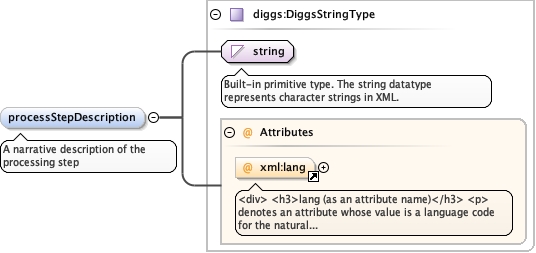
Element diggs:ProcessingStepType / diggs:processStepDescription
Namespace http://diggsml.org/schema-dev
Annotations
A narrative description of the processing
step
Diagram
Diagramxml_xsd_Attribute_xml_lang.tmp#langKernel_xsd_Complex_Type_diggs_DiggsStringType.tmp#DiggsStringType
Type diggs:DiggsStringType
Properties
content complex
minOccurs 0
mixed true
Attributes
QName Type Use Annotation
xml:lang union of(xs:language, restriction of xs:string) optional
<div>
  <h3>lang (as an attribute name)</h3>
  <p>denotes an attribute whose value is a language code for the natural language of the content of any element; its value is inherited. This name is reserved by virtue of its definition in the XML specification.</p>
</div>
<div>
  <h4>Notes</h4>
  <p>Attempting to install the relevant ISO 2- and 3-letter codes as the enumerated possible values is probably never going to be a realistic possibility.</p>
  <p>See BCP 47 at
    <a href="http://www.rfc-editor.org/rfc/bcp/bcp47.txt">http://www.rfc-editor.org/rfc/bcp/bcp47.txt</a>and the IANA language subtag registry at
    <a href="http://www.iana.org/assignments/language-subtag-registry">http://www.iana.org/assignments/language-subtag-registry</a>for further information.</p>
  <p>The union allows for the 'un-declaration' of xml:lang with the empty string.</p>
</div>
Source
<element minOccurs="0" name="processStepDescription" type="diggs:DiggsStringType">
  <annotation>
    <documentation>A narrative description of the processing step</documentation>
  </annotation>
</element>
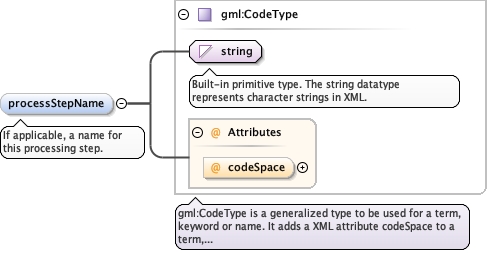
Element diggs:ProcessingStepType / diggs:processStepName
Namespace http://diggsml.org/schema-dev
Annotations
If applicable, a name for this processing
step.
Diagram
Diagramgml3_2Profile_diggs_xsd_Complex_Type_gml_CodeType.tmp#CodeType_codeSpacegml3_2Profile_diggs_xsd_Complex_Type_gml_CodeType.tmp#CodeType
Type gml:CodeType
Properties
content complex
minOccurs 0
Attributes
QName Type Use
codeSpace anyURI optional
Source
<element minOccurs="0" name="processStepName" type="gml:CodeType">
  <annotation>
    <documentation>If applicable, a name for this processing step.</documentation>
  </annotation>
</element>
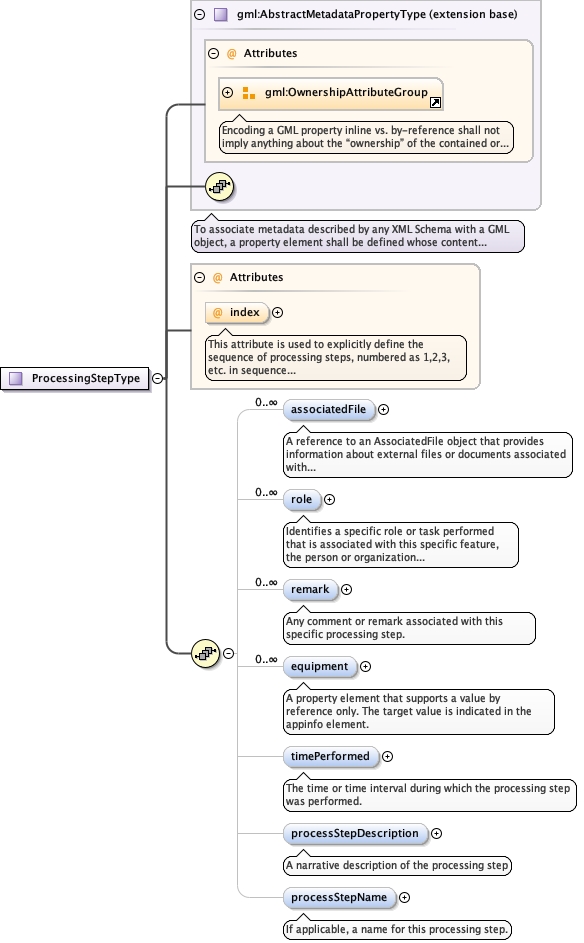
Complex Type diggs:ProcessingStepType
Namespace http://diggsml.org/schema-dev
Diagram
Diagramgml3_2Profile_diggs_xsd_Attribute_Group_gml_OwnershipAttributeGroup.tmp#OwnershipAttributeGroupgml3_2Profile_diggs_xsd_Complex_Type_gml_AbstractMetadataPropertyType.tmp#AbstractMetadataPropertyTypeGeophysics_xsd_Complex_Type_diggs_ProcessingStepType.tmp#ProcessingStepType_indexGeophysics_xsd_Complex_Type_diggs_ProcessingStepType.tmp#ProcessingStepType_associatedFileGeophysics_xsd_Complex_Type_diggs_ProcessingStepType.tmp#ProcessingStepType_roleGeophysics_xsd_Complex_Type_diggs_ProcessingStepType.tmp#ProcessingStepType_remarkGeophysics_xsd_Complex_Type_diggs_ProcessingStepType.tmp#ProcessingStepType_equipmentGeophysics_xsd_Complex_Type_diggs_ProcessingStepType.tmp#ProcessingStepType_timePerformedGeophysics_xsd_Complex_Type_diggs_ProcessingStepType.tmp#ProcessingStepType_processStepDescriptionGeophysics_xsd_Complex_Type_diggs_ProcessingStepType.tmp#ProcessingStepType_processStepName
Type extension of gml:AbstractMetadataPropertyType
Type hierarchy
Used by
Model
Children diggs:associatedFile, diggs:equipment, diggs:processStepDescription, diggs:processStepName, diggs:remark, diggs:role, diggs:timePerformed
Attributes
QName Type Default Use Annotation
index positiveInteger optional
This attribute is used to explicitly define the sequence of
processing steps, numbered as 1,2,3, etc. in sequence order. If omitted,
the processing sequence is assumed to follow the order of the
ProcessingStep
owns boolean false optional
Source
<complexType name="ProcessingStepType">
  <complexContent>
    <extension base="gml:AbstractMetadataPropertyType">
      <sequence>
        <element maxOccurs="unbounded" minOccurs="0" name="associatedFile" type="diggs:AssociatedFilePropertyType">
          <annotation>
            <appinfo source="urn:x-gml:targetElement">diggs:AssociatedFile</appinfo>
            <documentation>A reference to an AssociatedFile object that provides information about external files or documents associated with this processing step. The target value is indicated in the appinfo element.</documentation>
          </annotation>
        </element>
        <element maxOccurs="unbounded" minOccurs="0" name="role" type="diggs:RolePropertyType">
          <annotation>
            <documentation>Identifies a specific role or task performed that is associated with this specific feature, the person or organization that performed the role, and associated time frame, if applicable.</documentation>
          </annotation>
        </element>
        <element maxOccurs="unbounded" minOccurs="0" name="remark" type="diggs:RemarkPropertyType">
          <annotation>
            <documentation>Any comment or remark associated with this specific processing step.</documentation>
          </annotation>
        </element>
        <element maxOccurs="unbounded" minOccurs="0" name="equipment" type="diggs:EquipmentPropertyType">
          <annotation>
            <appinfo>diggs:AbstractEquipment</appinfo>
            <documentation>A property element that supports a value by reference only. The target value is indicated in the appinfo element.</documentation>
          </annotation>
        </element>
        <element minOccurs="0" name="timePerformed" type="diggs:TimeIntervalType">
          <annotation>
            <documentation>The time or time interval during which the processing step was performed.</documentation>
          </annotation>
        </element>
        <element minOccurs="0" name="processStepDescription" type="diggs:DiggsStringType">
          <annotation>
            <documentation>A narrative description of the processing step</documentation>
          </annotation>
        </element>
        <element minOccurs="0" name="processStepName" type="gml:CodeType">
          <annotation>
            <documentation>If applicable, a name for this processing step.</documentation>
          </annotation>
        </element>
      </sequence>
      <attribute name="index" type="positiveInteger">
        <annotation>
          <documentation>This attribute is used to explicitly define the sequence of processing steps, numbered as 1,2,3, etc. in sequence order. If omitted, the processing sequence is assumed to follow the order of the ProcessingStep</documentation>
        </annotation>
      </attribute>
    </extension>
  </complexContent>
</complexType>
Attribute diggs:ProcessingStepType / @index
Namespace No namespace
Annotations
This attribute is used to explicitly define the sequence of
processing steps, numbered as 1,2,3, etc. in sequence order. If omitted,
the processing sequence is assumed to follow the order of the
ProcessingStep
Type positiveInteger
Properties
content simple
Used by
Source
<attribute name="index" type="positiveInteger">
  <annotation>
    <documentation>This attribute is used to explicitly define the sequence of processing steps, numbered as 1,2,3, etc. in sequence order. If omitted, the processing sequence is assumed to follow the order of the ProcessingStep</documentation>
  </annotation>
</attribute>