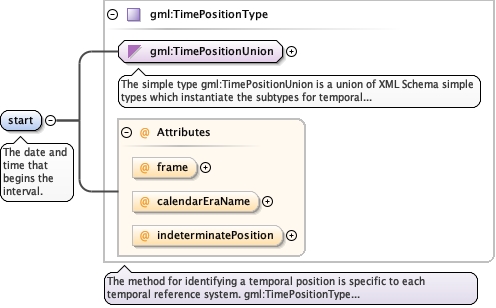
<element name="start" type="gml:TimePositionType" maxOccurs="1" minOccurs="1"><annotation><documentation>The date and time that begins the interval.</documentation></annotation></element>
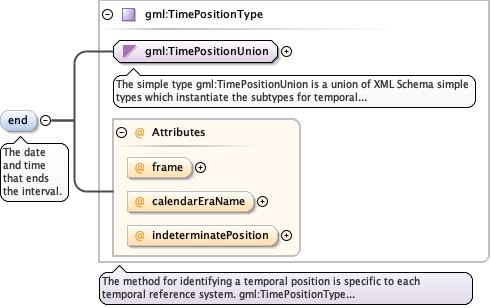
<element name="end" type="gml:TimePositionType" maxOccurs="1" minOccurs="0"><annotation><documentation>The date and time that ends the interval.</documentation></annotation></element>
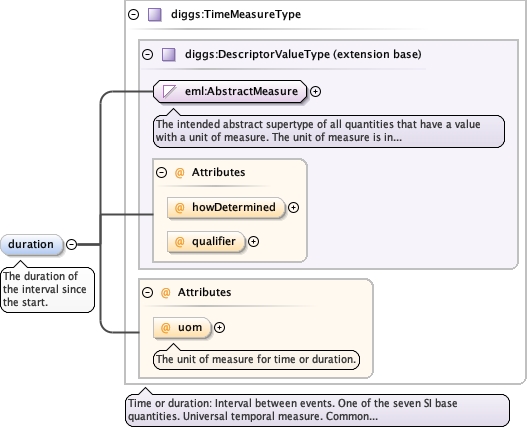
<element name="duration" type="diggs:TimeMeasureType" maxOccurs="1" minOccurs="0"><annotation><documentation>The duration of the interval since the start.</documentation></annotation></element>
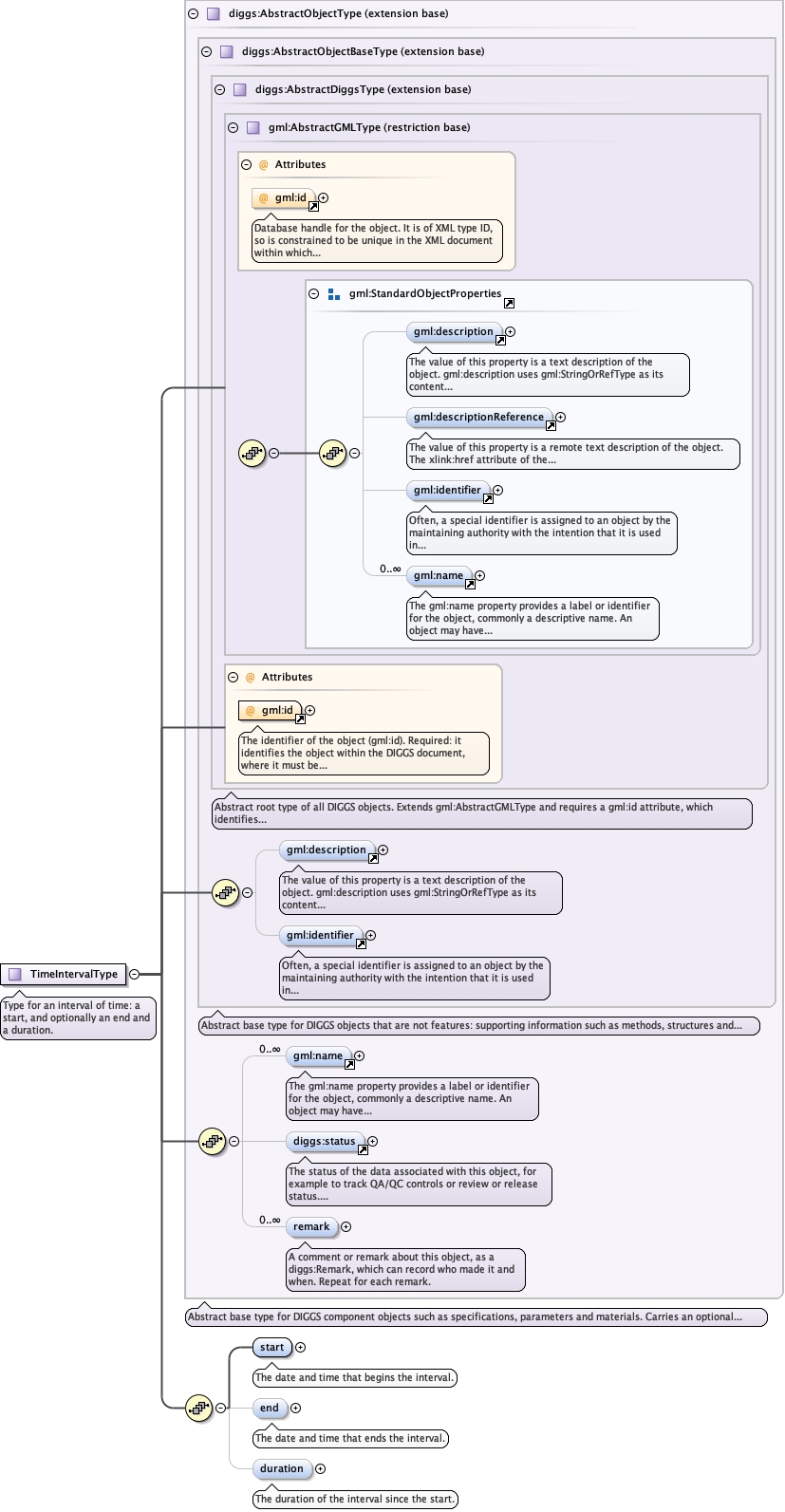
Complex Type diggs:TimeIntervalType
Namespace
http://diggsml.org/schemas/3
Annotations
Type for an interval of time: a start, and optionally an end and a duration.
Database handle for the object. It is of XML type ID, so is constrained to beunique in the XML document within which it occurs. An external identifier for the object inthe form of a URI may be constructed using standard XML and XPointer methods. This is doneby concatenating the URI for the document, a fragment separator, and the value of the idattribute.
Source
<complexType name="TimeIntervalType"><annotation><documentation>Type for an interval of time: a start, and optionally an end and a duration.</documentation></annotation><complexContent><extension base="diggs:AbstractObjectType"><sequence><element name="start" type="gml:TimePositionType" maxOccurs="1" minOccurs="1"><annotation><documentation>The date and time that begins the interval.</documentation></annotation></element><element name="end" type="gml:TimePositionType" maxOccurs="1" minOccurs="0"><annotation><documentation>The date and time that ends the interval.</documentation></annotation></element><element name="duration" type="diggs:TimeMeasureType" maxOccurs="1" minOccurs="0"><annotation><documentation>The duration of the interval since the start.</documentation></annotation></element></sequence></extension></complexContent></complexType>