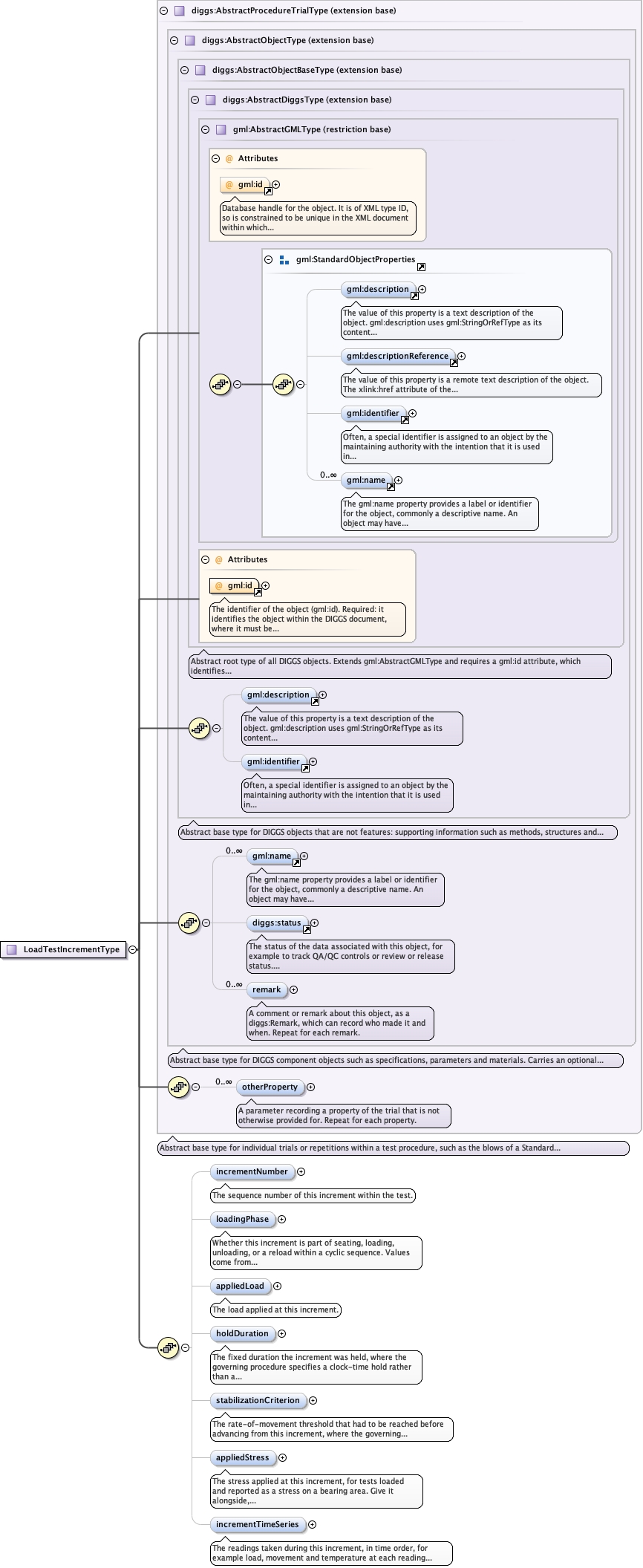
The sequence number of this increment within the test.
Diagram
Type
positiveInteger
Properties
content
simple
minOccurs
0
Source
<element minOccurs="0" name="incrementNumber" type="positiveInteger"><annotation><documentation>The sequence number of this increment within the test.</documentation></annotation></element>
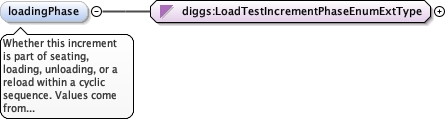
Whether this increment is part of seating, loading, unloading, or areload within a cyclic sequence. Values come from the enumeratedlist, or "Other: xx", where xx is a user-defined term whose meaningdiffers from every listed value (not a synonym of one).
<element minOccurs="0" name="loadingPhase" type="diggs:LoadTestIncrementPhaseEnumExtType"><annotation><documentation>Whether this increment is part of seating, loading, unloading, or a reload within a cyclic sequence. Values come from the enumerated list, or "Other: xx", where xx is a user-defined term whose meaning differs from every listed value (not a synonym of one).</documentation></annotation></element>
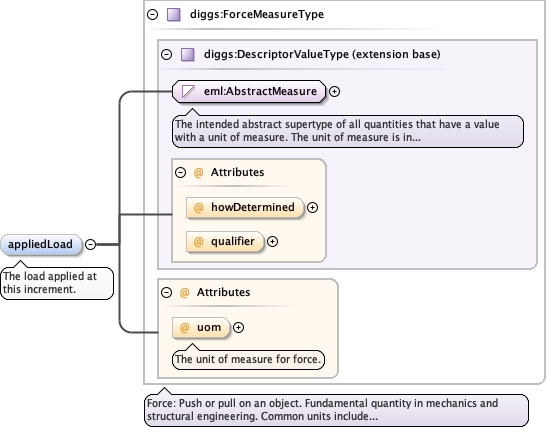
<element minOccurs="0" name="appliedLoad" type="diggs:ForceMeasureType"><annotation><documentation>The load applied at this increment.</documentation></annotation></element>
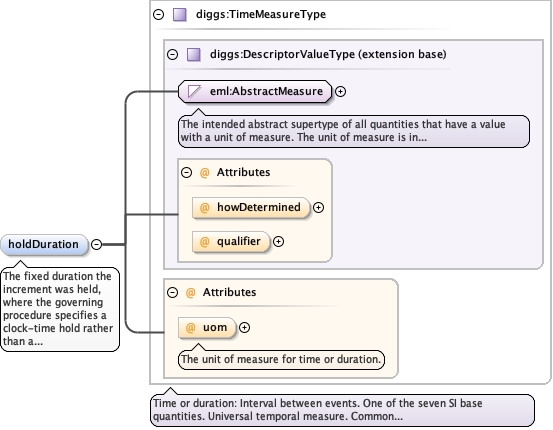
The fixed duration the increment was held, where the governingprocedure specifies a clock-time hold rather than a movement-ratestabilization criterion. It is the alternative tostabilizationCriterion.
<element minOccurs="0" name="holdDuration" type="diggs:TimeMeasureType"><annotation><documentation>The fixed duration the increment was held, where the governing procedure specifies a clock-time hold rather than a movement-rate stabilization criterion. It is the alternative to stabilizationCriterion.</documentation></annotation></element>
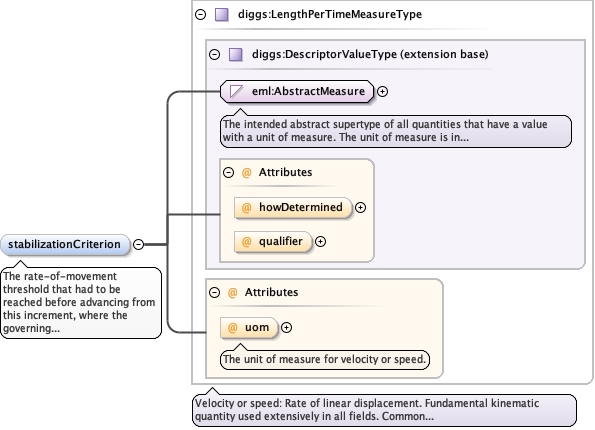
The rate-of-movement threshold that had to be reached beforeadvancing from this increment, where the governing procedurespecifies a stabilization criterion rather than a fixed-durationhold. It is the alternative to holdDuration.
<element minOccurs="0" name="stabilizationCriterion" type="diggs:LengthPerTimeMeasureType"><annotation><documentation>The rate-of-movement threshold that had to be reached before advancing from this increment, where the governing procedure specifies a stabilization criterion rather than a fixed-duration hold. It is the alternative to holdDuration.</documentation></annotation></element>
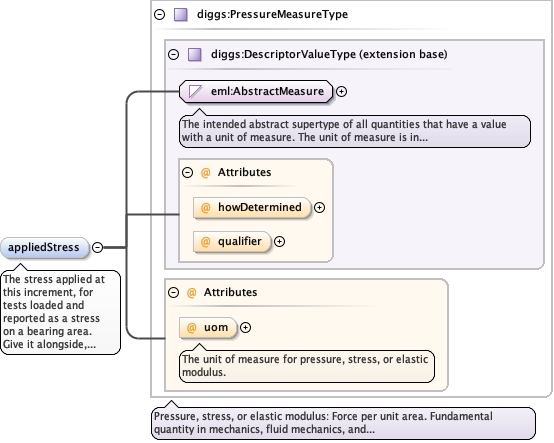
The unit of measure for pressure, stress, or elastic modulus.
Source
<element minOccurs="0" name="appliedStress" type="diggs:PressureMeasureType"><annotation><documentation>The stress applied at this increment, for tests loaded and reported as a stress on a bearing area. Give it alongside, not instead of, appliedLoad.</documentation></annotation></element>
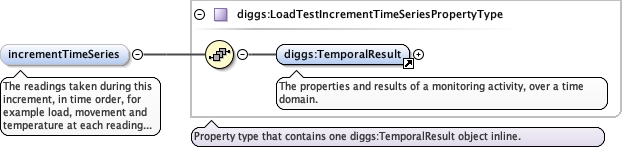
The readings taken during this increment, in time order, for exampleload, movement and temperature at each reading time. The first andlast times bound the hold.
<element minOccurs="0" name="incrementTimeSeries" type="diggs:LoadTestIncrementTimeSeriesPropertyType"><annotation><documentation>The readings taken during this increment, in time order, for example load, movement and temperature at each reading time. The first and last times bound the hold.</documentation></annotation></element>
Database handle for the object. It is of XML type ID, so is constrained to beunique in the XML document within which it occurs. An external identifier for the object inthe form of a URI may be constructed using standard XML and XPointer methods. This is doneby concatenating the URI for the document, a fragment separator, and the value of the idattribute.
Source
<complexType name="LoadTestIncrementType"><complexContent><extension base="diggs:AbstractProcedureTrialType"><sequence><element minOccurs="0" name="incrementNumber" type="positiveInteger"><annotation><documentation>The sequence number of this increment within the test.</documentation></annotation></element><element minOccurs="0" name="loadingPhase" type="diggs:LoadTestIncrementPhaseEnumExtType"><annotation><documentation>Whether this increment is part of seating, loading, unloading, or a reload within a cyclic sequence. Values come from the enumerated list, or "Other: xx", where xx is a user-defined term whose meaning differs from every listed value (not a synonym of one).</documentation></annotation></element><element minOccurs="0" name="appliedLoad" type="diggs:ForceMeasureType"><annotation><documentation>The load applied at this increment.</documentation></annotation></element><element minOccurs="0" name="holdDuration" type="diggs:TimeMeasureType"><annotation><documentation>The fixed duration the increment was held, where the governing procedure specifies a clock-time hold rather than a movement-rate stabilization criterion. It is the alternative to stabilizationCriterion.</documentation></annotation></element><element minOccurs="0" name="stabilizationCriterion" type="diggs:LengthPerTimeMeasureType"><annotation><documentation>The rate-of-movement threshold that had to be reached before advancing from this increment, where the governing procedure specifies a stabilization criterion rather than a fixed-duration hold. It is the alternative to holdDuration.</documentation></annotation></element><element minOccurs="0" name="appliedStress" type="diggs:PressureMeasureType"><annotation><documentation>The stress applied at this increment, for tests loaded and reported as a stress on a bearing area. Give it alongside, not instead of, appliedLoad.</documentation></annotation></element><element minOccurs="0" name="incrementTimeSeries" type="diggs:LoadTestIncrementTimeSeriesPropertyType"><annotation><documentation>The readings taken during this increment, in time order, for example load, movement and temperature at each reading time. The first and last times bound the hold.</documentation></annotation></element></sequence></extension></complexContent></complexType>