Showing:

Annotations
Attributes
Diagrams
Instances
Model
Properties
Source
Used by
Element diggs:LoadTestIncrement
Namespace http://diggsml.org/schemas/3
Annotations
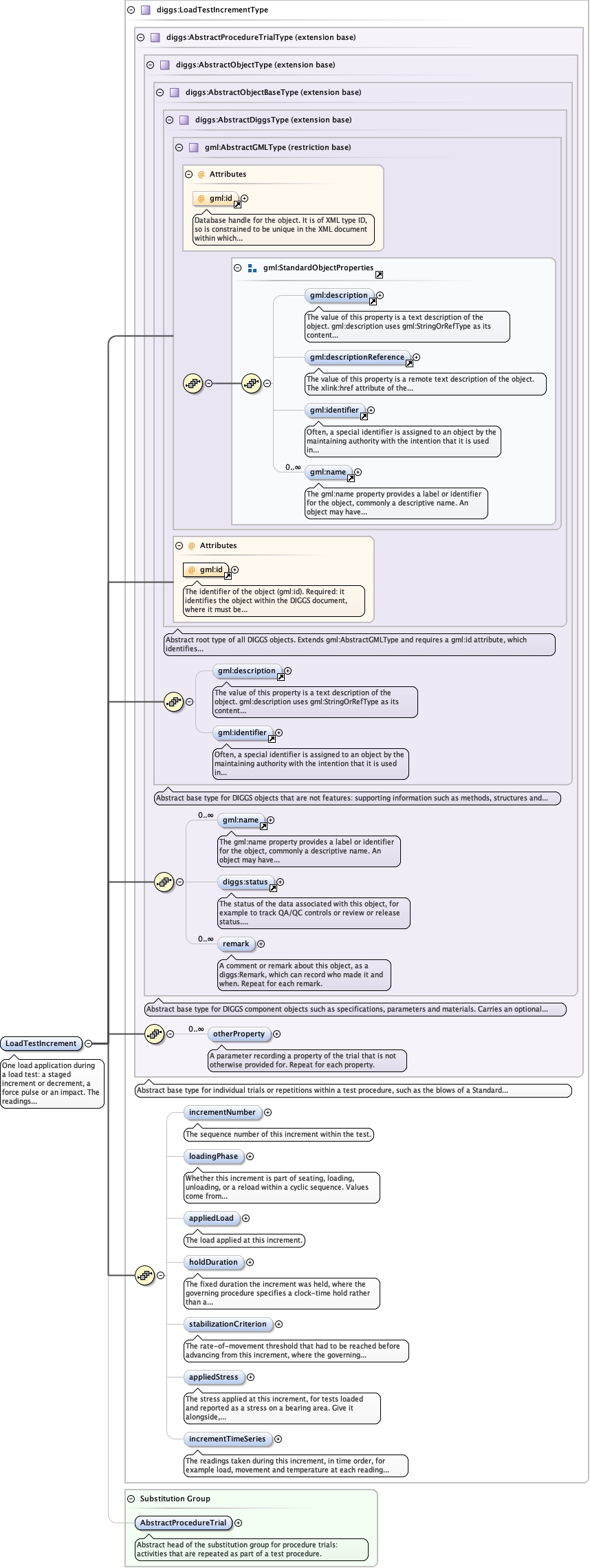
One load application during a load test: a staged increment or decrement, a force
pulse or an impact. The readings taken during it are in incrementTimeSeries.
holdDuration and stabilizationCriterion are alternative hold criteria, not two ways
of recording the same fact: holdDuration (a fixed clock time) is how ASTM's Quick
Test and Constant Time Interval procedures define when to advance to the next
increment, and stabilizationCriterion (a rate of movement) is how EN ISO 22477-1's
maintained-load method and ASTM's Maintained Test define it. Give whichever the
governing procedure uses and leave the other absent.
Diagram
Diagramgml3_2Profile_diggs_xsd_Attribute_gml_id.tmp#idgml3_2Profile_diggs_xsd_Element_gml_description.tmp#descriptiongml3_2Profile_diggs_xsd_Element_gml_descriptionReference.tmp#descriptionReferencegml3_2Profile_diggs_xsd_Element_gml_identifier.tmp#identifiergml3_2Profile_diggs_xsd_Element_gml_name.tmp#namegml3_2Profile_diggs_xsd_Element_Group_gml_StandardObjectProperties.tmp#StandardObjectPropertiesgml3_2Profile_diggs_xsd_Complex_Type_gml_AbstractGMLType.tmp#AbstractGMLTypegml3_2Profile_diggs_xsd_Attribute_gml_id.tmp#idAbstractTypes_xsd_Complex_Type_diggs_AbstractDiggsType.tmp#AbstractDiggsTypegml3_2Profile_diggs_xsd_Element_gml_description.tmp#descriptiongml3_2Profile_diggs_xsd_Element_gml_identifier.tmp#identifierAbstractTypes_xsd_Complex_Type_diggs_AbstractObjectBaseType.tmp#AbstractObjectBaseTypegml3_2Profile_diggs_xsd_Element_gml_name.tmp#nameCommon_xsd_Element_diggs_status.tmp#statusAbstractTypes_xsd_Complex_Type_diggs_AbstractObjectType.tmp#AbstractObjectType_remarkAbstractTypes_xsd_Complex_Type_diggs_AbstractObjectType.tmp#AbstractObjectTypeAbstractTypes_xsd_Complex_Type_diggs_AbstractProcedureTrialType.tmp#AbstractProcedureTrialType_otherPropertyAbstractTypes_xsd_Complex_Type_diggs_AbstractProcedureTrialType.tmp#AbstractProcedureTrialTypeExtProcedures_xsd_Complex_Type_diggs_LoadTestIncrementType.tmp#LoadTestIncrementType_incrementNumberExtProcedures_xsd_Complex_Type_diggs_LoadTestIncrementType.tmp#LoadTestIncrementType_loadingPhaseExtProcedures_xsd_Complex_Type_diggs_LoadTestIncrementType.tmp#LoadTestIncrementType_appliedLoadExtProcedures_xsd_Complex_Type_diggs_LoadTestIncrementType.tmp#LoadTestIncrementType_holdDurationExtProcedures_xsd_Complex_Type_diggs_LoadTestIncrementType.tmp#LoadTestIncrementType_stabilizationCriterionExtProcedures_xsd_Complex_Type_diggs_LoadTestIncrementType.tmp#LoadTestIncrementType_appliedStressExtProcedures_xsd_Complex_Type_diggs_LoadTestIncrementType.tmp#LoadTestIncrementType_incrementTimeSeriesExtProcedures_xsd_Complex_Type_diggs_LoadTestIncrementType.tmp#LoadTestIncrementTypeAbstractTypes_xsd_Element_diggs_AbstractProcedureTrial.tmp#AbstractProcedureTrial
Type diggs:LoadTestIncrementType
Type hierarchy
Properties
content complex
abstract false
Substitution Group Affiliation
Used by
Model
Children diggs:appliedLoad, diggs:appliedStress, diggs:holdDuration, diggs:incrementNumber, diggs:incrementTimeSeries, diggs:loadingPhase, diggs:otherProperty, diggs:remark, diggs:stabilizationCriterion, diggs:status, gml:description, gml:identifier, gml:name
Instance
<diggs:LoadTestIncrement gml:id="" xmlns:diggs="http://diggsml.org/schemas/3" xmlns:gml="http://www.opengis.net/gml/3.2">
  <gml:description xlink:href="" nilReason="">{0,1}</gml:description>
  <gml:identifier codeSpace="">{0,1}</gml:identifier>
  <gml:name codeSpace="">{0,unbounded}</gml:name>
  <diggs:status codeSpace="">{0,1}</diggs:status>
  <diggs:remark>{0,unbounded}</diggs:remark>
  <diggs:otherProperty>{0,unbounded}</diggs:otherProperty>
  <diggs:incrementNumber>{0,1}</diggs:incrementNumber>
  <diggs:loadingPhase>{0,1}</diggs:loadingPhase>
  <diggs:appliedLoad howDetermined="" qualifier="" uom="">{0,1}</diggs:appliedLoad>
  <diggs:holdDuration howDetermined="" qualifier="" uom="">{0,1}</diggs:holdDuration>
  <diggs:stabilizationCriterion howDetermined="" qualifier="" uom="">{0,1}</diggs:stabilizationCriterion>
  <diggs:appliedStress howDetermined="" qualifier="" uom="">{0,1}</diggs:appliedStress>
  <diggs:incrementTimeSeries>{0,1}</diggs:incrementTimeSeries>
</diggs:LoadTestIncrement>
Attributes
QName Type Use Annotation
gml:id ID required
Database handle for the object. It is of XML type ID, so is constrained to be
unique in the XML document within which it occurs. An external identifier for the object in
the form of a URI may be constructed using standard XML and XPointer methods. This is done
by concatenating the URI for the document, a fragment separator, and the value of the id
attribute.
Source
<element name="LoadTestIncrement" type="diggs:LoadTestIncrementType" abstract="false" substitutionGroup="diggs:AbstractProcedureTrial">
  <annotation>
    <documentation>One load application during a load test: a staged increment or decrement, a force pulse or an impact. The readings taken during it are in incrementTimeSeries. holdDuration and stabilizationCriterion are alternative hold criteria, not two ways of recording the same fact: holdDuration (a fixed clock time) is how ASTM's Quick Test and Constant Time Interval procedures define when to advance to the next increment, and stabilizationCriterion (a rate of movement) is how EN ISO 22477-1's maintained-load method and ASTM's Maintained Test define it. Give whichever the governing procedure uses and leave the other absent.</documentation>
  </annotation>
</element>