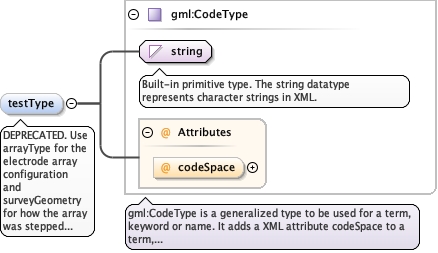
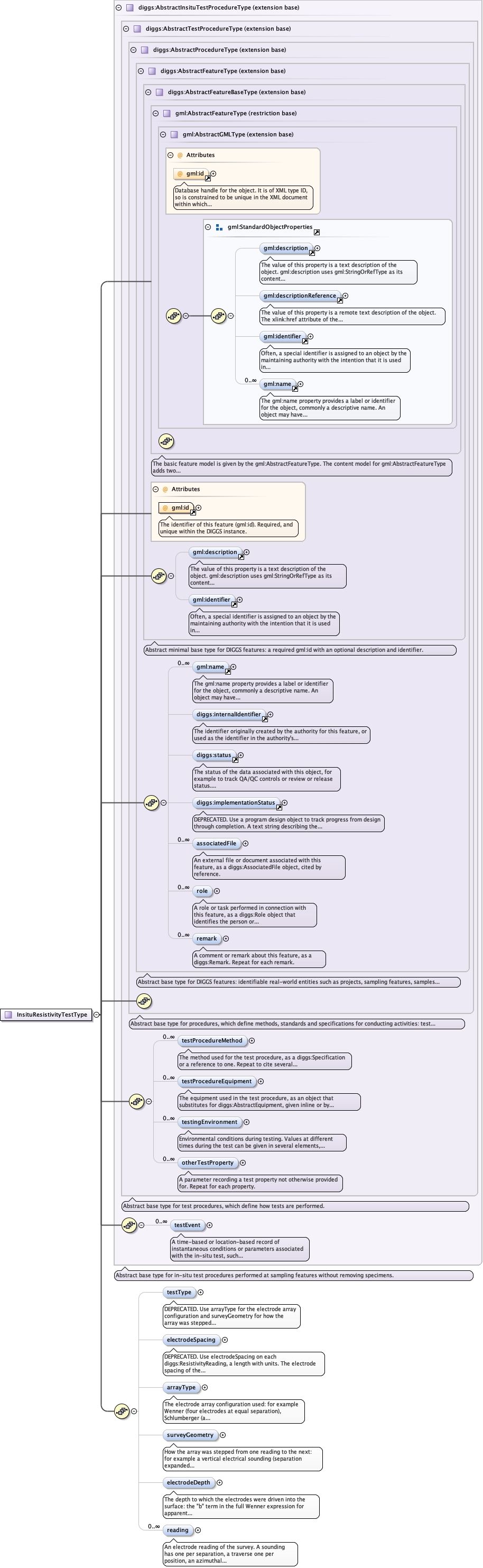
DEPRECATED. Use arrayType for the electrode arrayconfiguration and surveyGeometry for how the array was steppedbetween readings. The type of resistivity test.
<element minOccurs="0" name="testType" type="gml:CodeType"><annotation><appinfo><diggs:deprecated since="3.1.0" note="arrayType for the electrode array configuration and surveyGeometry for how the array was stepped between readings"/></appinfo><documentation>DEPRECATED. Use arrayType for the electrode array configuration and surveyGeometry for how the array was stepped between readings. The type of resistivity test.</documentation></annotation></element>
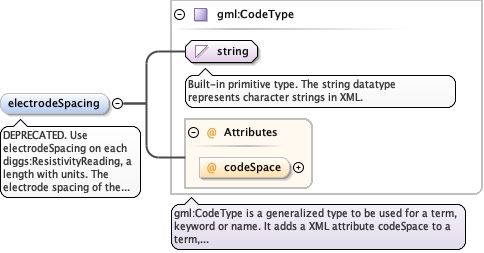
<element minOccurs="0" name="electrodeSpacing" type="gml:CodeType"><annotation><appinfo><diggs:deprecated since="3.1.0" replacedBy="diggs:electrodeSpacing" note="on each diggs:ResistivityReading, as a length"/></appinfo><documentation>DEPRECATED. Use electrodeSpacing on each diggs:ResistivityReading, a length with units. The electrode spacing of the survey, as a code.</documentation></annotation></element>
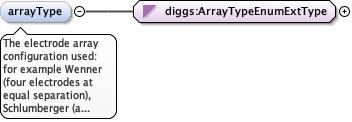
The electrode array configuration used: for example Wenner (fourelectrodes at equal separation), Schlumberger (a closely spacedpotential pair at the center of a wider, expanding current pair),dipole-dipole (a current dipole and a potential dipole of equallength, separated by a multiple of that length), pole-dipole orgradient. The array determines which geometry properties ofdiggs:ResistivityReading apply, and which expression converts ameasured resistance into an apparent resistivity. Values come fromthe enumerated list, or "Other: xx", where xx is a user-defined termwhose meaning differs from every listed value (not a synonym ofone).
<element minOccurs="0" name="arrayType" type="diggs:ArrayTypeEnumExtType"><annotation><documentation>The electrode array configuration used: for example Wenner (four electrodes at equal separation), Schlumberger (a closely spaced potential pair at the center of a wider, expanding current pair), dipole-dipole (a current dipole and a potential dipole of equal length, separated by a multiple of that length), pole-dipole or gradient. The array determines which geometry properties of diggs:ResistivityReading apply, and which expression converts a measured resistance into an apparent resistivity. Values come from the enumerated list, or "Other: xx", where xx is a user-defined term whose meaning differs from every listed value (not a synonym of one).</documentation></annotation></element>
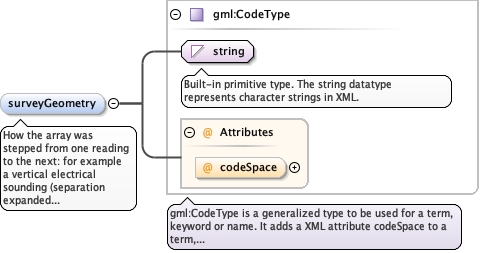
How the array was stepped from one reading to the next: for examplea vertical electrical sounding (separation expanded about a fixedcenter), constant separation traversing (fixed separation movedalong a line), an azimuthal sounding (orientation rotated about afixed center) or a single-separation measurement. It states thesurvey design; each diggs:ResistivityReading records the geometrythat resulted. Use the DIGGS dictionary surveyGeometry.xml for thelist of values.
<element minOccurs="0" name="surveyGeometry" type="gml:CodeType"><annotation><documentation>How the array was stepped from one reading to the next: for example a vertical electrical sounding (separation expanded about a fixed center), constant separation traversing (fixed separation moved along a line), an azimuthal sounding (orientation rotated about a fixed center) or a single-separation measurement. It states the survey design; each diggs:ResistivityReading records the geometry that resulted. Use the DIGGS dictionary surveyGeometry.xml for the list of values.</documentation></annotation></element>
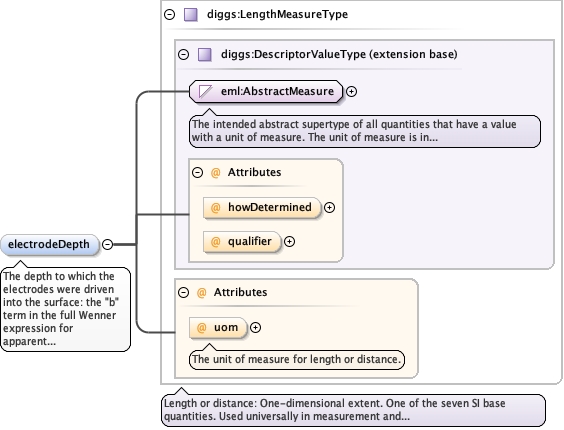
The depth to which the electrodes were driven into the surface: the"b" term in the full Wenner expression for apparent resistivity.ASTM G57 requires that it not exceed 5 % of the smallest electrodeseparation, the condition under which that expression reduces to thecommon short form. Given once for the procedure, as it is normallyconstant across a survey.
<element minOccurs="0" name="electrodeDepth" type="diggs:LengthMeasureType"><annotation><documentation>The depth to which the electrodes were driven into the surface: the "b" term in the full Wenner expression for apparent resistivity. ASTM G57 requires that it not exceed 5 % of the smallest electrode separation, the condition under which that expression reduces to the common short form. Given once for the procedure, as it is normally constant across a survey.</documentation></annotation></element>
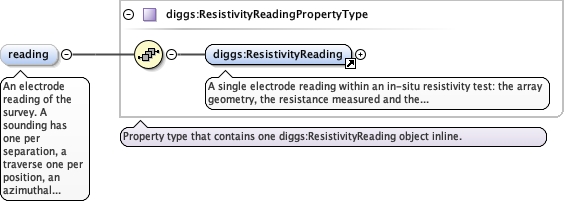
An electrode reading of the survey. A sounding has one perseparation, a traverse one per position, an azimuthal sounding oneper orientation, and a survey that varies more than one of these oneper combination. Repeat for each reading.
<element minOccurs="0" maxOccurs="unbounded" name="reading" type="diggs:ResistivityReadingPropertyType"><annotation><documentation>An electrode reading of the survey. A sounding has one per separation, a traverse one per position, an azimuthal sounding one per orientation, and a survey that varies more than one of these one per combination. Repeat for each reading.</documentation></annotation></element>
Database handle for the object. It is of XML type ID, so is constrained to beunique in the XML document within which it occurs. An external identifier for the object inthe form of a URI may be constructed using standard XML and XPointer methods. This is doneby concatenating the URI for the document, a fragment separator, and the value of the idattribute.
Source
<complexType name="InsituResistivityTestType"><complexContent><extension base="diggs:AbstractInsituTestProcedureType"><sequence><element minOccurs="0" name="testType" type="gml:CodeType"><annotation><appinfo><diggs:deprecated since="3.1.0" note="arrayType for the electrode array configuration and surveyGeometry for how the array was stepped between readings"/></appinfo><documentation>DEPRECATED. Use arrayType for the electrode array configuration and surveyGeometry for how the array was stepped between readings. The type of resistivity test.</documentation></annotation></element><element minOccurs="0" name="electrodeSpacing" type="gml:CodeType"><annotation><appinfo><diggs:deprecated since="3.1.0" replacedBy="diggs:electrodeSpacing" note="on each diggs:ResistivityReading, as a length"/></appinfo><documentation>DEPRECATED. Use electrodeSpacing on each diggs:ResistivityReading, a length with units. The electrode spacing of the survey, as a code.</documentation></annotation></element><element minOccurs="0" name="arrayType" type="diggs:ArrayTypeEnumExtType"><annotation><documentation>The electrode array configuration used: for example Wenner (four electrodes at equal separation), Schlumberger (a closely spaced potential pair at the center of a wider, expanding current pair), dipole-dipole (a current dipole and a potential dipole of equal length, separated by a multiple of that length), pole-dipole or gradient. The array determines which geometry properties of diggs:ResistivityReading apply, and which expression converts a measured resistance into an apparent resistivity. Values come from the enumerated list, or "Other: xx", where xx is a user-defined term whose meaning differs from every listed value (not a synonym of one).</documentation></annotation></element><element minOccurs="0" name="surveyGeometry" type="gml:CodeType"><annotation><documentation>How the array was stepped from one reading to the next: for example a vertical electrical sounding (separation expanded about a fixed center), constant separation traversing (fixed separation moved along a line), an azimuthal sounding (orientation rotated about a fixed center) or a single-separation measurement. It states the survey design; each diggs:ResistivityReading records the geometry that resulted. Use the DIGGS dictionary surveyGeometry.xml for the list of values.</documentation></annotation></element><element minOccurs="0" name="electrodeDepth" type="diggs:LengthMeasureType"><annotation><documentation>The depth to which the electrodes were driven into the surface: the "b" term in the full Wenner expression for apparent resistivity. ASTM G57 requires that it not exceed 5 % of the smallest electrode separation, the condition under which that expression reduces to the common short form. Given once for the procedure, as it is normally constant across a survey.</documentation></annotation></element><element minOccurs="0" maxOccurs="unbounded" name="reading" type="diggs:ResistivityReadingPropertyType"><annotation><documentation>An electrode reading of the survey. A sounding has one per separation, a traverse one per position, an azimuthal sounding one per orientation, and a survey that varies more than one of these one per combination. Repeat for each reading.</documentation></annotation></element></sequence></extension></complexContent></complexType>