Showing:

Annotations
Attributes
Diagrams
Instances
Model
Properties
Source
Used by
Element diggs:ResistivityReading
Namespace http://diggsml.org/schemas/3
Annotations
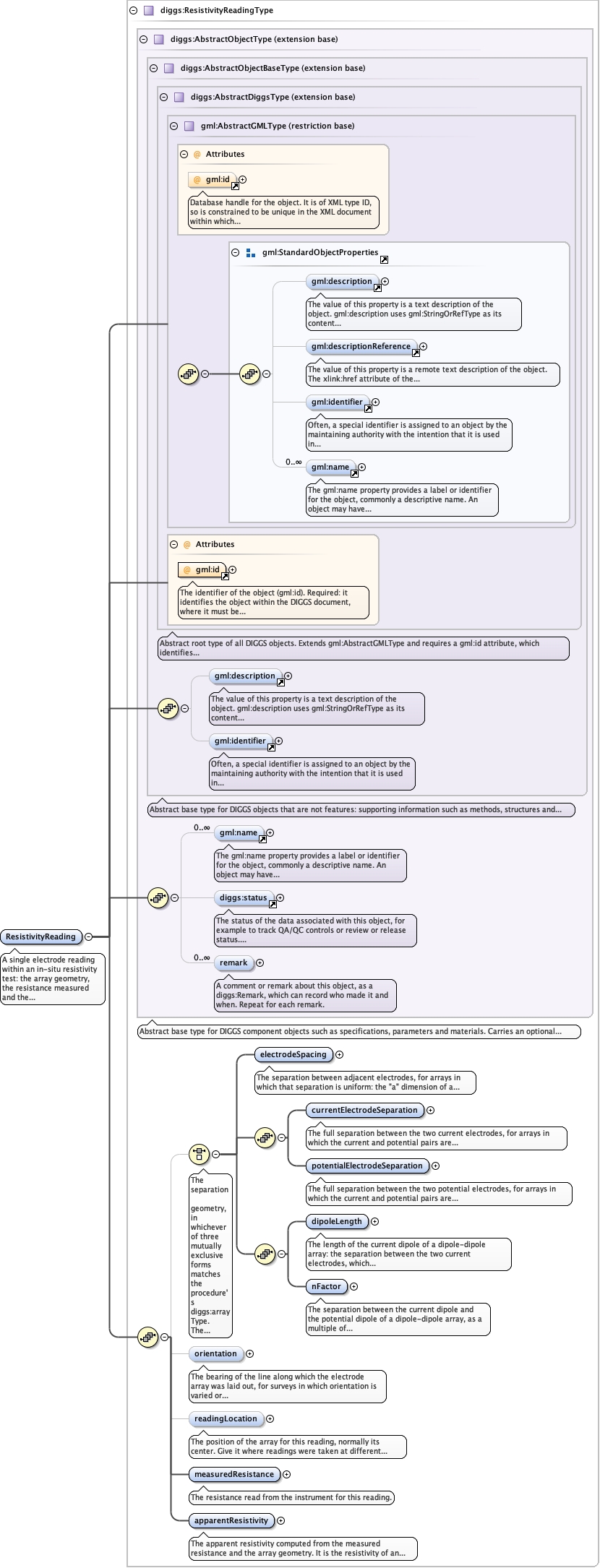
A single electrode reading within an in-situ resistivity test: the array geometry,
the resistance measured and the apparent resistivity computed from it. The
separation geometry is exactly one of three forms, selected by the procedure's
diggs:arrayType: a Wenner array gives diggs:electrodeSpacing alone, a Schlumberger
array the pair diggs:currentElectrodeSeparation and
diggs:potentialElectrodeSeparation, and a dipole-dipole array the pair
diggs:dipoleLength and diggs:nFactor. Independently of that form, a traverse also
gives diggs:readingLocation and an azimuthal survey diggs:orientation.
Diagram
Diagramgml3_2Profile_diggs_xsd_Attribute_gml_id.tmp#idgml3_2Profile_diggs_xsd_Element_gml_description.tmp#descriptiongml3_2Profile_diggs_xsd_Element_gml_descriptionReference.tmp#descriptionReferencegml3_2Profile_diggs_xsd_Element_gml_identifier.tmp#identifiergml3_2Profile_diggs_xsd_Element_gml_name.tmp#namegml3_2Profile_diggs_xsd_Element_Group_gml_StandardObjectProperties.tmp#StandardObjectPropertiesgml3_2Profile_diggs_xsd_Complex_Type_gml_AbstractGMLType.tmp#AbstractGMLTypegml3_2Profile_diggs_xsd_Attribute_gml_id.tmp#idAbstractTypes_xsd_Complex_Type_diggs_AbstractDiggsType.tmp#AbstractDiggsTypegml3_2Profile_diggs_xsd_Element_gml_description.tmp#descriptiongml3_2Profile_diggs_xsd_Element_gml_identifier.tmp#identifierAbstractTypes_xsd_Complex_Type_diggs_AbstractObjectBaseType.tmp#AbstractObjectBaseTypegml3_2Profile_diggs_xsd_Element_gml_name.tmp#nameCommon_xsd_Element_diggs_status.tmp#statusAbstractTypes_xsd_Complex_Type_diggs_AbstractObjectType.tmp#AbstractObjectType_remarkAbstractTypes_xsd_Complex_Type_diggs_AbstractObjectType.tmp#AbstractObjectTypeExtProcedures_xsd_Complex_Type_diggs_ResistivityReadingType.tmp#ResistivityReadingType_electrodeSpacingExtProcedures_xsd_Complex_Type_diggs_ResistivityReadingType.tmp#ResistivityReadingType_currentElectrodeSeparationExtProcedures_xsd_Complex_Type_diggs_ResistivityReadingType.tmp#ResistivityReadingType_potentialElectrodeSeparationExtProcedures_xsd_Complex_Type_diggs_ResistivityReadingType.tmp#ResistivityReadingType_dipoleLengthExtProcedures_xsd_Complex_Type_diggs_ResistivityReadingType.tmp#ResistivityReadingType_nFactorExtProcedures_xsd_Complex_Type_diggs_ResistivityReadingType.tmp#ResistivityReadingType_orientationExtProcedures_xsd_Complex_Type_diggs_ResistivityReadingType.tmp#ResistivityReadingType_readingLocationExtProcedures_xsd_Complex_Type_diggs_ResistivityReadingType.tmp#ResistivityReadingType_measuredResistanceExtProcedures_xsd_Complex_Type_diggs_ResistivityReadingType.tmp#ResistivityReadingType_apparentResistivityExtProcedures_xsd_Complex_Type_diggs_ResistivityReadingType.tmp#ResistivityReadingType
Type diggs:ResistivityReadingType
Type hierarchy
Properties
content complex
abstract false
Used by
Model
Children diggs:apparentResistivity, diggs:currentElectrodeSeparation, diggs:dipoleLength, diggs:electrodeSpacing, diggs:measuredResistance, diggs:nFactor, diggs:orientation, diggs:potentialElectrodeSeparation, diggs:readingLocation, diggs:remark, diggs:status, gml:description, gml:identifier, gml:name
Instance
<diggs:ResistivityReading gml:id="" xmlns:diggs="http://diggsml.org/schemas/3" xmlns:gml="http://www.opengis.net/gml/3.2">
  <gml:description xlink:href="" nilReason="">{0,1}</gml:description>
  <gml:identifier codeSpace="">{0,1}</gml:identifier>
  <gml:name codeSpace="">{0,unbounded}</gml:name>
  <diggs:status codeSpace="">{0,1}</diggs:status>
  <diggs:remark>{0,unbounded}</diggs:remark>
  <diggs:electrodeSpacing howDetermined="" qualifier="" uom="">{1,1}</diggs:electrodeSpacing>
  <diggs:currentElectrodeSeparation howDetermined="" qualifier="" uom="">{1,1}</diggs:currentElectrodeSeparation>
  <diggs:potentialElectrodeSeparation howDetermined="" qualifier="" uom="">{1,1}</diggs:potentialElectrodeSeparation>
  <diggs:dipoleLength howDetermined="" qualifier="" uom="">{1,1}</diggs:dipoleLength>
  <diggs:nFactor>{1,1}</diggs:nFactor>
  <diggs:orientation howDetermined="" qualifier="" refAzimuth="" uom="">{0,1}</diggs:orientation>
  <diggs:readingLocation owns="false" xlink:href="" nilReason="">{0,1}</diggs:readingLocation>
  <diggs:measuredResistance howDetermined="" qualifier="" uom="">{1,1}</diggs:measuredResistance>
  <diggs:apparentResistivity howDetermined="" qualifier="" uom="">{1,1}</diggs:apparentResistivity>
</diggs:ResistivityReading>
Attributes
QName Type Use Annotation
gml:id ID required
Database handle for the object. It is of XML type ID, so is constrained to be
unique in the XML document within which it occurs. An external identifier for the object in
the form of a URI may be constructed using standard XML and XPointer methods. This is done
by concatenating the URI for the document, a fragment separator, and the value of the id
attribute.
Source
<element name="ResistivityReading" type="diggs:ResistivityReadingType" abstract="false">
  <annotation>
    <documentation>A single electrode reading within an in-situ resistivity test: the array geometry, the resistance measured and the apparent resistivity computed from it. The separation geometry is exactly one of three forms, selected by the procedure's diggs:arrayType: a Wenner array gives diggs:electrodeSpacing alone, a Schlumberger array the pair diggs:currentElectrodeSeparation and diggs:potentialElectrodeSeparation, and a dipole-dipole array the pair diggs:dipoleLength and diggs:nFactor. Independently of that form, a traverse also gives diggs:readingLocation and an azimuthal survey diggs:orientation.</documentation>
  </annotation>
</element>